2002 JEEP LIBERTY brake system
[x] Cancel search: brake systemPage 1284 of 1803

(11) Bleed fuel system. Refer to FUEL SYSTEM.
(12) Remove fuel rail.
(13) Remove throttle body assembly and mounting
bracket.
(14) Drain cooling system below coolant tempera-
ture level. Refer to COOLING SYSTEM.
(15) Remove the heater hoses from the engine
front cover and the heater core.
(16) Unclip and remove heater hoses and tubes
from intake manifold.
(17) Remove coolant temperature sensor. Refer to
FUEL SYSTEM.
(18) Remove intake manifold retaining fasteners in
reverse order of tightening sequence.
(19) Remove intake manifold.
INSTALLATION
(1) Install intake manifold gaskets.
(2) Install intake manifold.
(3) Install intake manifold retaining bolts and
tighten in sequence shown in to 12 N´m (105 in. lbs.).
(4) Install left and right radio suppressor straps.
(5) Install throttle body assembly.
(6) Install throttle cable bracket.
(7) Connect throttle cable and speed control cable
to throttle body.
(8) Install fuel rail.
(9) Install ignition coil towers.
(10) Position and install heater hoses and tubes
onto intake manifold.
(11) Install the heater hoses to the heater core and
engine front cover.
(12) Connect electrical connectors for the following
components:
²Manifold Absolute Pressure (MAP) Sensor
²Intake Air Temperature (IAT) Sensor
²Throttle Position (TPS) Sensor
²Coolant Temperature (CTS) Sensor
²Idle Air Control (IAC) Motor
²Ignition coil towers
²Fuel injectors
(13) Install top oil dipstick tube retaining bolt and
ground strap.
(14) Connect generator electrical connections.
(15) Connect Vapor purge hose, Brake booster
hose, Speed control servo hose, Positive crankcase
ventilation (PCV) hose.
(16) Fill cooling system.
(17) Install resonator assembly and air inlet hose.
(18) Connect negative cable to battery.
EXHAUST MANIFOLD
DESCRIPTION
The exhaust manifolds (Fig. 87) are log style with
a patented flow enhancing design to maximize perfor-
mance. The exhaust manifolds are made of high sili-
con molybdenum cast iron. A perforated core graphite
exhaust manifold gasket is used to improve sealing
to the cylinder head. The exhaust manifolds are cov-
ered by a three layer laminated heat shield for ther-
mal protection and noise reduction. The heat shields
(Fig. 88) are fastened with a torque prevailing nut
that is backed off slightly to allow for the thermal
expansion of the exhaust manifold.
REMOVAL
RIGHT EXHAUST MANIFOLD
(1) Disconnect the negative cable from the battery.
(2) Raise and support the vehicle.
(3) Remove the bolts and nuts attaching the
exhaust pipe to the engine exhaust manifold.
(4) Lower the vehicle.
(5) Remove the exhaust heat shield (Fig. 89).
(6) Remove bolts, nuts and washers attaching
manifold to cylinder head.
(7) Remove manifold and gasket from the cylinder
head.
Fig. 87 EXHAUST MANIFOLDS
1 - LEFT SIDE EXHAUST MANIFOLD
2 - RIGHT SIDE EXHAUST MANIFOLD
KJENGINE - 3.7L 9 - 69
INTAKE MANIFOLD (Continued)
Page 1309 of 1803

NOTE: Plastigage is available in a variety of clear-
ance ranges. Use the most appropriate range for
the specifications you are checking.
(4) Install the proper crankshaft bearings to
achieve the specified bearing clearances. (Refer to 9 -
ENGINE/ENGINE BLOCK/CRANKSHAFT MAIN
BEARINGS - STANDARD PROCEDURE) (Refer to 9
- ENGINE/ENGINE BLOCK/CONNECTING ROD
BEARINGS - STANDARD PROCEDURE)
REMOVAL - ENGINE ASSEMBLY
(1) Disconnect the battery negative cable.
(2) Remove hood. Mark hood hinge location for
reinstallation.
(3) Remove air cleaner assembly.
(4) Remove radiator core support bracket.
(5) Remove fan shroud with electric fan assembly.
(6) Remove drive belt.
NOTE: It is NOT necessary to discharge the A/C
system to remove the engine.
(7) Remove A/C compressor and secure away from
engine with lines attached.
(8) Remove generator and secure away from
engine.
NOTE: Do NOT remove the phenolic pulley from the
P/S pump. It is not required for P/S pump removal.
(9) Remove power steering pump with lines
attached and secure away from engine.
(10) Drain cooling system.
(11) Remove coolant bottle.
(12) Disconnect the heater hoses from the engine.
(13) Disconnect heater hoses from heater core and
remove hose assembly.
(14) Disconnect throttle and speed control cables.
(15) Remove upper radiator hose from engine.
(16) Remove lower radiator hose from engine.
(17) Disconnect the engine to body ground straps
at the left side of cowl.
(18) Disconnect the engine wiring harness at the
following points:
²Intake air temperature (IAT) sensor
²Fuel Injectors
²Throttle Position (TPS) Switch
²Idle Air Control (IAC) Motor
²Engine Oil Pressure Switch
²Engine Coolant Temperature (ECT) Sensor
²Manifold Absolute Pressure MAP) Sensor
²Camshaft Position (CMP) Sensor
²Coil Over Plugs
²Crankshaft Position Sensor
(19) Remove coil over plugs.
(20) Release fuel rail pressure.(21) Remove fuel rail and secure away from
engine.
(22) Remove the PCV hose.
(23) Remove the breather hoses.
(24) Remove the vacuum hose for the power brake
booster.
(25) Disconnect knock sensors.
(26) Secure the left and right engine wiring har-
nesses away from engine.
(27) Raise vehicle.
(28) Disconnect oxygen sensor wiring.
(29) Disconnect crankshaft postion sensor.
(30) Disconnect the engine block heater power
cable, if equipped.
(31) Disconnect the front propshaft at the front
differential and secure out of way.
(32) Remove the starter.
(33) Remove the ground straps from the engine
(34) Disconnect the exhaust pipes at the manifold.
(35) Remove the structural cover, if equipped.
(36) Remove torque convertor bolts, and mark
location for reassembly.
(37) Remove transmission bellhousing to engine
bolts.
(38) Loosen left and right engine mount thru bolts.
NOTE: It is not necessary to completely remove
engine mount thru bolts, for engine removal.
(39) Lower the vehicle.
(40) Support the transmission with a suitable jack.
(41) Connect a suitable engine hoist to the engine.
CAUTION: The 2.4L engine with manual transmis-
sions, can be removed without removing the man-
ual transmission. Use caution when attempting this
procedure as the clearance is tight.
(42) Remove engine from vehicle.
INSTALLATION - ENGINE ASSEMBLY
(1) Position the engine in the vehicle.
CAUTION: Use caution when installing 2.4L engine
into vehicle equipped with manual transmission, as
clearance is tight.
(2) Install both left and right side engine mounts
into the frame mounts.
(3) Raise the vehicle.
(4) Install the transmission bellhousing to engine
mounting bolts. Tighten the bolts to 41 N´m (30ft.
lbs.).
(5) Tighten the engine mount thru bolts.
(6) Install the torque convertor bolts.
(7) Connect the ground straps on the left and right
side of the engine.
9s - 12 ENGINEKJ
ENGINE - 2.4L (Continued)
Page 1310 of 1803
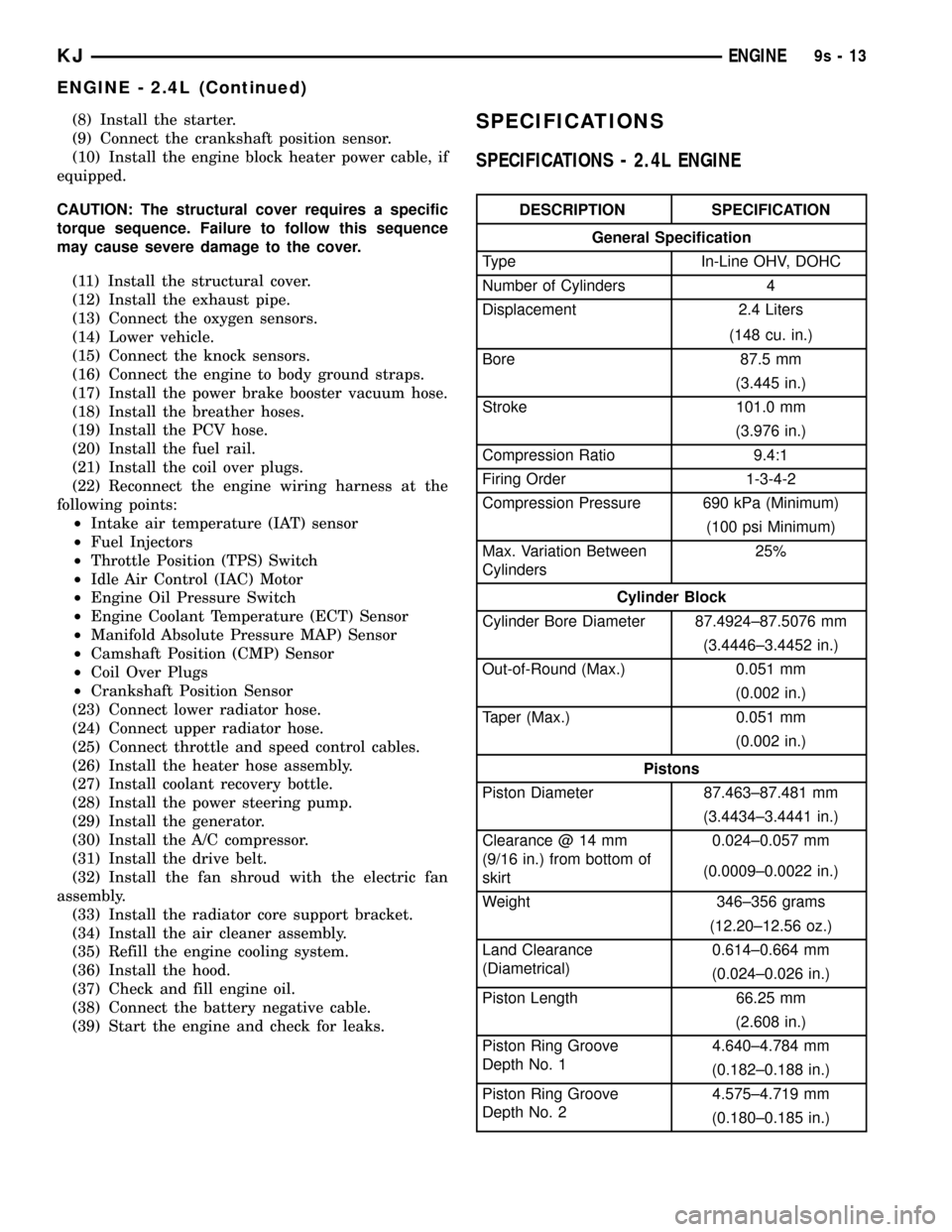
(8) Install the starter.
(9) Connect the crankshaft position sensor.
(10) Install the engine block heater power cable, if
equipped.
CAUTION: The structural cover requires a specific
torque sequence. Failure to follow this sequence
may cause severe damage to the cover.
(11) Install the structural cover.
(12) Install the exhaust pipe.
(13) Connect the oxygen sensors.
(14) Lower vehicle.
(15) Connect the knock sensors.
(16) Connect the engine to body ground straps.
(17) Install the power brake booster vacuum hose.
(18) Install the breather hoses.
(19) Install the PCV hose.
(20) Install the fuel rail.
(21) Install the coil over plugs.
(22) Reconnect the engine wiring harness at the
following points:
²Intake air temperature (IAT) sensor
²Fuel Injectors
²Throttle Position (TPS) Switch
²Idle Air Control (IAC) Motor
²Engine Oil Pressure Switch
²Engine Coolant Temperature (ECT) Sensor
²Manifold Absolute Pressure MAP) Sensor
²Camshaft Position (CMP) Sensor
²Coil Over Plugs
²Crankshaft Position Sensor
(23) Connect lower radiator hose.
(24) Connect upper radiator hose.
(25) Connect throttle and speed control cables.
(26) Install the heater hose assembly.
(27) Install coolant recovery bottle.
(28) Install the power steering pump.
(29) Install the generator.
(30) Install the A/C compressor.
(31) Install the drive belt.
(32) Install the fan shroud with the electric fan
assembly.
(33) Install the radiator core support bracket.
(34) Install the air cleaner assembly.
(35) Refill the engine cooling system.
(36) Install the hood.
(37) Check and fill engine oil.
(38) Connect the battery negative cable.
(39) Start the engine and check for leaks.SPECIFICATIONS
SPECIFICATIONS - 2.4L ENGINE
DESCRIPTION SPECIFICATION
General Specification
Type In-Line OHV, DOHC
Number of Cylinders 4
Displacement 2.4 Liters
(148 cu. in.)
Bore 87.5 mm
(3.445 in.)
Stroke 101.0 mm
(3.976 in.)
Compression Ratio 9.4:1
Firing Order 1-3-4-2
Compression Pressure 690 kPa (Minimum)
(100 psi Minimum)
Max. Variation Between
Cylinders25%
Cylinder Block
Cylinder Bore Diameter 87.4924±87.5076 mm
(3.4446±3.4452 in.)
Out-of-Round (Max.) 0.051 mm
(0.002 in.)
Taper (Max.) 0.051 mm
(0.002 in.)
Pistons
Piston Diameter 87.463±87.481 mm
(3.4434±3.4441 in.)
Clearance @ 14 mm
(9/16 in.) from bottom of
skirt0.024±0.057 mm
(0.0009±0.0022 in.)
Weight 346±356 grams
(12.20±12.56 oz.)
Land Clearance
(Diametrical)0.614±0.664 mm
(0.024±0.026 in.)
Piston Length 66.25 mm
(2.608 in.)
Piston Ring Groove
Depth No. 14.640±4.784 mm
(0.182±0.188 in.)
Piston Ring Groove
Depth No. 24.575±4.719 mm
(0.180±0.185 in.)
KJENGINE9s-13
ENGINE - 2.4L (Continued)
Page 1349 of 1803

(2) Spray a small stream of water (Spray Bottle) at
the suspected leak area.
(3) If engine RPM'S change, the area of the sus-
pected leak has been found.
(4) Repair as required.
REMOVAL
(1) Disconnect negative cable from battery.
(2) Disconnect connector from inlet air tempera-
ture sensor.
(3) Disconnect air intake tube at throttle body and
remove upper air cleaner housing.
(4) Disconnect connector from throttle position
sensor (TPS).
(5) Disconnect connector from idle air control (IAC)
motor.
(6) Disconnect connector from MAP sensor.
(7) Remove vacuum lines for purge solenoid and
PCV valve at intake manifold.
(8) Remove vacuum lines for power brake booster,
LDP, EGR transducer, and speed control vacuum res-
ervoir (if equipped) at intake manifold fittings.
(9) Disconnect throttle, speed control (if equipped),
and transaxle control (if equipped) and cables from
throttle lever and bracket. (Refer to 14 - FUEL SYS-
TEM/FUEL INJECTION/THROTTLE CONTROL
CABLE - REMOVAL)
(10) Perform fuel system pressure release proce-
durebefore attempting any repairs.(Refer to 14 -
FUEL SYSTEM/FUEL DELIVERY - STANDARD
PROCEDURE)
(11) Disconnect fuel line. (Refer to 14 - FUEL SYS-
TEM/FUEL DELIVERY/QUICK CONNECT FIT-
TING - STANDARD PROCEDURE)
(12) Disconnect coolant temperature sensor/fuel
injector wire harness connector.
(13) Disconnect fuel injector harness.
(14) Remove intake manifold to cylinder head fas-
teners.
(15) Remove the manifold from engine.
CAUTION: Cover intake manifold openings to pre-
vent foreign material from entering engine.
(16) Inspect the manifold. (Refer to 9 - ENGINE/
MANIFOLDS/INTAKE MANIFOLD - INSPECTION)
INSPECTION
(1) Check manifold surfaces for flatness with
straight edge. Surface must be flat within 0.15 mm
per 300 mm (0.006 in. per foot) of manifold length.
(2) Inspect manifold for cracks or distortion.
Replace manifold if necessary.
INSTALLATION
(1) Clean manifold sealing surfaces.
(2) Install new manifold to cylinder head seals.
(3) Install manifold to head.
(4) Install and tighten intake manifold fasteners to
28 N´m (250 in. lbs.) in the sequence shown (Fig. 90).
Repeat procedure until all bolts are at specified
torque.
(5) Install throttle cables in bracket.
(6) Connect throttle, speed control, (if equipped),
cables to throttle lever.
(7) Connect vacuum lines for power brake booster,
LDP, EGR transducer, and speed control vacuum res-
ervoir (if equipped) at upper intake manifold fittings.
(8) Connect vacuum lines for purge solenoid and
PCV valve.
(9) Connect electrical connectors for MAP sensor,
throttle position sensor (TPS), and idle air control
(IAC) motor.
(10) Connect the fuel line. (Refer to 14 - FUEL
SYSTEM/FUEL DELIVERY/QUICK CONNECT FIT-
TING - STANDARD PROCEDURE)
(11) Connect coolant temperature sensor/fuel injec-
tor wiring harness electrical connector.
(12) Install the air cleaner housing and air intake
tube to throttle body.
(13) Connect inlet air temperature sensor connec-
tor.
(14) Connect negative cable to battery.
Fig. 90 LOWER INTAKE MANIFOLD TIGHTENING
SEQUENCE
9s - 52 ENGINEKJ
INTAKE MANIFOLD (Continued)
Page 1433 of 1803
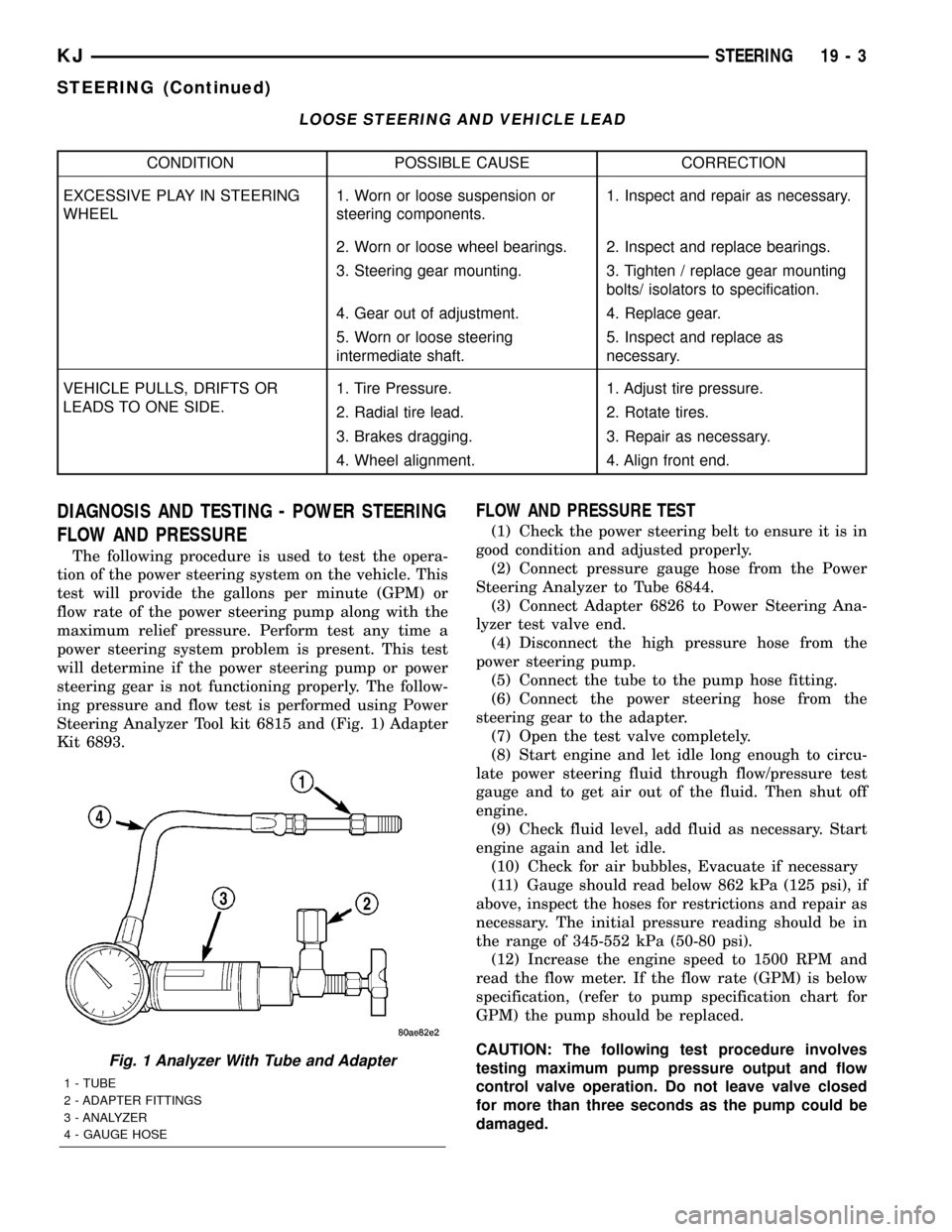
LOOSE STEERING AND VEHICLE LEAD
CONDITION POSSIBLE CAUSE CORRECTION
EXCESSIVE PLAY IN STEERING
WHEEL1. Worn or loose suspension or
steering components.1. Inspect and repair as necessary.
2. Worn or loose wheel bearings. 2. Inspect and replace bearings.
3. Steering gear mounting. 3. Tighten / replace gear mounting
bolts/ isolators to specification.
4. Gear out of adjustment. 4. Replace gear.
5. Worn or loose steering
intermediate shaft.5. Inspect and replace as
necessary.
VEHICLE PULLS, DRIFTS OR
LEADS TO ONE SIDE.1. Tire Pressure. 1. Adjust tire pressure.
2. Radial tire lead. 2. Rotate tires.
3. Brakes dragging. 3. Repair as necessary.
4. Wheel alignment. 4. Align front end.
DIAGNOSIS AND TESTING - POWER STEERING
FLOW AND PRESSURE
The following procedure is used to test the opera-
tion of the power steering system on the vehicle. This
test will provide the gallons per minute (GPM) or
flow rate of the power steering pump along with the
maximum relief pressure. Perform test any time a
power steering system problem is present. This test
will determine if the power steering pump or power
steering gear is not functioning properly. The follow-
ing pressure and flow test is performed using Power
Steering Analyzer Tool kit 6815 and (Fig. 1) Adapter
Kit 6893.
FLOW AND PRESSURE TEST
(1) Check the power steering belt to ensure it is in
good condition and adjusted properly.
(2) Connect pressure gauge hose from the Power
Steering Analyzer to Tube 6844.
(3) Connect Adapter 6826 to Power Steering Ana-
lyzer test valve end.
(4) Disconnect the high pressure hose from the
power steering pump.
(5) Connect the tube to the pump hose fitting.
(6) Connect the power steering hose from the
steering gear to the adapter.
(7) Open the test valve completely.
(8) Start engine and let idle long enough to circu-
late power steering fluid through flow/pressure test
gauge and to get air out of the fluid. Then shut off
engine.
(9) Check fluid level, add fluid as necessary. Start
engine again and let idle.
(10) Check for air bubbles, Evacuate if necessary
(11) Gauge should read below 862 kPa (125 psi), if
above, inspect the hoses for restrictions and repair as
necessary. The initial pressure reading should be in
the range of 345-552 kPa (50-80 psi).
(12) Increase the engine speed to 1500 RPM and
read the flow meter. If the flow rate (GPM) is below
specification, (refer to pump specification chart for
GPM) the pump should be replaced.
CAUTION: The following test procedure involves
testing maximum pump pressure output and flow
control valve operation. Do not leave valve closed
for more than three seconds as the pump could be
damaged.
Fig. 1 Analyzer With Tube and Adapter
1 - TUBE
2 - ADAPTER FITTINGS
3 - ANALYZER
4 - GAUGE HOSE
KJSTEERING 19 - 3
STEERING (Continued)
Page 1438 of 1803
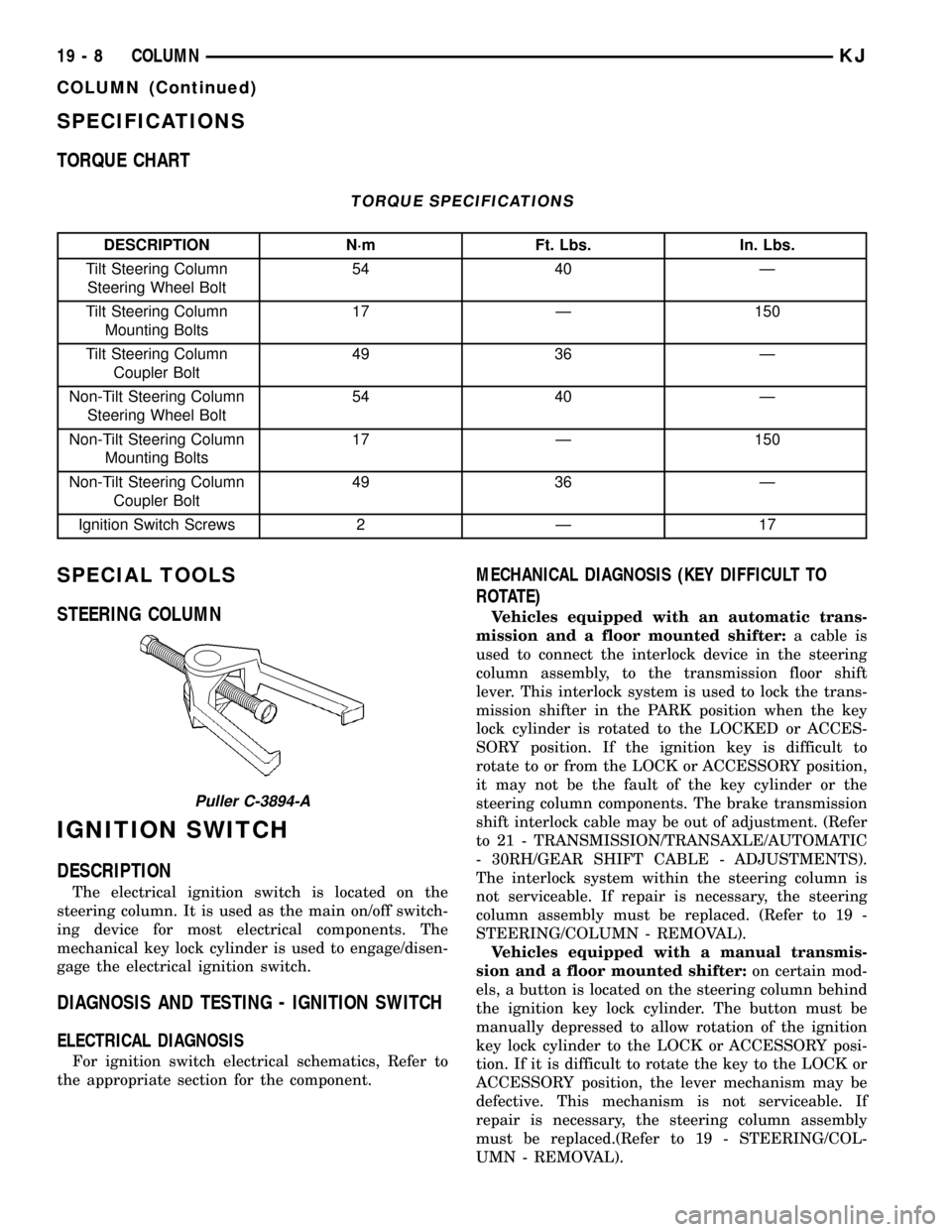
SPECIFICATIONS
TORQUE CHART
TORQUE SPECIFICATIONS
DESCRIPTION N´m Ft. Lbs. In. Lbs.
Tilt Steering Column
Steering Wheel Bolt54 40 Ð
Tilt Steering Column
Mounting Bolts17 Ð 150
Tilt Steering Column
Coupler Bolt49 36 Ð
Non-Tilt Steering Column
Steering Wheel Bolt54 40 Ð
Non-Tilt Steering Column
Mounting Bolts17 Ð 150
Non-Tilt Steering Column
Coupler Bolt49 36 Ð
Ignition Switch Screws 2 Ð 17
SPECIAL TOOLS
STEERING COLUMN
IGNITION SWITCH
DESCRIPTION
The electrical ignition switch is located on the
steering column. It is used as the main on/off switch-
ing device for most electrical components. The
mechanical key lock cylinder is used to engage/disen-
gage the electrical ignition switch.
DIAGNOSIS AND TESTING - IGNITION SWITCH
ELECTRICAL DIAGNOSIS
For ignition switch electrical schematics, Refer to
the appropriate section for the component.
MECHANICAL DIAGNOSIS (KEY DIFFICULT TO
ROTATE)
Vehicles equipped with an automatic trans-
mission and a floor mounted shifter:a cable is
used to connect the interlock device in the steering
column assembly, to the transmission floor shift
lever. This interlock system is used to lock the trans-
mission shifter in the PARK position when the key
lock cylinder is rotated to the LOCKED or ACCES-
SORY position. If the ignition key is difficult to
rotate to or from the LOCK or ACCESSORY position,
it may not be the fault of the key cylinder or the
steering column components. The brake transmission
shift interlock cable may be out of adjustment. (Refer
to 21 - TRANSMISSION/TRANSAXLE/AUTOMATIC
- 30RH/GEAR SHIFT CABLE - ADJUSTMENTS).
The interlock system within the steering column is
not serviceable. If repair is necessary, the steering
column assembly must be replaced. (Refer to 19 -
STEERING/COLUMN - REMOVAL).
Vehicles equipped with a manual transmis-
sion and a floor mounted shifter:on certain mod-
els, a button is located on the steering column behind
the ignition key lock cylinder. The button must be
manually depressed to allow rotation of the ignition
key lock cylinder to the LOCK or ACCESSORY posi-
tion. If it is difficult to rotate the key to the LOCK or
ACCESSORY position, the lever mechanism may be
defective. This mechanism is not serviceable. If
repair is necessary, the steering column assembly
must be replaced.(Refer to 19 - STEERING/COL-
UMN - REMOVAL).
Puller C-3894-A
19 - 8 COLUMNKJ
COLUMN (Continued)
Page 1715 of 1803
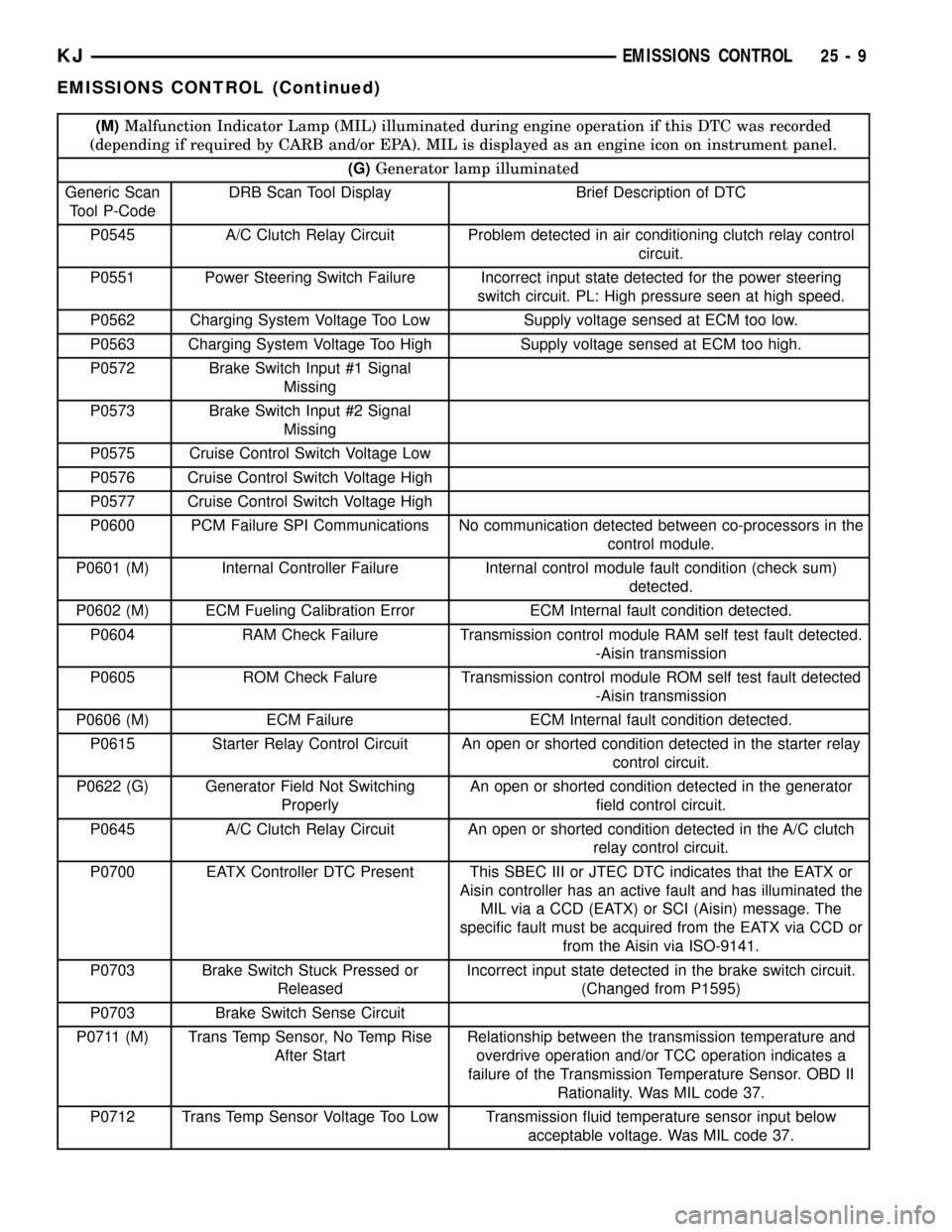
(M)Malfunction Indicator Lamp (MIL) illuminated during engine operation if this DTC was recorded
(depending if required by CARB and/or EPA). MIL is displayed as an engine icon on instrument panel.
(G)Generator lamp illuminated
Generic Scan
Tool P-CodeDRB Scan Tool Display Brief Description of DTC
P0545 A/C Clutch Relay Circuit Problem detected in air conditioning clutch relay control
circuit.
P0551 Power Steering Switch Failure Incorrect input state detected for the power steering
switch circuit. PL: High pressure seen at high speed.
P0562 Charging System Voltage Too Low Supply voltage sensed at ECM too low.
P0563 Charging System Voltage Too High Supply voltage sensed at ECM too high.
P0572 Brake Switch Input #1 Signal
Missing
P0573 Brake Switch Input #2 Signal
Missing
P0575 Cruise Control Switch Voltage Low
P0576 Cruise Control Switch Voltage High
P0577 Cruise Control Switch Voltage High
P0600 PCM Failure SPI Communications No communication detected between co-processors in the
control module.
P0601 (M) Internal Controller Failure Internal control module fault condition (check sum)
detected.
P0602 (M) ECM Fueling Calibration Error ECM Internal fault condition detected.
P0604 RAM Check Failure Transmission control module RAM self test fault detected.
-Aisin transmission
P0605 ROM Check Falure Transmission control module ROM self test fault detected
-Aisin transmission
P0606 (M) ECM Failure ECM Internal fault condition detected.
P0615 Starter Relay Control Circuit An open or shorted condition detected in the starter relay
control circuit.
P0622 (G) Generator Field Not Switching
ProperlyAn open or shorted condition detected in the generator
field control circuit.
P0645 A/C Clutch Relay Circuit An open or shorted condition detected in the A/C clutch
relay control circuit.
P0700 EATX Controller DTC Present This SBEC III or JTEC DTC indicates that the EATX or
Aisin controller has an active fault and has illuminated the
MIL via a CCD (EATX) or SCI (Aisin) message. The
specific fault must be acquired from the EATX via CCD or
from the Aisin via ISO-9141.
P0703 Brake Switch Stuck Pressed or
ReleasedIncorrect input state detected in the brake switch circuit.
(Changed from P1595)
P0703 Brake Switch Sense Circuit
P0711 (M) Trans Temp Sensor, No Temp Rise
After StartRelationship between the transmission temperature and
overdrive operation and/or TCC operation indicates a
failure of the Transmission Temperature Sensor. OBD II
Rationality. Was MIL code 37.
P0712 Trans Temp Sensor Voltage Too Low Transmission fluid temperature sensor input below
acceptable voltage. Was MIL code 37.
KJEMISSIONS CONTROL 25 - 9
EMISSIONS CONTROL (Continued)
Page 1741 of 1803

ANTENNA BODY & CABLE - OPERATION . . . 8A-5
ANTENNA BODY & CABLE - REMOVAL.....8A-6
ANTENNA BODY AND CABLE -
DIAGNOSIS AND TESTING..............8A-5
ANTENNA CABLE - INSTALLATION,
INSTRUMENT PANEL..................8A-8
ANTENNA CABLE - REMOVAL,
INSTRUMENT PANEL..................8A-7
ANTILOCK BRAKE - INSTALLATION,
CONTROLLER.......................8E-10
ANTILOCK BRAKE - REMOVAL,
CONTROLLER.......................8E-10
ANTILOCK BRAKING SYSTEM -
DIAGNOSIS AND TESTING..............5-33
A-PILLAR SEAL - INSTALLATION.......23-185
A-PILLAR SEAL - REMOVAL...........23-185
A-PILLAR TRIM AND GRAB HANDLE -
INSTALLATION......................23-156
A-PILLAR TRIM AND GRAB HANDLE -
REMOVAL.........................23-156
A-PILLAR WEATHERSTRIP/RETAINER -
INSTALLATION, WINDSHIELD..........23-187
A-PILLAR WEATHERSTRIP/RETAINER -
REMOVAL, WINDSHIELD..............23-186
APPLICATION TABLE, SPECIFICATIONS -
A/C ................................24-9
AREA LEAKS - DIAGNOSIS AND
TESTING, REAR SEAL..................9-61
ARM - DESCRIPTION, FRONT WIPER.....8R-12
ARM - DESCRIPTION, LOWER CONTROL . . . 2-21
ARM - DESCRIPTION, REAR WIPER......8R-37
ARM - DESCRIPTION, ROCKER......9-29,9-37
ARM - INSTALLATION, FRONT WIPER....8R-13
ARM - INSTALLATION, LOWER CONTROL . . 2-10,
2-21
ARM - INSTALLATION, REAR WIPER.....8R-38
ARM - INSTALLATION, ROCKER..........9-37
ARM - INSTALLATION, UPPER CONTROL . . . 2-21
ARM - OPERATION, FRONT WIPER......8R-12
ARM - OPERATION, LOWER CONTROL.....2-21
ARM - OPERATION, REAR WIPER.......8R-38
ARM - REMOVAL, FRONT WIPER........8R-12
ARM - REMOVAL, LOWER CONTROL . . 2-10,2-21
ARM - REMOVAL, REAR WIPER.........8R-38
ARM - REMOVAL, ROCKER..............9-37
ARM - REMOVAL, UPPER CONTROL......2-20
ARM, BUSHINGS, AND BALL JOINT -
DESCRIPTION, UPPER SUSPENSION......2-20
ARM, BUSHINGS, AND BALL JOINT -
OPERATION, UPPER SUSPENSION........2-20
ARM PARK RAMP - INSTALLATION,
WIPER.............................8R-43
ARM PARK RAMP - REMOVAL, WIPER . . . 8R-43
ASD AND FUEL PUMP RELAYS -
DIAGNOSIS AND TESTING...............8I-4
ASD SENSE - PCM INPUT - OPERATION....8I-4
ASH RECEIVER LAMP BULB -
INSTALLATION.......................8L-71
ASH RECEIVER LAMP BULB - REMOVAL . . 8L-71
ASH RECEIVER LAMP UNIT -
INSTALLATION.......................8L-72
ASH RECEIVER LAMP UNIT - REMOVAL . . 8L-72
ASSEMBLY - ASSEMBLY, INPUT CLUTCH . 21-138
ASSEMBLY - DESCRIPTION, INPUT
CLUTCH...........................21-133
ASSEMBLY - DESCRIPTION,
TRANSMISSION SOLENOID/TRS........21-169
ASSEMBLY - DISASSEMBLY, INPUT
CLUTCH...........................21-135
ASSEMBLY - INSTALLATION.........8W-97-11
ASSEMBLY - INSTALLATION, GUIDE.....23-179
ASSEMBLY - INSTALLATION,
INSTRUMENT PANEL.................23-151
ASSEMBLY - INSTALLATION, MODULE . . . 23-181
ASSEMBLY - INSTALLATION,
TRANSMISSION SOLENOID/TRS........21-170
ASSEMBLY - OPERATION, INPUT
CLUTCH...........................21-135
ASSEMBLY - OPERATION,
TRANSMISSION SOLENOID/TRS........21-169
ASSEMBLY - POWER DISTRIBUTION
CENTER ASSEMBLY
...............8W-97-10
ASSEMBLY - REMOVAL, GUIDE
........23-179
ASSEMBLY - REMOVAL, INSTRUMENT
PANEL
............................23-149
ASSEMBLY - REMOVAL, MODULE
......23-181
ASSEMBLY - REMOVAL, TRANSMISSION
SOLENOID/TRS
.....................21-170ASSEMBLY, 4C RETAINER/BULKHEAD....21-123
ASSEMBLY, ASSEMBLY - POWER
DISTRIBUTION CENTER............8W-97-10
ASSEMBLY, DIAGNOSIS AND TESTING....21-90
ASSEMBLY, DIFFERENTIAL.........3-105,3-41
ASSEMBLY, DIFFERENTIAL - TRAC-LOK . . . 3-109,
3-77
ASSEMBLY, DISC BRAKE CALIPERS.......5-16
ASSEMBLY, HVAC HOUSING............24-34
ASSEMBLY, INPUT CLUTCH ASSEMBLY . . 21-138
ASSEMBLY, INSTRUMENT CLUSTER......8J-10
ASSEMBLY, LOW/REVERSE CLUTCH.....21-146
ASSEMBLY, MANUAL - NV1500.........21-13
ASSEMBLY, MANUAL - NV3550.........21-48
ASSEMBLY, OIL PUMP.................9-67
ASSEMBLY, OIL PUMP...............21-151
ASSEMBLY, PLANETARY GEARTRAIN....21-160
ASSEMBLY, SINGLE CARDAN
UNIVERSAL JOINTS....................3-9
ASSEMBLY, TRANSFER CASE - NV231 . . . 21-194
ASSEMBLY, TRANSFER CASE - NV242 . . . 21-230
ASSEMBLY, VALVE BODY.............21-176
ASSEMBLY, WHEEL CYLINDERS..........5-29
ASSEMBLY WINDOW DEFOGGER
FUNCTION - DIAGNOSIS AND TESTING,
REAR HVAC CONTROL.................8G-9
ASSIST HANDLE - INSTALLATION.......23-157
ASSIST HANDLE - REMOVAL............23-157
AUDIO - DESCRIPTION.................8A-1
AUDIO - DIAGNOSIS AND TESTING.......8A-2
AUDIO - OPERATION...................8A-1
AUTOMATIC TRANSMISSION - 45RFE -
DESCRIPTION.......................21-76
AUTOMATIC TRANSMISSION - 45RFE -
OPERATION.........................21-77
AUTOMATIC TRANSMISSION -
DIAGNOSIS AND TESTING.............21-77
AUTOMATIC TRANSMISSION FLUID -
DESCRIPTION.........................0-2
AUTOMATIC TRANSMISSION FLUID -
OPERATION...........................0-4
AXLE - 186FIA - ADJUSTMENTS, FRONT . . . 3-25
AXLE - 186FIA - DESCRIPTION, FRONT....3-19
AXLE - 186FIA - INSTALLATION, FRONT....3-24
AXLE - 186FIA - OPERATION, FRONT......3-19
AXLE - 186FIA - REMOVAL, FRONT.......3-24
AXLE - 198RBI - DESCRIPTION, REAR.....3-49
AXLE - 198RBI - INSTALLATION, REAR....3-54
AXLE - 198RBI - OPERATION, REAR.......3-49
AXLE - 198RBI - REMOVAL, REAR........3-54
AXLE - 8 1/4 - ADJUSTMENTS, REAR.....3-92
AXLE - 8 1/4 - DESCRIPTION, REAR......3-86
AXLE - 8 1/4 - INSTALLATION, REAR......3-91
AXLE - 8 1/4 - OPERATION, REAR........3-86
AXLE - 8 1/4 - REMOVAL, REAR..........3-91
AXLE - DESCRIPTION...................0-2
AXLE - DIAGNOSIS AND TESTING....3-20,3-51,
3-88
AXLE - INSTALLATION, 198 RBI..........5-28
AXLE - INSTALLATION, 8 1/4............5-28
AXLE - REMOVAL, 198 RBI..............5-27
AXLE - REMOVAL, 8 1/4................5-27
AXLE - SPECIFICATIONS, FRONT.........3-33
AXLE - SPECIFICATIONS, REAR..........3-62
AXLE BEARINGS - INSTALLATION....3-102,3-38
AXLE BEARINGS - REMOVAL.......3-102,3-38
AXLE BEARING/SEAL - INSTALLATION.....3-67
AXLE BEARING/SEAL - REMOVAL.........3-66
AXLE SHAFT SEALS - INSTALLATION . 3-102,3-38
AXLE SHAFT SEALS - REMOVAL....3-101,3-37
AXLE SHAFTS - INSTALLATION . . 3-101,3-37,3-65
AXLE SHAFTS - REMOVAL.....3-101,3-37,3-65
AXLE, SPECIAL TOOLS - 8 1/4 ...........3-98
AXLE, SPECIAL TOOLS - FRONT..........3-34
AXLE, SPECIAL TOOLS - REAR...........3-63
AXLE, SPECIFICATIONS - REAR..........3-98
BACK - FRONT - INSTALLATION, SEAT . . . 23-166
BACK - FRONT - REMOVAL, SEAT.......23-166
BACK - REAR - INSTALLATION, SEAT....23-168
BACK - REAR - REMOVAL, SEAT.......23-168
BACK COVER - FRONT - INSTALLATION,
SEAT
.............................23-167
BACK COVER - FRONT - REMOVAL, SEAT
. 23-166
BACK COVER - REAR - INSTALLATION,
SEAT
.............................23-169
BACK COVER - REAR - REMOVAL, SEAT
. 23-169
BACK CUSHION - FRONT -
INSTALLATION, SEAT
.................23-167BACK CUSHION - FRONT - REMOVAL,
SEAT .............................23-167
BACK CUSHION - REAR - INSTALLATION,
SEAT .............................23-170
BACK CUSHION - REAR - REMOVAL,
SEAT .............................23-170
BACK FRAME - REAR - INSTALLATION,
SEAT .............................23-171
BACK FRAME - REAR - REMOVAL, SEAT . 23-171
BACK LATCH / LOCK - INSTALLATION,
FOLDING REAR SEAT................23-170
BACK LATCH / LOCK - REMOVAL,
FOLDING REAR SEAT................23-170
BACK LATCH STRIKER - INSTALLATION,
REAR SEAT........................23-171
BACK LATCH STRIKER - REMOVAL,
REAR SEAT........................23-170
BACK RECLINER - FRONT -
INSTALLATION, SEAT.................23-166
BACK RECLINER - FRONT - REMOVAL,
SEAT .............................23-166
BACKUP LAMP SWITCH - DESCRIPTION . . 8L-15
BACKUP LAMP SWITCH - DIAGNOSIS
AND TESTING.......................8L-15
BACKUP LAMP SWITCH - OPERATION....8L-15
BAFFLE SEAL - INSTALLATION,
COWL/PLENUM WINDOW.............23-187
BAFFLE SEAL - REMOVAL, COWL/
PLENUM WINDOW..................23-187
BALANCE SHAFT - INSTALLATION........9-74
BALANCE SHAFT - REMOVAL............9-74
BALANCING - STANDARD PROCEDURE,
WHEEL.............................22-4
BALL JOINT - DESCRIPTION, UPPER
SUSPENSION ARM, BUSHINGS..........2-20
BALL JOINT - DIAGNOSIS AND TESTING,
LOWER.............................2-10
BALL JOINT - INSTALLATION, UPPER.....2-20
BALL JOINT - OPERATION, UPPER
SUSPENSION ARM, BUSHINGS..........2-20
BALL JOINT - REMOVAL, UPPER.........2-20
BAR - INSTALLATION, STABILIZER....2-14,2-19
BAR - REMOVAL, STABILIZER.......2-14,2-19
BAR BUSHINGS - INSTALLATION,
STABILIZER...........................2-9
BAR BUSHINGS - REMOVAL, STABILIZER . . . 2-9
BARRELS - INSTALLATION, PANEL
OUTLET............................24-29
BARRELS - REMOVAL, PANEL OUTLET . . . 24-29
BASE - DESCRIPTION, BRAKES...........5-2
BASE - WARNING, BRAKES..............5-2
BASE BRAKE SYSTEM - DIAGNOSIS AND
TESTING.............................5-3
BASE BRAKES, SPECIAL TOOLS...........5-7
BASE COAT/CLEAR COAT FINISH -
DESCRIPTION......................23-162
BATTERIES - STANDARD PROCEDURE,
RKE TRANSMITTER...................8N-8
BATTERY - DESCRIPTION...............8F-7
BATTERY - DIAGNOSIS AND TESTING.....8F-8
BATTERY CABLES - DESCRIPTION.......8F-18
BATTERY CABLES - DIAGNOSIS AND
TESTING...........................8F-19
BATTERY CABLES - OPERATION.........8F-18
BATTERY CHARGING - STANDARD
PROCEDURE.........................8F-8
BATTERY HOLDDOWN - DESCRIPTION....8F-17
BATTERY HOLDDOWN - INSTALLATION . . . 8F-17
BATTERY HOLDDOWN - OPERATION.....8F-17
BATTERY HOLDDOWN - REMOVAL.......8F-17
BATTERY SYSTEM - CLEANING...........8F-5
BATTERY SYSTEM - DESCRIPTION........8F-1
BATTERY SYSTEM - DIAGNOSIS AND
TESTING............................8F-2
BATTERY SYSTEM - INSPECTION.........8F-6
BATTERY SYSTEM - OPERATION.........8F-2
BATTERY SYSTEM - SPECIAL TOOLS......8F-7
BATTERY SYSTEM - SPECIFICATIONS......8F-6
BATTERY TEMPERATURE SENSOR -
DESCRIPTION.......................8F-24
BATTERY TEMPERATURE SENSOR -
INSTALLATION
.......................8F-24
BATTERY TEMPERATURE SENSOR -
OPERATION
.........................8F-24
BATTERY TEMPERATURE SENSOR -
REMOVAL
..........................8F-24
BATTERY TRAY - DESCRIPTION
.........8F-21
BATTERY TRAY - INSTALLATION
.........8F-21
2 INDEXKJ
Description Group-Page Description Group-Page Description Group-Page