2002 JEEP LIBERTY insid
[x] Cancel search: insidPage 1596 of 1803
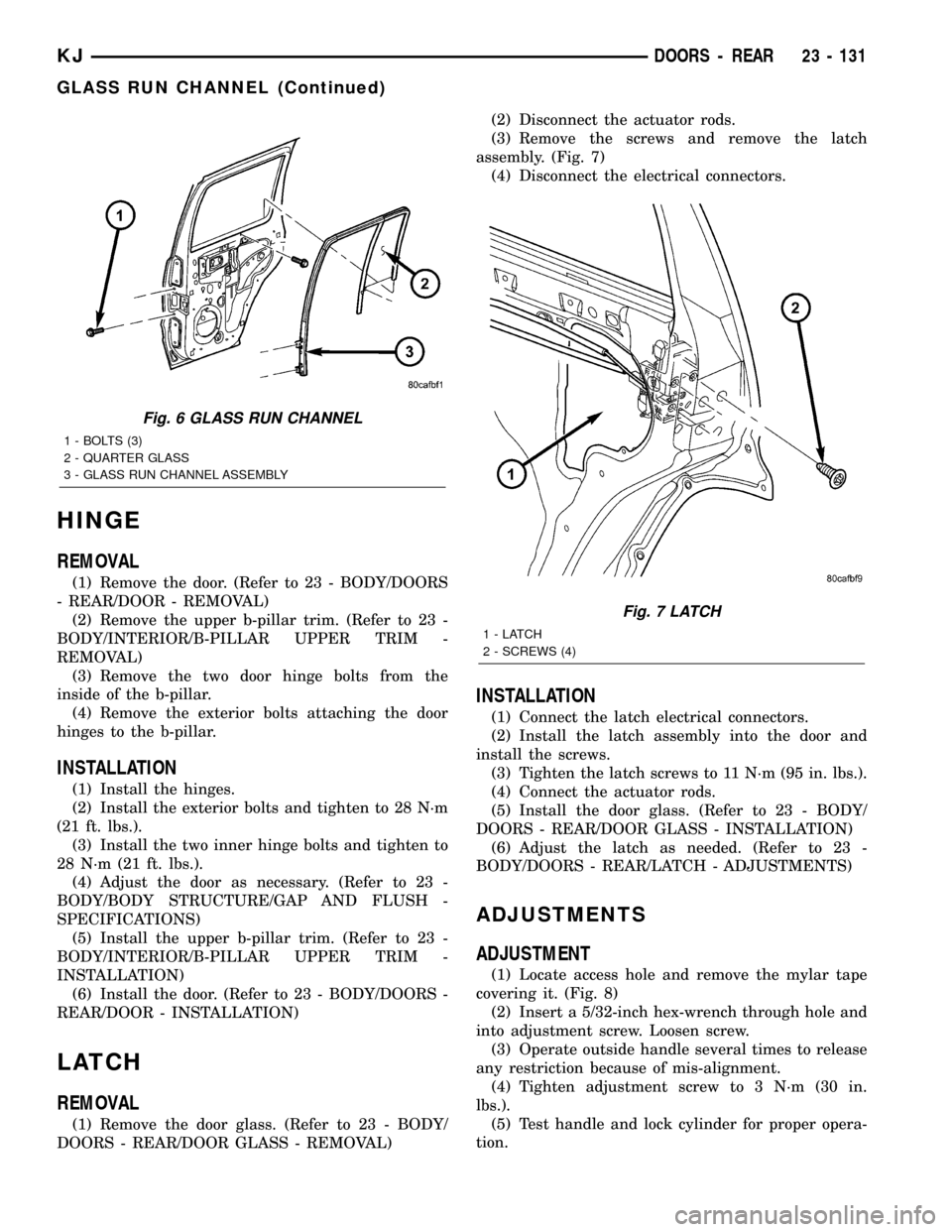
HINGE
REMOVAL
(1) Remove the door. (Refer to 23 - BODY/DOORS
- REAR/DOOR - REMOVAL)
(2) Remove the upper b-pillar trim. (Refer to 23 -
BODY/INTERIOR/B-PILLAR UPPER TRIM -
REMOVAL)
(3) Remove the two door hinge bolts from the
inside of the b-pillar.
(4) Remove the exterior bolts attaching the door
hinges to the b-pillar.
INSTALLATION
(1) Install the hinges.
(2) Install the exterior bolts and tighten to 28 N´m
(21 ft. lbs.).
(3) Install the two inner hinge bolts and tighten to
28 N´m (21 ft. lbs.).
(4) Adjust the door as necessary. (Refer to 23 -
BODY/BODY STRUCTURE/GAP AND FLUSH -
SPECIFICATIONS)
(5) Install the upper b-pillar trim. (Refer to 23 -
BODY/INTERIOR/B-PILLAR UPPER TRIM -
INSTALLATION)
(6) Install the door. (Refer to 23 - BODY/DOORS -
REAR/DOOR - INSTALLATION)
LATCH
REMOVAL
(1) Remove the door glass. (Refer to 23 - BODY/
DOORS - REAR/DOOR GLASS - REMOVAL)(2) Disconnect the actuator rods.
(3) Remove the screws and remove the latch
assembly. (Fig. 7)
(4) Disconnect the electrical connectors.
INSTALLATION
(1) Connect the latch electrical connectors.
(2) Install the latch assembly into the door and
install the screws.
(3) Tighten the latch screws to 11 N´m (95 in. lbs.).
(4) Connect the actuator rods.
(5) Install the door glass. (Refer to 23 - BODY/
DOORS - REAR/DOOR GLASS - INSTALLATION)
(6) Adjust the latch as needed. (Refer to 23 -
BODY/DOORS - REAR/LATCH - ADJUSTMENTS)
ADJUSTMENTS
ADJUSTMENT
(1) Locate access hole and remove the mylar tape
covering it. (Fig. 8)
(2) Insert a 5/32-inch hex-wrench through hole and
into adjustment screw. Loosen screw.
(3) Operate outside handle several times to release
any restriction because of mis-alignment.
(4) Tighten adjustment screw to 3 N´m (30 in.
lbs.).
(5) Test handle and lock cylinder for proper opera-
tion.
Fig. 6 GLASS RUN CHANNEL
1 - BOLTS (3)
2 - QUARTER GLASS
3 - GLASS RUN CHANNEL ASSEMBLY
Fig. 7 LATCH
1-LATCH
2 - SCREWS (4)
KJDOORS - REAR 23 - 131
GLASS RUN CHANNEL (Continued)
Page 1597 of 1803
LATCH STRIKER
REMOVAL
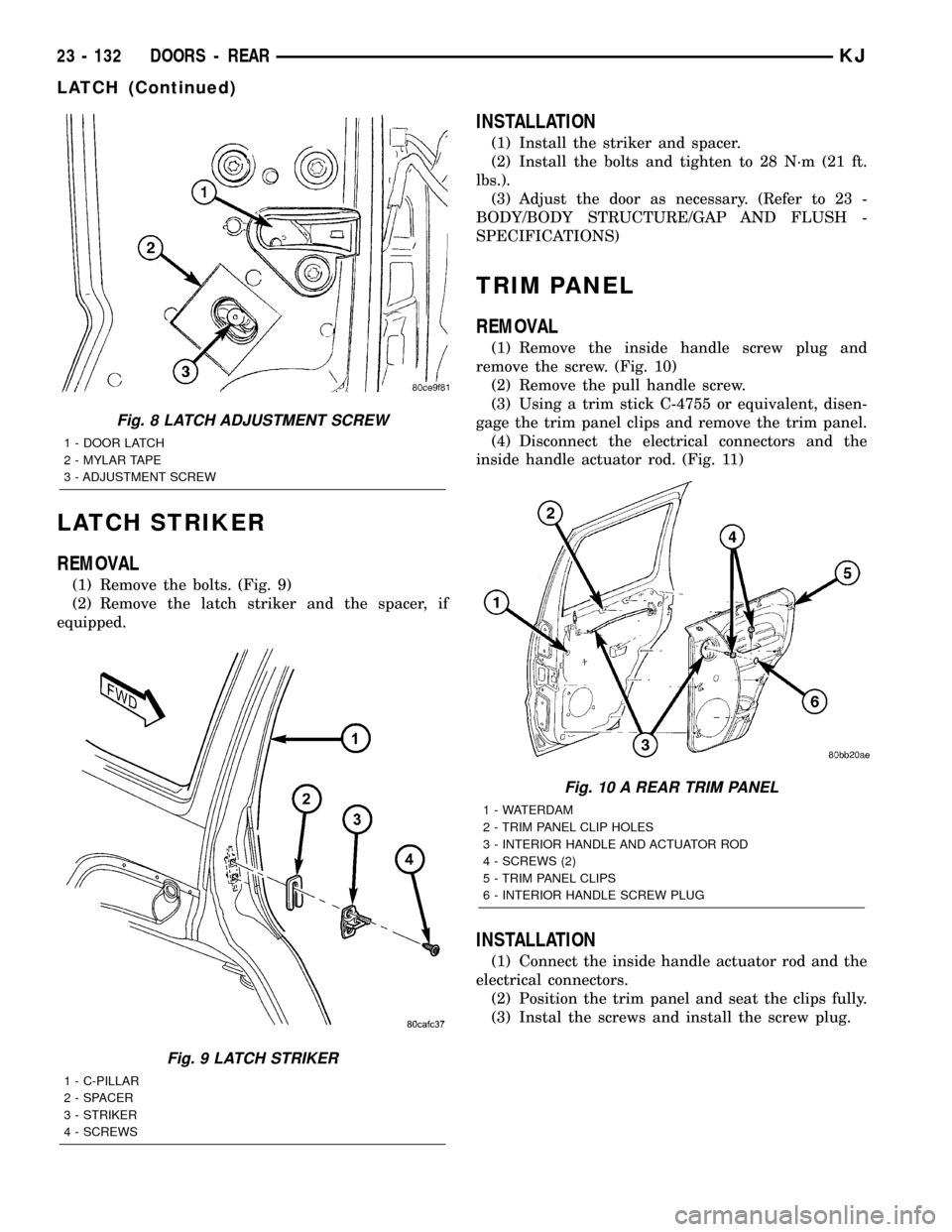
(1) Remove the bolts. (Fig. 9)
(2) Remove the latch striker and the spacer, if
equipped.
INSTALLATION
(1) Install the striker and spacer.
(2) Install the bolts and tighten to 28 N´m (21 ft.
lbs.).
(3) Adjust the door as necessary. (Refer to 23 -
BODY/BODY STRUCTURE/GAP AND FLUSH -
SPECIFICATIONS)
TRIM PANEL
REMOVAL
(1) Remove the inside handle screw plug and
remove the screw. (Fig. 10)
(2) Remove the pull handle screw.
(3) Using a trim stick C-4755 or equivalent, disen-
gage the trim panel clips and remove the trim panel.
(4) Disconnect the electrical connectors and the
inside handle actuator rod. (Fig. 11)
INSTALLATION
(1) Connect the inside handle actuator rod and the
electrical connectors.
(2) Position the trim panel and seat the clips fully.
(3) Instal the screws and install the screw plug.
Fig. 8 LATCH ADJUSTMENT SCREW
1 - DOOR LATCH
2 - MYLAR TAPE
3 - ADJUSTMENT SCREW
Fig. 9 LATCH STRIKER
1 - C-PILLAR
2 - SPACER
3 - STRIKER
4 - SCREWS
Fig. 10 A REAR TRIM PANEL
1 - WATERDAM
2 - TRIM PANEL CLIP HOLES
3 - INTERIOR HANDLE AND ACTUATOR ROD
4 - SCREWS (2)
5 - TRIM PANEL CLIPS
6 - INTERIOR HANDLE SCREW PLUG
23 - 132 DOORS - REARKJ
LATCH (Continued)
Page 1598 of 1803
WATERDAM
REMOVAL
(1) Remove the trim panel. (Refer to 23 - BODY/
DOORS - REAR/TRIM PANEL - REMOVAL)
(2) Remove the door speaker.
(3) Peal waterdam away from inner door panel
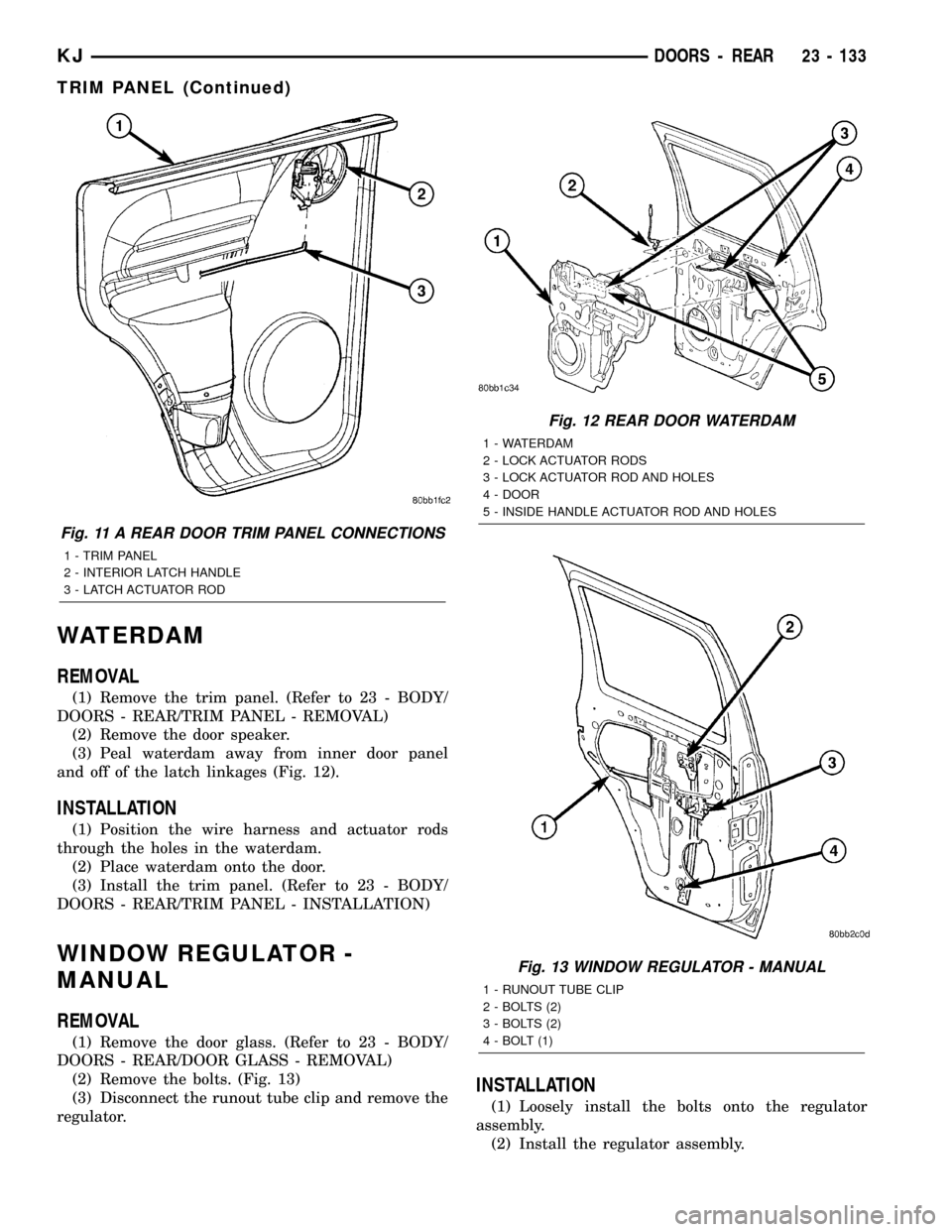
and off of the latch linkages (Fig. 12).
INSTALLATION
(1) Position the wire harness and actuator rods
through the holes in the waterdam.
(2) Place waterdam onto the door.
(3) Install the trim panel. (Refer to 23 - BODY/
DOORS - REAR/TRIM PANEL - INSTALLATION)
WINDOW REGULATOR -
MANUAL
REMOVAL
(1) Remove the door glass. (Refer to 23 - BODY/
DOORS - REAR/DOOR GLASS - REMOVAL)
(2) Remove the bolts. (Fig. 13)
(3) Disconnect the runout tube clip and remove the
regulator.
INSTALLATION
(1) Loosely install the bolts onto the regulator
assembly.
(2) Install the regulator assembly.
Fig. 11 A REAR DOOR TRIM PANEL CONNECTIONS
1 - TRIM PANEL
2 - INTERIOR LATCH HANDLE
3 - LATCH ACTUATOR ROD
Fig. 12 REAR DOOR WATERDAM
1 - WATERDAM
2 - LOCK ACTUATOR RODS
3 - LOCK ACTUATOR ROD AND HOLES
4 - DOOR
5 - INSIDE HANDLE ACTUATOR ROD AND HOLES
Fig. 13 WINDOW REGULATOR - MANUAL
1 - RUNOUT TUBE CLIP
2 - BOLTS (2)
3 - BOLTS (2)
4 - BOLT (1)
KJDOORS - REAR 23 - 133
TRIM PANEL (Continued)
Page 1610 of 1803

SIDE VIEW MIRROR
REMOVAL
(1) Remove the trim panel. (Refer to 23 - BODY/
DOOR - FRONT/TRIM PANEL - REMOVAL)
(2) Disconnect the electrical connector. (Fig. 10)
(3) Remove the three nuts and remove the mirror
assembly.
INSTALLATION
(1) Install the mirror assembly.
(2) Install the three nuts and tighten to 7 N´m (65
in. lbs.).
(3) Connect the electrical connector.
(4) Install the trim panel. (Refer to 23 - BODY/
DOOR - FRONT/TRIM PANEL - INSTALLATION)
FRONT WHEEL OPENING
FLARE MOLDINGS
REMOVAL
(1) Remove the 10 rivets connecting the flare to
the splash shield, flare brackets, fascia and air dam.
(Fig. 11)
(2) Using a trim stick C-4755 or equivalent, sepa-
rate the clips attaching the molding to the fascia and
fender.
(3) Remove the flare molding.
INSTALLATION
(1) Position flare molding and seat clips into the
fascia.
(2) Seat the remaining clips into the fender.(3) Install ten new rivets securing the flare mold-
ing to the splash shield, flare brackets, fascia and air
dam.
REAR WHEEL OPENING FLARE
MOLDINGS
REMOVAL
(1) Open the rear door and remove the five rivets
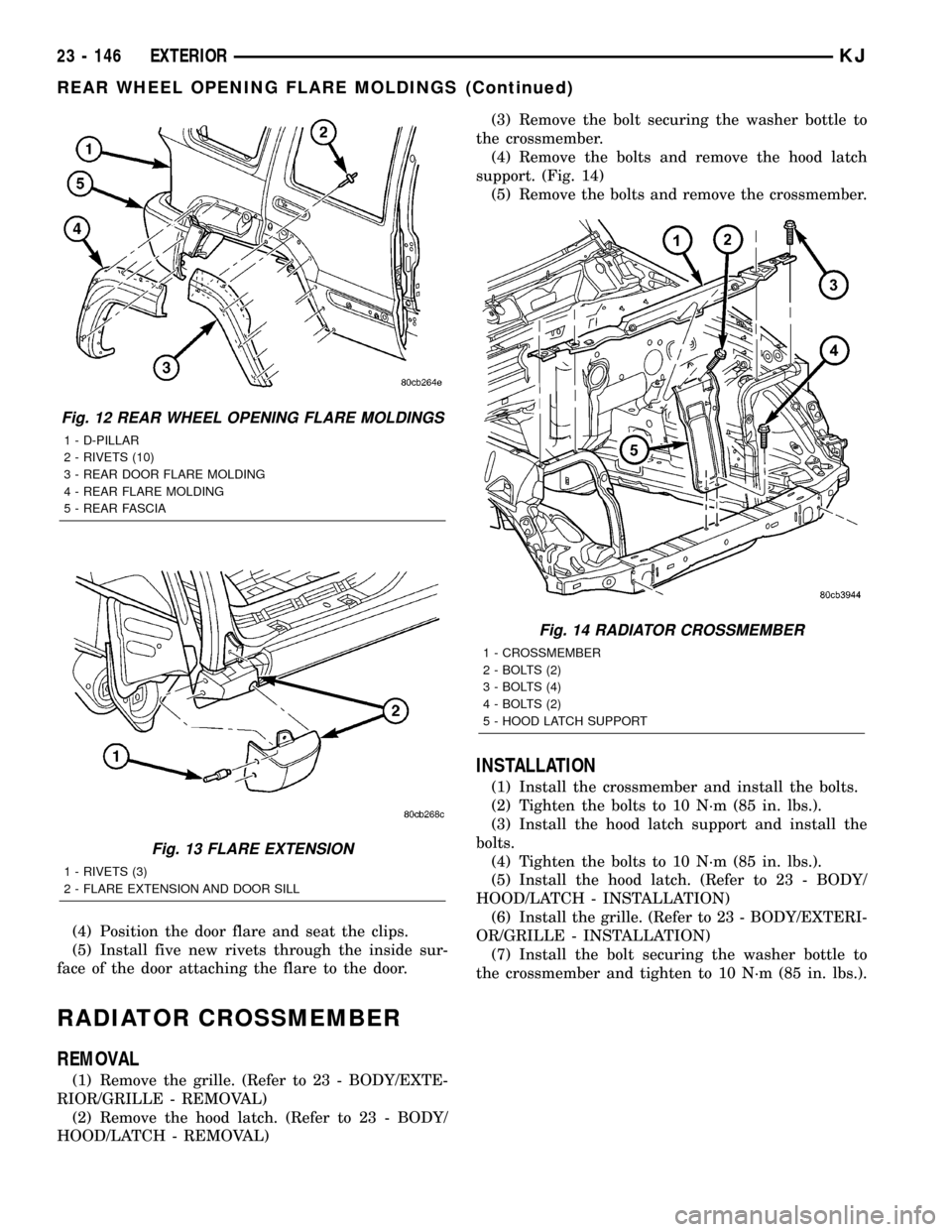
from the inside surface of the door. (Fig. 12)
(2) Using a trim stick C-4755 or equivalent, sepa-
rate the clips attaching the molding to the door and
remove the molding.
(3) Remove the 5 rivets from the rear flare and
splash shield.
(4) Using a trim stick C-4755 or equivalent, sepa-
rate the clips attaching the molding to the body and
the rear fascia and remove the molding.
(5) Remove the two rivets and remove the flare
extension. (Fig. 13)
INSTALLATION
(1) Install the flare extension and install two new
rivets.
(2) Position the rear flare molding and seat the
clips attaching it to the body and the rear fascia.
(3) Install five new rivets attaching the flare to the
splash shield.
Fig. 10 SIDE VIEW MIRROR
1 - MIRROR ASSEMBLY
2 - NUTS (3)
3 - ELECTRICAL CONNECTOR
Fig. 11 FRONT WHEEL OPENING FLARE MOLDING
1 - FLARE MOLDING
2 - RIVETS (10)
KJEXTERIOR 23 - 145
Page 1611 of 1803
(4) Position the door flare and seat the clips.
(5) Install five new rivets through the inside sur-
face of the door attaching the flare to the door.
RADIATOR CROSSMEMBER
REMOVAL
(1) Remove the grille. (Refer to 23 - BODY/EXTE-
RIOR/GRILLE - REMOVAL)
(2) Remove the hood latch. (Refer to 23 - BODY/
HOOD/LATCH - REMOVAL)(3) Remove the bolt securing the washer bottle to
the crossmember.
(4) Remove the bolts and remove the hood latch
support. (Fig. 14)
(5) Remove the bolts and remove the crossmember.
INSTALLATION
(1) Install the crossmember and install the bolts.
(2) Tighten the bolts to 10 N´m (85 in. lbs.).
(3) Install the hood latch support and install the
bolts.
(4) Tighten the bolts to 10 N´m (85 in. lbs.).
(5) Install the hood latch. (Refer to 23 - BODY/
HOOD/LATCH - INSTALLATION)
(6) Install the grille. (Refer to 23 - BODY/EXTERI-
OR/GRILLE - INSTALLATION)
(7) Install the bolt securing the washer bottle to
the crossmember and tighten to 10 N´m (85 in. lbs.).
Fig. 12 REAR WHEEL OPENING FLARE MOLDINGS
1 - D-PILLAR
2 - RIVETS (10)
3 - REAR DOOR FLARE MOLDING
4 - REAR FLARE MOLDING
5 - REAR FASCIA
Fig. 13 FLARE EXTENSION
1 - RIVETS (3)
2 - FLARE EXTENSION AND DOOR SILL
Fig. 14 RADIATOR CROSSMEMBER
1 - CROSSMEMBER
2 - BOLTS (2)
3 - BOLTS (4)
4 - BOLTS (2)
5 - HOOD LATCH SUPPORT
23 - 146 EXTERIORKJ
REAR WHEEL OPENING FLARE MOLDINGS (Continued)
Page 1628 of 1803

CAUTION: Do not use abrasive chemicals or com-
pounds on painted surfaces. Damage to finish can
result.
Do not use harsh alkaline based cleaning solvents
on painted surfaces. Damage to finish or color can
result.
PAINT TOUCH-UP
DESCRIPTION
When a painted metal surface has been scratched
or chipped, it should be touched-up as soon as possi-
ble to avoid corrosion. For best results, use Mopart
Scratch Filler/Primer, Touch-Up Paints and Clear Top
Coat. Refer to Introduction group of this manual for
Body Code Plate information.
WARNING: USE AN OSHA APPROVED BREATHING
FILTER WHEN SPRAYING PAINT OR SOLVENTS IN
A CONFINED AREA. PERSONAL INJURY CAN
RESULT.
OPERATION
(1) Scrape loose paint and corrosion from inside
scratch or chip.
(2) Clean affected area with MopartTar/Road Oil
Remover, and allow to dry.
(3) Fill the inside of the scratch or chip with a coat
of filler/primer. Do not overlap primer onto good sur-
face finish. The applicator brush should be wet
enough to puddle-fill the defect without running. Do
not stroke brush applicator on body surface. Allow
the filler/primer to dry hard.
(4) Cover the filler/primer with color touch-up
paint. Do not overlap touch-up color onto the originalcolor coat around the scratch or chip. Butt the new
color to the original color, if possible. Do not stroke
applicator brush on body surface. Allow touch-up
paint to dry hard.
(5) On vehicles without clear coat, the touch-up
color can be lightly finesse sanded (1500 grit) and
polished with rubbing compound.
(6) On vehicles with clear coat, apply clear top coat
to touch-up paint with the same technique as
described in Step 4. Allow clear top coat to dry hard.
If desired, Step 5 can be performed on clear top coat.
WARNING: AVOID PROLONGED SKIN CONTACT
WITH PETROLEUM OR ALCOHOL ± BASED CLEAN-
ING SOLVENTS. PERSONAL INJURY CAN RESULT.
AVOID PROLONGED SKIN CONTACT WITH PETRO-
LEUM OR ALCOHOL ± BASED CLEANING SOL-
VENTS. PERSONAL INJURY CAN RESULT.
FINESSE SANDING/BUFFING &
POLISHING
DESCRIPTION
Minor acid etching, orange peel, or smudging in
clear coat or single-stage finishes can be reduced
with light finesse sanding, hand buffing, and polish-
ing.If the finish has been finesse sanded in the
past, it cannot be repeated. Finesse sanding
operation should be performed by a trained
automotive paint technician.
CAUTION: Do not remove clear coat finish, if
equipped. Base coat paint must retain clear coat for
durability.
KJPAINT 23 - 163
BASE COAT/CLEAR COAT FINISH (Continued)
Page 1637 of 1803

STATIONARY GLASS
TABLE OF CONTENTS
page page
DOOR GLASS
REMOVAL............................172
INSTALLATION........................172
QUARTER WINDOW
REMOVAL............................172
INSTALLATION........................172WINDSHIELD
WARNING
WINDSHIELD SAFETY PRECAUTIONS....173
REMOVAL............................173
INSTALLATION........................173
DOOR GLASS
REMOVAL
(1) Remove the rear door glass run channel. (Refer
to 23 - BODY/DOORS - REAR/GLASS RUN CHAN-
NEL - REMOVAL)
INSTALLATION
(1) Install the rear door glass run channel. (Refer
to 23 - BODY/DOORS - REAR/GLASS RUN CHAN-
NEL - INSTALLATION)
QUARTER WINDOW
REMOVAL
(1) Remove the headliner as necessary to gain
access to the glass seal from the inside. (Refer to 23 -
BODY/INTERIOR/HEADLINER - REMOVAL)
(2) Cut urethane bonding from around quarter
window glass using a suitable sharp cold knife. A
pneumatic cutting device can be used if available.
(3) Separate glass from vehicle.
INSTALLATION
CAUTION: Open a window before installing glass.
This will avoid pressurizing the passenger compart-
ment. If a door or swing gate flip-up glass is
slammed before urethane is cured, water leaks can
result.
The window opening fence should be cleaned of old
urethane bonding material.
(1) Install the headliner as necessary. (Refer to 23
- BODY/INTERIOR/HEADLINER - INSTALLATION)
(2) Clean inside of glass with Mopar Glass Cleaner
and lint-free cloth.
(3) Apply PVC (vinyl) primer 25 mm (1 in.) wide
around edge of glass. Wipe with clean/dry lint-free
cloth.
(4) Apply fence primer around edge of fence. Allow
at least eighteen minutes drying time.
(5) Apply a 10 mm (0.4 in.) bead of urethane
around window vinyl border location.
(6)
Position glass into window opening and lock clips
into place.
23 - 172 STATIONARY GLASSKJ
Page 1638 of 1803

WINDSHIELD
WARNING
WINDSHIELD SAFETY PRECAUTIONS
WARNING: DO NOT OPERATE THE VEHICLE
WITHIN 24 HOURS OF WINDSHIELD INSTALLATION.
IT TAKES AT LEAST 24 HOURS FOR URETHANE
ADHESIVE TO CURE. IF IT IS NOT CURED, THE
WINDSHIELD MAY NOT PERFORM PROPERLY IN
AN ACCIDENT.
²URETHANE ADHESIVES ARE APPLIED AS A
SYSTEM. USE GLASS CLEANER, GLASS PREP
SOLVENT, GLASS PRIMER, PVC (VINYL) PRIMER
AND PINCH WELD (FENCE) PRIMER PROVIDED BY
THE ADHESIVE MANUFACTURER. IF NOT, STRUC-
TURAL INTEGRITY COULD BE COMPROMISED.
²DAIMLERCHRYSLER DOES NOT RECOMMEND
GLASS ADHESIVE BY BRAND. TECHNICIANS
SHOULD REVIEW PRODUCT LABELS AND TECHNI-
CAL DATA SHEETS, AND USE ONLY ADHESIVES
THAT THEIR MANUFACTURES WARRANT WILL
RESTORE A VEHICLE TO THE REQUIREMENTS OF
FMVSS 212. TECHNICIANS SHOULD ALSO INSURE
THAT PRIMERS AND CLEANERS ARE COMPATIBLE
WITH THE PARTICULAR ADHESIVE USED.
²BE SURE TO REFER TO THE URETHANE MAN-
UFACTURER'S DIRECTIONS FOR CURING TIME
SPECIFICATIONS, AND DO NOT USE ADHESIVE
AFTER ITS EXPIRATION DATE.
²VAPORS THAT ARE EMITTED FROM THE URE-
THANE ADHESIVE OR PRIMER COULD CAUSE
PERSONAL INJURY. USE THEM IN A WELL-VENTI-
LATED AREA.
²SKIN CONTACT WITH URETHANE ADHESIVE
SHOULD BE AVOIDED. PERSONAL INJURY MAY
RESULT.
²ALWAYS WEAR EYE AND HAND PROTECTION
WHEN WORKING WITH GLASS.
CAUTION: Protect all painted and trimmed surfaces
from coming in contact with urethane or primers.
Be careful not to damage painted surfaces when
removing moldings or cutting urethane around
windshield.
REMOVAL
(1) Remove inside rear view mirror. (Refer to 23 -
BODY/INTERIOR/REAR VIEW MIRROR -
REMOVAL)
(2) Remove cowl cover. (Refer to 23 - BODY/EXTE-
RIOR/COWL GRILLE - REMOVAL)(3) Remove screws attaching windshield side mold-
ing to A-pillar.
(4) Remove upper windshield molding.
(5) Cut urethane bonding from around windshield
using a suitable sharp cold knife. A pneumatic cut-
ting device can be used if available.
(6) Separate windshield from vehicle.
INSTALLATION
WARNING: REVIEW ALL WARNINGS AND CAU-
TIONS IN THIS GROUP BEFORE PRECEDING WITH
INSTALLATION.
CAUTION: Open a window before installing wind-
shield. This will avoid pressurizing the passenger
compartment. If a door or swing gate flip-up glass
is slammed before urethane is cured, water leaks
can result.
The windshield fence should be cleaned of old ure-
thane bonding material. Support spacers should be
cleaned and properly installed on weld studs or
repair screws at bottom of windshield opening.
(1) Place replacement windshield into windshield
opening. Position glass in the center of the opening
against the support spacers. Mark the glass at the
support spacers with a grease pencil or masking tape
and ink pen to use as a reference for installation.
Remove replacement windshield from windshield
opening.
(2) Position the windshield inside up on a suitable
work surface with two padded, wood 10 cm by 10 cm
by 50 cm (4 in. by 4 in. by 20 in.) blocks, placed par-
allel 75 cm (2.5 ft.) apart.
(3) Clean inside of windshield with Mopar Glass
Cleaner and lint-free cloth.
(4) Apply clear glass primer 25 mm (1 in.) wide
around edge of windshield. Wipe with clean/dry lint-
free cloth.
(5) Apply black-out primer 15 mm (.75 in.) wide on
top and sides of windshield and 25 mm (1 in.) on bot-
tom of windshield. Allow at least three minutes dry-
ing time.
(6) Position windshield spacers on lower fence
above support spacers at the edge of the windshield
opening.
(7) Align the dot on the upper molding to the tick
mark in the center of the glass and install upper
molding onto windshield.
(8) Apply a 10 mm (0.4 in.) bead of urethane
around perimeter of windshield along the inside of
the moldings. Apply two beads along the bottom
edge.
KJSTATIONARY GLASS 23 - 173