2002 Hyundai Grandeur check engine light
[x] Cancel search: check engine lightPage 55 of 230
1- 42 FEATURES OF YOUR HYUNDAI
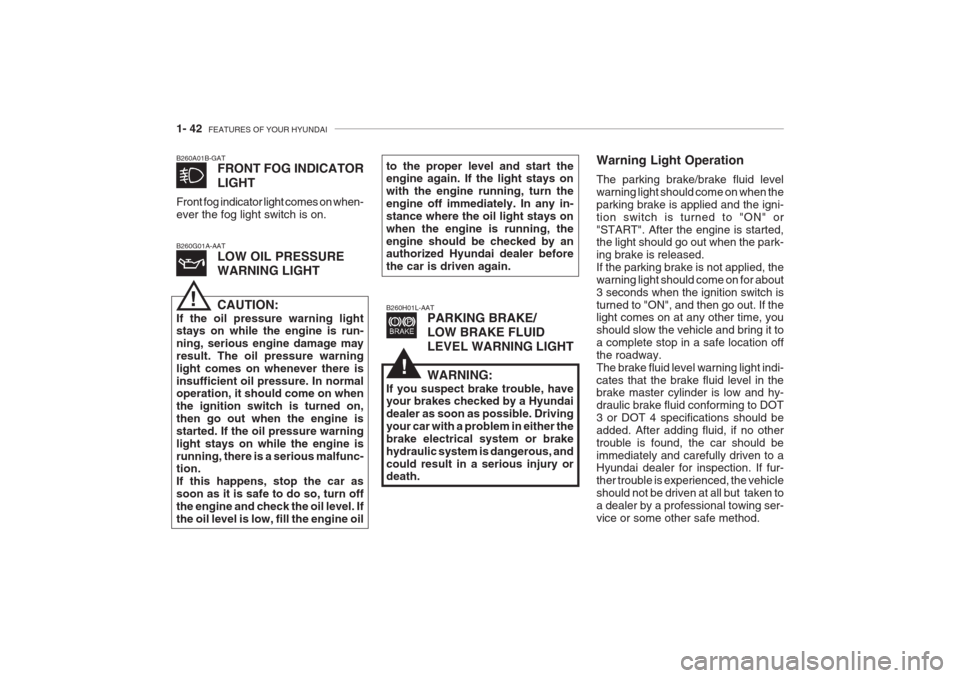
B260A01B-GAT
FRONT FOG INDICATOR LIGHT
Front fog indicator light comes on when- ever the fog light switch is on. B260G01A-AAT LOW OIL PRESSURE WARNING LIGHT CAUTION:
If the oil pressure warning light stays on while the engine is run- ning, serious engine damage mayresult. The oil pressure warninglight comes on whenever there isinsufficient oil pressure. In normal operation, it should come on when the ignition switch is turned on,then go out when the engine isstarted. If the oil pressure warninglight stays on while the engine isrunning, there is a serious malfunc- tion. If this happens, stop the car assoon as it is safe to do so, turn offthe engine and check the oil level. Ifthe oil level is low, fill the engine oil to the proper level and start the engine again. If the light stays on with the engine running, turn theengine off immediately. In any in-stance where the oil light stays onwhen the engine is running, theengine should be checked by an authorized Hyundai dealer before the car is driven again.
!B260H01L-AAT
PARKING BRAKE/ LOW BRAKE FLUID
LEVEL WARNING LIGHT
WARNING:
If you suspect brake trouble, have your brakes checked by a Hyundai dealer as soon as possible. Drivingyour car with a problem in either thebrake electrical system or brakehydraulic system is dangerous, andcould result in a serious injury or death. Warning Light Operation The parking brake/brake fluid level warning light should come on when theparking brake is applied and the igni-tion switch is turned to "ON" or"START". After the engine is started, the light should go out when the park- ing brake is released.If the parking brake is not applied, thewarning light should come on for about3 seconds when the ignition switch isturned to "ON", and then go out. If the light comes on at any other time, you should slow the vehicle and bring it toa complete stop in a safe location offthe roadway.The brake fluid level warning light indi-cates that the brake fluid level in the brake master cylinder is low and hy- draulic brake fluid conforming to DOT3 or DOT 4 specifications should beadded. After adding fluid, if no othertrouble is found, the car should beimmediately and carefully driven to a Hyundai dealer for inspection. If fur- ther trouble is experienced, the vehicleshould not be driven at all but taken toa dealer by a professional towing ser-vice or some other safe method.
!
Page 56 of 230
FEATURES OF YOUR HYUNDAI 1- 43
Your Hyundai is equipped with dual- diagonal braking systems. This meansyou still have braking on two wheelseven if one of the dual systems shouldfail. With only one of the dual systems working, more than normal pedal travel and greater pedal pressure are re-quired to stop the car. Also, the car willnot stop in as short a distance with onlyhalf of the brake system working. If thebrakes fail while you are driving, shift to a lower gear for additional engine braking and stop the car as soon as itis safe to do so. B260J01A-GAT
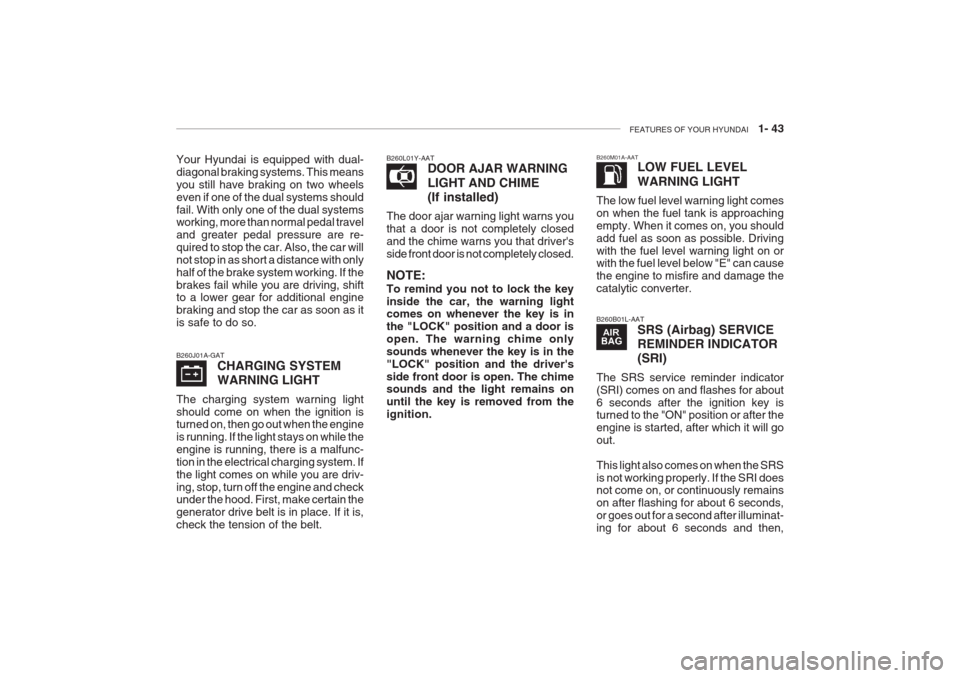
CHARGING SYSTEM WARNING LIGHT
The charging system warning light should come on when the ignition is turned on, then go out when the engine is running. If the light stays on while theengine is running, there is a malfunc-tion in the electrical charging system. Ifthe light comes on while you are driv-ing, stop, turn off the engine and check under the hood. First, make certain the generator drive belt is in place. If it is,check the tension of the belt. B260L01Y-AAT
DOOR AJAR WARNING
LIGHT AND CHIME (If installed)
The door ajar warning light warns you that a door is not completely closedand the chime warns you that driver'sside front door is not completely closed. NOTE: To remind you not to lock the key inside the car, the warning light comes on whenever the key is in the "LOCK" position and a door isopen. The warning chime onlysounds whenever the key is in the"LOCK" position and the driver'sside front door is open. The chime sounds and the light remains on until the key is removed from theignition. B260M01A-AAT
LOW FUEL LEVEL WARNING LIGHT
The low fuel level warning light comes on when the fuel tank is approachingempty. When it comes on, you shouldadd fuel as soon as possible. Drivingwith the fuel level warning light on or with the fuel level below "E" can cause the engine to misfire and damage thecatalytic converter. B260B01L-AAT SRS (Airbag) SERVICE REMINDER INDICATOR(SRI)
The SRS service reminder indicator (SRI) comes on and flashes for about6 seconds after the ignition key is turned to the "ON" position or after the engine is started, after which it will goout. This light also comes on when the SRS is not working properly. If the SRI does not come on, or continuously remains on after flashing for about 6 seconds,or goes out for a second after illuminat-ing for about 6 seconds and then,
Page 57 of 230

1- 44 FEATURES OF YOUR HYUNDAI
B260N02FC-GAT
MALFUNCTION INDICATOR LIGHT(If installed)
This light illuminates when there is a malfunction of an exhaust gas relatedcomponent, and the system is not functioning properly so that the ex- haust gas regulation values are notsatisfied. This light will also illuminatewhen the ignition key is turned to the"ON" position, and will go out in a fewseconds. If it illuminates while driving, or does not illuminate when the ignition key is turned to the "ON" position, takeyour car to your nearest authorizedHyundai dealer and have the systemchecked. B270B01L-AAT
STOP/TAIL LIGHT FAIL URE WARNING LIGHT
If the Stop/Tail Light Failure warning light comes on when the parking brakeis applied or the tail light is turned on,check the brake lines or the tail lightbulb.
B260Q01HP-DAT
CRUISE INDICATOR (If installed)
The cruise indicator light in the instru- ment cluster is illuminated only whenthe vehicle cruising speed has beenset using the control switch on thesteering wheel. The indicator light does not illuminate when the main cruise control switch isactivated.Information on the use of cruise con-trol may be found on page 1-72.
continuously comes on again, whenyou turned the ignition key to the "ON"position or started the engine, or if itcomes on while driving, have the SRSinspected by an authorized Hyundai Dealer.
B270A01A-AAT BRAKE PAD WEAR WARNING SOUND The front disc brake pads have wear indicators that should make a high-pitched squealing or scraping noisewhen new pads are needed. The soundmay come and go or be heard all the time when the vehicle is moving. It may also be heard when the brakepedal is pushed down firmly. Exces-sive rotor damage will result if the wornpads are not replaced. See your
Hyundai dealer immediately.
Page 132 of 230
DRIVING YOUR HYUNDAI 2- 3
C020A01A-AAT BEFORE STARTING THE EN- GINE Before you start the engine, you should always:
1. Look around the vehicle to be sure
there are no flat tires, puddles of oil, water or other indications of pos- sible trouble.
2. After entering the car, check to be
sure the parking brake is engaged.
3. Check that all windows, and lights are clean.
4. Check that the interior and exterior
mirrors are clean and in position.
5. Check your seat, seatback and
headrest to be sure they are in theirproper positions.
6. Lock all the doors.
7. Fasten your seat belt and be sure
that all other occupants have fas- tened theirs.
8. Turn off all lights and accessories that are not needed.
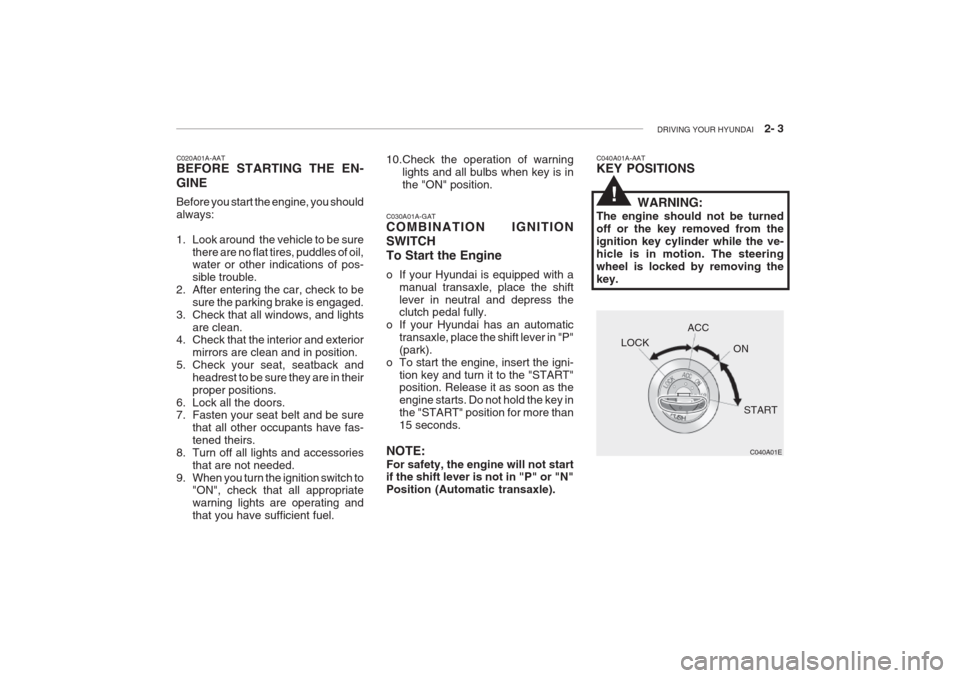
9. When you turn the ignition switch to "ON", check that all appropriatewarning lights are operating andthat you have sufficient fuel. C030A01A-GAT COMBINATION IGNITION SWITCHTo Start the Engine
o If your Hyundai is equipped with a
manual transaxle, place the shift lever in neutral and depress the clutch pedal fully.
o If your Hyundai has an automatic
transaxle, place the shift lever in "P" (park).
o To start the engine, insert the igni- tion key and turn it to the "START" position. Release it as soon as the engine starts. Do not hold the key inthe "START" position for more than15 seconds.
NOTE: For safety, the engine will not start if the shift lever is not in "P" or "N" Position (Automatic transaxle).
10.Check the operation of warning
lights and all bulbs when key is inthe "ON" position.C040A01A-AAT KEY POSITIONS
WARNING:
The engine should not be turned off or the key removed from theignition key cylinder while the ve-hicle is in motion. The steeringwheel is locked by removing thekey.
C040A01E
LOCK
ACC
ON
START
!
Page 142 of 230

DRIVING YOUR HYUNDAI 2- 13
NOTE:
1) When TCS illuminates, traction
control is automatically deacti- vated for safety.
2) This warning function is not pro- vided when in the TCS-OFF mode.
3) When the engine starts, a click is
heard from the engine compart-ment; however, this is only thesound of traction control beingchecked.
4) When moving out of the mud or
fresh snow, pressing the accel-erator pedal may not cause theengine speed to increase.
C300D02L-GAT Indicator and Warning The indicator should illuminate when
the ignition key is turned ON or START but should go out after three seconds. If the indicators do not illuminate or goout after three seconds, have themchecked by an authorized dealer. Should there be any unusual condi- tions in the device, TCS illuminates asa warning.If TCS illuminates, pull your car to asafe place and stop the engine.Then, start the engine again to check if the TCS indicator goes out. If the indicator do not go out after three seconds even after the engine hasbeen started, have your car checkedby an authorized Hyundai dealer. C130A01A-AAT GOOD BRAKING PRACTICES
WARNING:
Nothing should be carried on top of the cargo area cover behind therear seat. If there were an accidentor a sudden stop, such objectscould move forward and cause dam- age to the vehicle or injure the oc- cupants.
o After being parked, check to be sure the parking brake is not engaged and that the parking brake indicator light is out before driving away.
o Driving through water may get the brakes wet. They can also get wet when the car is washed. Wet brakescan be dangerous! Your car will notstop as quickly if the brakes are wet. Wet brakes cause the car to pull toone side. To dry the brakes, applythe brakes lightly until the braking
action returns to normal, taking careto keep the car under control at all times. If the braking action does not return to normal, stop as soon as it
is safe to do so and call your Hyundaidealer for assistance.
o Don't coast down hills with the car out of gear. This is extremely haz- ardous. Keep the car in gear at all times, use the brakes to slow down,then shift to a lower gear so thatengine braking will help you main-tain a safe speed.
o Don't "ride" the brake pedal. Rest- ing your foot on the brake pedalwhile driving can be dangerous be-cause it can result in the brakes
overheating and losing their effec-tiveness. It also increases the wearof the brake components.
o If a tire goes flat while you are
driving, apply the brakes gently and
keep the car pointed straight aheadwhile you slow down. When you are
moving slowly enough for it to besafe to do so, pull off the road and stop in a safe place.
!
Page 146 of 230

DRIVING YOUR HYUNDAI 2- 17
C160I01A-AAT Don't Let Your Parking Brake Freeze Under some conditions your parking brake can freeze in the engaged posi-tion. This is most likely to happenwhen there is an accumulation of snow or ice around or near the rear brakes or if the brakes are wet. If there is a riskthe parking brake may freeze, apply itonly temporarily while you put the gearselector lever in "P" (automatic) or infirst or reverse gear (manual transaxle) and block the rear wheels so the car cannot roll. Then release the parkingbrake.
C160H01A-AAT Use Approved Anti-Freeze in Window Washer System To keep the water in the window washer system from freezing, add an approvedanti-freeze solution in accordance withinstructions on the container. Windowwasher anti-freeze is available fromHyundai dealers and most auto parts outlets. Do not use engine coolant or other types of anti-freeze as thesemay damage the finish.
C160K01A-AAT Carry Emergency Equipment Depending on the severity of the weather where you drive your car, youshould carry appropriate emergency equipment. Some of the items you may want to carry include tire chains,tow straps or chains, flashlight, emer-gency flares, sand, a shovel, jumpercables, a window scraper, gloves,ground cloth, coveralls, a blanket, etc.
C160J01A-AAT Don't Let Ice and Snow Accumu- late Underneath Under some conditions, snow and ice can build up under the fenders andinterfere with the steering. When driv-ing in severe winter conditions wherethis may happen, you should periodi- cally check underneath the car to be sure the movement of the front wheelsand the steering components is notobstructed.
C170A01A-AAT HIGH SPEED MOTORING Pre-Trip Inspections 1. Tires: Adjust the tire inflation pressures tospecification. Low tire inflation pres-sures will result in overheating andpossible failure of the tires. Avoid using worn or damaged tires which may result in reduced traction ortire failure. NOTE: Never exceed the maximum tire in- flation pressure shown on the tires. 2. Fuel, engine coolant and engine oil: High speed travel consumes 1.5 timesmore fuel than urban motoring. Do notforget to check both engine coolantand engine oil. 3. Drive belt: A loose or damaged drive belt mayresult in overheating of the engine.
Page 147 of 230

2- 18 DRIVING YOUR HYUNDAI
C190C01Y-GAT Trailer Brakes If your trailer is equipped with a braking system, make sure it conforms to fed-eral and/or local regulations and that it
is properly installed and operating cor-rectly. NOTE: If you tow a trailer or vehicle, your car will require more frequent main-tenance due to the additional load.See "Maintenance Under SevereUsage Conditions" on page 5-6.
CAUTION:
o Never connect a trailer brake sys- tem directly to the vehicle brakesystem.
o When towing a trailer on steep grades (in excess of 12%) pay
close attention to the engine cool- ant temperature gauge to ensure
the engine does not overheat. Ifthe needle of the coolant tem-
perature gauge moves across thedial towards "H" (HOT), pull over and stop as soon as it is safe to
C190B01S-AATTrailer Hitches Select the proper hitch and ball combi- nation, making sure that it's location is compatible with that of the trailer or vehicle being towed.Use a quality non-equalizing hitch whichdistributes the tongue load uniformlythroughout the chassis. The hitch should be bolted securely to the car and installed by a qualifiedtechnician. DO NOT USE A HITCHDESIGNED FOR TEMPORARY IN-STALLATION AND NEVER USE ONETHAT ATTACHES ONLY TO THE BUMPER.
C180A01A-AAT USE OF LIGHTS Check your lights regularly for correct operation and always keep them clean.When driving during the day in condi-tions of poor visibility, it is helpful todrive with headlights on low beam. This enables you to be seen as well as to see. C190A01A-GAT TRAILER OR VEHICLE TOWING If you are considering towing with your car, you should first check with your Province Department of Motor Vehiclesto determine their legal requirements.Since laws vary from province to prov-ince the requirements for towing trail- ers, cars, or other types of vehicles or apparatus may differ. Ask your Hyundaidealer for further details before towing.
CAUTION:
Do not do any towing with your carduring its first 2,000 km (1,200 miles)in order to allow the engine to prop-erly break in. Failure to heed thiscaution may result in serious en- gine or transaxle damage.
!
!
Page 149 of 230
2- 20 DRIVING YOUR HYUNDAI
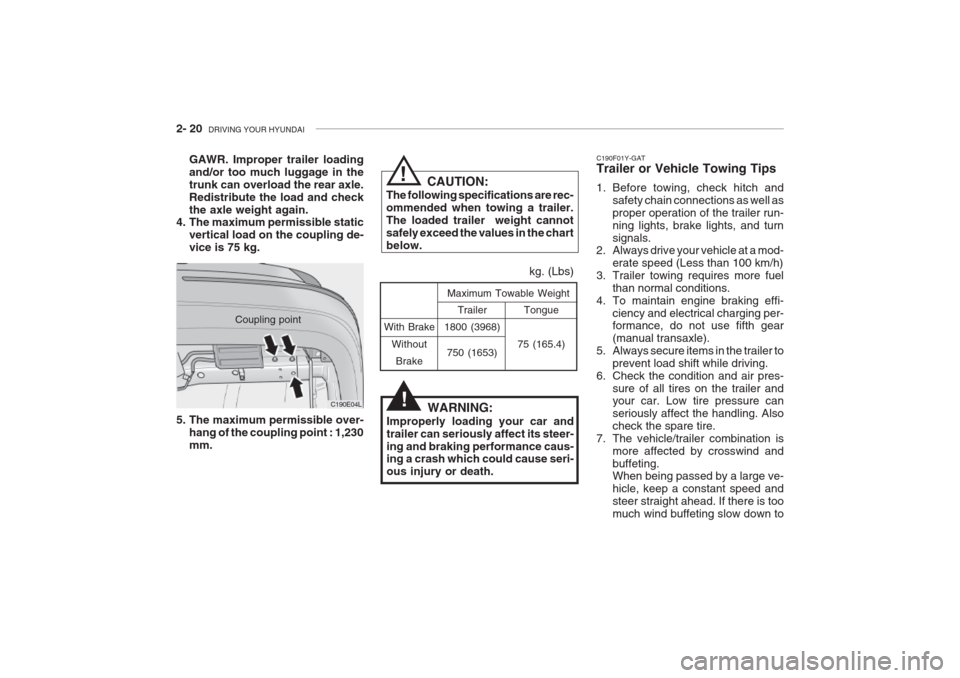
With Brake
WithoutBrake Tongue
75 (165.4)
Maximum Towable Weight
kg. (Lbs)
Trailer
1800 (3968)
750 (1653)
WARNING:
Improperly loading your car and trailer can seriously affect its steer-ing and braking performance caus- ing a crash which could cause seri- ous injury or death. C190F01Y-GAT Trailer or Vehicle Towing Tips
1. Before towing, check hitch and
safety chain connections as well as proper operation of the trailer run-ning lights, brake lights, and turnsignals.
2. Always drive your vehicle at a mod-
erate speed (Less than 100 km/h)
3. Trailer towing requires more fuel
than normal conditions.
4. To maintain engine braking effi-
ciency and electrical charging per- formance, do not use fifth gear (manual transaxle).
5. Always secure items in the trailer to prevent load shift while driving.
6. Check the condition and air pres-
sure of all tires on the trailer and your car. Low tire pressure can seriously affect the handling. Alsocheck the spare tire.
7. The vehicle/trailer combination is more affected by crosswind andbuffeting. When being passed by a large ve- hicle, keep a constant speed andsteer straight ahead. If there is toomuch wind buffeting slow down to
Coupling point
C190E04L
GAWR. Improper trailer loadingand/or too much luggage in thetrunk can overload the rear axle.Redistribute the load and checkthe axle weight again.
4. The maximum permissible static
vertical load on the coupling de-vice is 75 kg. CAUTION:
The following specifications are rec-ommended when towing a trailer.The loaded trailer weight cannotsafely exceed the values in the chartbelow.
!
!
5. The maximum permissible over- hang of the coupling point : 1,230 mm.