2002 Hyundai Grandeur brake fluid
[x] Cancel search: brake fluidPage 13 of 230
YOUR VEHICLE AT A GLANCE
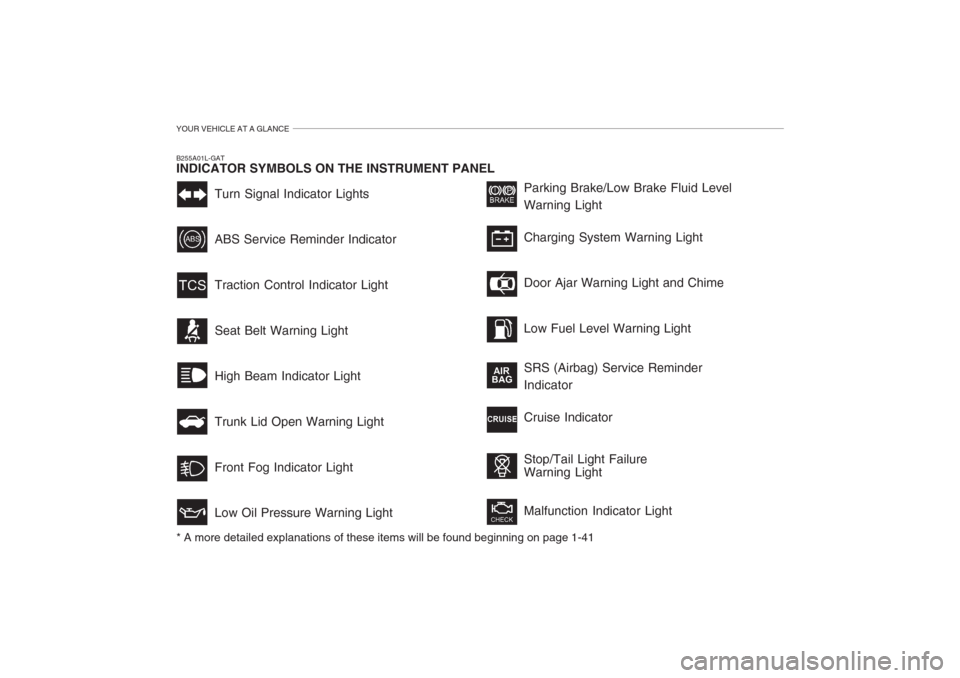
Turn Signal Indicator Lights ABS Service Reminder Indicator Traction Control Indicator LightSeat Belt Warning Light High Beam Indicator Light Trunk Lid Open Warning LightFront Fog Indicator Light Low Oil Pressure Warning LightParking Brake/Low Brake Fluid Level Warning Light Charging System Warning Light Door Ajar Warning Light and Chime Low Fuel Level Warning Light SRS (Airbag) Service Reminder Indicator Cruise Indicator Stop/Tail Light Failure Warning Light Malfunction Indicator Light
B255A01L-GAT INDICATOR SYMBOLS ON THE INSTRUMENT PANEL * A more detailed explanations of these items will be found beginning on page 1-41
Page 52 of 230
FEATURES OF YOUR HYUNDAI 1- 39
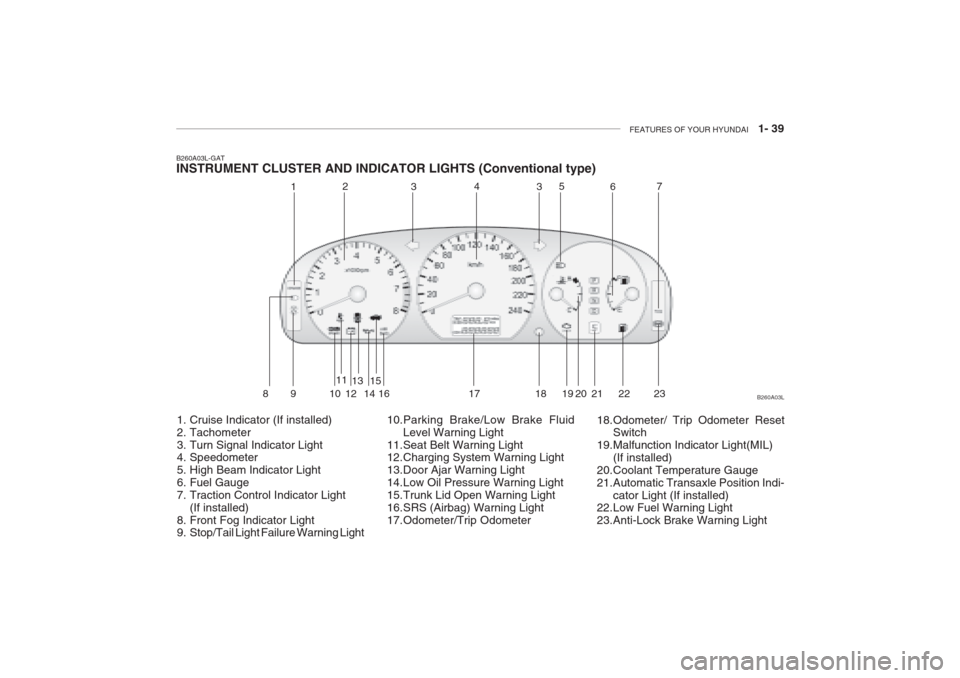
B260A03L-GAT INSTRUMENT CLUSTER AND INDICATOR LIGHTS (Conventional type)
1. Cruise Indicator (If installed)
2. Tachometer
3. Turn Signal Indicator Light
4. Speedometer
5. High Beam Indicator Light
6. Fuel Gauge
7. Traction Control Indicator Light (If installed)
8. Front Fog Indicator Light
9. Stop/Tail Light Failure Warning Light 10.Parking Brake/Low Brake Fluid
Level Warning Light
11.Seat Belt Warning Light
12.Charging System Warning Light
13.Door Ajar Warning Light
14.Low Oil Pressure Warning Light
15.Trunk Lid Open Warning Light
16.SRS (Airbag) Warning Light
17.Odometer/Trip Odometer 18.Odometer/ Trip Odometer Reset
Switch
19.Malfunction Indicator Light(MIL)
(If installed)
20.Coolant Temperature Gauge
21.Automatic Transaxle Position Indi-
cator Light (If installed)
22.Low Fuel Warning Light
23.Anti-Lock Brake Warning Light B260A03L
1
2
343
5
67
89 1 011
1213
1415
16 17 18 19 20 21 22
23
Page 53 of 230
1- 40 FEATURES OF YOUR HYUNDAI
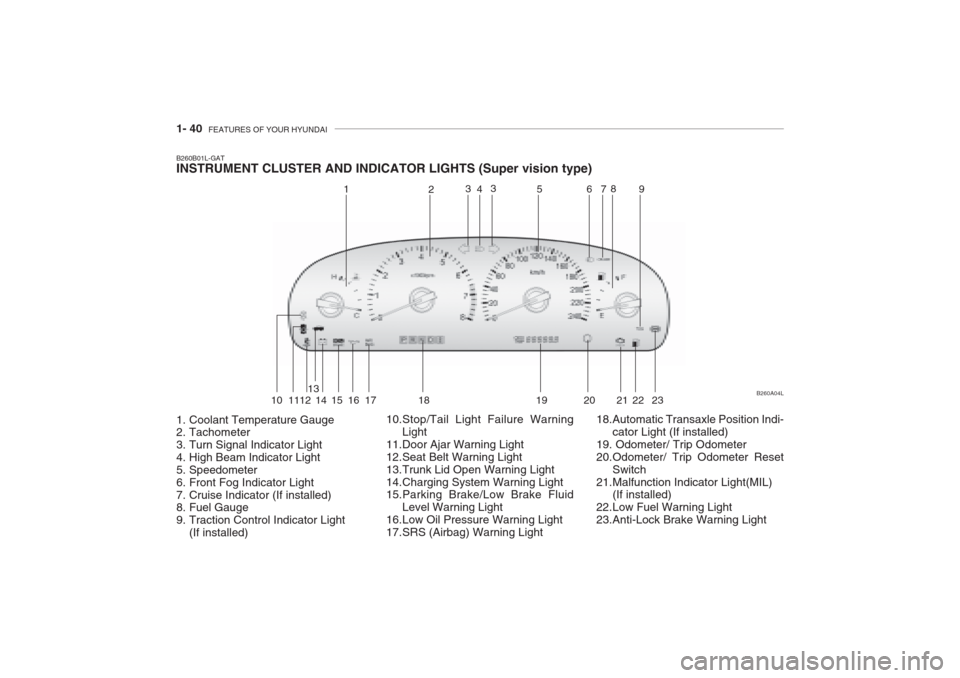
B260B01L-GAT INSTRUMENT CLUSTER AND INDICATOR LIGHTS (Super vision type)
1. Coolant Temperature Gauge
2. Tachometer
3. Turn Signal Indicator Light
4. High Beam Indicator Light
5. Speedometer
6. Front Fog Indicator Light
7. Cruise Indicator (If installed)
8. Fuel Gauge
9. Traction Control Indicator Light
(If installed) 10.Stop/Tail Light Failure Warning
Light
11.Door Ajar Warning Light
12.Seat Belt Warning Light
13.Trunk Lid Open Warning Light
14.Charging System Warning Light
15.Parking Brake/Low Brake Fluid Level Warning Light
16.Low Oil Pressure Warning Light
17.SRS (Airbag) Warning Light 18.Automatic Transaxle Position Indi-
cator Light (If installed)
19. Odometer/ Trip Odometer
20.Odometer/ Trip Odometer Reset Switch
21.Malfunction Indicator Light(MIL) (If installed)
22.Low Fuel Warning Light
23.Anti-Lock Brake Warning Light B260A04L
1
2
4
3 3
56 78
9
10 1112 13
14 15 16 17 18 19 20 21 22 23
Page 54 of 230
FEATURES OF YOUR HYUNDAI 1- 41
B260C02L-GAT
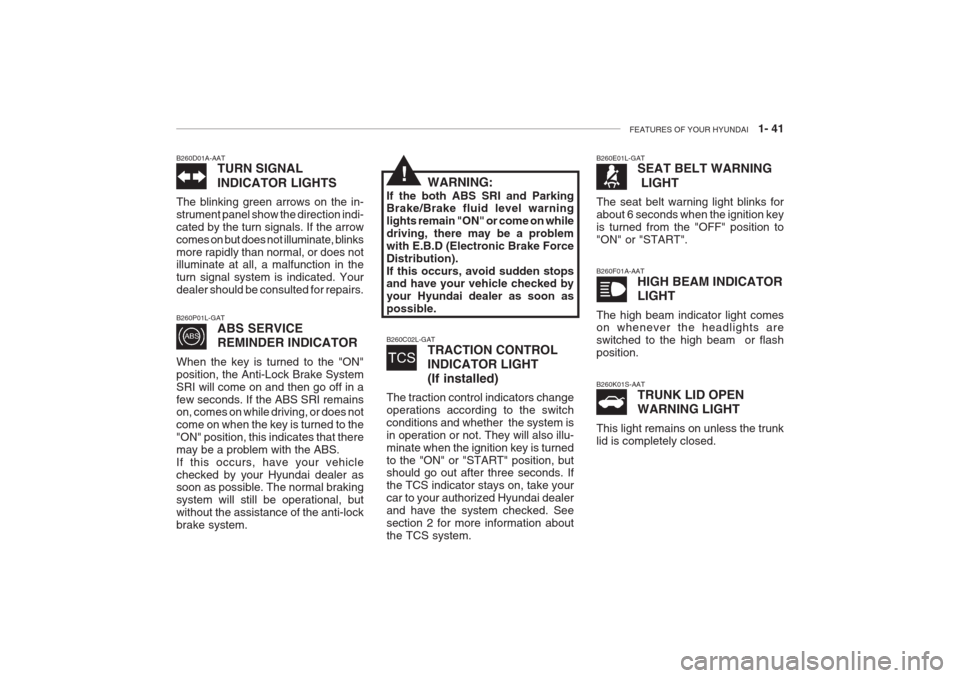
TRACTION CONTROL INDICATOR LIGHT(If installed)
The traction control indicators change operations according to the switchconditions and whether the system isin operation or not. They will also illu-minate when the ignition key is turnedto the "ON" or "START" position, but should go out after three seconds. If the TCS indicator stays on, take yourcar to your authorized Hyundai dealerand have the system checked. Seesection 2 for more information aboutthe TCS system.
B260D01A-AAT TURN SIGNAL INDICATOR LIGHTS
The blinking green arrows on the in- strument panel show the direction indi-cated by the turn signals. If the arrowcomes on but does not illuminate, blinksmore rapidly than normal, or does not illuminate at all, a malfunction in the turn signal system is indicated. Yourdealer should be consulted for repairs. B260F01A-AAT
HIGH BEAM INDICATOR LIGHT
The high beam indicator light comes on whenever the headlights are switched to the high beam or flashposition.
B260E01L-GAT
SEAT BELT WARNING LIGHT
The seat belt warning light blinks for about 6 seconds when the ignition keyis turned from the "OFF" position to"ON" or "START". B260K01S-AAT TRUNK LID OPEN WARNING LIGHT
This light remains on unless the trunk lid is completely closed.
B260P01L-GAT
ABS SERVICE REMINDER INDICATOR
When the key is turned to the "ON" position, the Anti-Lock Brake SystemSRI will come on and then go off in afew seconds. If the ABS SRI remains on, comes on while driving, or does not come on when the key is turned to the"ON" position, this indicates that theremay be a problem with the ABS.If this occurs, have your vehiclechecked by your Hyundai dealer as soon as possible. The normal braking system will still be operational, butwithout the assistance of the anti-lockbrake system. WARNING:
If the both ABS SRI and Parking Brake/Brake fluid level warning lights remain "ON" or come on whiledriving, there may be a problem
with E.B.D (Electronic Brake Force
Distribution).If this occurs, avoid sudden stops and have your vehicle checked by your Hyundai dealer as soon aspossible.
!
Page 55 of 230
1- 42 FEATURES OF YOUR HYUNDAI
B260A01B-GAT
FRONT FOG INDICATOR LIGHT
Front fog indicator light comes on when- ever the fog light switch is on. B260G01A-AAT LOW OIL PRESSURE WARNING LIGHT CAUTION:
If the oil pressure warning light stays on while the engine is run- ning, serious engine damage mayresult. The oil pressure warninglight comes on whenever there isinsufficient oil pressure. In normal operation, it should come on when the ignition switch is turned on,then go out when the engine isstarted. If the oil pressure warninglight stays on while the engine isrunning, there is a serious malfunc- tion. If this happens, stop the car assoon as it is safe to do so, turn offthe engine and check the oil level. Ifthe oil level is low, fill the engine oil to the proper level and start the engine again. If the light stays on with the engine running, turn theengine off immediately. In any in-stance where the oil light stays onwhen the engine is running, theengine should be checked by an authorized Hyundai dealer before the car is driven again.
!B260H01L-AAT
PARKING BRAKE/ LOW BRAKE FLUID
LEVEL WARNING LIGHT
WARNING:
If you suspect brake trouble, have your brakes checked by a Hyundai dealer as soon as possible. Drivingyour car with a problem in either thebrake electrical system or brakehydraulic system is dangerous, andcould result in a serious injury or death. Warning Light Operation The parking brake/brake fluid level warning light should come on when theparking brake is applied and the igni-tion switch is turned to "ON" or"START". After the engine is started, the light should go out when the park- ing brake is released.If the parking brake is not applied, thewarning light should come on for about3 seconds when the ignition switch isturned to "ON", and then go out. If the light comes on at any other time, you should slow the vehicle and bring it toa complete stop in a safe location offthe roadway.The brake fluid level warning light indi-cates that the brake fluid level in the brake master cylinder is low and hy- draulic brake fluid conforming to DOT3 or DOT 4 specifications should beadded. After adding fluid, if no othertrouble is found, the car should beimmediately and carefully driven to a Hyundai dealer for inspection. If fur- ther trouble is experienced, the vehicleshould not be driven at all but taken toa dealer by a professional towing ser-vice or some other safe method.
!
Page 139 of 230

2- 10 DRIVING YOUR HYUNDAI
C090H01L-GAT NOTE:
o For smooth and safe operation,
depress the brake pedal when shifting from "Neutral" positionor "Park" position to a forward orreverse gear.
o The ignition key must be in the "ON" position and the brake pedalfully depressed in order to movethe shift lever from the "P" (Park)position to any of the other posi-tions.
o It is always possible to shift from "R", "N", "D" position to "P" po-sition. The vehicle must be fullystopped to avoid transaxle dam-age. C090I01L-GAT
CAUTION:
o Shift into "R" and "P" position only when the vehicle has com-pletely stopped.
o Do not accelerate the engine in reverse or any of the forwardpositions with the brakes applied.
o Always apply the footbrake when
shifting from "P" or "N", to "R" or"D" position.
o Do not use the "P" (Park) posi- tion in place of the parking brake.Always set the parking brake,shift the transaxle into "P" (Park)position and turn off the ignitionwhen you leave the vehicle, evenmomentarily. Never leave the ve- hicle unattended while the en- gine is running.
o Check the automatic transaxle fluid level regularly, and add fluidas necessary.
o See the maintenance schedule for the proper fluid reco-mendation. C090N01Y-AAT Good Driving Practices
o Never move the gear selector lever
from "P" or "N" to any other position with the accelerator pedal de-pressed.
o Never move the gear selector lever into "P" when the vehicle is in mo-tion.
o Be sure the car is completely stopped
before you attempt to shift into "R".
o Never take the car out of gear and
coast down a hill. This may be ex- tremely hazardous. Always leave the car in gear when moving.
o Do not "ride" the brakes. This can cause them to overheat and mal-function. Instead, when you are driv-ing down a long hill, slow down and shift to a lower gear. When you do this, engine braking will help slowthe car.
o Slow down before shifting to a lower gear. Otherwise, the lower gear maynot be engaged.
o Always use the parking brake. Do
not depend on placing the transaxlein "P" to keep the car from moving.
!
Page 150 of 230

DRIVING YOUR HYUNDAI 2- 21
14.When going down a hill, shift into a
lower gear and use the engine brak- ing effect.When ascending a long grade,downshift the transaxle to a lower gear and reduce speed to reduce chances of engine overloading and/or overheating.
15.If you have to stop while going uphill, do not hold the vehicle inplace by pressing on the accelera- tor. This can cause the automatic transaxle to overheat. Use the park-ing brake or footbrake.
NOTE: When towing, check transaxle fluid more frequently.
CAUTION:
If overheating should occur whentowing, (temperature gauge readsnear red zone), taking the followingaction may reduce or eliminate theproblem.
get out of the other vehicle's airturbulence.
8. When parking your car and trailer,
especially on a hill, be sure to followall the normal precautions. Turn your front wheel into the curb, set the parking brake firmly, and putthe transaxle in 1st or Reverse(manual) or Park (automatic). Inaddition, place wheel chocks ateach of the trailer's tires.
9. If the trailer has electric brakes,
start your vehicle and trailer mov-ing, and then apply the trailer brakecontroller by hand to be sure thebrakes are working. This lets youcheck your electrical connection at the same time.
10.During your trip, check occasion- ally to be sure that the load is secure, and that the lights and anytrailer brakes are still working.
11.Avoid jerky starts, sudden accel- eration or sudden stops.
12.Avoid sharp turns and rapid lane changes.
13.Avoid holding the brake pedal down too long or too frequently. This couldcause the brakes to overheat, re- sulting in reduced braking efficien- cy. 1. Turn off the air conditioner.
2. Reduce highway speed.
3. Select a lower gear when going
uphill.
4. While in stop and go traffic, place the gear selector in park or neutraland idle the engine at a higher speed.
!
Page 154 of 230
3- 4 WHAT TO DO IN AN EMERGENCY
check for coolant leaking from the radiator, hoses or under the car. (Ifthe air conditioning had been in use,it is normal for cold water to bedraining from it when you stop).
WARNING:
While the engine is running, keephair, hands, and clothing away frommoving parts such as the fan anddrive belts to prevent injury.
5. If the water pump drive belt is bro- ken or engine coolant is leaking out, stop the engine immediately andcall the nearest Hyundai dealer forassistance.
WARNING:
Do not remove the radiator cap whenthe engine is hot. This can allowcoolant to be blown out of the open-ing and cause serious burns.
D030A01A-AAT IF THE ENGINE OVERHEATS If your temperature gauge indicates overheating, you experience a loss ofpower, or hear loud pinging or knock-ing, the engine is probably too hot. Ifthis happens to you, you should:
1. Pull off the road and stop as soon as
it is safe to do so.
2. Place the gear selector lever in "P" (automatic), or neutral (manual transaxle) and set the parking brake. If the air conditioning is on, turn it off.
3. If engine coolant is running out un- der the car or steam is coming outfrom the hood, stop the engine. Donot open the hood until the engine coolant has stopped running or the steaming has stopped. If there is novisible loss of coolant and no steam,leave the engine running and checkto be sure the engine cooling fan isoperating. If the fan is not running, turn the engine off.
4. Check to see if the water pump drive belt is missing. If it is not missing, check to see that it is tight. If thedrive belt seems to be satisfactory, 6. If you cannot find the cause of the
overheating, wait until the enginetemperature has returned to nor-mal. Then, if the engine coolant hasbeen lost, carefully remove the ra- diator cap and add engine coolant to bring the fluid level in the reservoirup to the halfway mark.
7. Proceed with caution, keeping alert for further signs of overheating. Ifoverheating happens again, call a Hyundai dealer for assistance.
CAUTION:
Serious loss of engine coolant indi- cates there is a leak in the coolingsystem and this should be checkedas soon as possible by a Hyundai dealer.
!
!
!