2002 Hyundai Grandeur belt
[x] Cancel search: beltPage 13 of 230
YOUR VEHICLE AT A GLANCE
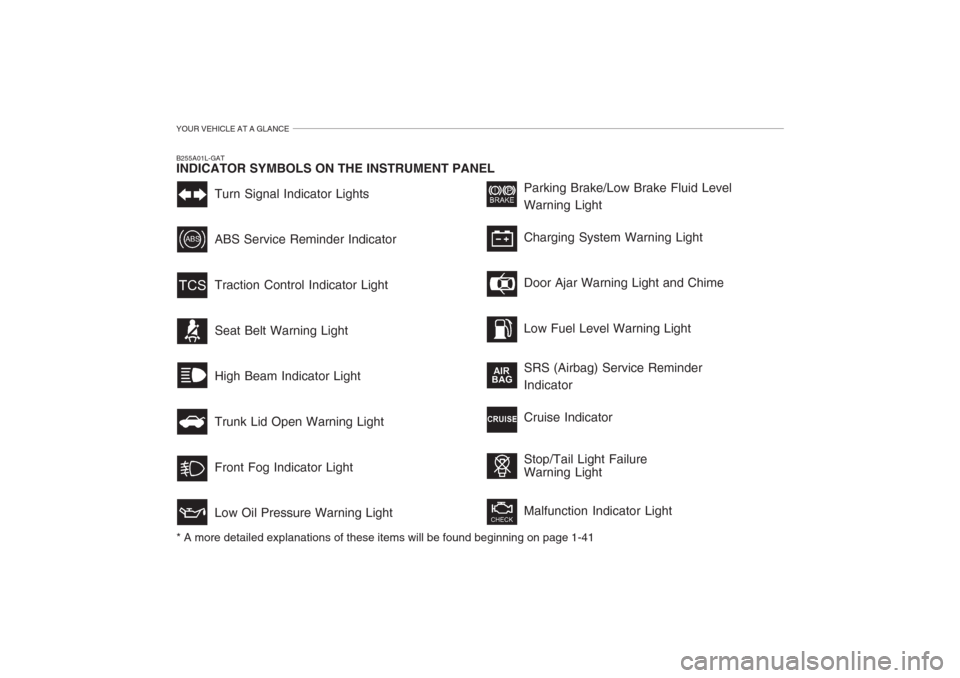
Turn Signal Indicator Lights ABS Service Reminder Indicator Traction Control Indicator LightSeat Belt Warning Light High Beam Indicator Light Trunk Lid Open Warning LightFront Fog Indicator Light Low Oil Pressure Warning LightParking Brake/Low Brake Fluid Level Warning Light Charging System Warning Light Door Ajar Warning Light and Chime Low Fuel Level Warning Light SRS (Airbag) Service Reminder Indicator Cruise Indicator Stop/Tail Light Failure Warning Light Malfunction Indicator Light
B255A01L-GAT INDICATOR SYMBOLS ON THE INSTRUMENT PANEL * A more detailed explanations of these items will be found beginning on page 1-41
Page 14 of 230
1. FEATURES OF YOUR HYUNDAI
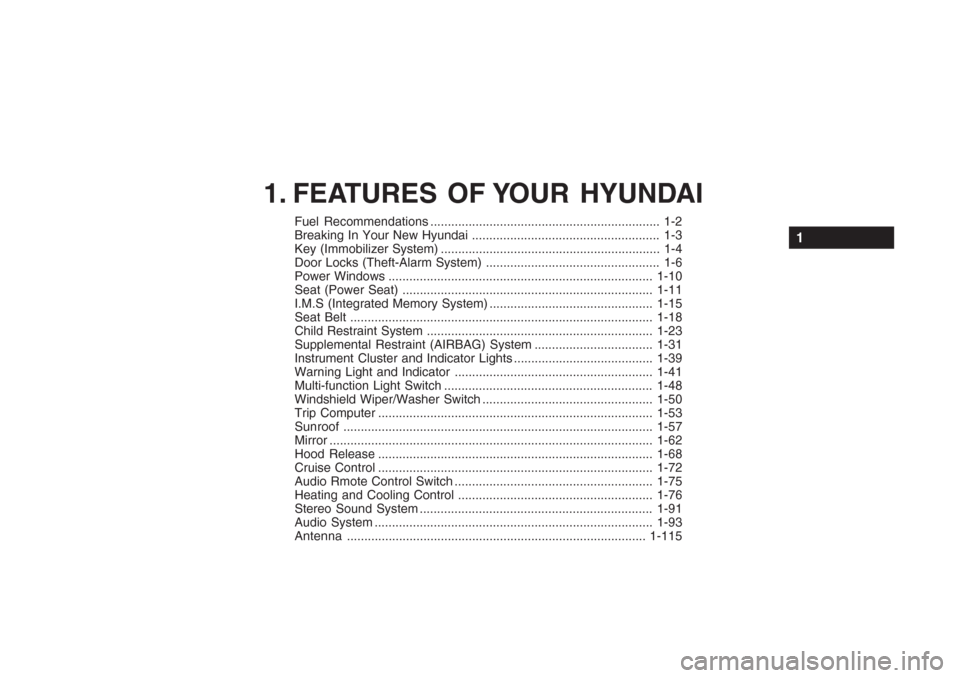
Fuel Recommendations .................................................................. 1-2
Breaking In Your New Hyundai ...................................................... 1-3
Key (Immobilizer System) ............................................................... 1-4
Door Locks (Theft-Alarm System) .................................................. 1-6
Power Windows ............................................................................1-10
Seat (Power Seat) ........................................................................ 1-11
I.M.S (Integrated Memory System) ............................................... 1-15
Seat Belt ....................................................................................... 1-18
Child Restraint System ................................................................. 1-23
Supplemental Restraint (AIRBAG) System .................................. 1-31
Instrument Cluster and Indicator Lights ........................................ 1-39
Warning Light and Indicator ......................................................... 1-41
Multi-function Light Switch ............................................................ 1-48
Windshield Wiper/Washer Switch .................................................1-50
Trip Computer ............................................................................... 1-53
Sunroof ......................................................................................... 1-57
Mirror ............................................................................................. 1-62
Hood Release ............................................................................... 1-68
Cruise Control ............................................................................... 1-72
Audio Rmote Control Switch ......................................................... 1-75
Heating and Cooling Control ........................................................ 1-76
Stereo Sound System ................................................................... 1-91
Audio Syste m ................................................................................ 1-93
Antenna ...................................................................................... 1-115
1
Page 19 of 230

1- 6 FEATURES OF YOUR HYUNDAI
UNLOCK
LOCK
HXG018
B040A01A-AAT DOOR LOCKS
B040B01A-AATLocking and unlocking front doors with a key
o The door can be locked or unlocked
with a key.
o Lock the door by turning the key toward the front of the vehicle and unlock it by turning the key towardthe rear.
!
B040C03L
B040C02Y-AAT Locking From the Outside The doors can be locked without a key. To lock the doors, first push the insidelock switch to the "LOCK" position, sothat the red mark on the switch is notvisible, then closed the door.The door will not lock if the key is left in the ignition switch when the front doors close. This is normal. NOTE:
o When locking the door this way,
be careful not to lock the door with the ignition key left in thevehicle.
WARNING:
o Unlocked doors can be danger- ous. Before you drive away (es-pecially if there are children inthe car), be sure that all the doorsare securely closed and lockedso that the doors cannot be inad- vertently opened from the inside. This helps ensure that the doorswill not be opened accidentally.Also, when combined with theproper use of seat belts, lockingthe doors helps keep occupants from being ejected from the car in case of an accident.
o Before opening the door, always
look for and avoid oncoming traf-fic.
Page 25 of 230

1- 12 FEATURES OF YOUR HYUNDAI
To move the seat toward the front or rear, pull the lock release lever up-ward. This will releases the seat on itstrack so you can move it forward orrearward to the desired position. When you find the position you want, release the lever and slide the seat forward orrearward on its track until it locks intothe desired position and cannot bemoved further.
HXG103
B080C01A-AAT Adjusting Seatback Angle
To recline the seatback, lean forward to take your weight off it, then pull upon the recliner control lever at theoutside edge of the seat. Now leanback until the desired seatback angle is achieved. To lock the seatback into position, release the recliner controllever.
WARNING:
To minimize risk of severe injury inthe event of a collision or a suddenstop, both the driver and passen- ger seatbacks should always be in an upright position while the ve-hicle is in motion. The protectionprovided by the seat belts andairbags in a frontal collision may bereduced significantly when the seatbacks are reclined. There is greater risk that the driver and pas-senger will slide under the beltwhich may result in serious injury ifa crash occurs when the seatbacksare reclined. The seat belt cannot provide full protection to an occupant if theseat back is reclined.
!
HXG200J
Lock Knob
B080D01L-GAT Adjustable Headrests Headrests are designed to help re- duce the risk of neck injuries.To raise the headrest, pull it up. Tolower it, push it down while pressingthe lock knob. If equipped with a hori- zontally adjustable type of headrest, pull on the top.
Page 28 of 230

FEATURES OF YOUR HYUNDAI 1- 15
B090E03L-GAT I.M.S (Integrated Memory Sys- tem) (If installed) Your vehicle is equipped with I.M.S on the left side of driver's door. Afteradjusting the position of the driver'sseat, outside rearview mirrors andsteering wheel column (if installed the steering wheel electric tilt and tele- scopic), use the I.M.S to memorizethem. Two different driving positionprofiles can be entered in the I.M.S. Ifyou turn the ignition key to the "ON"position, the memorized position is adjusted automatically. HXG212
HXG181
B090D01Y-AAT Adjusting Seatback Angle Rotate the upper portion of the control knob forward or backward to recline the seatback to the desired position. Release the control knob and then theseatback will remain in that position. WARNING:
To minimize the risk of personalinjury in the event of a collision ora sudden stop, both the driver'sand passenger's seatback should remain in an upright position while the car is in motion. The protectionprovided by the seat belts andairbags may be reduced signifi-cantly when the seatbacks are re-clined. There is a greater risk that the seat occupants will slide under the belt resulting in serious injuryif a crash occurs when the seatbacksare reclined. The seat belt cannotprovide full protection to an occu-pant if the seat back is reclined.
!
Page 31 of 230

1- 18 FEATURES OF YOUR HYUNDAI
FREE
LOCK
B120A01Y-GAT REAR SEATBACK SAFETY LOCK (If installed) If the rear seatback lock lever (located on the backside of the rear seatback)is in the "LOCK" position when the rearseatbacks are closed, it will not bepossible to fold the rear seatback byusing the release lock lever. In this instance, move the lock lever to the "FREE" position and fold the rearseatback. The rear seatback lock le-ver is designed to provide protectionfrom unauthorized entry into the trunk. B150B01Y-GAT Infant or Small Child Some countries require the use of child restraint systems for infants andsmall children. Whether this is requiredby law or not, it is strongly recom-mended that a child restraint seat or infant restraint system be used for infants or small children weighing lessthan 18 kilograms (40 pounds). NOTE: Small children are best protected in an accident when properly re- strained by a child restraint sys- tem.
B120A03L
B150A02A-GAT SEAT BELT PRECAUTIONS All occupants of the vehicle should wear their seat belts at all times. In-deed, your province's laws may re-quire that some or all occupants of thevehicle use seat belts. The possibility of injury or the severity of injury in an accident will be de-creased if this elementary safety pre-caution is observed. In addition, thefollowing recommendations are made:
WARNING:
The purpose of the folding rear seatbacks is to allow you to carrylonger objects than could other-wise be accommodated. Do not al-low passengers to sit on top of the folded down seatback. This could result in injury in case of an acci-dent or a sudden braking as this isnot a designated seating positionand seat belt restraint systems arenot accessible when the seatbacks are folded down. B110A02L!
Page 32 of 230

FEATURES OF YOUR HYUNDAI 1- 19
B150D01A-AAT Pregnant Women The use of a seat belt is recommended for pregnant women to lessen thechance of injury in an accident. Whena seat belt is used, the lap belt portionshould be placed as low and snugly as possible on the hips, not across the abdomen. For specific recommenda-tions, consult a physician.
B150C02A-AAT Larger Children Children who are too large for child restraint systems should always oc-cupy the rear seat and use the avail-able lap/shoulder belts. The lap por-tion should be fastened snug on the hips and as low as possible. Check belt fit periodically. A child's squirmingcould put the belt out of position. Chil-dren are afforded the most safety inthe event of an accident when they arerestrained by a proper restraint sys- tem in the rear seat. If a larger child (over age 13) must be seated in thefront seat, the child should be securelyrestrained by the available lap/shoul-der belt and the seat should be placedin the rear most position. Children un- der the age of 13 should be restrained securely in the rear seat. NEVER placea child under the age of 13 in the frontseat. NEVER place a rear facing childseat in the front seat of a vehicle.
B150F01A-AAT One Person Per Belt Two people (including children) should never attempt to use a single seat belt.this could increase the severity of inju- ries in case of an accident.B150G01A-AAT Do Not Lie Down To reduce the chance of injuries in the event of an accident, and to achievemaximum effectiveness of the restraintsystem, all passengers should be sit-ting up and the front seats should be in an upright position when the car is moving. A seat belt cannot provideproper protection if the person is lyingdown in the rear seat or if the front seatis in a reclined position.
B150E01A-AAT Injured Person A seat belt should be used when an injured person is being transported. When this is necessary, you should consult a physician for recommenda-tions. WARNING:
Sitting in a reclined position or ly-ing down when your vehicle is inmotion can be dangerous. Even ifyou buckle up, your seat belts can'tdo their job when you're reclined.The shoulder belt can't do its job because it won't be against your body. Instead, it will be in front ofyou. In a crash you could go into it,receiving serious neck or other in-juries.The lap belt can't do its job either. In a crash the belt could go up over your abdomen. The belt forceswould be applied there, not at yourstrong pelvic bones.
!
Page 33 of 230

1- 20 FEATURES OF YOUR HYUNDAI
You can adjust the height of the shoul- der belt anchor to one of the 4 positionsfor maximum comfort and safety. If the height of the adjusting seat belt is too near your neck, you will not begetting the most effective protection.The shoulder portion should be ad-justed so that it lies across your chestand midway over your shoulder near- est the door and not your neck. To adjust the height of the seat beltanchor, lower or raise the height ad-juster into an appropriate position. Toraise the height adjuster, pull it up. Tolower it, push it down while pressing the height adjuster button. B170A01L
B170A01L-GAT HEIGHT ADJUSTABLE FRONT SEAT SHOULDER BELT
B160C01A-AAT Keep Belts Clean and Dry Seat belts should be kept clean and dry. If belts become dirty, they can becleaned by using a mild soap solutionand warm water. Bleach, dye, strongdetergents or abrasives should not be used because they may damage and weaken the fabric. B160D01A-AAT When to Replace Seat Belts Entire in-use seat belt assembly or assemblies should be replaced if the vehicle has been involved in an acci- dent. This should be done even if nodamage is visible. Additional ques-tions concerning seat belt operationshould be directed to your HyundaiDealer.
B160A01A-AAT CARE OF SEAT BELTS Seat belt systems should never be disassembled or modified. In addition,care should be taken to assure thatseat belts and belt hardware are notdamaged by seat hinges, doors orother abuse.
This could cause serious internalinjuries. For proper protection when the ve- hicle is in motion, have the seatbackupright. Then sit back in the seatand wear your seat belt properly.See page 1-21
B160B01A-AAT Periodic Inspection It is recommended that all seat belts be inspected periodically for wear ordamage of any kind. Parts of the sys-tem that are damaged should be re-placed as soon as possible.
WARNING:
When you return the rear seatback to its upright position after the rear seatback was folded down, be care- ful not to damage the seat belt web-bing or buckle. Be sure that thewebbing or buckle does not getcaught or pinched in the rear seat.!