2002 Hyundai Atos maintenance schedule
[x] Cancel search: maintenance schedulePage 106 of 249
DO-IT-YOURSELF MAINTENANCE
DO-IT-YOURSELF MAINTENANCE DO-IT-YOURSELF MAINTENANCE
DO-IT-YOURSELF MAINTENANCE
DO-IT-YOURSELF MAINTENANCE
6-10 G110A01A-AAT
CHECKING THE TRANSAXLE FLUID
CHECKING THE TRANSAXLE FLUID CHECKING THE TRANSAXLE FLUID
CHECKING THE TRANSAXLE FLUID
CHECKING THE TRANSAXLE FLUID
(AUTOMATIC)
(AUTOMATIC) (AUTOMATIC)
(AUTOMATIC)
(AUTOMATIC)
Transaxle fluid in the automatic transaxle should be checked at those intervals specified in thevehicle maintenance schedule in Section 5. G110B01X-AAT
Recommended Fluid
Recommended Fluid Recommended Fluid
Recommended Fluid
Recommended Fluid Your Hyundai automatic transaxle is specially designed to operate with ESSO JWS3314. Dam-age caused by a nonspecified fluid is not cov-ered by your new vehicle limited warranty. G110C01X-GAT
Transaxle Fluid Capacity
Transaxle Fluid Capacity Transaxle Fluid Capacity
Transaxle Fluid Capacity
Transaxle Fluid Capacity
The fluid capacity of the automatic transaxle is
5.2 liters (5.48 U.S. quarts).
WARNING:
WARNING: WARNING:
WARNING:
WARNING:
The transaxle fluid level should be checked
The transaxle fluid level should be checked The transaxle fluid level should be checked
The transaxle fluid level should be checked
The transaxle fluid level should be checked
when the engine
when the engine when the engine
when the engine
when the engine is at normal operating tem-
is at normal operating tem- is at normal operating tem-
is at normal operating tem-
is at normal operating tem-
perature. This means that the engine, radia-
perature. This means that the engine, radia- perature. This means that the engine, radia-
perature. This means that the engine, radia-
perature. This means that the engine, radia-
tor, tor,
tor, tor,
tor, exhaust system etc., are very hot. Exer-
exhaust system etc., are very hot. Exer- exhaust system etc., are very hot. Exer-
exhaust system etc., are very hot. Exer-
exhaust system etc., are very hot. Exer-
cise great care not to burn yourself
cise great care not to burn yourself cise great care not to burn yourself
cise great care not to burn yourself
cise great care not to burn yourself during
during during
during
during
this procedure.
this procedure. this procedure.
this procedure.
this procedure.
G100A04X-GAT
CHECKING THE TRANSAXLE OIL
CHECKING THE TRANSAXLE OIL CHECKING THE TRANSAXLE OIL
CHECKING THE TRANSAXLE OIL
CHECKING THE TRANSAXLE OIL
(MANUAL)
(MANUAL) (MANUAL)
(MANUAL)
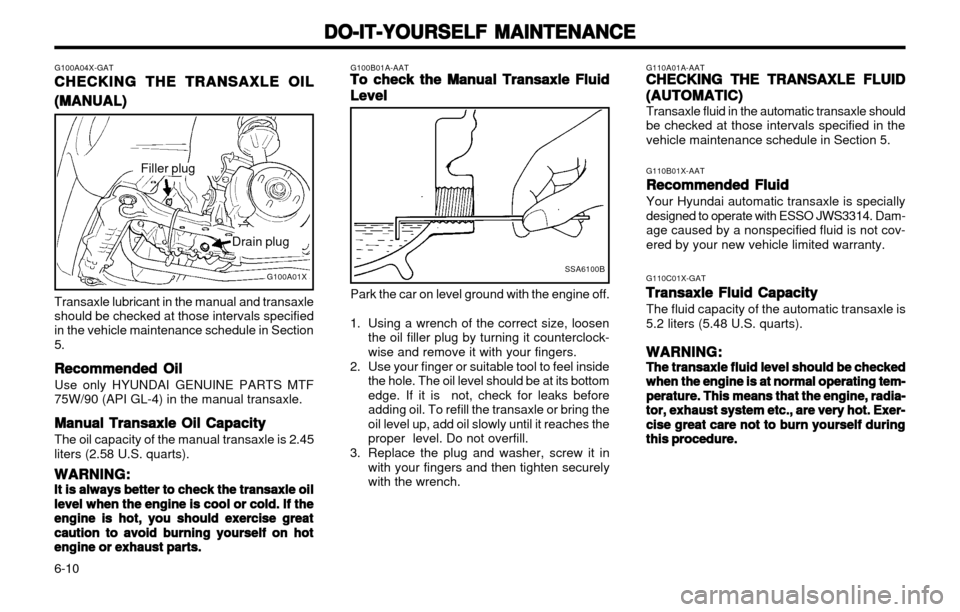
(MANUAL) Transaxle lubricant in the manual and transaxle should be checked at those intervals specified in the vehicle maintenance schedule in Section5.
Recommended Oil
Recommended Oil Recommended Oil
Recommended Oil
Recommended Oil Use only HYUNDAI GENUINE PARTS MTF 75W/90 (API GL-4) in the manual transaxle.
Manual Transaxle Oil Capacity
Manual Transaxle Oil Capacity Manual Transaxle Oil Capacity
Manual Transaxle Oil Capacity
Manual Transaxle Oil Capacity The oil capacity of the manual transaxle is 2.45 liters (2.58 U.S. quarts).
WARNING:
WARNING: WARNING:
WARNING:
WARNING:
It is always better to check the transaxle oil
It is always better to check the transaxle oil It is always better to check the transaxle oil
It is always better to check the transaxle oil
It is always better to check the transaxle oil
level when the
level when the level when the
level when the
level when the engine is cool or cold. If the
engine is cool or cold. If the engine is cool or cold. If the
engine is cool or cold. If the
engine is cool or cold. If the
engine is hot, you should exercise great
engine is hot, you should exercise great engine is hot, you should exercise great
engine is hot, you should exercise great
engine is hot, you should exercise great
caution
caution caution
caution
caution to avoid burning yourself on hot
to avoid burning yourself on hot to avoid burning yourself on hot
to avoid burning yourself on hot
to avoid burning yourself on hot
engine or exhaust parts.
engine or exhaust parts. engine or exhaust parts.
engine or exhaust parts.
engine or exhaust parts. G100B01A-AAT
To check the Manual Transaxle Fluid
To check the Manual Transaxle Fluid To check the Manual Transaxle Fluid
To check the Manual Transaxle Fluid
To check the Manual Transaxle Fluid
Level
Level Level
Level
Level
SSA6100B
Park the car on level ground with the engine off.
1. Using a wrench of the correct size, loosen the oil filler plug by turning it counterclock- wise and remove it with your fingers.
2. Use your finger or suitable tool to feel inside the hole. The oil level should be at its bottomedge. If it is not, check for leaks beforeadding oil. To refill the transaxle or bring theoil level up, add oil slowly until it reaches theproper level. Do not overfill.
3. Replace the plug and washer, screw it in with your fingers and then tighten securelywith the wrench.
G100A01X
Filler plug
Drain plug
Page 107 of 249
DO-IT-YOURSELF MAINTENANCE
DO-IT-YOURSELF MAINTENANCE DO-IT-YOURSELF MAINTENANCE
DO-IT-YOURSELF MAINTENANCE
DO-IT-YOURSELF MAINTENANCE
6-11
WARNING:
WARNING: WARNING:
WARNING:
WARNING:
The cooling fan is controlled by engine cool-
The cooling fan is controlled by engine cool- The cooling fan is controlled by engine cool-
The cooling fan is controlled by engine cool-
The cooling fan is controlled by engine cool- ant temperature and may sometimes oper-
ant temperature and may sometimes oper- ant temperature and may sometimes oper-
ant temperature and may sometimes oper-
ant temperature and may sometimes oper-
ate even when the engine is not running.
ate even when the engine is not running. ate even when the engine is not running.
ate even when the engine is not running.
ate even when the engine is not running.
Use extreme caution when working near the
Use extreme caution when working near the Use extreme caution when working near the
Use extreme caution when working near the
Use extreme caution when working near the
blades of the cooling fan, so that you are not
blades of the cooling fan, so that you are not blades of the cooling fan, so that you are not
blades of the cooling fan, so that you are not
blades of the cooling fan, so that you are not
injured by a rotating fan blade. As the en-
injured by a rotating fan blade. As the en- injured by a rotating fan blade. As the en-
injured by a rotating fan blade. As the en-
injured by a rotating fan blade. As the en-
gine coolant temperature decreases, the fan
gine coolant temperature decreases, the fan gine coolant temperature decreases, the fan
gine coolant temperature decreases, the fan
gine coolant temperature decreases, the fan
will automatically shut off. This is a normal
will automatically shut off. This is a normal will automatically shut off. This is a normal
will automatically shut off. This is a normal
will automatically shut off. This is a normal
condition.
condition. condition.
condition.
condition.
G120C02A-AATRecommended Brake Fluid
Recommended Brake Fluid Recommended Brake Fluid
Recommended Brake Fluid
Recommended Brake Fluid
Use only hydraulic brake fluid conforming to
DOT 3 or DOT 4 specifications in your braking G120A01A-AAT
CHECKING THE BRAKES
CHECKING THE BRAKES CHECKING THE BRAKES
CHECKING THE BRAKES
CHECKING THE BRAKES
CAUTION:
CAUTION: CAUTION:
CAUTION:
CAUTION:
Because brakes are essential to the safe
Because brakes are essential to the safe Because brakes are essential to the safe
Because brakes are essential to the safe
Because brakes are essential to the safeoperation of the car, it is suggested that
operation of the car, it is suggested that operation of the car, it is suggested that
operation of the car, it is suggested that
operation of the car, it is suggested that
they be checked and inspected by your
they be checked and inspected by your they be checked and inspected by your
they be checked and inspected by your
they be checked and inspected by your
Hyundai dealer. The brakes should be
Hyundai dealer. The brakes should be Hyundai dealer. The brakes should be
Hyundai dealer. The brakes should be
Hyundai dealer. The brakes should be
checked and inspected for wear at those
checked and inspected for wear at those checked and inspected for wear at those
checked and inspected for wear at those
checked and inspected for wear at those
intervals specified in the vehicle mainte-
intervals specified in the vehicle mainte- intervals specified in the vehicle mainte-
intervals specified in the vehicle mainte-
intervals specified in the vehicle mainte-
nance schedule in Section 5.
nance schedule in Section 5. nance schedule in Section 5.
nance schedule in Section 5.
nance schedule in Section 5.
G120B01A-AATChecking the Brake Fluid Level
Checking the Brake Fluid Level Checking the Brake Fluid Level
Checking the Brake Fluid Level
Checking the Brake Fluid Level
WARNING:
WARNING: WARNING:
WARNING:
WARNING:
Use caution when handling brake fluid. It
Use caution when handling brake fluid. It Use caution when handling brake fluid. It
Use caution when handling brake fluid. It
Use caution when handling brake fluid. Itcan damage your vision if it gets into your
can damage your vision if it gets into your can damage your vision if it gets into your
can damage your vision if it gets into your
can damage your vision if it gets into your
eyes. It will also damage your vehicle's paint
eyes. It will also damage your vehicle's paint eyes. It will also damage your vehicle's paint
eyes. It will also damage your vehicle's paint
eyes. It will also damage your vehicle's paint
if spilled on it and not removed immediately.
if spilled on it and not removed immediately. if spilled on it and not removed immediately.
if spilled on it and not removed immediately.
if spilled on it and not removed immediately.
G110D02A-GAT
To Check the Automatic Transaxle Fluid
To Check the Automatic Transaxle Fluid To Check the Automatic Transaxle Fluid
To Check the Automatic Transaxle Fluid
To Check the Automatic Transaxle Fluid
Level
Level Level
Level
Level
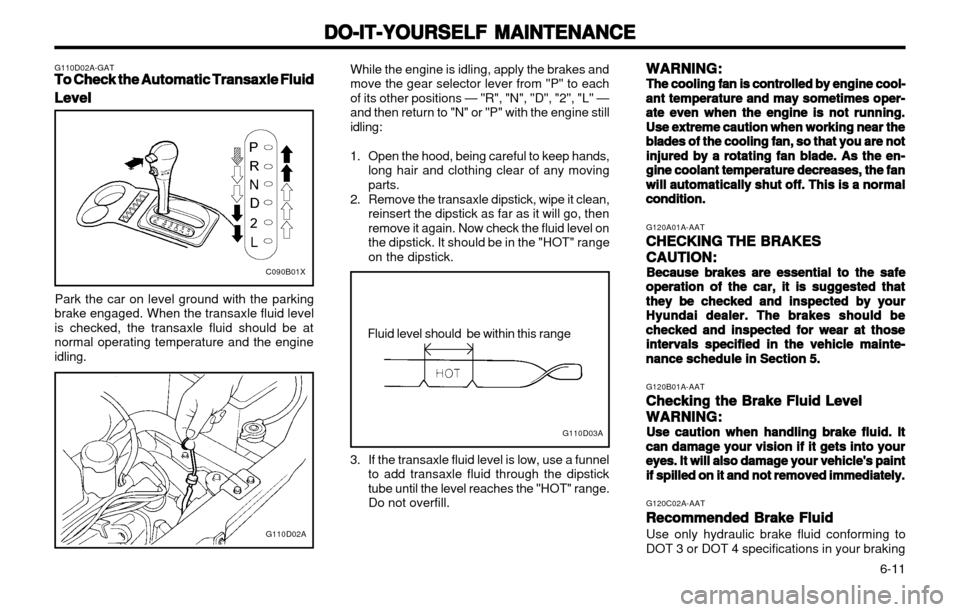
Park the car on level ground with the parking
brake engaged. When the transaxle fluid level is checked, the transaxle fluid should be atnormal operating temperature and the engineidling. While the engine is idling, apply the brakes andmove the gear selector lever from "P" to eachof its other positions — "R", "N", "D", "2", "L" —and then return to "N" or "P" with the engine stillidling:
1. Open the hood, being careful to keep hands,
long hair and clothing clear of any moving parts.
2. Remove the transaxle dipstick, wipe it clean, reinsert the dipstick as far as it will go, thenremove it again. Now check the fluid level onthe dipstick. It should be in the "HOT" rangeon the dipstick.
Fluid level should be within this range
3. If the transaxle fluid level is low, use a funnel to add transaxle fluid through the dipsticktube until the level reaches the "HOT" range.Do not overfill.
C090B01X
G110D02A
G110D03A
Page 113 of 249

DO-IT-YOURSELF MAINTENANCE
DO-IT-YOURSELF MAINTENANCE DO-IT-YOURSELF MAINTENANCE
DO-IT-YOURSELF MAINTENANCE
DO-IT-YOURSELF MAINTENANCE
6-17
G270A02X-GAT
HEADLIGHT BULB
HEADLIGHT BULB HEADLIGHT BULB
HEADLIGHT BULB
HEADLIGHT BULB
Replacement instructions:
1. Allow the bulb to cool. Wear eye protection.
2. Always grasp the bulb by its base, avoid touching the glass.
3. Disconnect the connector, then remove the dust cover.
4. Push the bulb spring for removing the head- light bulb.
5. Remove the headlight bulb. If the bulb is burned out, replace it with the same watt- age.
6. Installation is the reverse order of the re- moval.
7. Use the protective cap and carton to promptly dispose of the old bulb.
8. Check for proper headlight aim. WARNING:
WARNING: WARNING:
WARNING:
WARNING:
The halogen bulb contains gas under pres-
The halogen bulb contains gas under pres- The halogen bulb contains gas under pres-
The halogen bulb contains gas under pres-
The halogen bulb contains gas under pres- sure and if impacted
sure and if impacted sure and if impacted
sure and if impacted
sure and if impacted
could shatter, and re-
could shatter, and re- could shatter, and re-
could shatter, and re-
could shatter, and re-
sulting in flying fragments. Always wear eye
sulting in flying fragments. Always wear eye sulting in flying fragments. Always wear eye
sulting in flying fragments. Always wear eye
sulting in flying fragments. Always wear eye
protection
protection protection
protection
protection
when servicing the bulb. Protect
when servicing the bulb. Protect when servicing the bulb. Protect
when servicing the bulb. Protect
when servicing the bulb. Protect
the bulb against abrasions or scratches and
the bulb against abrasions or scratches and the bulb against abrasions or scratches and
the bulb against abrasions or scratches and
the bulb against abrasions or scratches and
against liquids when lighted. Turn the bulb
against liquids when lighted. Turn the bulb against liquids when lighted. Turn the bulb
against liquids when lighted. Turn the bulb
against liquids when lighted. Turn the bulb
on only when installed in a headlight. Re-
on only when installed in a headlight. Re- on only when installed in a headlight. Re-
on only when installed in a headlight. Re-
on only when installed in a headlight. Re-
place the headlight if damaged or cracked.
place the headlight if damaged or cracked. place the headlight if damaged or cracked.
place the headlight if damaged or cracked.
place the headlight if damaged or cracked.
Keep the bulb out of the reach
Keep the bulb out of the reach Keep the bulb out of the reach
Keep the bulb out of the reach
Keep the bulb out of the reach
of children
of children of children
of children
of children
and dispose of the used bulb with care.
and dispose of the used bulb with care. and dispose of the used bulb with care.
and dispose of the used bulb with care.
and dispose of the used bulb with care. G290A02X-GAT
HEADLIGHT AIMING ADJUSTMENT
HEADLIGHT AIMING ADJUSTMENT HEADLIGHT AIMING ADJUSTMENT
HEADLIGHT AIMING ADJUSTMENT
HEADLIGHT AIMING ADJUSTMENT Before performing aiming adjustment, make sure of the following.
1. Keep all tires inflated to the correct pres-
sure.
2. Place the vehicle on level ground and press the front bumper & rear bumper down sev- eral times. Place the vehicle at a distance of3,000 mm (118 in.) from the test wall.
3. See that the vehicle is unloaded (except for full levels of coolant, engine oil and fuel, andspare tire, jack, and tools). Have the driveror equivalent weight placed in driver's seat.
Recommended Fluid
Recommended Fluid Recommended Fluid
Recommended Fluid
Recommended Fluid
Use PSF-3 type fluid.
NOTE:
NOTE: NOTE:
NOTE:
NOTE:
Do not start the engine when the power
Do not start the engine when the power Do not start the engine when the power
Do not start the engine when the power
Do not start the engine when the power steering oil reservoir is empty.
steering oil reservoir is empty. steering oil reservoir is empty.
steering oil reservoir is empty.
steering oil reservoir is empty.
G240A01A-AATPOWER STEERING HOSES
POWER STEERING HOSES POWER STEERING HOSES
POWER STEERING HOSES
POWER STEERING HOSES
It is suggested that you check the power steer-
ing hose connections for fluid leakage at those intervals specified in the vehicle maintenanceschedule in Section 5.
The power steering hoses should be replaced if
there is severe surface cracking, pulling, scuff-ing or worn spots. Deterioration of the hosecould cause premature failure.
G260A03A-AATREPLACING HEADLIGHT BULBS
REPLACING HEADLIGHT BULBS REPLACING HEADLIGHT BULBS
REPLACING HEADLIGHT BULBS
REPLACING HEADLIGHT BULBS
Before attempting to replace a headlight bulb,
be sure the switch is turned to the "OFF"position.
The next paragraph shows how to reach head-
light bulbs so they may be changed. Be sure toreplace the burned-out bulb with one of thesame number and wattage rating.
CAUTION:
CAUTION: CAUTION:
CAUTION:
CAUTION:
Keep the lamps out of contact with petro-
Keep the lamps out of contact with petro- Keep the lamps out of contact with petro-
Keep the lamps out of contact with petro-
Keep the lamps out of contact with petro- leum product, such as oil, gasoline, etc.
leum product, such as oil, gasoline, etc. leum product, such as oil, gasoline, etc.
leum product, such as oil, gasoline, etc.
leum product, such as oil, gasoline, etc.
G270A01X
Page 117 of 249
EMISSION CONTROL SYSTEMS
EMISSION CONTROL SYSTEMS EMISSION CONTROL SYSTEMS
EMISSION CONTROL SYSTEMS
EMISSION CONTROL SYSTEMS
7-1
7.7.
7.7.
7.
EMISSION CON-
EMISSION CON- EMISSION CON-
EMISSION CON-
EMISSION CON-
TR
TR TR
TR
TR
OL SYSTEMS
OL SYSTEMS OL SYSTEMS
OL SYSTEMS
OL SYSTEMS
H010A01A-GAT EMISSION CONTROL SYSTEM
EMISSION CONTROL SYSTEM EMISSION CONTROL SYSTEM
EMISSION CONTROL SYSTEM
EMISSION CONTROL SYSTEM
(If Installed)
(If Installed) (If Installed)
(If Installed)
(If Installed)
Your Hyundai is equipped with an emission
control system to meet all requirements of the Emission prohibition rules of your province. There are three emission control systems which
are as follows.
1) Crankcase emission control system
2) Evaporative emission control system
3) Exhaust emission control system In order to assure the proper function of the
emission control systems, it is recommended that you have your car inspected and main-tained by an authorized Hyundai dealer in ac-cordance with the maintenance schedule in thismanual. the crankcase through the air intake hose.Inside the crankcase, the fresh air mixes withblow-by gases, which then pass through thePCV valve and into the induction system.
H010C02A-GAT2.2.
2.2.
2. Evaporative Emission Control
Evaporative Emission Control Evaporative Emission Control
Evaporative Emission Control
Evaporative Emission Control
System (If installed)
System (If installed) System (If installed)
System (If installed)
System (If installed)
The Evaporative Emission Control System is
designed to prevent fuel vapors from escapinginto the atmosphere.
Canister
Canister Canister
Canister
Canister
While the engine is inoperative, fuel vapors
generated inside the fuel tank are absorbed andstored in the onboard canister. When the en-gine is running, the fuel vapors absorbed in thecanister are drawn into the induction systemthrough
the purge control solenoid valve.
Purge Control Solenoid Valve
Purge Control Solenoid Valve Purge Control Solenoid Valve
Purge Control Solenoid Valve
Purge Control Solenoid Valve
The purge control solenoid valve is controlled
by the ECM; when the engine coolant temper-ature is low, and during idling, it closes, so thatevaporated fuel is not taken into the engine.After engine warm-up, during ordinary driving, itopens so as to introduce evaporated fuel to theengine.
H010B01A-AAT
1.1.
1.1.
1.
Crankcase Emission Control Sys-
Crankcase Emission Control Sys- Crankcase Emission Control Sys-
Crankcase Emission Control Sys-
Crankcase Emission Control Sys-
tem
tem tem
tem
tem
The Positive Crankcase Ventilation System is
employed to prevent air pollution caused byblow-by gases being emitted from the crank-case. This system supplies fresh filtered air to H010D01A-AAT
3. Exhaust Emission Control System
3. Exhaust Emission Control System 3. Exhaust Emission Control System
3. Exhaust Emission Control System
3. Exhaust Emission Control System
The exhaust emission control system is a high-
ly effective system which controls exhaust emis-sion while maintaining good vehicle perfor-mance.
H020A01A-GATCATALYTIC CONVERTER
CATALYTIC CONVERTER CATALYTIC CONVERTER
CATALYTIC CONVERTER
CATALYTIC CONVERTER
(If Installed)
(If Installed) (If Installed)
(If Installed)
(If Installed)
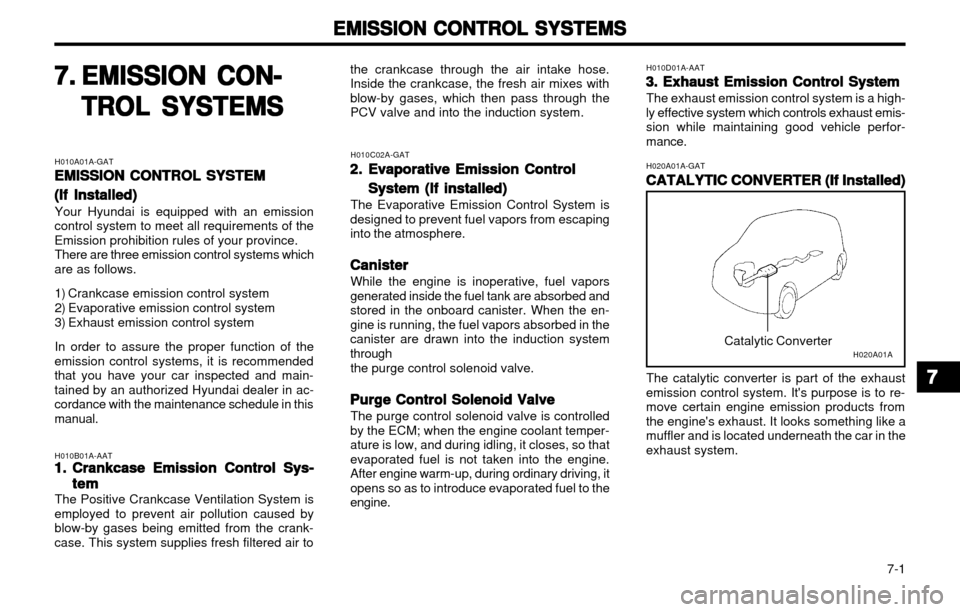
The catalytic converter is part of the exhaust
emission control system. It's purpose is to re-move certain engine emission products from
the engine's exhaust. It looks something like amuffler and is located underneath the car in theexhaust system. Catalytic Converter
H020A01A
77
77
7
Page 127 of 249

INDEX
INDEX INDEX
INDEX
INDEX
10-3
Adjustable height ........................................................................... 1-9
Adjusting your seat belt ...............................................................
1-10
Care of seat belts .......................................................................... 1-8
Precautions .................................................................................... 1-7
Spark Plugs ............................................................................... 6-7 ~ 6-8 Speedometer ..................................................................................... 1-22
Starting Procedure .............................................................................. 2-3
Steering Wheel Free play ................................................................. 6-13
Stereo Radio Operation (H922M) .......................................... 1-47 ~ 1-48
Stereo Radio Operation (HMR90) ......................................... 1-42 ~ 1-43
Stereo Sound System ............................................................ 1-40 ~ 1-41
Sun Visor .......................................................................................... 1-32
TT
TT
T Tail Gate
Open ............................................................................................ 1-30
Remote release ............................................................................ 1-30
Tires
Balancing ....................................................................................... 8-3
Chains ............................................................................................ 8-2
Changing a flat tire ........................................................................ 3-4
If you have a flat tire ...................................................................... 3-3Information ..................................................................................... 8-1
Pressure ........................................................................................ 8-1 Replacement .................................................................................. 8-3
Rotation .......................................................................................... 8-2
Snow tires ...................................................................................... 8-2
Spare tire ....................................................................................... 3-3
Traction .......................................................................................... 8-3
MM
MM
MMaintenance Intervals
Explanation of scheduled maintenance items ...................... 5-5 ~ 5-7
Maintenance under severe usage conditions ................................ 5-4
Scheduled maintenance ................................................................. 5-2
Service requirements ..................................................................... 5-1
Mirrors Day-night inside rearview ............................................................ 1-28
Outside rear view ........................................................................ 1-27
OO
OO
OOdometer .......................................................................................... 1-23
PP
PP
P
Parking Brake ................................................................................... 1-28
Power Steering Fluid Level .................................................... 6-16 ~ 6-17
Pretensioner Seat Belt ...................................................................... 1-13
RR
RR
RRear Seat
Fold down .................................................................................... 1-29
Rear Window Defroster Switch ......................................................... 1-26
Rear Window Wiper and Washer ..................................................... 1-25
Roof Rack ......................................................................................... 1-33
SS
SS
SSeat Belts
2-Point static type ............................................................. 1-10 ~ 1-11
3-Point type ......................................................................... 1-9 ~ 1-10
Page 132 of 249
A020A01A-EATResponsibilty For Maintenance
It is the responsibility of the vehicle owner/driver to ensure that all routine maintenance services are undertaken in line with the recommendations specifiedin Section 5 of this manual. In addition, in order to ensure continued validity ofthe new vehicle warranty and safe operation of the vehicle, non scheduledmaintenance/running repairs should be undertaken at the earliest availableopportunity. Under severe operating conditions, more frequent maintenance isrequired. Details of the maintenance schedule for such conditions are also givenin section 5.It is recommended that all maintenance operations and repairs are entrusted toa franchised Hyundai dealer to ensure that the latest repair methods, specializedtooling and genuine Hyundai parts are used to ensure the continued reliabilityand safety of the vehicle.
Page 197 of 249
DRIVING YOUR HYUNDAI
2- 8 in emergency situations or on slick roads, ABS will increase vehicle control during braking. NOTE: During ABS operation, a slight pulsation may be felt in the brake pedal when thebrakes are applied. Also, a noise may beheard in the engine compartment while brak-ing. These conditions are normal and indi-cate that the anti-lock brake system is func-tioning properly. WARNING: Your ABS will not prevent accidents due to improper or dangerous driving maneuvers.Even though vehicle control is improvedduring emergency braking, always maintaina safe distance between you and objectsahead. Vehicle speeds should always bereduced during extreme road conditions.The braking distance for cars equipped withan anti-lock braking system may be longerthan for those without it in the followingroad conditions.
o Driving on rough, gravel or snow-cov- ered roads.
o Driving with tire chains installed.
o Driving on roads where the road surface is pitted or has different surface height.
These roads should be driven at reduced speeds. The safety features of an ABSequipped vehicle should not be tested by high speed driving or cornering. This couldendanger the safety of yourself or others.
unnecessary tire wear. Check the tire pres-sures at least once a month.
o Be sure that the wheels are aligned cor- rectly. Improper alignment can result fromhitting curbs or driving too fast over irregularsurfaces. Poor alignment causes faster tirewear and may also result in other problemsas well as greater fuel consumption.
o Keep your car in good condition. For better fuel economy and reduced maintenancecosts, maintain your car in accordance withthe maintenance schedule in Section 5. Ifyou drive your car in severe conditions,more frequent maintenance is required (seeSection 5 for details).
o Keep your car clean. For maximum service, your car should be kept clean and free ofcorrosive materials. It is especially impor-tant that mud, dirt, ice, etc. not be allowed toaccumulate on the underside of the car. Thisextra weight can result in increased fuelconsumption and also contribute to corro-sion.
o Travel lightly. Don’t carry unnecessary weight in your car. Weight is an enemy of good fueleconomy.
o Don’t let the engine idle longer than neces- sary. If you are waiting (and not in traffic),turn off your engine and restart only whenyou’re ready to go.
o Remember, your car does not require ex- tended warm-up. As soon as the engine isrunning smoothly, you can drive away. Invery cold weather, however, give your en-gine a slightly longer warm-up period.
SC150A1-F
DRIVING FOR ECONOMY You can save fuel and get more miles from yourcar if you follow these suggestions:
o Drive smoothly. Accelerate at a moderate rate. Don’t make "jack-rabbit" starts or full-throttle shifts and maintain a steady cruisingspeed. Don’t race between stoplights. Try toadjust your speed to that of the other trafficso you don’t have to change speeds unnec-essarily. Avoid heavy traffic whenever possible. Al- ways maintain a safe distance from othervehicles so you can avoid unnecessary brak-ing. This also reduces brake wear.
o Drive at a moderate speed. The faster you drive, the more fuel your car uses. Driving ata moderate speed, especially on the high-way, is one of the most effective ways toreduce fuel consumption.
o Don’t "ride" the brake or clutch pedal. This can increase fuel consumption and alsoincrease wear on these components. In ad-dition, driving with your foot resting on thebrake pedal may cause the brakes to over-heat, which reduces their effectiveness andmay lead to more serious consequences.
o Take care of your tires. Keep them inflated to the recommended pressure. Incorrect infla-tion, either too much or too little, results in
Page 212 of 249
VEHICLE MAINTENANCE REQUIREMENTS 5-1
NOTE: The inspection and testing of certain elec-
tronic fuel injection/engine management and automatic transmission control systems re-quire specialised electronic equipment spe-cifically designed for Hyundai vehicles. Theuse of general purpose electrical test equip-ment may result in damage to the controlunit microprocessors. be sure these are equivalent to the quality ofthe original Hyundai parts. Your Service Pass-port provides further information about yourwarranty coverage.
DF020F1-E SERVICE HISTORYIt is important that all scheduled maintenance
services are recorded in the warranty and ser- vice passport to ensure that proof of mainte-nance is available when warranty service isrequired.
DF020A1-E MAINTENANCE AND SERVICING REQUIREMENTS To ensure the continued reliability and safety of
the vehicle, certain routine maintenance opera-tions are required at specific mileage or timeintervals.
It is the responsibility of the vehicle owner to
ensure that the maintenance schedules shownin both this Owners Manual and the Warrantyand Service Passport are adhered to.
The new vehicle warranty may be invalidated if
the routine maintenance operations are notperformed in line with the recommendationsoutlined and the safety and durability of thevehicle adversely affected.
It is recommended that all maintenance opera-
tions with the exception of the daily operatingchecks are entrusted to a Hyundai dealer toensure that the latest repair and maintenanceprocedures and specialized servicing tools areemployed. In addition, the use of genuineHyundai replacement parts will ensure that thevehicle safety and performance will not becompromised. ZF010A1-A
5. VEHICLE MAINTE-
NANCE REQUIRE- MENTS
SF020C1-B Specified Scheduled ProceduresThese are the procedures such as inspections,
adjustments and replacements that are listed in the maintenance charts starting on page 5-2.These procedures must be performed at theintervals shown in the maintenance scheduleto assure that your warranty remains in effect.Although it is strongly recommended that theybe performed by the factory-trained or distribu-tor-trained technicians at your Hyundai dealer,these procedures may be performed at anyqualified service facility.
It is suggested that genuine Hyundai service
parts be used for any required repairs or re-placements. Other parts of equivalent qualitysuch as engine oil, engine coolant, manual orauto transaxle oil, brake fluid and so on whichare not supplied by Hyundai Motor Company orits distributor may be used without affectingyour warranty coverage but you should always
5