2002 Hyundai Atos maintenance schedule
[x] Cancel search: maintenance schedulePage 213 of 249

VEHICLE MAINTENANCE REQUIREMENTS
5-2 XF040C1-E SCHEDULED MAINTENANCEIn order to ensure the continued safety, reliability and longevity of the
vehicle, the following maintenance service operations should be per- formed at the time or mileage intervals specified. It is recommended that all routine maintenance services are entrusted to
a Hyundai dealer to ensure that the manufacturers recommended proce-dures are employed and that only genuine Hyundai replacement parts areused. Incorrect maintenance techniques or the use of non genuinereplacement parts may invalidate the vehicle warranty.
F030B02X-EAT R : Replace I : Inspect and, after inspection, clean, adjust, repair or replace if necessary
ENGINE CONTROL SYSTEM MAINTENANCE
1 ENGINE OIL & FILTER (SG OR ABOVE)
2 DRIVE BELT (WATER PUMP & GENERATOR)
3 FUEL FILTER (MFI)
4 FUEL LINES, FUEL HOSES & CONNECTIONS
5 TIMING BELT
6 VAPOR HOSE & FUEL FILLER CAP
7 VACUUM CRANKCASE VENTILATION HOSES
8 AIR CLEANER FILTER
9 SPARK PLUGS
10 VALVE CLEARANCE
No. DESCRIPTION60 72
R
I
R R R I
5060
R R I
R I I
4048
R R I
R R I
1012
R
I I
MILES X 1000 MONTHS30 36
R
II I
20 24
R
I
R R I
Page 216 of 249

VEHICLE MAINTENANCE REQUIREMENTS 5-5
F060A01A-AAT EXPLANATION OF SCHEDULED MAIN-
TENANCE ITEMS
F060M01A-AAT
o Engine oil and filterThe engine oil and filter should be changed at
the intervals specified in the maintenance sched- ule. If the car is being driven in severe condi-tions, more frequent oil and filter changes arerequired.
F060B01A-AAT
o Drive belts Inspect all drive belts for evidence of cuts,
cracks, excessive wear or oil saturation and replace if necessary. Drive belts should be checked periodically for proper tension andadjusted as necessary.
F060C01A-AAT
o Fuel filterA clogged filter can limit the speed at which the
vehicle may be driven, damage the emission system and cause hard starting. If an exces-sive amount of foreign matter accumulates in
the fuel tank, the filter may require replacementmore frequently.
After installing a new filter, run the engine for
several minutes, and check for leaks at theconnections. F060D01A-AAT
o Fuel lines, fuel hoses and connec-
tions
Check the fuel lines, fuel hoses and connec-
tions for leakage and damage. Replace anydamaged or leaking parts immediately.
F060E01A-AAT
o Timing beltInspect all parts related to the timing belt for
damage and deformation. Replace any dam- aged parts immediately.
F060G01A-AAT
o Vapour hose and fuel filler capThe vapor hose and fuel filler cap should be
inspected at those intervals specified in the maintenance schedule. Make sure that a new
vapour hose or fuel filler cap is correctly re-placed.
F060F01A-AAT
o Vacuum, crankcase
ventilation hoses
Inspect the surface of hoses for evidence of
heat and/or mechanical damage. Hard andbrittle rubber, cracking, tears, cuts, abrasions,and excessive swelling indicate deterioration.Particular attention should be paid to examine
those hose surfaces nearest to high heat sourc-
es, such as the exhaust manifold. Inspect the hose routing to assure that the
hoses do not come in contact with any heatsource, sharp edges or moving component
which might cause heat damage or mechanicalwear. Inspect all hose connections, such as
clamps and couplings, to make sure they aresecure, and that no leaks are present. Hoses
should be replaced immediately if there is any
evidence of deterioration or damage.
F060H01A-AAT
o Air cleaner filter A Genuine Hyundai air cleaner filter is recom-
mended when filter is replaced.
F060J01A-AAT
o Spark plugsMake sure to install new spark plugs of the
correct heat range.
F060N01X-GAT
o Valve clearances Incorrect valve clearance will not only result in
unsteady engine operation, but will also cause excessive noise and reduced engine perfor-mance. Inspect valve clearance and adjust asrequired while the engine is hot.
Valve-to-rocker arm clearance Intake valves ..... 0.008 in. (0.2 mm)Exhaust valves .... 0.010 in. (0.25 mm)
Page 217 of 249
VEHICLE MAINTENANCE REQUIREMENTS
5-6 F070B01A-GAT
o Cooling SystemCheck the cooling system part, such as radia-
tor, coolant reservoir, hoses and connections for leakage and damage. Replace any dam-aged parts.
F070C01A-AAT
o Engine coolant The coolant should be changed at the intervals
specified in the maintenance schedule.
F070D01X-GAT
o Manual or semi-automatic transaxle
oil
Inspect the manual or semi-automatic transaxle
oil according to the maintenance schedule.
NOTE: If the oil level is low, check for possible
leaks before adding oil. Do not overfill.
F070E01X-AAT
o Automatic transaxle fluidThe fluid level should be in the “HOT” range of
the dipstick, after engine and transaxle are at
normal operating temperature. Check the Auto-matic Transaxle Fluid level with the engine
running and the transaxle in neutral, with theparking brake properly applied. Use ESSOJWS3314 when adding or changing fluid. F070F01A-AAT o Brake hoses and linesVisually check for proper installation, chafing, cracks, deterioration and any leakage. Replaceany deteriorated or damaged parts immediate-ly. F070G02A-AAT
o Brake fluid Check brake fluid level in the brake fluid reser- voir. The level should be between "MIN" and"MAX" marks on the side of the reservoir. Use only hydraulic brake fluid conforming to DOT 3 or DOT 4. F070H01A-AAT
o Rear brake drums/linings, parking
brake
Check the rear brake drums and linings for
scoring, burning, leaking fluid, broken parts,and excessive wear. Inspect the parking brake
system including the parking brake lever andcables. For detailed service procedures, referto the Shop Manual. F070J01A-AAT
o Brake pads, calipers and rotorsCheck the pads for excessive wear, discs for run out and wear, and calipers for fluid leakage. F070K01A-AAT
o Exhaust pipe and mufflerVisually inspect the exhaust pipes, muffler and hangers for cracks, deterioration, or damage.Start the engine and listen carefully for any
exhaust gas leakage. Tighten connections orreplace parts as necessary. F070L01A-AAT
o Suspension mounting bolts Check the suspension connections for loose- ness or damage. Retighten to the specifiedtorque. F070M01A-AAT
o Steering gear box, linkage & boots/
lower arm ball joint
With the vehicle stopped and engine off, check for excessive free-play in the steering wheel.Check the linkage for bends or damage. Check
the dust boots and ball joints for deterioration,cracks, or damage. Replace any damagedparts. F070N01A-AAT
o Power steering pump, belt and hos-
es
Check the power steering pump and hoses for leakage and damage. Replace any damagedor leaking parts immediately. Inspect the powersteering belt for evidence of cuts, cracks, ex-cessive wear, oiliness and proper tension.Replace or adjust it if necessary.
Page 222 of 249
DO-IT-YOURSELF MAINTENANCE
6-4 G040A01X-GAT
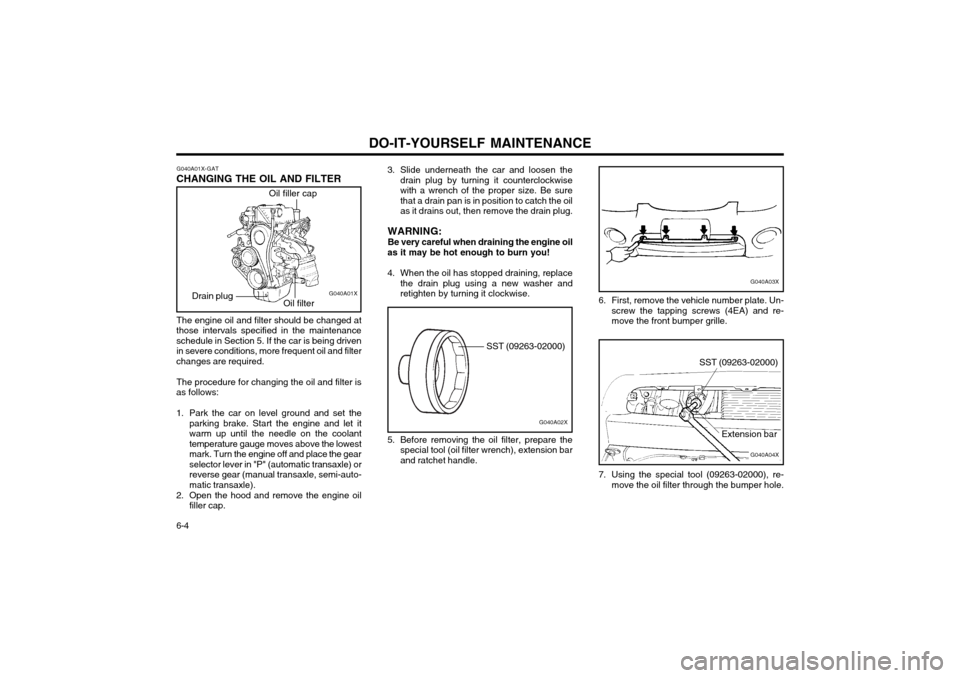
CHANGING THE OIL AND FILTER
Oil filler cap
Oil filter G040A01X
Drain plug
The engine oil and filter should be changed at
those intervals specified in the maintenance schedule in Section 5. If the car is being driven in severe conditions, more frequent oil and filter
changes are required.
The procedure for changing the oil and filter is
as follows:
1. Park the car on level ground and set the parking brake. Start the engine and let it warm up until the needle on the coolanttemperature gauge moves above the lowest
mark. Turn the engine off and place the gearselector lever in "P" (automatic transaxle) orreverse gear (manual transaxle, semi-auto-matic transaxle).
2. Open the hood and remove the engine oil filler cap. 3. Slide underneath the car and loosen the
drain plug by turning it counterclockwisewith a wrench of the proper size. Be sure
that a drain pan is in position to catch the oilas it drains out, then remove the drain plug.
WARNING: Be very careful when draining the engine oil
as it may be hot enough to burn you!
4. When the oil has stopped draining, replace the drain plug using a new washer and retighten by turning it clockwise.
G040A03X
6. First, remove the vehicle number plate. Un- screw the tapping screws (4EA) and re- move the front bumper grille.
G040A04X
SST (09263-02000)
Extension bar
7. Using the special tool (09263-02000), re- move the oil filter through the bumper hole.
G040A02X
SST (09263-02000)
5. Before removing the oil filter, prepare the special tool (oil filter wrench), extension bar and ratchet handle.
Page 227 of 249
DO-IT-YOURSELF MAINTENANCE 6-9
AS60160A
ZG080A1-A
WINDSHIELD WIPER BLADES
The wiper blades should be carefully inspected from time to time and cleaned to remove accu-mulations of road film or other debris. To clean the wiper blades and arms, use a clean sponge or cloth with a mild soap ordetergent and water. If the wipers continue to streak or smear the glass, replace them with genuine Hyundai re-placement parts or their equivalent. NOTE:
o Do not operate the wipers on dry glass. This can result in more rapid wear of the wiper blades and may scratch the glass.
o Keep the blade rubber out of contact with petroleum products such as engineoil, gasoline etc.G090A01X-EAT
FILLING THE WASHER RESERVOIR
The washer fluid reservoir supplies fluid to the
windshield washer system.
A good quality washer fluid should be used to fill
the washer reservoir. The fluid level should be checked more frequently during bad weather orwhenever the washer system is in more fre-quent use.
The capacity of the washer reservoir is 2.19
lmp.qts (2.5 Litres).
CAUTION:
o Radiator antifreeze (engine coolant) should not be used in the washer systembecause it will damage the car’s finish.
o The washer lever should not be pulled and the washer should not be operated ifthe washer reservoir is empty. This can
damage the washer fluid pump. XG100A2-E
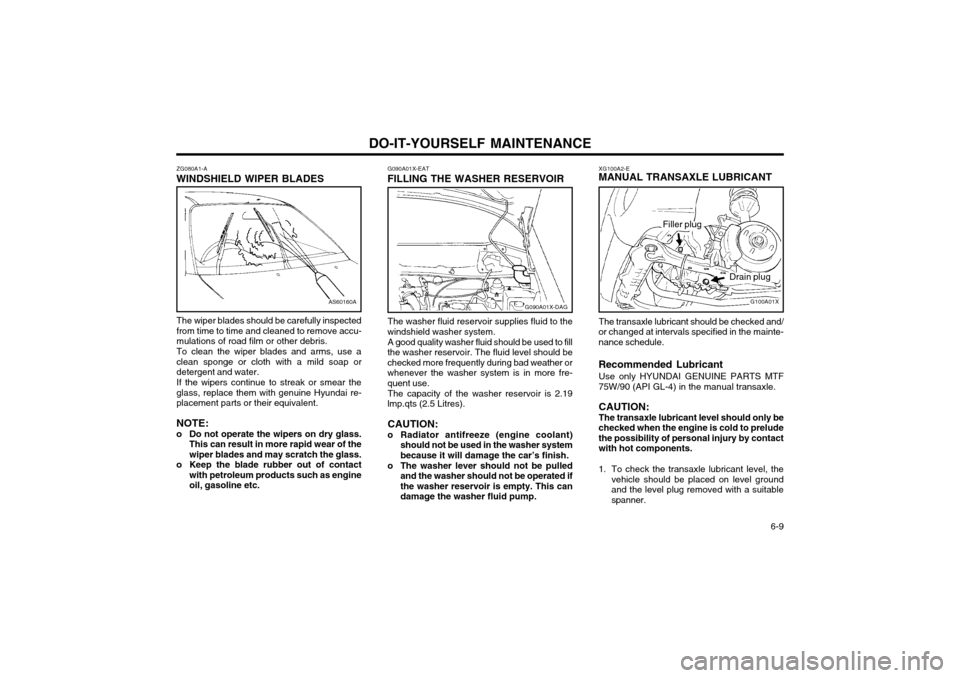
MANUAL TRANSAXLE LUBRICANT
G100A01X
Filler plug
Drain plug
The transaxle lubricant should be checked and/
or changed at intervals specified in the mainte- nance schedule. Recommended Lubricant
Use only HYUNDAI GENUINE PARTS MTF
75W/90 (API GL-4) in the manual transaxle.
CAUTION: The transaxle lubricant level should only be
checked when the engine is cold to preludethe possibility of personal injury by contactwith hot components.
1. To check the transaxle lubricant level, the vehicle should be placed on level ground and the level plug removed with a suitablespanner.
G090A01X-DAG
Page 228 of 249
DO-IT-YOURSELF MAINTENANCE
6-10
C090B01X-DAG
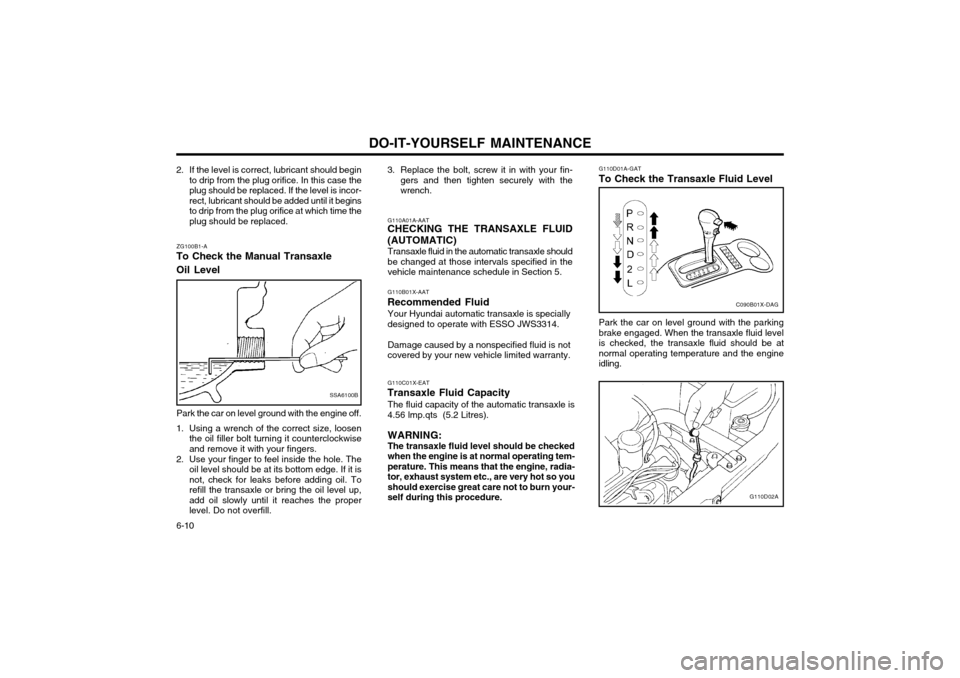
G110D01A-GAT To Check the Transaxle Fluid Level
G110D02A
Park the car on level ground with the parking brake engaged. When the transaxle fluid levelis checked, the transaxle fluid should be atnormal operating temperature and the engineidling.
G110A01A-AAT
CHECKING THE TRANSAXLE FLUID (AUTOMATIC)
Transaxle fluid in the automatic transaxle should be changed at those intervals specified in thevehicle maintenance schedule in Section 5.
3. Replace the bolt, screw it in with your fin-
gers and then tighten securely with thewrench.
G110C01X-EAT
Transaxle Fluid Capacity
The fluid capacity of the automatic transaxle is4.56 lmp.qts (5.2 Litres). WARNING: The transaxle fluid level should be checked when the engine is at normal operating tem-perature. This means that the engine, radia-tor, exhaust system etc., are very hot so youshould exercise great care not to burn your-self during this procedure.
G110B01X-AAT
Recommended Fluid Your Hyundai automatic transaxle is speciallydesigned to operate with ESSO JWS3314. Damage caused by a nonspecified fluid is not covered by your new vehicle limited warranty.
ZG100B1-A
To Check the Manual Transaxle Oil Level
SSA6100B
Park the car on level ground with the engine off.
1. Using a wrench of the correct size, loosen the oil filler bolt turning it counterclockwise and remove it with your fingers.
2. Use your finger to feel inside the hole. The oil level should be at its bottom edge. If it isnot, check for leaks before adding oil. Torefill the transaxle or bring the oil level up,add oil slowly until it reaches the properlevel. Do not overfill.
2. If the level is correct, lubricant should begin
to drip from the plug orifice. In this case theplug should be replaced. If the level is incor-rect, lubricant should be added until it beginsto drip from the plug orifice at which time theplug should be replaced.
Page 229 of 249
DO-IT-YOURSELF MAINTENANCE 6-11
While the engine is idling, apply the brakes and move the gear selector lever from "P" to each
of its other positions — "R", "N", "D", "2", "L" —and then return to "N". With the engine stillidling:
1. Open the hood, being careful to keep hands, long hair and clothing clear of any movingparts.
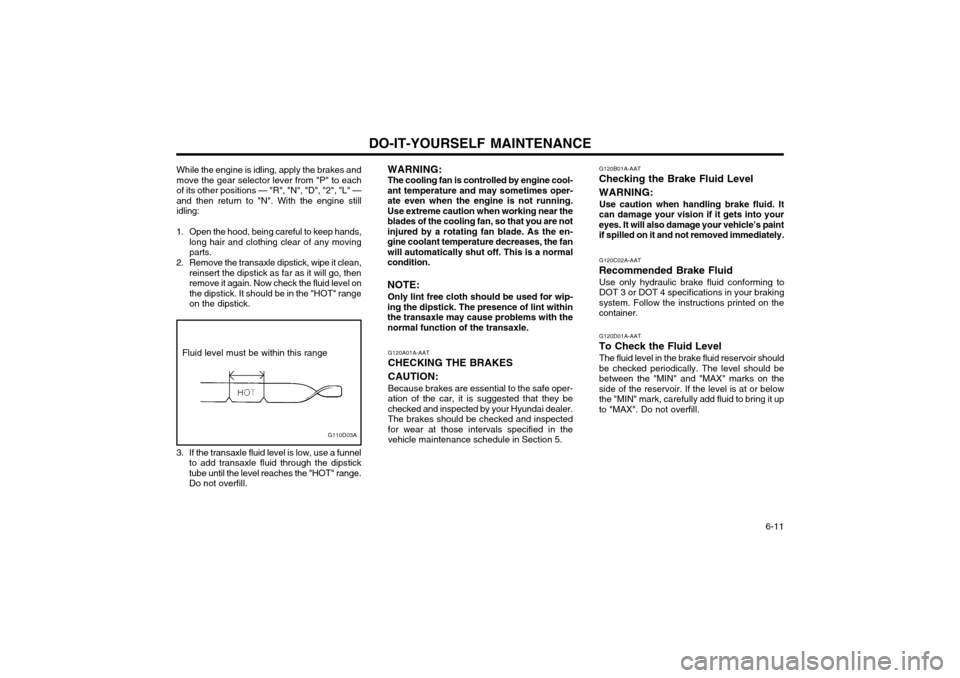
2. Remove the transaxle dipstick, wipe it clean, reinsert the dipstick as far as it will go, thenremove it again. Now check the fluid level on
the dipstick. It should be in the "HOT" rangeon the dipstick.
Fluid level must be within this range
3. If the transaxle fluid level is low, use a funnel to add transaxle fluid through the dipsticktube until the level reaches the "HOT" range.
Do not overfill.
G110D03A
G120A01A-AAT CHECKING THE BRAKES CAUTION: Because brakes are essential to the safe oper- ation of the car, it is suggested that they bechecked and inspected by your Hyundai dealer.The brakes should be checked and inspectedfor wear at those intervals specified in thevehicle maintenance schedule in Section 5. G120B01A-AAT
Checking the Brake Fluid Level WARNING:
Use caution when handling brake fluid. It
can damage your vision if it gets into your eyes. It will also damage your vehicle’s paint
if spilled on it and not removed immediately.
G120C02A-AAT
Recommended Brake Fluid Use only hydraulic brake fluid conforming to
DOT 3 or DOT 4 specifications in your brakingsystem. Follow the instructions printed on thecontainer.
G120D01A-AAT
To Check the Fluid Level The fluid level in the brake fluid reservoir should
be checked periodically. The level should bebetween the "MIN" and "MAX" marks on theside of the reservoir. If the level is at or below
the "MIN" mark, carefully add fluid to bring it upto "MAX". Do not overfill.
WARNING: The cooling fan is controlled by engine cool-
ant temperature and may sometimes oper- ate even when the engine is not running.
Use extreme caution when working near theblades of the cooling fan, so that you are notinjured by a rotating fan blade. As the en-
gine coolant temperature decreases, the fanwill automatically shut off. This is a normalcondition. NOTE:
Only lint free cloth should be used for wip-
ing the dipstick. The presence of lint within the transaxle may cause problems with thenormal function of the transaxle.
Page 239 of 249
EMISSION CONTROL SYSTEMS 7-1
H010A01A-GAT EMISSION CONTROL SYSTEM (Not all models) Your Hyundai is equipped with an emission
control system to meet all requirements of the Emission prohibition rules of your province.
There are three emission control systems which
are as follows.
1) Crankcase emission control system
2) Evaporative emission control system
3) Exhaust emission control system In order to assure the proper function of the
emission control systems, it is recommended that you have your car inspected and main-tained by an authorized Hyundai dealer in ac-
cordance with the maintenance schedule in thismanual. ZH000A1-A
7. EMISSION
CONTROL SYSTEMS
H010B01A-AAT
1. Crankcase Emission Control Sys-
tem
The Positive Crankcase Ventilation System is
employed to prevent air pollution caused by blow-by gases being emitted from the crank- case. This system supplies fresh filtered air to
the crankcase through the air intake hose.Inside the crankcase, the fresh air mixes with
blow-by gases, which then pass through thePCV valve and into the induction system.
H010D01A-AAT
3. Exhaust Emission Control SystemThe Exhaust Emission Control System is a
highly effective system which controls exhaust
emission while maintaining good vehicle perfor-mance.
H010C02A-GAT
2. Evaporative Emission
Control System (Not all models)
The Evaporative Emission Control System is
designed to prevent fuel vapors from escapinginto the atmosphere.
Canister While the engine is inoperative, fuel vapours
generated inside the fuel tank are absorbed and stored in the onboard canister. When the en-gine is running, the fuel vapors absorbed in thecanister are drawn into the induction systemthrough the purge control solenoid valve.
Purge Control Solenoid Valve The purge control solenoid valve is controlled
by the ECM; when the engine coolant temper- ature is low, and during idling, it closes, so that
evaporated fuel is not taken into the engine.
After engine warm-up, during ordinary driving, itopens so as to introduce evaporated fuel to theengine.
H020A01ACatalytic Converter
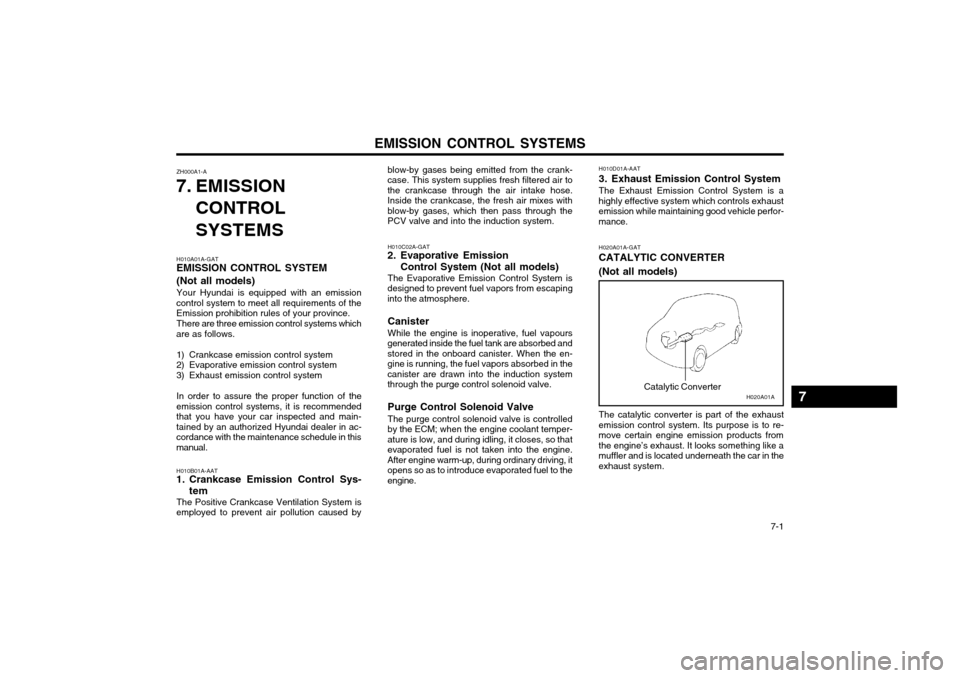
H020A01A-GAT CATALYTIC CONVERTER (Not all models) The catalytic converter is part of the exhaust
emission control system. Its purpose is to re- move certain engine emission products from
the engine’s exhaust. It looks something like amuffler and is located underneath the car in theexhaust system.
7