2002 Hyundai Atos heating
[x] Cancel search: heatingPage 66 of 249
DRIVING YOUR HYUNDAI
DRIVING YOUR HYUNDAI DRIVING YOUR HYUNDAI
DRIVING YOUR HYUNDAI
DRIVING YOUR HYUNDAI
2- 3
C050A01X-GAT
STARTING
STARTING STARTING
STARTING
STARTING
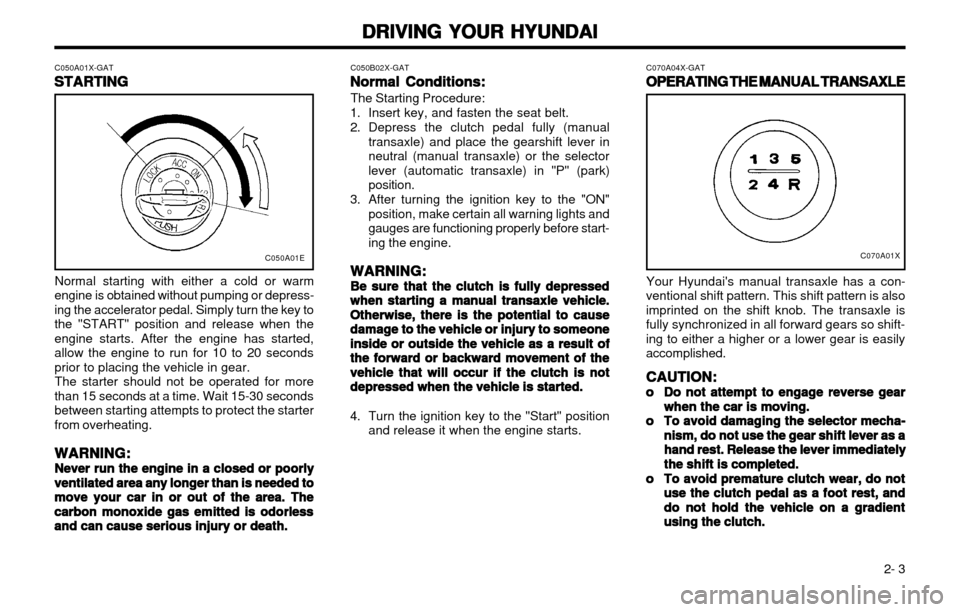
Normal starting with either a cold or warm
engine is obtained without pumping or depress-
ing the accelerator pedal. Simply turn the key tothe "START" position and release when theengine starts. After the engine has started,allow the engine to run for 10 to 20 secondsprior to placing the vehicle in gear. The starter should not be operated for more
than 15 seconds at a time. Wait 15-30 secondsbetween starting attempts to protect the starterfrom overheating.
WARNING:
WARNING: WARNING:
WARNING:
WARNING:
Never run the engine in a closed or poorly
Never run the engine in a closed or poorly Never run the engine in a closed or poorly
Never run the engine in a closed or poorly
Never run the engine in a closed or poorly ventilated area
ventilated area ventilated area
ventilated area
ventilated area any longer than is needed to
any longer than is needed to any longer than is needed to
any longer than is needed to
any longer than is needed to
move your car in or out of the area. The
move your car in or out of the area. The move your car in or out of the area. The
move your car in or out of the area. The
move your car in or out of the area. The
carbon
carbon carbon
carbon
carbon monoxide gas emitted is odorless
monoxide gas emitted is odorless monoxide gas emitted is odorless
monoxide gas emitted is odorless
monoxide gas emitted is odorless
and can cause serious injury or death.
and can cause serious injury or death. and can cause serious injury or death.
and can cause serious injury or death.
and can cause serious injury or death. C050B02X-GAT
Normal Conditions:
Normal Conditions: Normal Conditions:
Normal Conditions:
Normal Conditions:
The Starting Procedure:
1. Insert key, and fasten the seat belt.
2. Depress the clutch pedal fully (manual transaxle) and place the gearshift lever in neutral (manual transaxle) or the selectorlever (automatic transaxle) in "P" (park)position.
3. After turning the ignition key to the "ON" position, make certain all warning lights andgauges are functioning properly before start-
ing the engine.
WARNING:
WARNING: WARNING:
WARNING:
WARNING:
Be sure that the clutch is fully depressed
Be sure that the clutch is fully depressed Be sure that the clutch is fully depressed
Be sure that the clutch is fully depressed
Be sure that the clutch is fully depressed when starting a
when starting a when starting a
when starting a
when starting a manual transaxle vehicle.
manual transaxle vehicle. manual transaxle vehicle.
manual transaxle vehicle.
manual transaxle vehicle.
Otherwise, there is the potential to cause
Otherwise, there is the potential to cause Otherwise, there is the potential to cause
Otherwise, there is the potential to cause
Otherwise, there is the potential to cause
damage
damage damage
damage
damage to the vehicle or injury to someone
to the vehicle or injury to someone to the vehicle or injury to someone
to the vehicle or injury to someone
to the vehicle or injury to someone
inside or outside the vehicle as a result
inside or outside the vehicle as a result inside or outside the vehicle as a result
inside or outside the vehicle as a result
inside or outside the vehicle as a result ofof
ofof
of
the forward or backward movement of the
the forward or backward movement of the the forward or backward movement of the
the forward or backward movement of the
the forward or backward movement of the
vehicle that will occur if the
vehicle that will occur if the vehicle that will occur if the
vehicle that will occur if the
vehicle that will occur if the clutch is not
clutch is not clutch is not
clutch is not
clutch is not
depressed when the vehicle is started.
depressed when the vehicle is started. depressed when the vehicle is started.
depressed when the vehicle is started.
depressed when the vehicle is started.
4. Turn the ignition key to the "Start" position
and release it when the engine starts. C070A04X-GAT
OPERATING THE MANUAL TRANSAXLE
OPERATING THE MANUAL TRANSAXLE OPERATING THE MANUAL TRANSAXLE
OPERATING THE MANUAL TRANSAXLE
OPERATING THE MANUAL TRANSAXLE
C070A01X
Your Hyundai's manual transaxle has a con-
ventional shift pattern. This shift pattern is also imprinted on the shift knob. The transaxle isfully synchronized in all forward gears so shift-
ing to either a higher or a lower gear is easilyaccomplished.
CAUTION:
CAUTION: CAUTION:
CAUTION:
CAUTION:
oo
oo
o Do not attempt to engage reverse gear
Do not attempt to engage reverse gear Do not attempt to engage reverse gear
Do not attempt to engage reverse gear
Do not attempt to engage reverse gear
when the
when the when the
when the
when the car is moving.
car is moving. car is moving.
car is moving.
car is moving.
oo
oo
o To avoid damaging the selector mecha-
To avoid damaging the selector mecha- To avoid damaging the selector mecha-
To avoid damaging the selector mecha-
To avoid damaging the selector mecha-
nism, do not use the gear
nism, do not use the gear nism, do not use the gear
nism, do not use the gear
nism, do not use the gear shift lever as a
shift lever as a shift lever as a
shift lever as a
shift lever as a
hand rest. Release the lever immediately
hand rest. Release the lever immediately hand rest. Release the lever immediately
hand rest. Release the lever immediately
hand rest. Release the lever immediately
the shift is completed.
the shift is completed. the shift is completed.
the shift is completed.
the shift is completed.
oo
oo
o To avoid premature clutch wear, do not
To avoid premature clutch wear, do not To avoid premature clutch wear, do not
To avoid premature clutch wear, do not
To avoid premature clutch wear, do not
use the clutch pedal as
use the clutch pedal as use the clutch pedal as
use the clutch pedal as
use the clutch pedal as
a foot rest, and
a foot rest, and a foot rest, and
a foot rest, and
a foot rest, and
do not hold the vehicle on a gradient
do not hold the vehicle on a gradient do not hold the vehicle on a gradient
do not hold the vehicle on a gradient
do not hold the vehicle on a gradient
using the clutch.
using the clutch. using the clutch.
using the clutch.
using the clutch.
C050A01E
Page 67 of 249

DRIVING YOUR HYUNDAI
DRIVING YOUR HYUNDAI DRIVING YOUR HYUNDAI
DRIVING YOUR HYUNDAI
DRIVING YOUR HYUNDAI
2- 4 C070B01X-GAT
Using the Clutch of Manual transaxle
Using the Clutch of Manual transaxle Using the Clutch of Manual transaxle
Using the Clutch of Manual transaxle
Using the Clutch of Manual transaxle
The clutch should be pressed all the way to the floor before shifting, then released slowly. Theclutch pedal should be always used after fullyreturning to the original position. Do not restyour foot on the clutch pedal while driving. Thiscan cause unnecessary wear. Do not partiallyengage the clutch to hold the car on an incline.This causes unnecessary wear. Use the park-ing brake to hold the car on an incline. Do notoperate the clutch pedal rapidly and repeatedly. o Slow down when you encounter cross winds.
This gives you much better control of yourcar.
o Be sure the car is completely stopped be- fore you attempt to shift into reverse. Thetransaxle can be damaged if you do not. To
shift into reverse, depress the clutch (manualtransaxle), move the shift lever to neutral,
wait three seconds, then shift to the reverseposition.
o Exercise extreme caution when driving on a slippery surface. Be especially careful whenbraking, accelerating or shifting gears. On aslippery surface, an abrupt change in ve-hicle speed can cause the drive wheels tolose traction and the vehicle to go out ofcontrol.
CAUTION:
CAUTION: CAUTION:
CAUTION:
CAUTION:
oo
oo
o The risk of rollover is greatly increased if
The risk of rollover is greatly increased if The risk of rollover is greatly increased if
The risk of rollover is greatly increased if
The risk of rollover is greatly increased if
you you
you you
you lose control of your vehicle at high-
lose control of your vehicle at high- lose control of your vehicle at high-
lose control of your vehicle at high-
lose control of your vehicle at high-
way speeds.
way speeds. way speeds.
way speeds.
way speeds.
oo
oo
o Loss of control often occurs if two or
Loss of control often occurs if two or Loss of control often occurs if two or
Loss of control often occurs if two or
Loss of control often occurs if two or
more wheels drop off the
more wheels drop off the more wheels drop off the
more wheels drop off the
more wheels drop off the roadway and
roadway and roadway and
roadway and
roadway and
the driver oversteers to reenter the road-
the driver oversteers to reenter the road- the driver oversteers to reenter the road-
the driver oversteers to reenter the road-
the driver oversteers to reenter the road-
way.
way. way.
way.
way.
oo
oo
o In the event your vehicle leaves the road-
In the event your vehicle leaves the road- In the event your vehicle leaves the road-
In the event your vehicle leaves the road-
In the event your vehicle leaves the road-
way, do not steer sharply.
way, do not steer sharply. way, do not steer sharply.
way, do not steer sharply.
way, do not steer sharply. Instead, slow
Instead, slow Instead, slow
Instead, slow
Instead, slow
down before pulling back into the travel
down before pulling back into the travel down before pulling back into the travel
down before pulling back into the travel
down before pulling back into the travel
lanes.
lanes. lanes.
lanes.
lanes.
oo
oo
o
In a collision crash, on unbelted person
In a collision crash, on unbelted person In a collision crash, on unbelted person
In a collision crash, on unbelted person
In a collision crash, on unbelted person
is significantly more likely to die than a
is significantly more likely to die than a is significantly more likely to die than a
is significantly more likely to die than a
is significantly more likely to die than a
person wearing a seatbelt.
person wearing a seatbelt. person wearing a seatbelt.
person wearing a seatbelt.
person wearing a seatbelt.
oo
oo
o Ensure that the engine is not over-revved
Ensure that the engine is not over-revved Ensure that the engine is not over-revved
Ensure that the engine is not over-revved
Ensure that the engine is not over-revved
by upshifting.
by upshifting. by upshifting.
by upshifting.
by upshifting.
oo
oo
o Do not coast with the shift lever at the
Do not coast with the shift lever at the Do not coast with the shift lever at the
Do not coast with the shift lever at the
Do not coast with the shift lever at the
neutral position.
neutral position. neutral position.
neutral position.
neutral position.
oo
oo
o
When descending long gradients, make
When descending long gradients, make When descending long gradients, make
When descending long gradients, make
When descending long gradients, make
use of the engine braking
use of the engine braking use of the engine braking
use of the engine braking
use of the engine braking
to assist the
to assist the to assist the
to assist the
to assist the
footbrake to avoid brake fade or over-
footbrake to avoid brake fade or over- footbrake to avoid brake fade or over-
footbrake to avoid brake fade or over-
footbrake to avoid brake fade or over-
heating.
heating. heating.
heating.
heating.
oo
oo
o When slippery conditions are encoun-
When slippery conditions are encoun- When slippery conditions are encoun-
When slippery conditions are encoun-
When slippery conditions are encoun-
tered, increased caution should
tered, increased caution should tered, increased caution should
tered, increased caution should
tered, increased caution should be ex-
be ex- be ex-
be ex-
be ex-
ecuted when gear changing, braking or
ecuted when gear changing, braking or ecuted when gear changing, braking or
ecuted when gear changing, braking or
ecuted when gear changing, braking or
accelerating. Abrupt changes in
accelerating. Abrupt changes in accelerating. Abrupt changes in
accelerating. Abrupt changes in
accelerating. Abrupt changes in
speed
speed speed
speed
speed
may cause a loss of traction.
may cause a loss of traction. may cause a loss of traction.
may cause a loss of traction.
may cause a loss of traction.
oo
oo
o To shift into reverse, rest the lever in
To shift into reverse, rest the lever in To shift into reverse, rest the lever in
To shift into reverse, rest the lever in
To shift into reverse, rest the lever in
neutral for at least
neutral for at least neutral for at least
neutral for at least
neutral for at least
3 seconds after your
3 seconds after your 3 seconds after your
3 seconds after your
3 seconds after your
car is completely stopped. Then move
car is completely stopped. Then move car is completely stopped. Then move
car is completely stopped. Then move
car is completely stopped. Then move
the lever into the reverse position.
the lever into the reverse position. the lever into the reverse position.
the lever into the reverse position.
the lever into the reverse position.
oo
oo
o During cold weather, shifting may be dif-
During cold weather, shifting may be dif- During cold weather, shifting may be dif-
During cold weather, shifting may be dif-
During cold weather, shifting may be dif-
ficult until the transaxle lubricant has
ficult until the transaxle lubricant has ficult until the transaxle lubricant has
ficult until the transaxle lubricant has
ficult until the transaxle lubricant has
warmed up. This is normal and not harm-
warmed up. This is normal and not harm- warmed up. This is normal and not harm-
warmed up. This is normal and not harm-
warmed up. This is normal and not harm-
ful to the transaxle.
ful to the transaxle. ful to the transaxle.
ful to the transaxle.
ful to the transaxle.
oo
oo
o
If you 've come to a complete stop and
If you 've come to a complete stop and If you 've come to a complete stop and
If you 've come to a complete stop and
If you 've come to a complete stop and
it's hard to shift into 1
it's hard to shift into 1 it's hard to shift into 1
it's hard to shift into 1
it's hard to shift into 1 stst
stst
st
or R(Reverse),
or R(Reverse), or R(Reverse),
or R(Reverse),
or R(Reverse),
put the shift lever in N(Neutral) position
put the shift lever in N(Neutral) position put the shift lever in N(Neutral) position
put the shift lever in N(Neutral) position
put the shift lever in N(Neutral) position
and let up on the clutch. Press the clutch
and let up on the clutch. Press the clutch and let up on the clutch. Press the clutch
and let up on the clutch. Press the clutch
and let up on the clutch. Press the clutch
pedal back down, and then shift into 1
pedal back down, and then shift into 1 pedal back down, and then shift into 1
pedal back down, and then shift into 1
pedal back down, and then shift into 1 stst
stst
st
or R(Reverse) gear position.
or R(Reverse) gear position. or R(Reverse) gear position.
or R(Reverse) gear position.
or R(Reverse) gear position.
oo
oo
o
Do not use the shift lever as a handrest
Do not use the shift lever as a handrest Do not use the shift lever as a handrest
Do not use the shift lever as a handrest
Do not use the shift lever as a handrest
during driving, as this can result in pre-
during driving, as this can result in pre- during driving, as this can result in pre-
during driving, as this can result in pre-
during driving, as this can result in pre-
mature wear of the transaxle shift forks.
mature wear of the transaxle shift forks. mature wear of the transaxle shift forks.
mature wear of the transaxle shift forks.
mature wear of the transaxle shift forks. C070D01X-GAT
Good Driving Practices
Good Driving Practices Good Driving Practices
Good Driving Practices
Good Driving Practices
o Never take the car out of gear and coast
down a hill. This is extremely hazardous. Always leave the car in gear.
o Don't "ride" the brakes. This can cause them to overheat and malfunction. Instead,when you are driving down a long hill, slowdown and shift to a lower gear. When you dothis, engine braking will help slow the car.
o Slow down before shifting to a lower gear. This will help avoid over-revving the engine,which can cause damage.
WARNING:
WARNING: WARNING:
WARNING:
WARNING:
When downshifting from fifth gear to fourth
When downshifting from fifth gear to fourth When downshifting from fifth gear to fourth
When downshifting from fifth gear to fourth
When downshifting from fifth gear to fourth
gear, caution should
gear, caution should gear, caution should
gear, caution should
gear, caution should
be taken not to inad-
be taken not to inad- be taken not to inad-
be taken not to inad-
be taken not to inad-
vertently press the gear shift lever sideways
vertently press the gear shift lever sideways vertently press the gear shift lever sideways
vertently press the gear shift lever sideways
vertently press the gear shift lever sideways
in such
in such in such
in such
in such
a manner that second gear is en-
a manner that second gear is en- a manner that second gear is en-
a manner that second gear is en-
a manner that second gear is en-
gaged. Such over revving of the engine may
gaged. Such over revving of the engine may gaged. Such over revving of the engine may
gaged. Such over revving of the engine may
gaged. Such over revving of the engine may
possibly cause engine damage.
possibly cause engine damage. possibly cause engine damage.
possibly cause engine damage.
possibly cause engine damage.
Page 71 of 249

DRIVING YOUR HYUNDAI
DRIVING YOUR HYUNDAI DRIVING YOUR HYUNDAI
DRIVING YOUR HYUNDAI
DRIVING YOUR HYUNDAI
2- 8 WARNING:
WARNING: WARNING:
WARNING:
WARNING:
Your ABS will not prevent accidents due to
Your ABS will not prevent accidents due to Your ABS will not prevent accidents due to
Your ABS will not prevent accidents due to
Your ABS will not prevent accidents due to improper or dangerous
improper or dangerous improper or dangerous
improper or dangerous
improper or dangerous
driving maneuvers.
driving maneuvers. driving maneuvers.
driving maneuvers.
driving maneuvers.
Even though vehicle control is improved
Even though vehicle control is improved Even though vehicle control is improved
Even though vehicle control is improved
Even though vehicle control is improved
during emergency
during emergency during emergency
during emergency
during emergency
braking, always maintain
braking, always maintain braking, always maintain
braking, always maintain
braking, always maintain
a safe distance between you and objects
a safe distance between you and objects a safe distance between you and objects
a safe distance between you and objects
a safe distance between you and objects
ahead. Vehicle
ahead. Vehicle ahead. Vehicle
ahead. Vehicle
ahead. Vehicle
speeds should always be
speeds should always be speeds should always be
speeds should always be
speeds should always be
reduced during extreme road conditions.
reduced during extreme road conditions. reduced during extreme road conditions.
reduced during extreme road conditions.
reduced during extreme road conditions.
The braking distance for cars equipped with
The braking distance for cars equipped with The braking distance for cars equipped with
The braking distance for cars equipped with
The braking distance for cars equipped withan anti-lock braking system
an anti-lock braking system an anti-lock braking system
an anti-lock braking system
an anti-lock braking system may be longer
may be longer may be longer
may be longer
may be longer
than for those without it in the following
than for those without it in the following than for those without it in the following
than for those without it in the following
than for those without it in the following
road conditions.
road conditions. road conditions.
road conditions.
road conditions.
oo
oo
o Driving on rough, gravel or snow-cov-
Driving on rough, gravel or snow-cov- Driving on rough, gravel or snow-cov-
Driving on rough, gravel or snow-cov-
Driving on rough, gravel or snow-cov-
ered roads.
ered roads. ered roads.
ered roads.
ered roads.
oo
oo
o Driving with tire chains installed.
Driving with tire chains installed. Driving with tire chains installed.
Driving with tire chains installed.
Driving with tire chains installed.
oo
oo
o Driving on roads where the road surface
Driving on roads where the road surface Driving on roads where the road surface
Driving on roads where the road surface
Driving on roads where the road surface
is pitted or has different
is pitted or has different is pitted or has different
is pitted or has different
is pitted or has different surface height.
surface height. surface height.
surface height.
surface height.
During these conditions the vehicle
During these conditions the vehicle During these conditions the vehicle
During these conditions the vehicle
During these conditions the vehicle should
should should
should
should
be driven at reduced speeds. The safety
be driven at reduced speeds. The safety be driven at reduced speeds. The safety
be driven at reduced speeds. The safety
be driven at reduced speeds. The safety
features
features features
features
features of an ABS equipped vehicle should
of an ABS equipped vehicle should of an ABS equipped vehicle should
of an ABS equipped vehicle should
of an ABS equipped vehicle should
not be tested by high speed driving or cor-
not be tested by high speed driving or cor- not be tested by high speed driving or cor-
not be tested by high speed driving or cor-
not be tested by high speed driving or cor-
nering.
nering. nering.
nering.
nering. This could endanger the safety of
This could endanger the safety of This could endanger the safety of
This could endanger the safety of
This could endanger the safety of
yourself or others.
yourself or others. yourself or others.
yourself or others.
yourself or others.
C120A02A-AAT
ANTI-LOCK BRAKE SYSTEM
ANTI-LOCK BRAKE SYSTEM ANTI-LOCK BRAKE SYSTEM
ANTI-LOCK BRAKE SYSTEM
ANTI-LOCK BRAKE SYSTEM
(If installed)
(If installed) (If installed)
(If installed)
(If installed)
The Anti-Lock Brake System (ABS) is designed
to prevent wheel lock-up during sudden braking or on hazardous road surfaces. The ABS con-
trol module monitors the wheel speed and con-trols the pressure applied to each brake. Thus,in emergency situations or on slick roads, ABSwill increase vehicle control during braking.
NOTE:
NOTE: NOTE:
NOTE:
NOTE:
During ABS operation, a slight pulsation
During ABS operation, a slight pulsation During ABS operation, a slight pulsation
During ABS operation, a slight pulsation
During ABS operation, a slight pulsation may be felt in the brake
may be felt in the brake may be felt in the brake
may be felt in the brake
may be felt in the brake
pedal when the
pedal when the pedal when the
pedal when the
pedal when the
brakes are applied. Also, a noise may be
brakes are applied. Also, a noise may be brakes are applied. Also, a noise may be
brakes are applied. Also, a noise may be
brakes are applied. Also, a noise may be
heard in the engine
heard in the engine heard in the engine
heard in the engine
heard in the engine
compartment while brak-
compartment while brak- compartment while brak-
compartment while brak-
compartment while brak-
ing. These conditions are normal and indi-
ing. These conditions are normal and indi- ing. These conditions are normal and indi-
ing. These conditions are normal and indi-
ing. These conditions are normal and indi-
cate that the
cate that the cate that the
cate that the
cate that the
anti-lock brake system is func-
anti-lock brake system is func- anti-lock brake system is func-
anti-lock brake system is func-
anti-lock brake system is func-
tioning properly.
tioning properly. tioning properly.
tioning properly.
tioning properly. put the gear selector lever in "P" (automatic) or in first or reverse gear (manual transaxle)and block the rear wheels so the car cannotroll. Then release the parking brake.
o Do not hold the vehicle on the upgrade with the accelerator pedal. This can cause thetransaxle to overheat. Always use the brake
pedal or parking brake.
o Don't "ride" the brake pedal. Resting your
foot on the brake pedal while driving can bedangerous because it can result in the brakesoverheating and losing their effectiveness. Italso increases the wear of the brake compo-nents.
o If a tire goes flat while you are driving, apply the brakes gently and keep the car pointedstraight ahead while you slow down. Whenyou are moving slowly enough for it to be
safe to do so, pull off the road and stop in asafe place.
o If your car is equipped with an automatic transaxle, don't let your car creep forward.To avoid creeping forward, keep your foot
on the brake pedal when the car is stopped.
o Use caution when parking on a hill. Engage the parking brake and place the gear selec-tor lever in "P" (automatic transaxle) or in
first or reverse gear (manual transaxle). Ifyour car is facing downhill, turn the frontwheels into the curb to help keep the carfrom rolling. If your car is facing uphill, turnthe front wheels away from the curb to helpkeep the car from rolling. If there is no curb
or if it is required by other conditions to keepthe car from rolling, block the wheels.
o Under some conditions your parking brake can freeze in the engaged position. This ismost likely to happen when there is an
accumulation of snow or ice around or nearthe rear brakes or if the brakes are wet. If
there is a risk that the parking brake may
freeze, apply it only temporarily while you
Page 74 of 249

DRIVING YOUR HYUNDAI
DRIVING YOUR HYUNDAI DRIVING YOUR HYUNDAI
DRIVING YOUR HYUNDAI
DRIVING YOUR HYUNDAI
2- 11
C190A01A-GAT
TRAILER OR VEHICLE TOWING
TRAILER OR VEHICLE TOWING TRAILER OR VEHICLE TOWING
TRAILER OR VEHICLE TOWING
TRAILER OR VEHICLE TOWING
If you are considering towing with your car, you
should first check with your Province Depart- ment of Motor Vehicles to determine their legal
requirements. Since laws vary from province to province the
requirements for towing trailers, cars, or other types of vehicles or apparatus may differ. Askyour Hyundai dealer for further details beforetowing.
CAUTION:
CAUTION: CAUTION:
CAUTION:
CAUTION:
Do not do any towing with your car during
Do not do any towing with your car during Do not do any towing with your car during
Do not do any towing with your car during
Do not do any towing with your car during its first 2,000 km (1,200 miles) in order to
its first 2,000 km (1,200 miles) in order to its first 2,000 km (1,200 miles) in order to
its first 2,000 km (1,200 miles) in order to
its first 2,000 km (1,200 miles) in order to
allow the engine to properly break in. Fail-
allow the engine to properly break in. Fail- allow the engine to properly break in. Fail-
allow the engine to properly break in. Fail-
allow the engine to properly break in. Fail-
ure to heed this caution may result in seri-
ure to heed this caution may result in seri- ure to heed this caution may result in seri-
ure to heed this caution may result in seri-
ure to heed this caution may result in seri-
ous engine or transaxle damage.
ous engine or transaxle damage. ous engine or transaxle damage.
ous engine or transaxle damage.
ous engine or transaxle damage.
C190B01S-AATTrailer Hitches
Trailer Hitches Trailer Hitches
Trailer Hitches
Trailer Hitches
Select the proper hitch and ball combination,
making sure that it's location is compatible with that of the trailer or vehicle being towed.
Use a quality non-equalizing hitch which distrib-
utes the tongue load uniformly throughout thechassis.
The hitch should be bolted securely to the car
and installed by a qualified technician. DO NOTUSE A HITCH DESIGNED FOR TEMPORARYINSTALLATION AND NEVER USE ONE THATATTACHES ONLY TO THE BUMPER.
C170A01A-AAT
HIGHER SPEED MOTORING
HIGHER SPEED MOTORING HIGHER SPEED MOTORING
HIGHER SPEED MOTORING
HIGHER SPEED MOTORING
Pre-Trip Inspections
Pre-Trip Inspections Pre-Trip Inspections
Pre-Trip Inspections
Pre-Trip Inspections 1. Tires:
Adjust the tire inflation pressures to specifica-
tion driving. Low tire inflation pressures will result in overheating and possible failure of thetires.
Avoid using worn or damaged tires which may
result in reduced traction or tire failure.
NOTE:
NOTE: NOTE:
NOTE:
NOTE:
Never exceed the maximum tire inflation
Never exceed the maximum tire inflation Never exceed the maximum tire inflation
Never exceed the maximum tire inflation
Never exceed the maximum tire inflation pressure shown on the tires.
pressure shown on the tires. pressure shown on the tires.
pressure shown on the tires.
pressure shown on the tires.
2. Fuel, engine coolant and engine oil:High speed travel consumes 1.5 times more
fuel than urban motoring. Do not forget to check both engine coolant and engine oil. 3. Drive belt:
A loose or damaged drive belt may result in
overheating of the engine.
C180A01A-AATUSE OF LIGHTS
USE OF LIGHTS USE OF LIGHTS
USE OF LIGHTS
USE OF LIGHTS
Check your lights regularly for correct operation
and always keep them clean. When driving during the day in conditions of poor visibility, itis helpful to drive with headlights on low beam.This enables you to be seen as well as to see.
rarily while you put the gear selector lever in"P" (automatic transaxle) or in first or reversegear (manual transaxle) and block the rearwheels so the car cannot roll. Then release theparking brake.
C160J01A-AATDon't Let Ice and Snow Accumulate
Don't Let Ice and Snow Accumulate Don't Let Ice and Snow Accumulate
Don't Let Ice and Snow Accumulate
Don't Let Ice and Snow Accumulate
Underneath
Underneath Underneath
Underneath
Underneath
Under some conditions, snow and ice can build
up under the fenders and interfere with thesteering. When driving in severe winter condi-tions where this may happen, you should peri-odically check underneath the car to be surethe movement of the front wheels and thesteering components are not obstructed.
C160K01A-AATCarry Emergency Equipment
Carry Emergency Equipment Carry Emergency Equipment
Carry Emergency Equipment
Carry Emergency Equipment
Depending on the severity of the weather where
you drive your car, you should carry appropri-ate emergency equipment. Some of the itemsyou may want to carry include tire chains, towstraps or chains, flashlight, emergency flares,sand, a shovel, jumper cables, a windowscraper, gloves, ground cloth, coveralls, a blan-ket, etc.
Page 77 of 249
DRIVING YOUR HYUNDAI
DRIVING YOUR HYUNDAI DRIVING YOUR HYUNDAI
DRIVING YOUR HYUNDAI
DRIVING YOUR HYUNDAI
2- 14
11. Avoid jerky starts, sudden acceleration or
sudden stops.
12. Avoid sharp turns and rapid lane changes.
13. Avoid holding the brake pedal down too long or too frequently. This could cause the brakes to overheat, resulting in reduced brakingefficiency.
14. When going down a hill, shift into a lower gear and use the engine braking effect. When ascending a long grade, downshift the transaxle to a lower gear and reduce speedto reduce chances of engine overloadingand/or overheating.
15. If you have to stop while going uphill, do not hold the vehicle in place by pressing on theaccelerator. This can cause the automatictransaxle to overheat. Use the parking brakeor footbrake.
NOTE:
NOTE: NOTE:
NOTE:
NOTE:
When towing check transaxle fluid more
When towing check transaxle fluid more When towing check transaxle fluid more
When towing check transaxle fluid more
When towing check transaxle fluid more frequently.
frequently. frequently.
frequently.
frequently.
CAUTION:
CAUTION: CAUTION:
CAUTION:
CAUTION:
If overheating should occur when towing,
If overheating should occur when towing, If overheating should occur when towing,
If overheating should occur when towing,
If overheating should occur when towing,(temperature gauge reads near red zone),
(temperature gauge reads near red zone), (temperature gauge reads near red zone),
(temperature gauge reads near red zone),
(temperature gauge reads near red zone),
taking the following action may reduce or
taking the following action may reduce or taking the following action may reduce or
taking the following action may reduce or
taking the following action may reduce or
eliminate the problem.
eliminate the problem. eliminate the problem.
eliminate the problem.
eliminate the problem. 1. Turn off the air conditioner.
2. Reduce highway speed.
3. Select a lower gear when going uphill.
4. While in stop and go traffic, place the gear
selector in park or neutral and idle the en- gine at a higher speed.
Page 80 of 249
WHAT TO DO IN AN EMERGENCY
WHAT TO DO IN AN EMERGENCY WHAT TO DO IN AN EMERGENCY
WHAT TO DO IN AN EMERGENCY
WHAT TO DO IN AN EMERGENCY
3-3
WARNING:
WARNING: WARNING:
WARNING:
WARNING:
While the engine is running, keep hands,
While the engine is running, keep hands, While the engine is running, keep hands,
While the engine is running, keep hands,
While the engine is running, keep hands, long hair
long hair long hair
long hair
long hair
and clothing away from moving
and clothing away from moving and clothing away from moving
and clothing away from moving
and clothing away from moving
parts such as the fan and drive belts to
parts such as the fan and drive belts to parts such as the fan and drive belts to
parts such as the fan and drive belts to
parts such as the fan and drive belts to
prevent
prevent prevent
prevent
prevent
injury.
injury. injury.
injury.
injury.
5. If the water pump drive belt is broken or engine coolant is leaking out, stop the en- gine immediately and call the nearestHyundai dealer for assistance.
WARNING:
WARNING: WARNING:
WARNING:
WARNING:
Do not remove the radiator cap when the
Do not remove the radiator cap when the Do not remove the radiator cap when the
Do not remove the radiator cap when the
Do not remove the radiator cap when the engine is hot. This may allow
engine is hot. This may allow engine is hot. This may allow
engine is hot. This may allow
engine is hot. This may allow coolant to be
coolant to be coolant to be
coolant to be
coolant to be
blown out of the opening and cause serious
blown out of the opening and cause serious blown out of the opening and cause serious
blown out of the opening and cause serious
blown out of the opening and cause serious
burns.
burns. burns.
burns.
burns.
6. If you cannot find the cause of the overheat-
ing, wait until the engine temperature has returned to normal. Then, if engine coolanthas been lost, carefully remove the radiator
cap and add engine coolant to bring the fluidlevel in the reservoir up to the halfway mark.
7. Proceed with caution, keeping alert for fur- ther signs of overheating. If overheating hap-pens again, call a Hyundai dealer for assis-tance.
CAUTION:
CAUTION: CAUTION:
CAUTION:
CAUTION:
Serious loss of engine coolant indicates
Serious loss of engine coolant indicates Serious loss of engine coolant indicates
Serious loss of engine coolant indicates
Serious loss of engine coolant indicates there is a leak in
there is a leak in there is a leak in
there is a leak in
there is a leak in the cooling system and this
the cooling system and this the cooling system and this
the cooling system and this
the cooling system and this
should be checked as soon as possible by a
should be checked as soon as possible by a should be checked as soon as possible by a
should be checked as soon as possible by a
should be checked as soon as possible by a
Hyundai
Hyundai Hyundai
Hyundai
Hyundai dealer.
dealer. dealer.
dealer.
dealer. D040A01A-GAT
SPARE TIRE
SPARE TIRE SPARE TIRE
SPARE TIRE
SPARE TIRE
The following instructions for the FULL SIZE
spare tire should be observed:
Check inflation pressure as soon as practical
after installing the spare tire, and adjust to the specified pressure. The tire pressure should beperiodically checked and maintained at thespecified pressure while the tire is stored.
Tire Size Inflation Pressure Full Size 210 kPa (30 psi)
Spare Tire Pressure
D040B01A-AAT
Handling the Spare Tire
Handling the Spare Tire Handling the Spare Tire
Handling the Spare Tire
Handling the Spare Tire
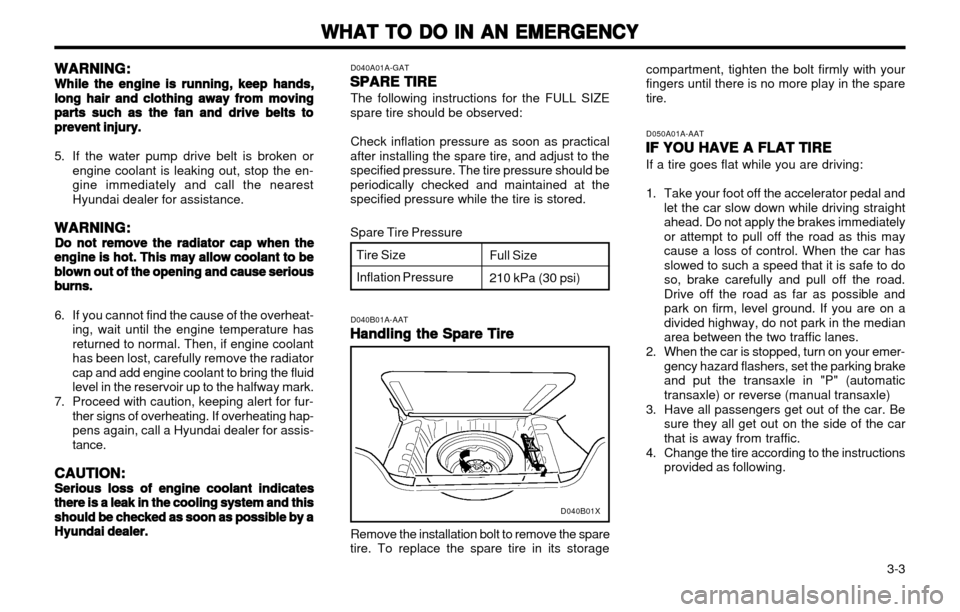
Remove the installation bolt to remove the spare
tire. To replace the spare tire in its storage D050A01A-AAT
IF YOU HAVE A FLAT TIRE
IF YOU HAVE A FLAT TIRE IF YOU HAVE A FLAT TIRE
IF YOU HAVE A FLAT TIRE
IF YOU HAVE A FLAT TIRE If a tire goes flat while you are driving:
1. Take your foot off the accelerator pedal and
let the car slow down while driving straight ahead. Do not apply the brakes immediatelyor attempt to pull off the road as this may
cause a loss of control. When the car hasslowed to such a speed that it is safe to doso, brake carefully and pull off the road.Drive off the road as far as possible and
park on firm, level ground. If you are on adivided highway, do not park in the medianarea between the two traffic lanes.
2. When the car is stopped, turn on your emer- gency hazard flashers, set the parking brakeand put the transaxle in "P" (automatic
transaxle) or reverse (manual transaxle)
3. Have all passengers get out of the car. Be sure they all get out on the side of the carthat is away from traffic.
4. Change the tire according to the instructions provided as following.
compartment, tighten the bolt firmly with yourfingers until there is no more play in the sparetire.
D040B01X
Page 98 of 249
DO-IT-YOURSELF MAINTENANCE
DO-IT-YOURSELF MAINTENANCE DO-IT-YOURSELF MAINTENANCE
DO-IT-YOURSELF MAINTENANCE
DO-IT-YOURSELF MAINTENANCE
6-2 G020A01A-AAT
GENERAL CHECKS
GENERAL CHECKS GENERAL CHECKS
GENERAL CHECKS
GENERAL CHECKS
Engine Compartment
Engine Compartment Engine Compartment
Engine Compartment
Engine Compartment The following should be checked regularly:
o Engine oil level and condition
o Transaxle fluid level and condition
o Brake fluid level
o Clutch fluid level
o Engine coolant level
o Windshield washer fluid level
o Accessory drive belt condition
o Engine coolant hose condition
o Fluid leaks (on or below components)
o Power steering fluid level
o Battery Condition G020C01X-GAT
Vehicle Interior
Vehicle Interior Vehicle Interior
Vehicle Interior
Vehicle Interior
The following should be checked each time
when the vehicle is driven:
o Lights operation
o Windshield wipers operation
o Horn operation
o Defroster, heating system operation (and air conditioning, if installed)
o Steering operation and condition
o Mirror condition and operation
o Turn signal operation
o Accelerator pedal operation
o Brake operation, including parking brake
o Manual transaxle operation, including clutch operation
o Automatic transaxle operation, including "Park" mechanism operation
o Seat control condition and operation
o Seat belt condition and operation
o Sunvisor operation
If you notice anything that does not operate
correctly or appears to be functioning in cor-rectly, inspect it carefully and seek assistancefrom your Hyundai dealer if service is needed. G030A01A-AAT
CHECKING THE ENGINE OIL
CHECKING THE ENGINE OIL CHECKING THE ENGINE OIL
CHECKING THE ENGINE OIL
CHECKING THE ENGINE OIL
Engine oil is essential to the performance andservice of the engine. It is suggested that youcheck the oil level at least once a week innormal use and more often if you are on a tripor driving in severe conditions. G030B01A-GAT
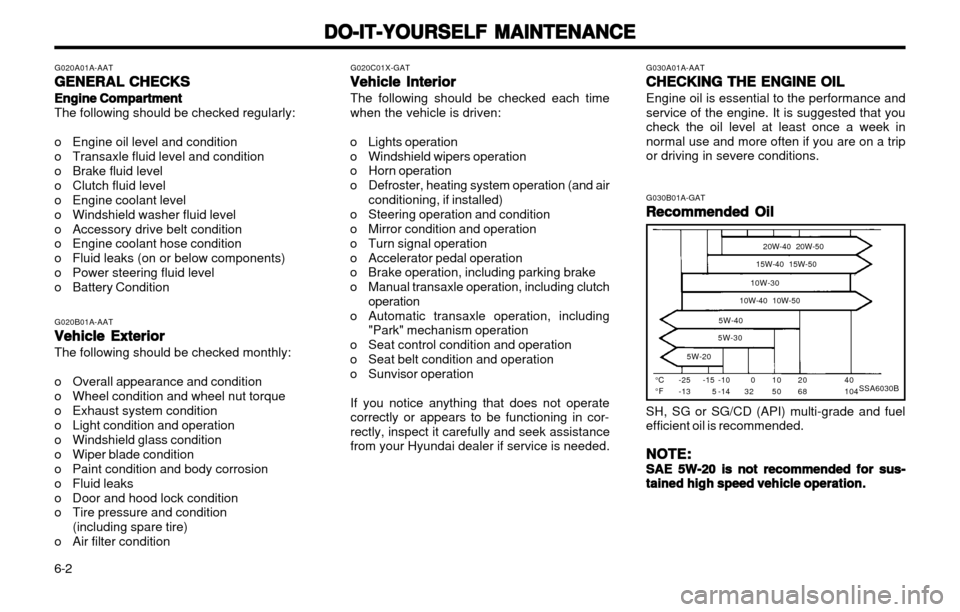
Recommended Oil
Recommended Oil Recommended Oil
Recommended Oil
Recommended Oil
SSA6030B°C °F -25-13 20W-40 20W-50
15W-40 15W-50
10W-30
10W-40 10W-50
5W-40
5W-30
5W-2040 104
2068
1050
032
-15 5 -10-14
SH, SG or SG/CD (API) multi-grade and fuel efficient oil is recommended.
NOTE:
NOTE: NOTE:
NOTE:
NOTE:
SAE 5W-20 is not recommended for sus-
SAE 5W-20 is not recommended for sus- SAE 5W-20 is not recommended for sus-
SAE 5W-20 is not recommended for sus-
SAE 5W-20 is not recommended for sus-
tained high speed vehicle operation.
tained high speed vehicle operation. tained high speed vehicle operation.
tained high speed vehicle operation.
tained high speed vehicle operation.
G020B01A-AAT
Vehicle Exterior
Vehicle Exterior Vehicle Exterior
Vehicle Exterior
Vehicle Exterior The following should be checked monthly:
o Overall appearance and condition
o Wheel condition and wheel nut torque
o Exhaust system condition
o Light condition and operation
o Windshield glass condition
o Wiper blade condition
o Paint condition and body corrosion
o Fluid leaks
o Door and hood lock condition
o Tire pressure and condition
(including spare tire)
o Air filter condition
Page 125 of 249
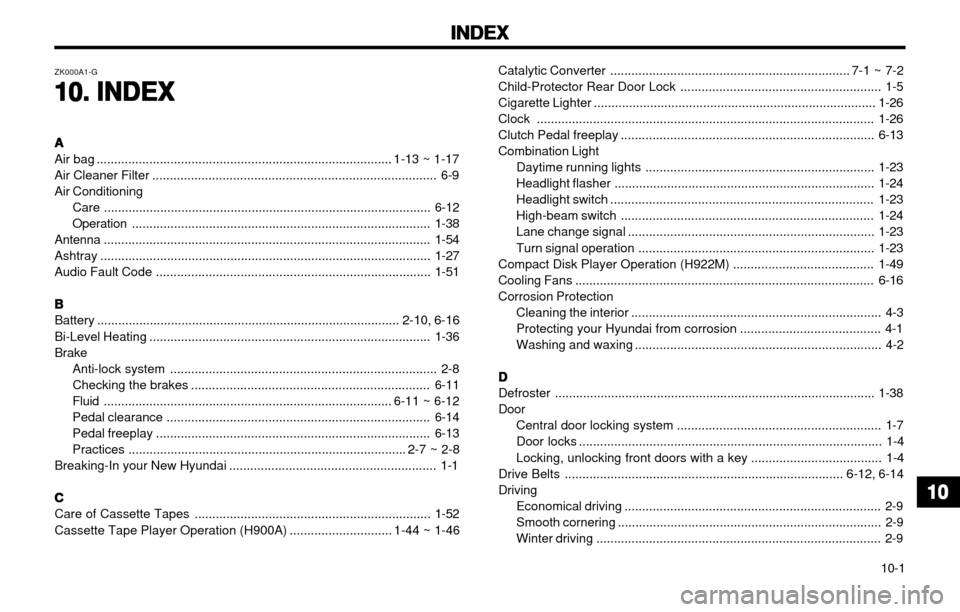
INDEX
INDEX INDEX
INDEX
INDEX
10-1
Catalytic Converter .................................................................... 7-1 ~ 7-2
Child-Protector Rear Door Lock ......................................................... 1-5
Cigarette Lighter ................................................................................
1-26
Clock ................................................................................................ 1-26
Clutch Pedal freeplay ........................................................................ 6-13
Combination Light Daytime running lights ................................................................. 1-23
Headlight flasher .......................................................................... 1-24
Headlight switch ........................................................................... 1-23
High-beam switch ........................................................................ 1-24
Lane change signal ...................................................................... 1-23
Turn signal operation ................................................................... 1-23
Compact Disk Player Operation (H922M) ........................................ 1-49
Cooling Fans ..................................................................................... 6-16
Corrosion Protection Cleaning the interior ....................................................................... 4-3
Protecting your Hyundai from corrosion ........................................ 4-1
Washing and waxing ...................................................................... 4-2
DD
DD
D
Defroster ........................................................................................... 1-38
Door Central door locking system .......................................................... 1-7
Door locks ...................................................................................... 1-4
Locking, unlocking front doors with a key ..................................... 1-4
Drive Belts ............................................................................... 6-12, 6-14 Driving Economical driving ......................................................................... 2-9
Smooth cornering ........................................................................... 2-9
Winter driving ................................................................................. 2-9
ZK000A1-G
10. INDEX
10. INDEX 10. INDEX
10. INDEX
10. INDEX
AA
AA
A
Air bag .................................................................................... 1-13 ~ 1-17
Air Cleaner Filter ................................................................................. 6-9Air Conditioning
Care ............................................................................................. 6-12
Operation ..................................................................................... 1-38
Antenna ............................................................................................. 1-54
Ashtray .............................................................................................. 1-27
Audio Fault Code .............................................................................. 1-51
BB
BB
B
Battery ...................................................................................... 2-10, 6-16
Bi-Level Heating ................................................................................ 1-36
Brake Anti-lock system ............................................................................ 2-8
Checking the brakes .................................................................... 6-11
Fluid .................................................................................. 6-11 ~ 6-12
Pedal clearance ........................................................................... 6-14
Pedal freeplay .............................................................................. 6-13
Practices ............................................................................... 2-7 ~ 2-8
Breaking-In your New Hyundai ........................................................... 1-1
CC
CC
C
Care of Cassette Tapes ................................................................... 1-52
Cassette Tape Player Operation (H900A) ............................. 1-44 ~ 1-46
1010
1010
10