Page 222 of 264
Brake fluid is toxic. If brake fluid contacts the eyes, flush eyes
with running water for 15 minutes. Seek medical if irritation
persists. If taken internally, drink water and induce vomiting. Seek
medical attention immediately.
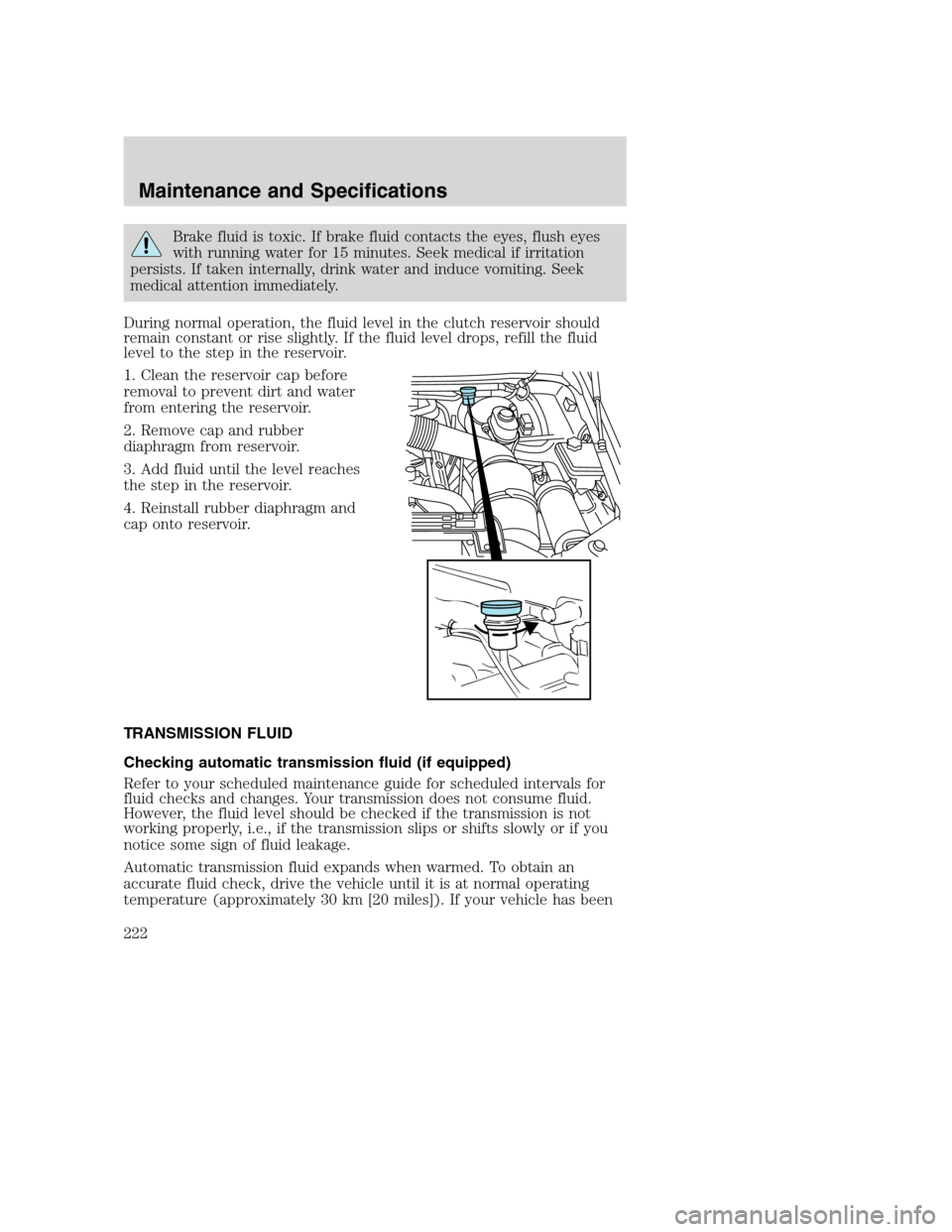
During normal operation, the fluid level in the clutch reservoir should
remain constant or rise slightly. If the fluid level drops, refill the fluid
level to the step in the reservoir.
1. Clean the reservoir cap before
removal to prevent dirt and water
from entering the reservoir.
2. Remove cap and rubber
diaphragm from reservoir.
3. Add fluid until the level reaches
the step in the reservoir.
4. Reinstall rubber diaphragm and
cap onto reservoir.
TRANSMISSION FLUID
Checking automatic transmission fluid (if equipped)
Refer to your scheduled maintenance guide for scheduled intervals for
fluid checks and changes. Your transmission does not consume fluid.
However, the fluid level should be checked if the transmission is not
working properly, i.e., if the transmission slips or shifts slowly or if you
notice some sign of fluid leakage.
Automatic transmission fluid expands when warmed. To obtain an
accurate fluid check, drive the vehicle until it is at normal operating
temperature (approximately 30 km [20 miles]). If your vehicle has been
Maintenance and Specifications
222
Page 223 of 264
operated for an extended period at high speeds, in city traffic during hot
weather or pulling a trailer, the vehicle should be turned off for about 30
minutes to allow fluid to cool before checking.
1. Drive the vehicle 30 km (20 miles) or until it reaches normal operating
temperature.
2. Park the vehicle on a level surface and engage the parking brake.
3. With the parking brake engaged and your foot on the brake pedal,
start the engine and move the gearshift lever through all of the gear
ranges. Allow sufficient time for each gear to engage.
4. Latch the gearshift lever in P (Park) and leave the engine running.
5. Remove the dipstick, wiping it clean with a clean, dry lint free rag. If
necessary, refer toIdentifying components in the engine compartment
in this chapter for the location of the dipstick.
6. Install the dipstick making sure it is fully seated in the filler tube.
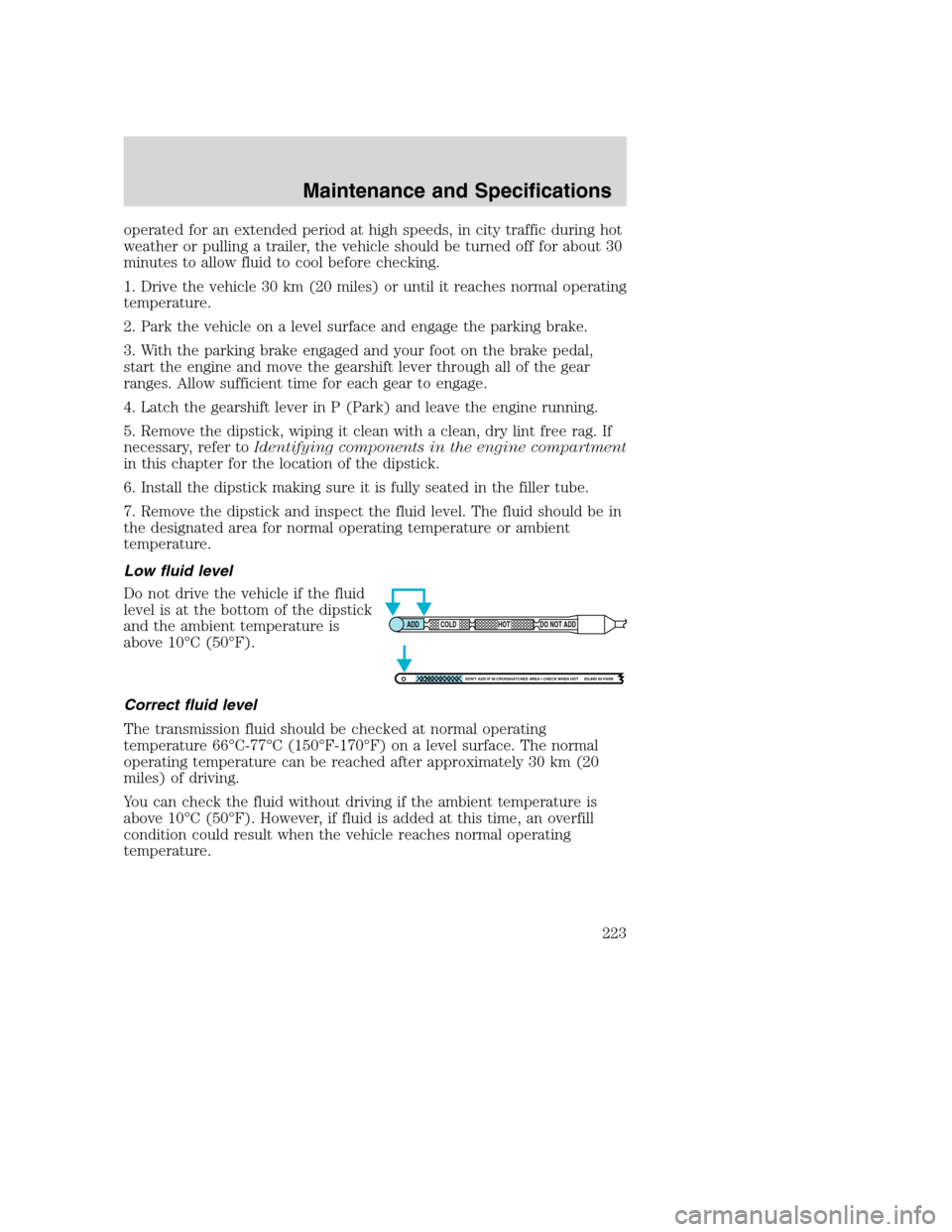
7. Remove the dipstick and inspect the fluid level. The fluid should be in
the designated area for normal operating temperature or ambient
temperature.
Low fluid level
Do not drive the vehicle if the fluid
level is at the bottom of the dipstick
and the ambient temperature is
above 10°C (50°F).
Correct fluid level
The transmission fluid should be checked at normal operating
temperature 66°C-77°C (150°F-170°F) on a level surface. The normal
operating temperature can be reached after approximately 30 km (20
miles) of driving.
You can check the fluid without driving if the ambient temperature is
above 10°C (50°F). However, if fluid is added at this time, an overfill
condition could result when the vehicle reaches normal operating
temperature.
ADD COLD HOT DO NOT ADD
DON'T ADD IF IN CROSSHATCHED AREA CHECK WHEN HOT IDLING IN PARK
Maintenance and Specifications
223
Page 233 of 264
Make sure that all replacement tires are of the same size, type,
load-carrying capacity and tread design (e.g., “All Terrain”,
“Touring”, etc.), as originally offered by Ford.
Do not replace your tires with “high performance” tires or larger
size tires.
Failure to follow these precautions, your vehicle handling may be
adversely effected which can lead to loss of vehicle control,
vehicle rollover and/or personal injury.
Tires that are larger or smaller than your vehicle’s original tires may also
affect the accuracy of your speedometer.
SNOW TIRES AND CHAINS
Snow tires must be the same size and grade as the tires you
currently have on your vehicle.
The tires on your vehicle have all weather treads to provide traction in
rain and snow. However, in some climates, you may need to use snow
tires and chains. If you need to use chains, it is recommended that steel
wheels (of the same size and specifications) be used, as chains may chip
aluminum wheels.
Follow these guidelines when using snow tires and chains:
•Use only SAE Class S chains.
•Install chains securely, verifying that the chains do not touch any
wiring, brake lines or fuel lines.
•Drive cautiously. If you hear the chains rub or bang against your
vehicle, stop and re-tighten the chains. If this does not work, remove
the chains to prevent damage to your vehicle.
•If possible, avoid fully loading your vehicle.
•Remove the tire chains when they are no longer needed. Do not use
tire chains on dry roads.
•The suspension insulation and bumpers will help prevent vehicle
damage. Do not remove these components from your vehicle when
using snow tires and chains.
Maintenance and Specifications
233
Page 235 of 264
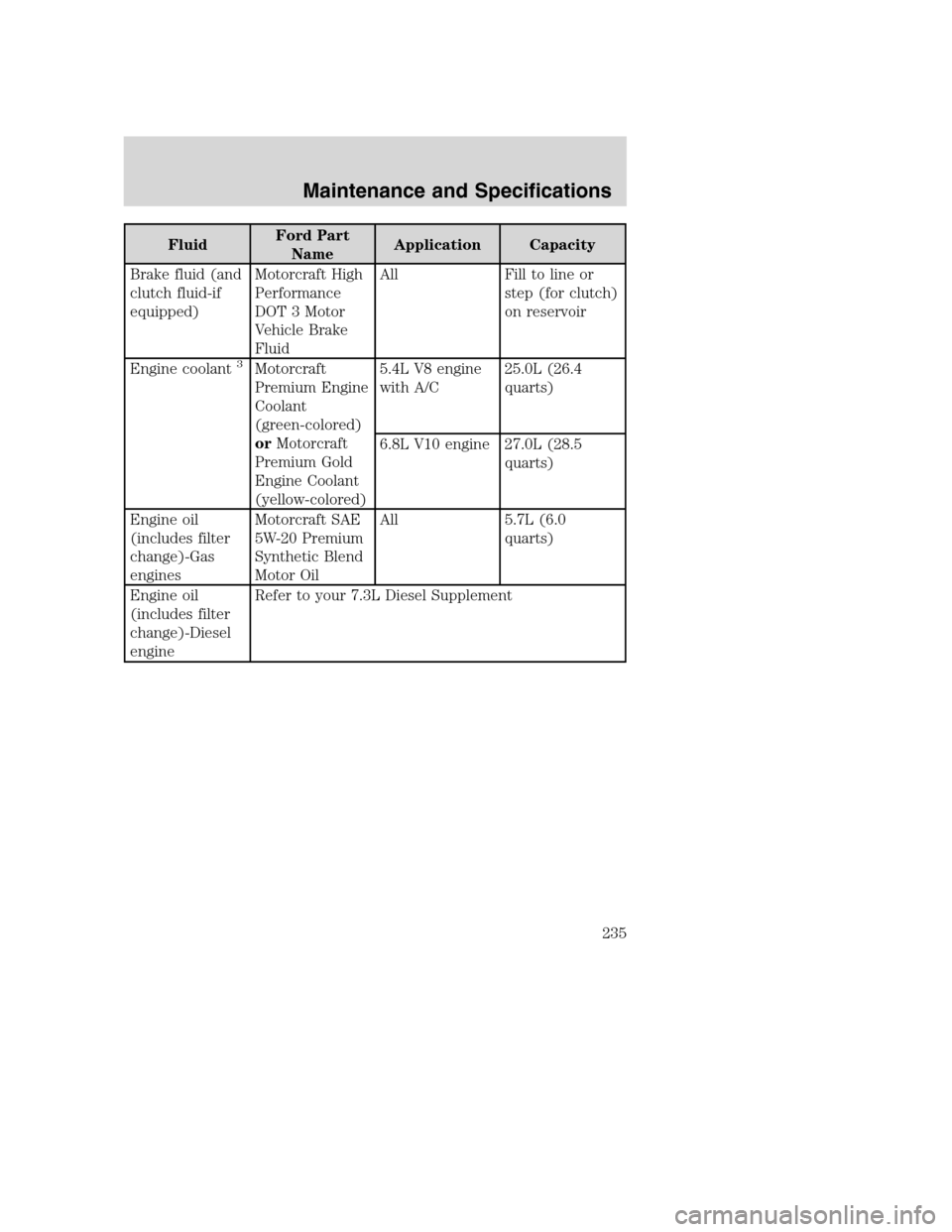
FluidFord Part
NameApplication Capacity
Brake fluid (and
clutch fluid-if
equipped)Motorcraft High
Performance
DOT 3 Motor
Vehicle Brake
FluidAll Fill to line or
step (for clutch)
on reservoir
Engine coolant
3Motorcraft
Premium Engine
Coolant
(green-colored)
orMotorcraft
Premium Gold
Engine Coolant
(yellow-colored)5.4L V8 engine
with A/C25.0L (26.4
quarts)
6.8L V10 engine 27.0L (28.5
quarts)
Engine oil
(includes filter
change)-Gas
enginesMotorcraft SAE
5W-20 Premium
Synthetic Blend
Motor OilAll 5.7L (6.0
quarts)
Engine oil
(includes filter
change)-Diesel
engineRefer to your 7.3L Diesel Supplement
Maintenance and Specifications
235
Page 238 of 264
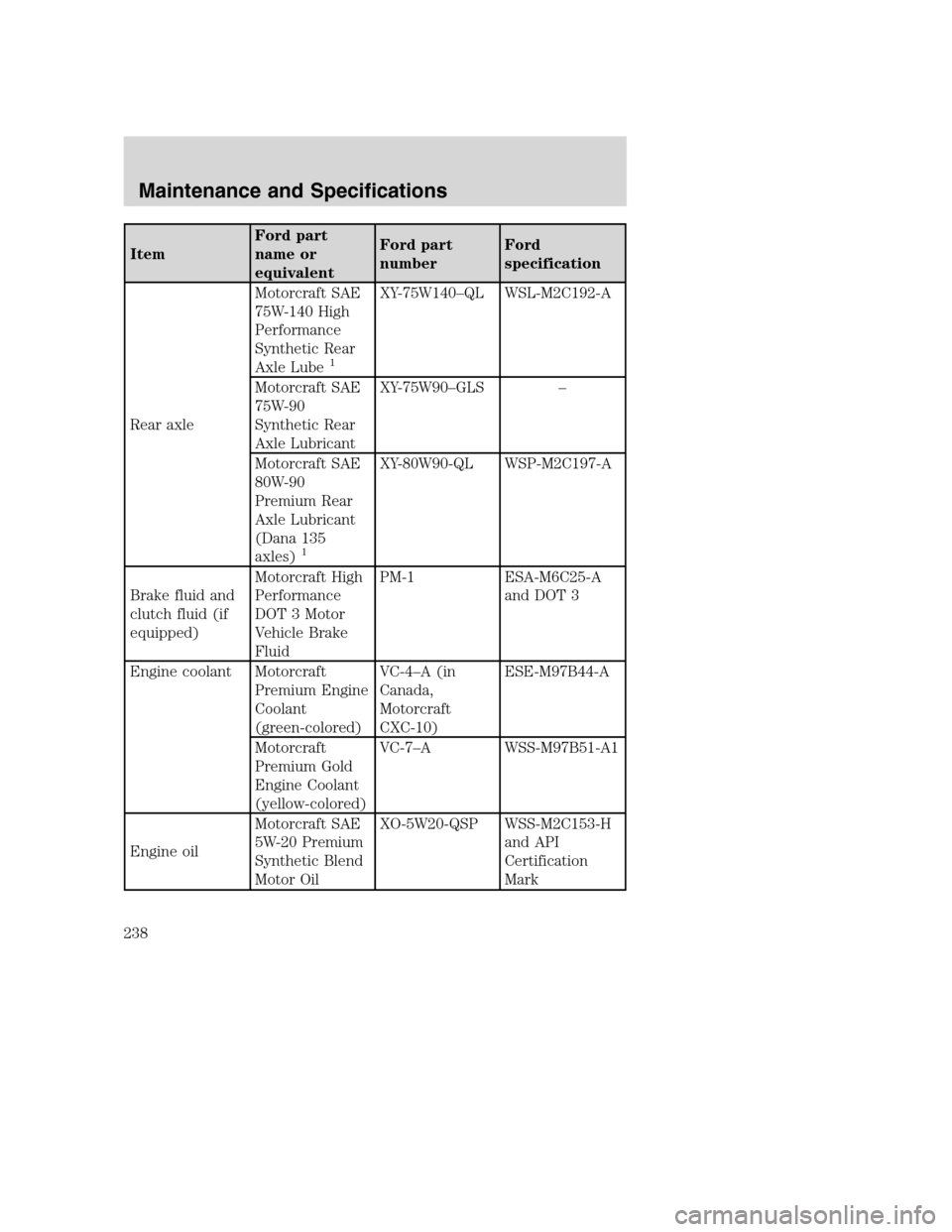
ItemFord part
name or
equivalentFord part
numberFord
specification
Rear axleMotorcraft SAE
75W-140 High
Performance
Synthetic Rear
Axle Lube
1
XY-75W140–QL WSL-M2C192-A
Motorcraft SAE
75W-90
Synthetic Rear
Axle LubricantXY-75W90–GLS –
Motorcraft SAE
80W-90
Premium Rear
Axle Lubricant
(Dana 135
axles)
1
XY-80W90-QL WSP-M2C197-A
Brake fluid and
clutch fluid (if
equipped)Motorcraft High
Performance
DOT 3 Motor
Vehicle Brake
FluidPM-1 ESA-M6C25-A
and DOT 3
Engine coolant Motorcraft
Premium Engine
Coolant
(green-colored)VC-4–A (in
Canada,
Motorcraft
CXC-10)ESE-M97B44-A
Motorcraft
Premium Gold
Engine Coolant
(yellow-colored)VC-7–A WSS-M97B51-A1
Engine oilMotorcraft SAE
5W-20 Premium
Synthetic Blend
Motor OilXO-5W20-QSP WSS-M2C153-H
and API
Certification
Mark
Maintenance and Specifications
238
Page 239 of 264
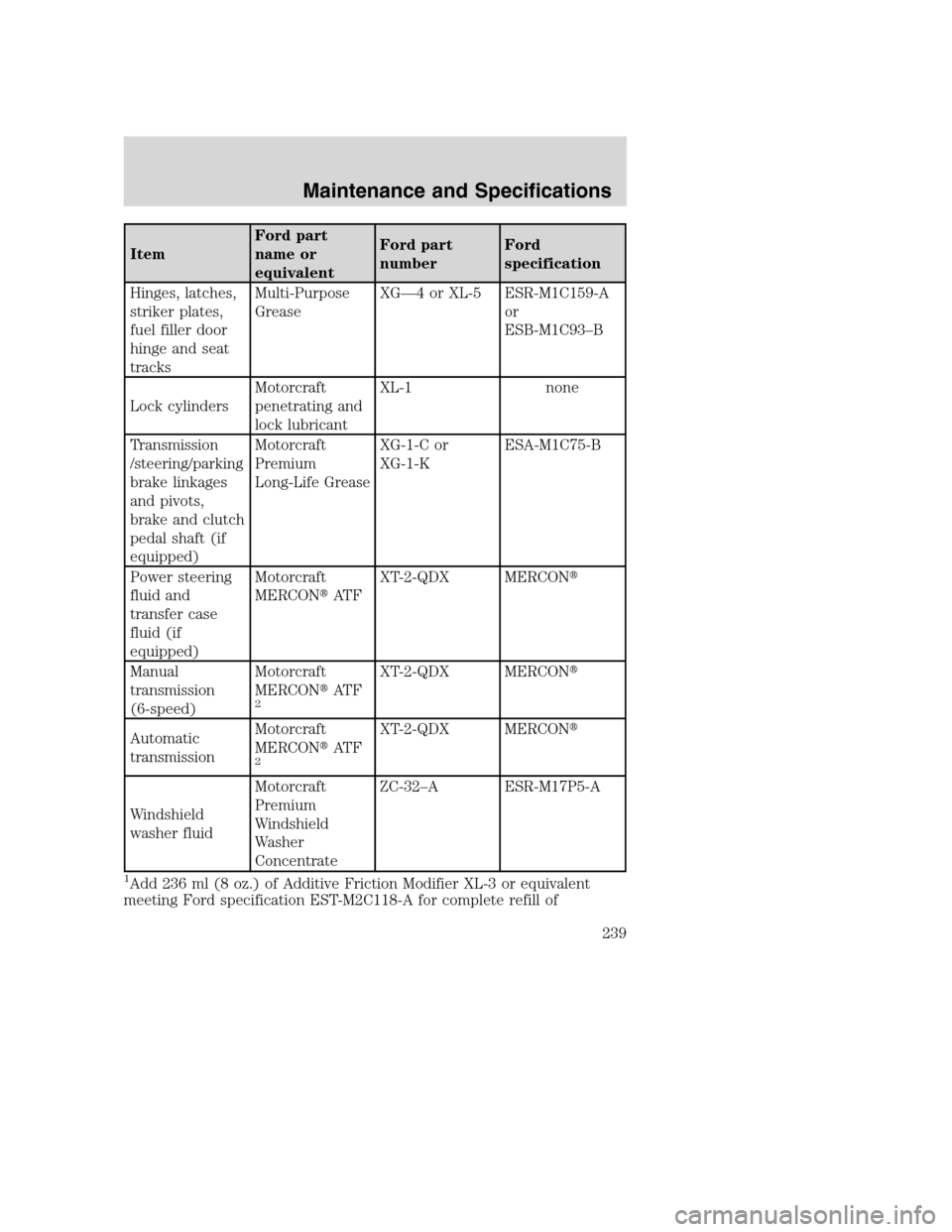
ItemFord part
name or
equivalentFord part
numberFord
specification
Hinges, latches,
striker plates,
fuel filler door
hinge and seat
tracksMulti-Purpose
GreaseXG—4 or XL-5 ESR-M1C159-A
or
ESB-M1C93–B
Lock cylindersMotorcraft
penetrating and
lock lubricantXL-1 none
Transmission
/steering/parking
brake linkages
and pivots,
brake and clutch
pedal shaft (if
equipped)Motorcraft
Premium
Long-Life GreaseXG-1-C or
XG-1-KESA-M1C75-B
Power steering
fluid and
transfer case
fluid (if
equipped)Motorcraft
MERCON�AT FXT-2-QDX MERCON�
Manual
transmission
(6-speed)Motorcraft
MERCON�AT F
2
XT-2-QDX MERCON�
Automatic
transmissionMotorcraft
MERCON�AT F
2
XT-2-QDX MERCON�
Windshield
washer fluidMotorcraft
Premium
Windshield
Washer
ConcentrateZC-32–A ESR-M17P5-A
1Add 236 ml (8 oz.) of Additive Friction Modifier XL-3 or equivalent
meeting Ford specification EST-M2C118-A for complete refill of
Maintenance and Specifications
239
Page 250 of 264
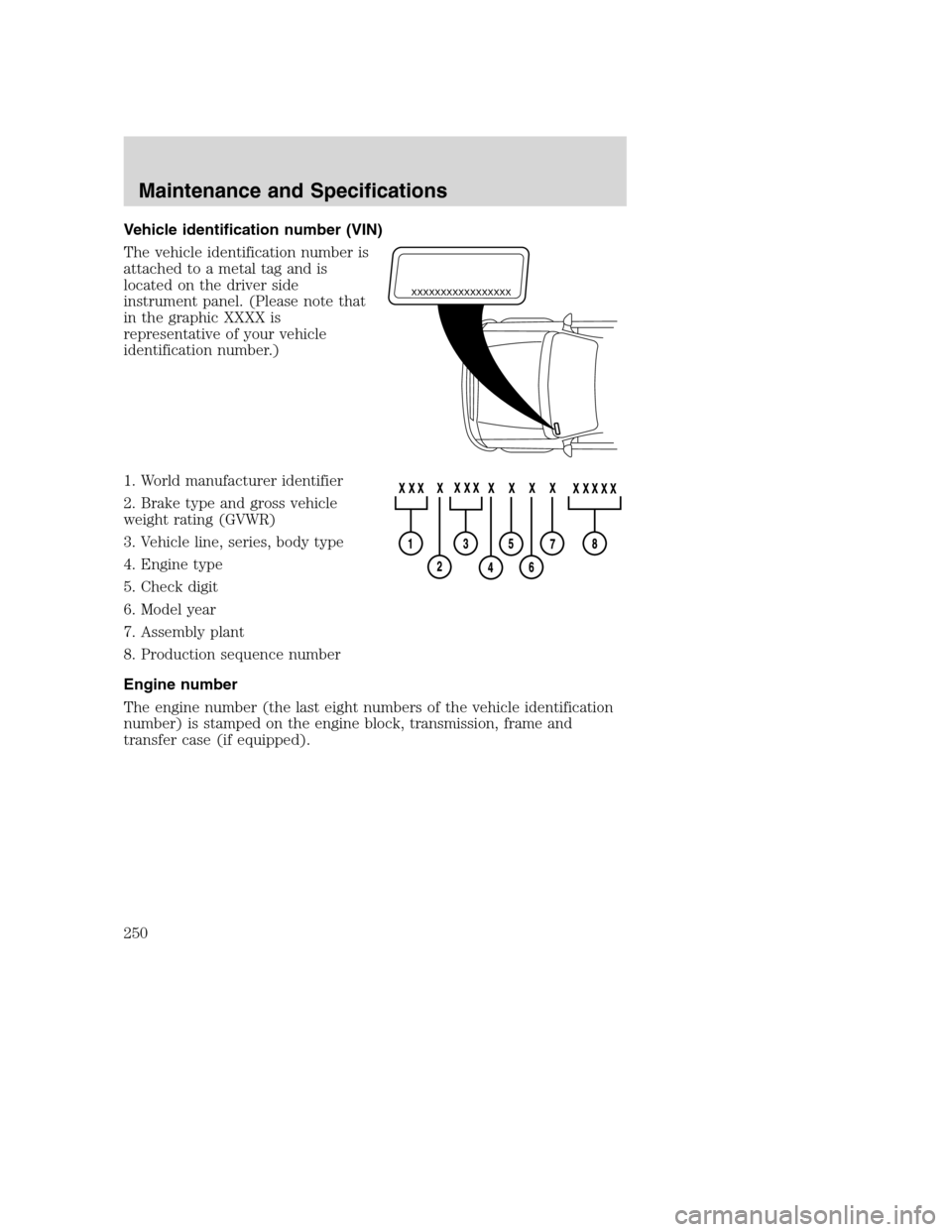
Vehicle identification number (VIN)
The vehicle identification number is
attached to a metal tag and is
located on the driver side
instrument panel. (Please note that
in the graphic XXXX is
representative of your vehicle
identification number.)
1. World manufacturer identifier
2. Brake type and gross vehicle
weight rating (GVWR)
3. Vehicle line, series, body type
4. Engine type
5. Check digit
6. Model year
7. Assembly plant
8. Production sequence number
Engine number
The engine number (the last eight numbers of the vehicle identification
number) is stamped on the engine block, transmission, frame and
transfer case (if equipped).
XXXXXXXXXXXXXXXXX
Maintenance and Specifications
250
Page 255 of 264

A
Accessory delay ..........................48
Air bag supplemental restraint
system ..........................................82
and child safety seats ..............83
description ................................82
disposal ......................................86
driver air bag ............................84
indicator light ...........................85
operation ...................................84
passenger air bag .....................84
passenger deactivation
switch ........................................86
Air cleaner filter .......226–227, 234
Ambulance packages ....................6
Antifreeze
(see Engine coolant) ................204
Anti-lock brake system
(see Brakes) ......................106–107
Audio system
(see Radio) ................17, 19, 22, 26
Automatic transmission ............109
driving an automatic
overdrive .................................110
fluid, adding ............................222
fluid, checking ........................222
fluid, refill capacities ..............234
fluid, specification ..................240
Auxiliary power point .................47
Axle
lubricant specifications ..237, 240
refill capacities ........................234
traction lok ..............................108
B
Battery .......................................202
acid, treating emergencies .....202jumping a disabled battery ....174
maintenance-free ....................202
replacement, specifications ...234
servicing ..................................202
BeltMinder ...................................77
Brakes ........................................105
anti-lock ...........................105–107
anti-lock brake system (ABS)
warning light ...........................106
fluid, checking and adding ....221
fluid, refill capacities ..............234
fluid, specifications .........237, 240
lubricant specifications ..237, 240
parking ....................................107
pedals (see Power adjustable
foot pedals) ...............................49
shift interlock ..........................109
Break-in period .............................4
Bulbs ............................................39
C
Capacities for refilling fluids ....234
Cassette tape player ...................26
CD changer .................................28
CD-single premium .........17, 19, 22
Certification Label ....................249
Child safety restraints ................91
child safety belts ......................91
Child safety seats ........................93
attaching with tether straps ....97
in front seat ..............................95
in rear seat ................................95
Cleaning your vehicle
engine compartment ..............191
instrument panel ....................193
interior .....................................193
plastic parts ............................192
Index
255