Page 153 of 184
FFV engine (if equipped)
Flexible fuel vehicle (FFV) fuel tanks may contain 0 to 85 percent or
more of ethnanol. Any fuel blends containing gasoline and ethanol should
be treated the same as“Fuel Ethanol (E85).”To identify if your vehicle
is an FFV, check your VIN or the label on the inside of your fuel filler
door. When checking your VIN, the engine type identifier (8th character)
is“K.”
If you have a flex fuel vehicle, use only UNLEADED FUEL and
ETHANOL (E85).
Note:Flexible fuel components and standard unleaded fuel components
are NOT interchangeable. If your vehicle is not serviced in accordance
with flexible fuel vehicle procedures, damage may occur and your
warranty may be invalidated.
U.S. government regulations require fuel ethanol dispensing
pumps to have a small, square, orange and black label with the
common abbreviation E85 or the appropriate percentage for that
region. Use of other fuels such as Fuel Methanol may cause power
train damage, a loss of vehicle performance, and your warranty
may be invalidated.
Fuel quality
The World-wide Fuel Charter
recommends gasoline specifications
to provide improved performance
and emission control system
protection. Ask your fuel supplier
about gasolines that meet the
World-wide Fuel Charter. In Canada,
look for fuels that display theAuto
Makers’Choice�logo.
It should not be necessary to add
any aftermarket products to your
fuel tank if you use high quality fuel of the recommended octane rating.
Aftermarket products could cause damage to the fuel system and
invalidate your warranty.
Cleaner air
Ford endorses the use of reformulated“cleaner-burning”gasolines to
improve air quality.
Maintenance and Specifications
153
Page 154 of 184
Running out of fuel
Running out of fuel may have an adverse affect on powertrain
components.
•You may need to cycle the ignition from off to on several times after
refueling to allow the fuel system to pump the fuel from the tank to
the engine.
•Your“Check Engine”indicator may come on.
Fuel filler cap
When fueling:
1. Turn the engine off.
2. Carefully turn the filler cap counterclockwise 1/8 of a turn until it
stops.
3. Pull to remove the cap.
4. To install the cap, align the tabs on the cap with the notches on the
filler pipe.
5. Turn the filler cap clockwise 1/8 of a turn until it stops.
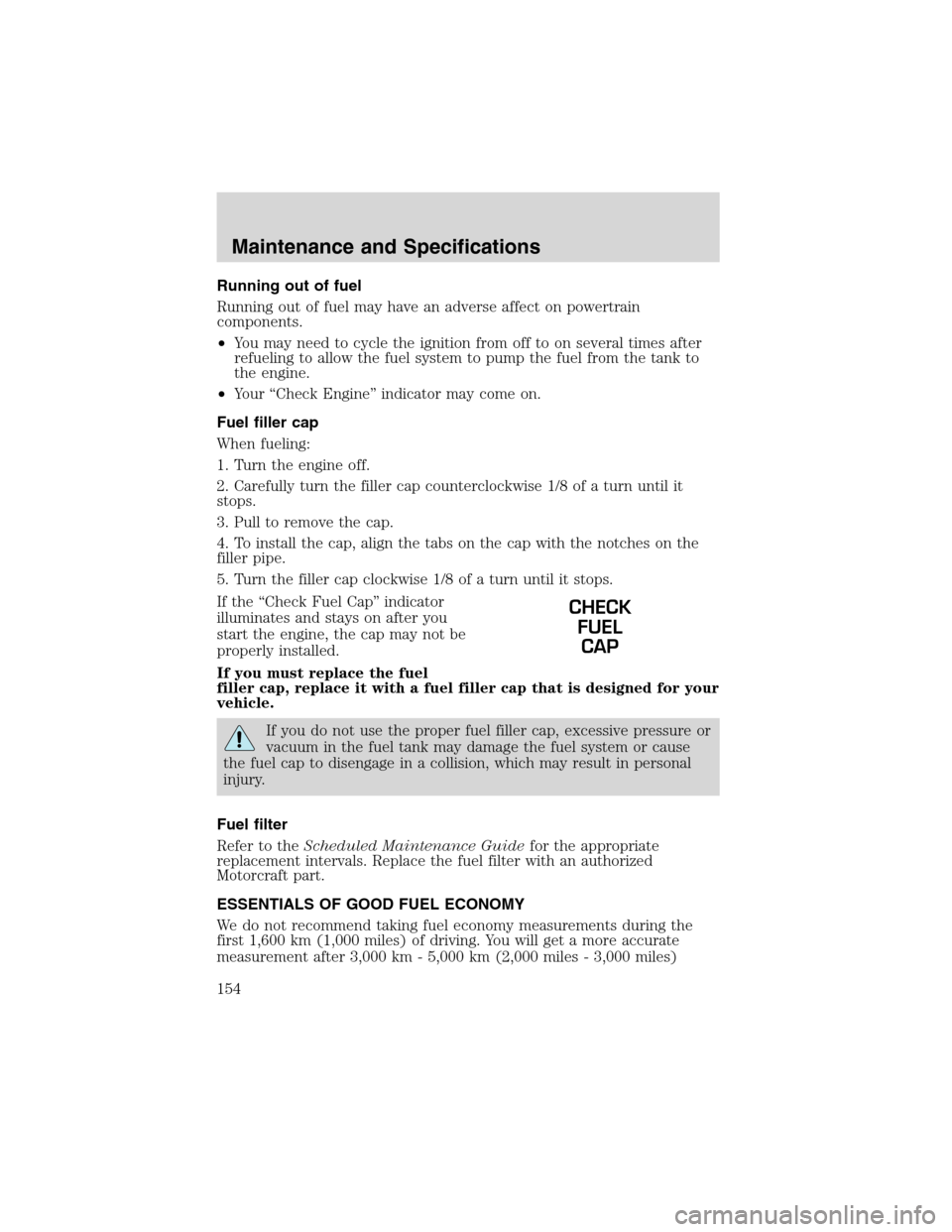
If the“Check Fuel Cap”indicator
illuminates and stays on after you
start the engine, the cap may not be
properly installed.
If you must replace the fuel
filler cap, replace it with a fuel filler cap that is designed for your
vehicle.
If you do not use the proper fuel filler cap, excessive pressure or
vacuum in the fuel tank may damage the fuel system or cause
the fuel cap to disengage in a collision, which may result in personal
injury.
Fuel filter
Refer to theScheduled Maintenance Guidefor the appropriate
replacement intervals. Replace the fuel filter with an authorized
Motorcraft part.
ESSENTIALS OF GOOD FUEL ECONOMY
We do not recommend taking fuel economy measurements during the
first 1,600 km (1,000 miles) of driving. You will get a more accurate
measurement after 3,000 km - 5,000 km (2,000 miles - 3,000 miles)
CHECK
FUEL
CAP
Maintenance and Specifications
154
Page 157 of 184
The following signs could indicate a problem with your emission control
system:
•Fluid leaks
•Strange odors
•Smoke
•Loss of engine power
•Illumination of the charging system, temperature, or“Check Engine”
light in the instrument panel.
Exhaust leaks may result in harmful and potentially lethal fumes
entering the passenger compartment.
It is unlawful to intentionally remove an emission control device or
prevent it from working. Information about your vehicle’s emission
system is on the Vehicle Emission Control Information decal located on
or near the engine.
READINESS FOR INSPECTION/MAINTENANCE (I/M) TESTING
It may be a legal requirement in your area to pass an I/M test of the
on-board diagnostics system. If the system or battery has just been
serviced, the on-board diagnostic system is reset to a“not ready for I/M
test”condition. To ready the system, allow the vehicle to sit for at least
eight hours without starting. Then, start the engine and complete the
following driving cycle:
1. Drive on an expressway or highway for at least 10 minutes.
2. Drive in stop-and-go traffic for at least 20 minutes with a minimum of
four idle periods.
The engine must warm up to its normal operating temperature. Once
started, do not turn off the engine until the above drive cycle is
complete.
Note:If your“Check Engine”light is on, your vehicle may not pass an
I/M test.
Maintenance and Specifications
157
Page 158 of 184
CHECKING AND ADDING POWER STEERING FLUID
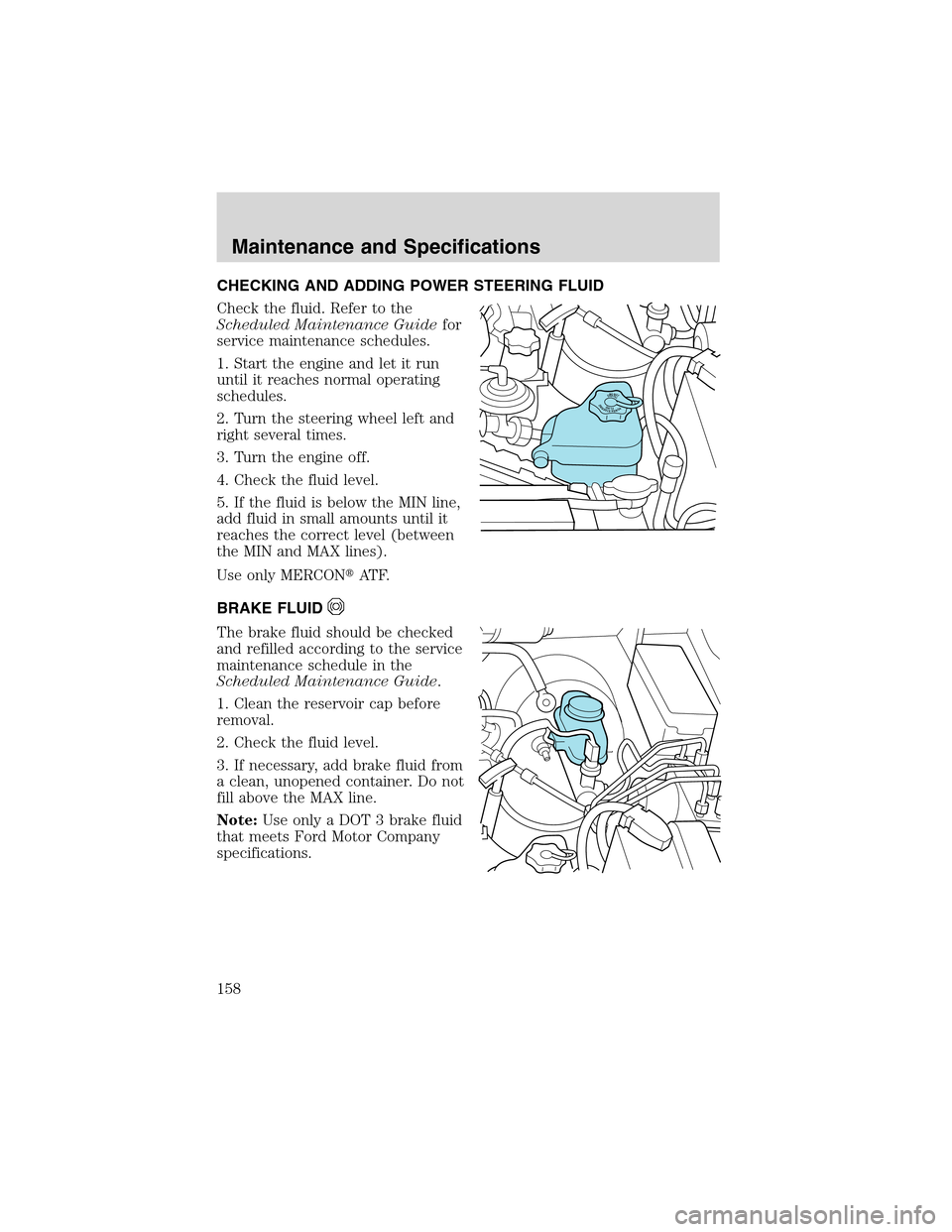
Check the fluid. Refer to the
Scheduled Maintenance Guidefor
service maintenance schedules.
1. Start the engine and let it run
until it reaches normal operating
schedules.
2. Turn the steering wheel left and
right several times.
3. Turn the engine off.
4. Check the fluid level.
5. If the fluid is below the MIN line,
add fluid in small amounts until it
reaches the correct level (between
the MIN and MAX lines).
Use only MERCON�AT F.
BRAKE FLUID
The brake fluid should be checked
and refilled according to the service
maintenance schedule in the
Scheduled Maintenance Guide.
1. Clean the reservoir cap before
removal.
2. Check the fluid level.
3. If necessary, add brake fluid from
a clean, unopened container. Do not
fill above the MAX line.
Note:Use only a DOT 3 brake fluid
that meets Ford Motor Company
specifications.
DONOTOVERFILLPOWERSTEERINGFLUID
Maintenance and Specifications
158
Page 159 of 184
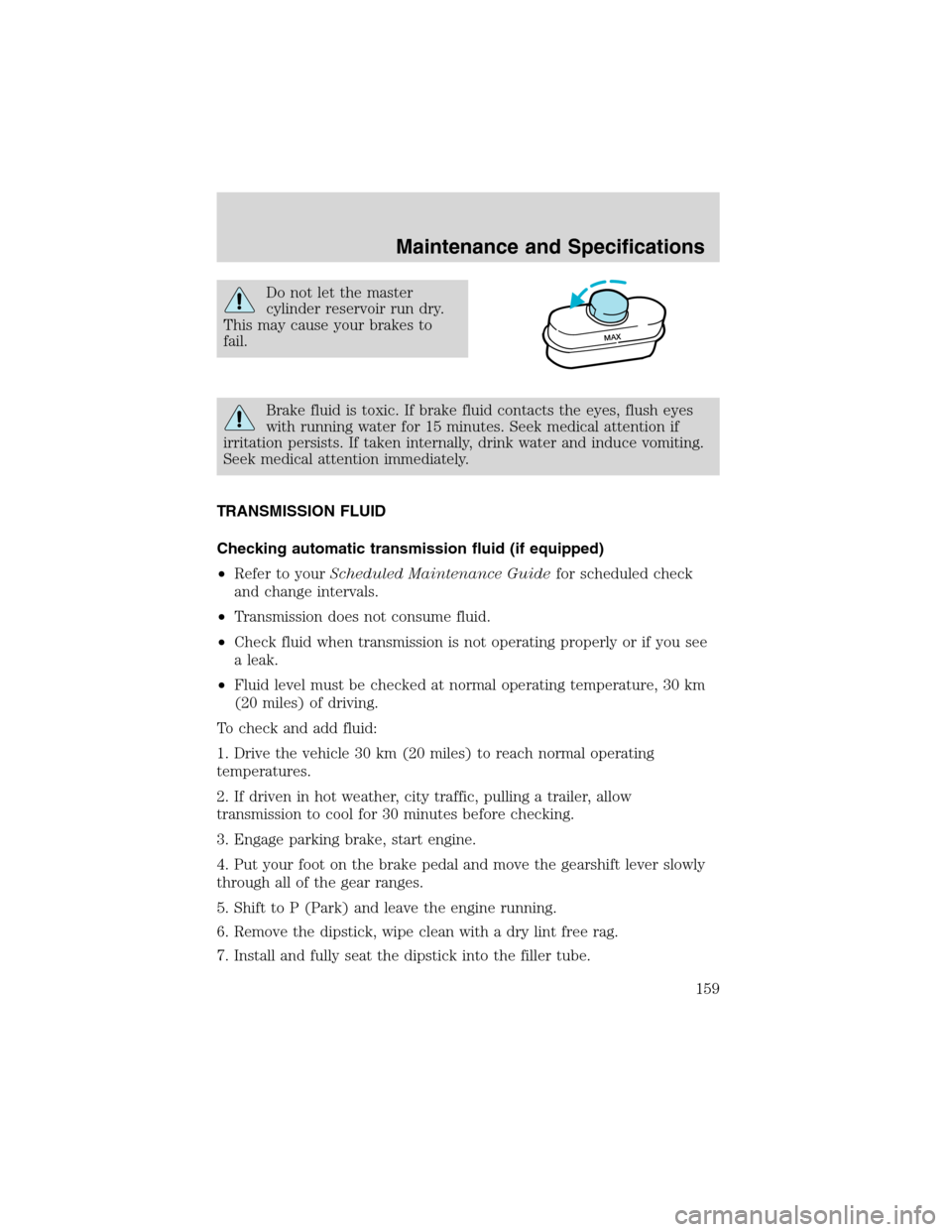
Do not let the master
cylinder reservoir run dry.
This may cause your brakes to
fail.
Brake fluid is toxic. If brake fluid contacts the eyes, flush eyes
with running water for 15 minutes. Seek medical attention if
irritation persists. If taken internally, drink water and induce vomiting.
Seek medical attention immediately.
TRANSMISSION FLUID
Checking automatic transmission fluid (if equipped)
•Refer to yourScheduled Maintenance Guidefor scheduled check
and change intervals.
•Transmission does not consume fluid.
•Check fluid when transmission is not operating properly or if you see
a leak.
•Fluid level must be checked at normal operating temperature, 30 km
(20 miles) of driving.
To check and add fluid:
1. Drive the vehicle 30 km (20 miles) to reach normal operating
temperatures.
2. If driven in hot weather, city traffic, pulling a trailer, allow
transmission to cool for 30 minutes before checking.
3. Engage parking brake, start engine.
4. Put your foot on the brake pedal and move the gearshift lever slowly
through all of the gear ranges.
5. Shift to P (Park) and leave the engine running.
6. Remove the dipstick, wipe clean with a dry lint free rag.
7. Install and fully seat the dipstick into the filler tube.
MAX
Maintenance and Specifications
159
Page:
< prev 1-8 9-16 17-24