Page 2 of 184
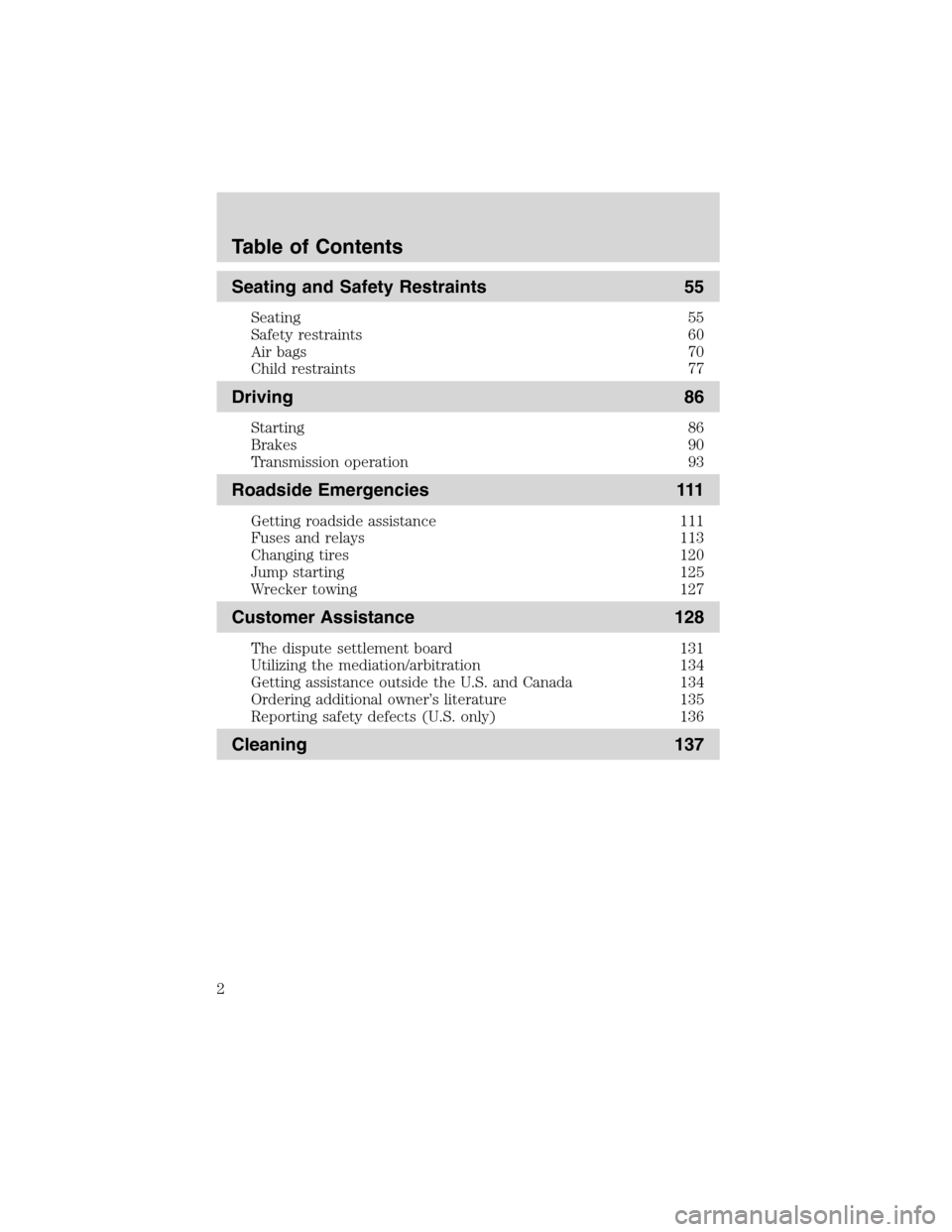
Seating and Safety Restraints 55
Seating 55
Safety restraints 60
Air bags 70
Child restraints 77
Driving 86
Starting 86
Brakes 90
Transmission operation 93
Roadside Emergencies 111
Getting roadside assistance 111
Fuses and relays 113
Changing tires 120
Jump starting 125
Wrecker towing 127
Customer Assistance 128
The dispute settlement board 131
Utilizing the mediation/arbitration 134
Getting assistance outside the U.S. and Canada 134
Ordering additional owner’s literature 135
Reporting safety defects (U.S. only) 136
Cleaning 137
Table of Contents
2
Page 6 of 184
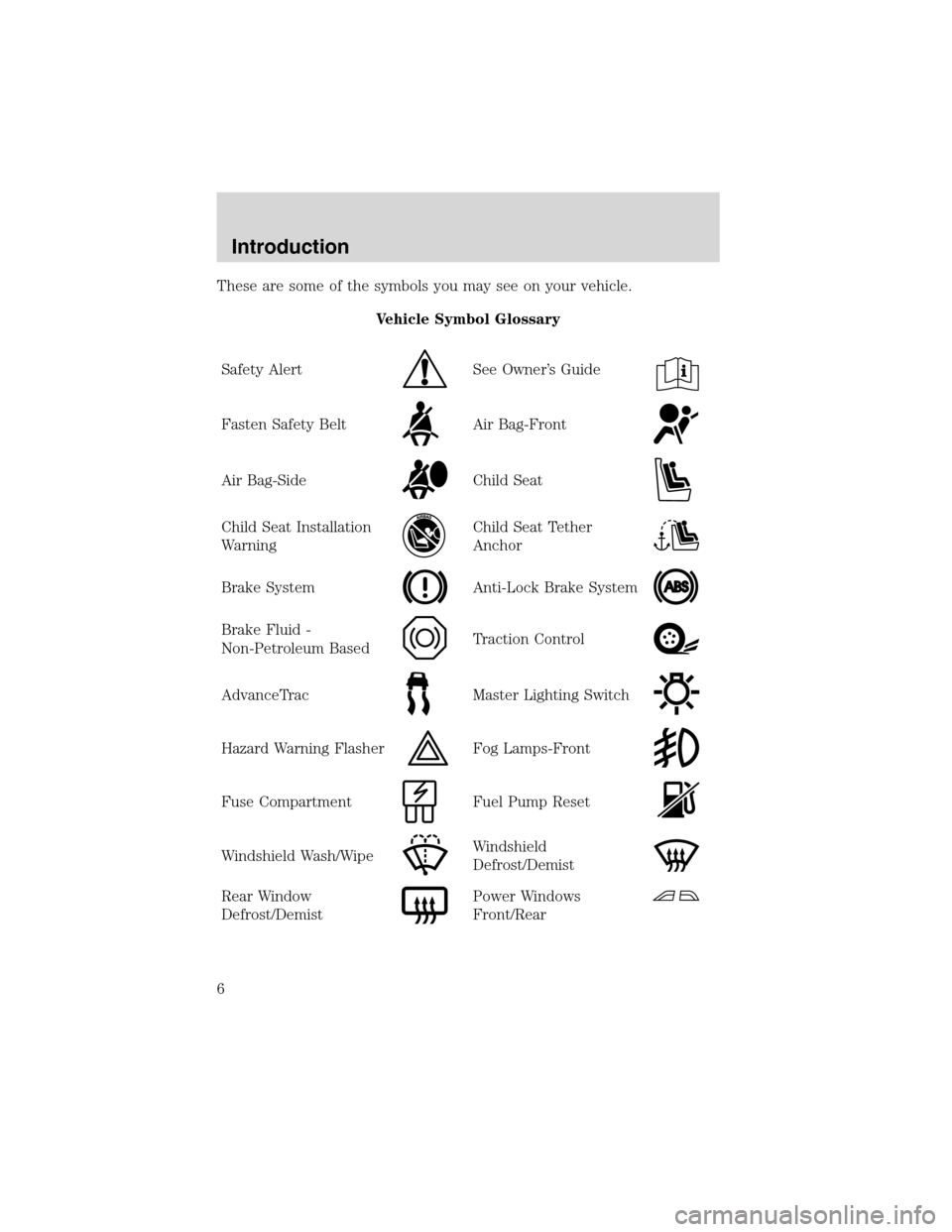
These are some of the symbols you may see on your vehicle.
Vehicle Symbol Glossary
Safety Alert
See Owner’s Guide
Fasten Safety BeltAir Bag-Front
Air Bag-SideChild Seat
Child Seat Installation
WarningChild Seat Tether
Anchor
Brake SystemAnti-Lock Brake System
Brake Fluid -
Non-Petroleum BasedTraction Control
AdvanceTracMaster Lighting Switch
Hazard Warning FlasherFog Lamps-Front
Fuse CompartmentFuel Pump Reset
Windshield Wash/WipeWindshield
Defrost/Demist
Rear Window
Defrost/DemistPower Windows
Front/Rear
Introduction
6
Page 36 of 184
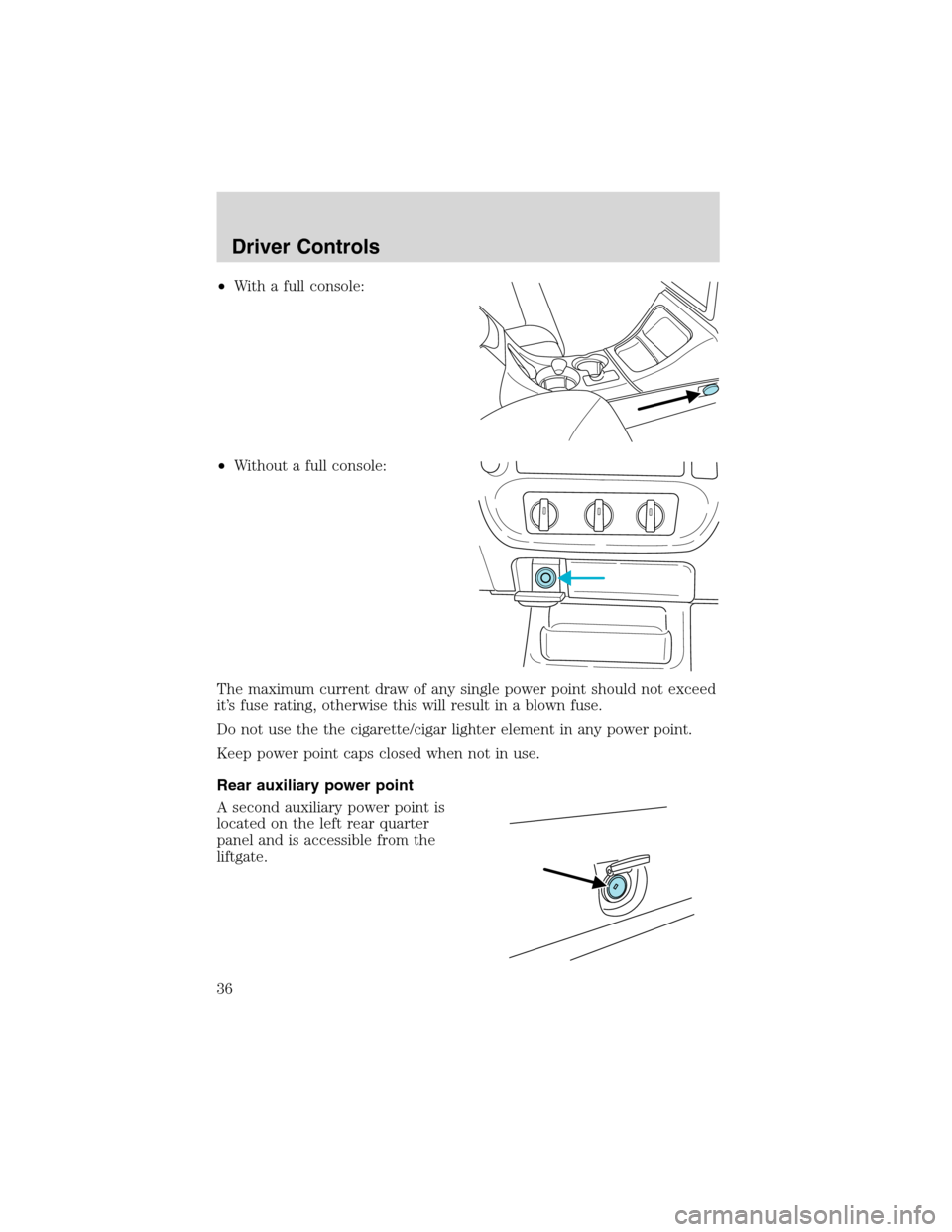
•With a full console:
•Without a full console:
The maximum current draw of any single power point should not exceed
it’s fuse rating, otherwise this will result in a blown fuse.
Do not use the the cigarette/cigar lighter element in any power point.
Keep power point caps closed when not in use.
Rear auxiliary power point
A second auxiliary power point is
located on the left rear quarter
panel and is accessible from the
liftgate.
Driver Controls
36
Page 72 of 184
Do not attempt to service, repair, or modify the air bag
supplemental restraint systems or its fuses. See your Ford or
Lincoln Mercury dealer.
Modifying or adding equipment to the front end of the vehicle
(including frame, bumper, front end body structure and tow
hooks) may affect the performance of the air bag system, increasing
the risk of injury. Do not modify the front end of the vehicle.
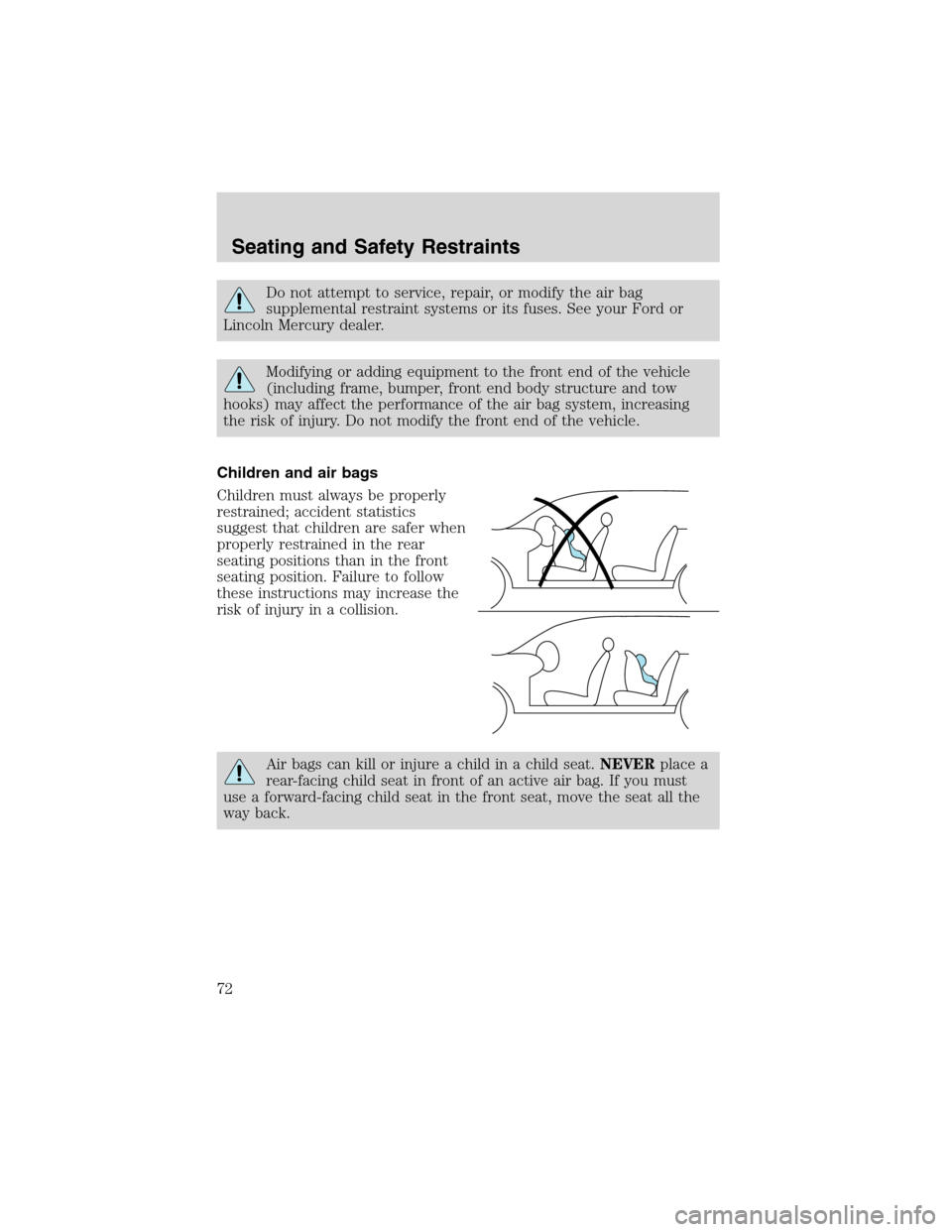
Children and air bags
Children must always be properly
restrained; accident statistics
suggest that children are safer when
properly restrained in the rear
seating positions than in the front
seating position. Failure to follow
these instructions may increase the
risk of injury in a collision.
Air bags can kill or injure a child in a child seat.NEVERplace a
rear-facing child seat in front of an active air bag. If you must
use a forward-facing child seat in the front seat, move the seat all the
way back.
Seating and Safety Restraints
72
Page 75 of 184
Do not use accessory seat covers. The use of accessory seat
covers may prevent the deployment of the side air bags and
increase the risk of injury in an accident.
Do not lean your head on the door. The side air bag could injure
you as it deploys from the side of the seatback.
Do not attempt to service, repair, or modify the air bag SRS, its
fuses or the seat cover on a seat containing an air bag. See your
Ford or Lincoln Mercury dealer.
All occupants of the vehicle should always wear their safety belts
even when an air bag SRS is provided.
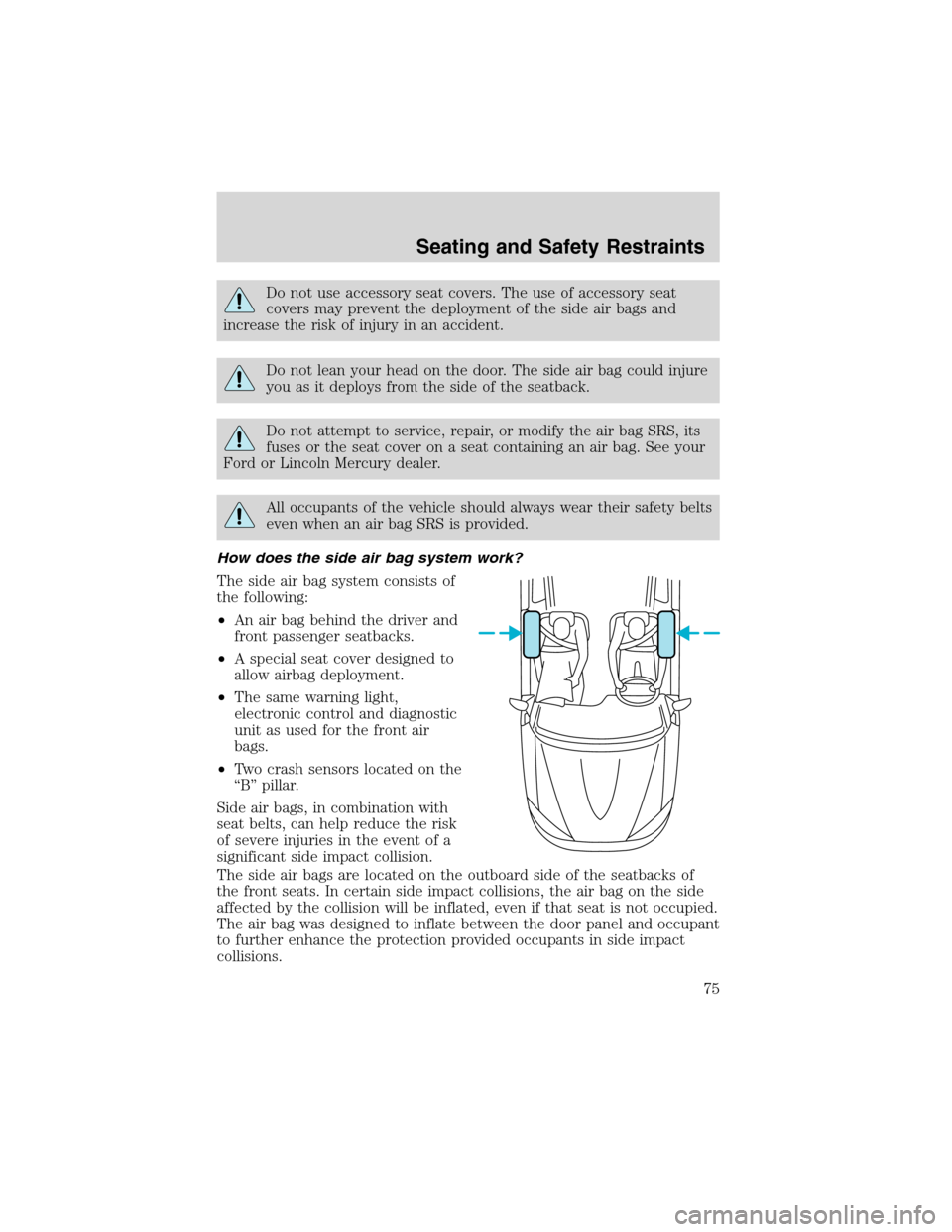
How does the side air bag system work?
The side air bag system consists of
the following:
•An air bag behind the driver and
front passenger seatbacks.
•A special seat cover designed to
allow airbag deployment.
•The same warning light,
electronic control and diagnostic
unit as used for the front air
bags.
•Two crash sensors located on the
“B”pillar.
Side air bags, in combination with
seat belts, can help reduce the risk
of severe injuries in the event of a
significant side impact collision.
The side air bags are located on the outboard side of the seatbacks of
the front seats. In certain side impact collisions, the air bag on the side
affected by the collision will be inflated, even if that seat is not occupied.
The air bag was designed to inflate between the door panel and occupant
to further enhance the protection provided occupants in side impact
collisions.
Seating and Safety Restraints
75
Page 93 of 184
Loaded vehicles, with a higher center of gravity, may handle
differently than unloaded vehicles. Extra precautions, such as
slower speeds and increased stopping distance, should be taken when
driving a heavily loaded vehicle.
AUTOMATIC TRANSMISSION OPERATION (IF EQUIPPED)
Brake-shift interlock
This vehicle is equipped with a brake-shift interlock feature that prevents
the gearshift lever from being moved from P (Park) when the ignition is
in the ON position unless brake pedal is depressed.
If you cannot move the gearshift lever out of P (Park) with ignition in
the ON position and the brake pedal depressed:
1. Apply the parking brake, turn ignition key to LOCK, then remove the
key.
2. Insert the key and turn it to OFF.Apply the brake pedal and shift
to N (Neutral).
In the ignition OFF position, the automatic transmission shift
lever can be moved from the P (Park) position without the brake
pedal depressed. To avoid unwanted vehicle movement, always set the
parking brake.
3. Start the vehicle.
If it is necessary to use the above procedure to move the gearshift lever,
it is possible that a fuse has blown or the vehicle’s brakelamps are not
operating properly. Refer toFuses and relaysin theRoadside
emergencieschapter.
Do not drive your vehicle until you verify that the brakelamps
are working.
Always set the parking brake fully and make sure the gearshift is
latched in P (Park). Turn the ignition to the LOCK position and
remove the key whenever you leave your vehicle.
Driving
93
Page 113 of 184
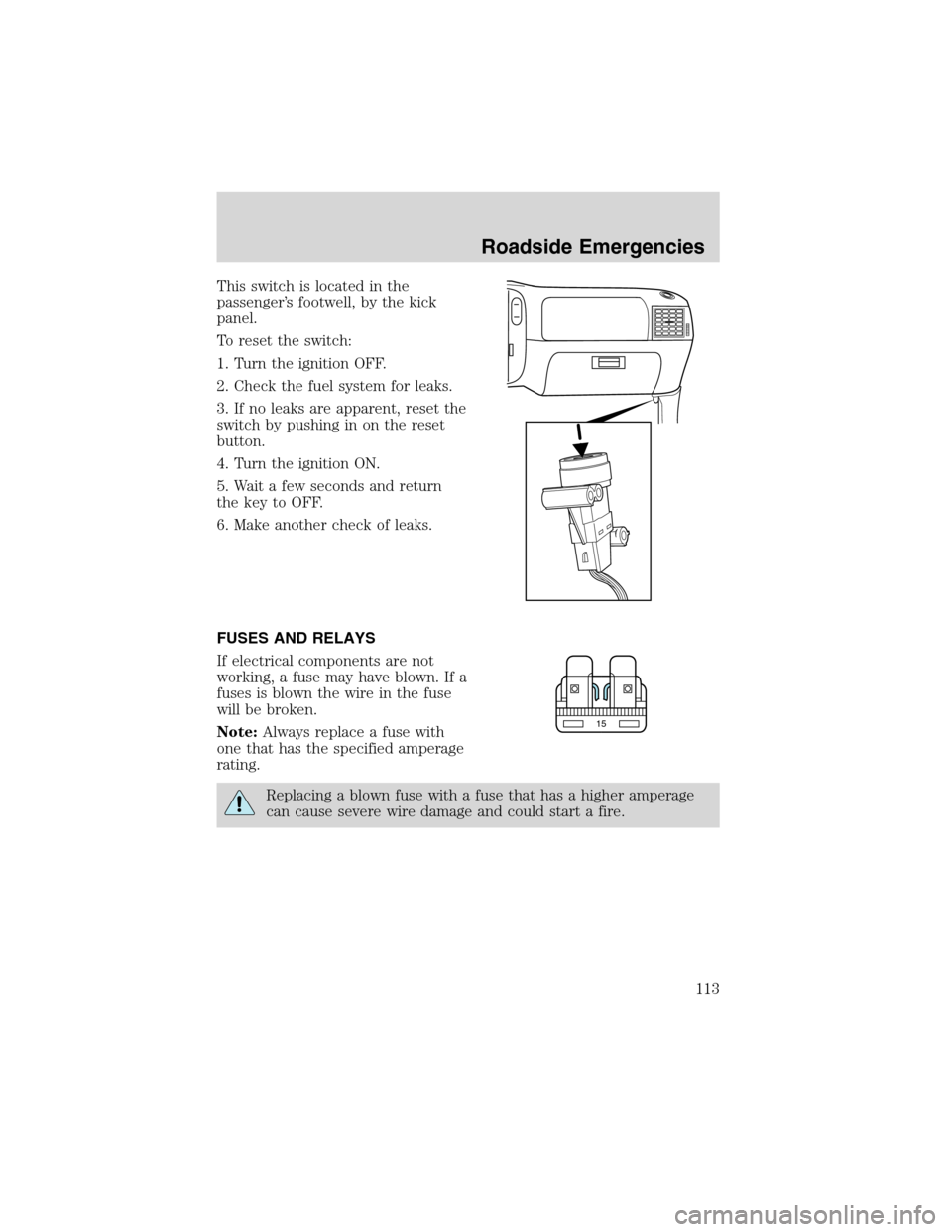
This switch is located in the
passenger’s footwell, by the kick
panel.
To reset the switch:
1. Turn the ignition OFF.
2. Check the fuel system for leaks.
3. If no leaks are apparent, reset the
switch by pushing in on the reset
button.
4. Turn the ignition ON.
5. Wait a few seconds and return
the key to OFF.
6. Make another check of leaks.
FUSES AND RELAYS
If electrical components are not
working, a fuse may have blown. If a
fuses is blown the wire in the fuse
will be broken.
Note:Always replace a fuse with
one that has the specified amperage
rating.
Replacing a blown fuse with a fuse that has a higher amperage
can cause severe wire damage and could start a fire.
15
Roadside Emergencies
113
Page 114 of 184
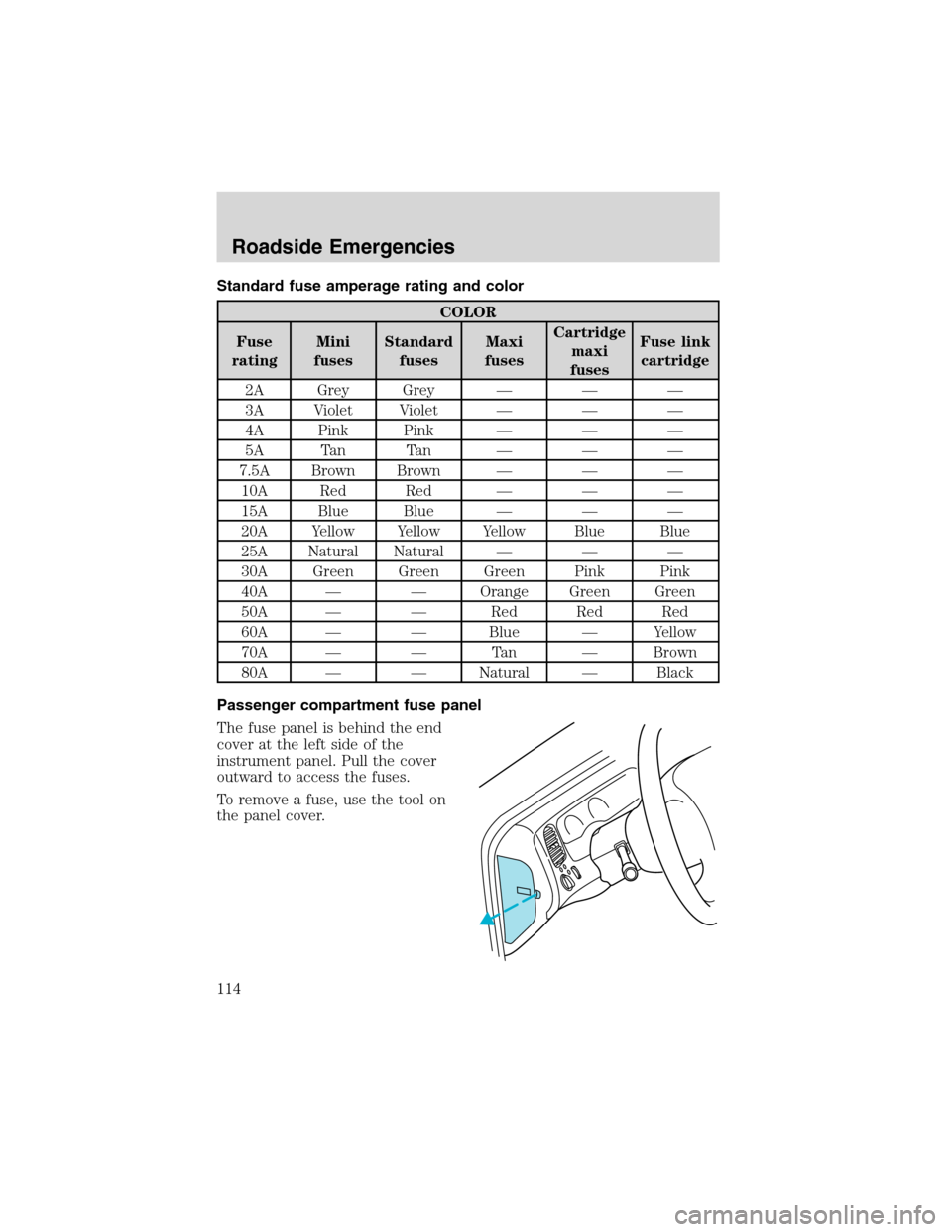
Standard fuse amperage rating and color
COLOR
Fuse
ratingMini
fusesStandard
fusesMaxi
fusesCartridge
maxi
fusesFuse link
cartridge
2A Grey Grey———
3A Violet Violet———
4A Pink Pink———
5A Tan Tan———
7.5A Brown Brown———
10A Red Red———
15A Blue Blue———
20A Yellow Yellow Yellow Blue Blue
25A Natural Natural———
30A Green Green Green Pink Pink
40A——Orange Green Green
50A——Red Red Red
60A——Blue—Yellow
70A——Ta n—Brown
80A——Natural—Black
Passenger compartment fuse panel
The fuse panel is behind the end
cover at the left side of the
instrument panel. Pull the cover
outward to access the fuses.
To remove a fuse, use the tool on
the panel cover.
Roadside Emergencies
114