Page 41 of 184
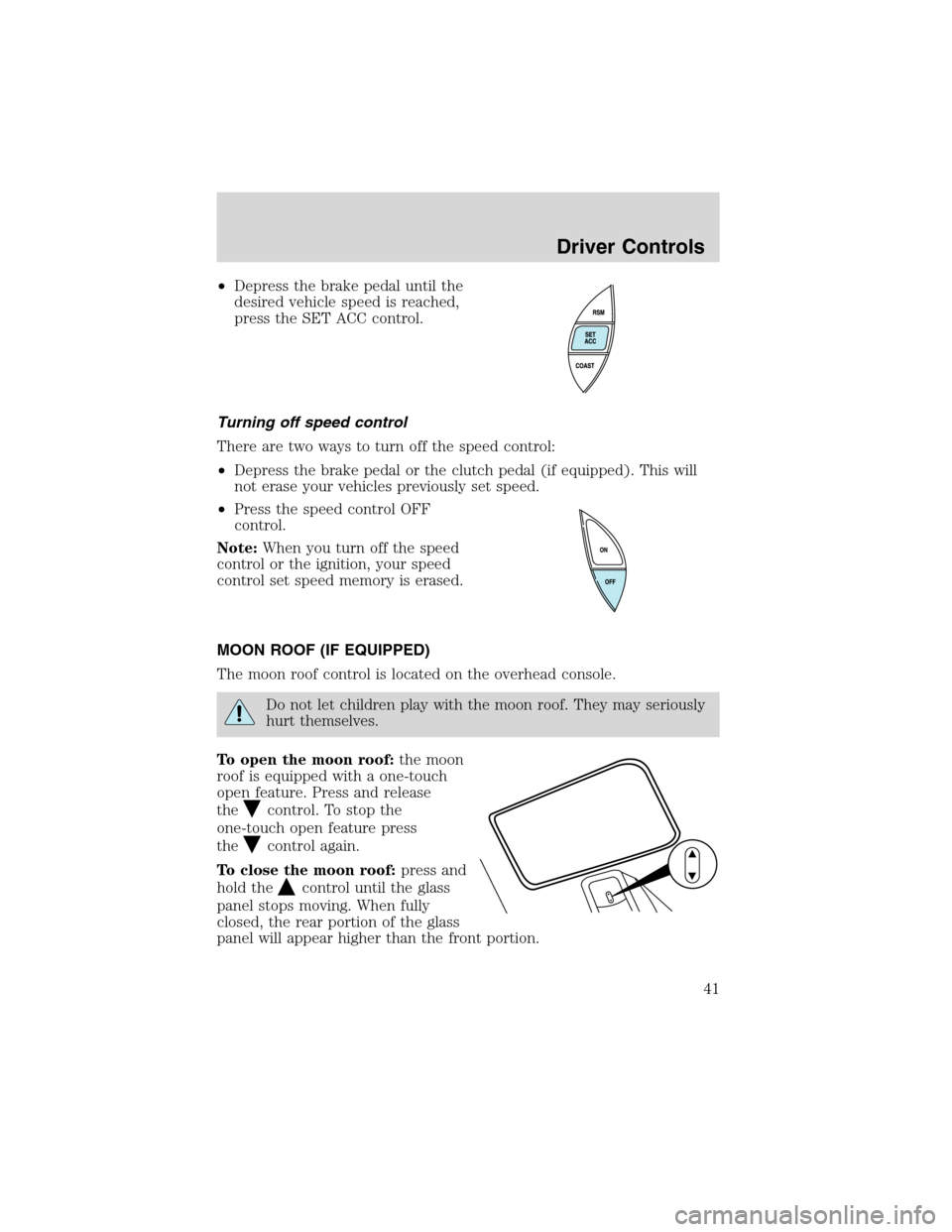
•Depress the brake pedal until the
desired vehicle speed is reached,
press the SET ACC control.
Turning off speed control
There are two ways to turn off the speed control:
•Depress the brake pedal or the clutch pedal (if equipped). This will
not erase your vehicles previously set speed.
•Press the speed control OFF
control.
Note:When you turn off the speed
control or the ignition, your speed
control set speed memory is erased.
MOON ROOF (IF EQUIPPED)
The moon roof control is located on the overhead console.
Do not let children play with the moon roof. They may seriously
hurt themselves.
To open the moon roof:the moon
roof is equipped with a one-touch
open feature. Press and release
the
control. To stop the
one-touch open feature press
the
control again.
To close the moon roof:press and
hold the
control until the glass
panel stops moving. When fully
closed, the rear portion of the glass
panel will appear higher than the front portion.
Driver Controls
41
Page 45 of 184
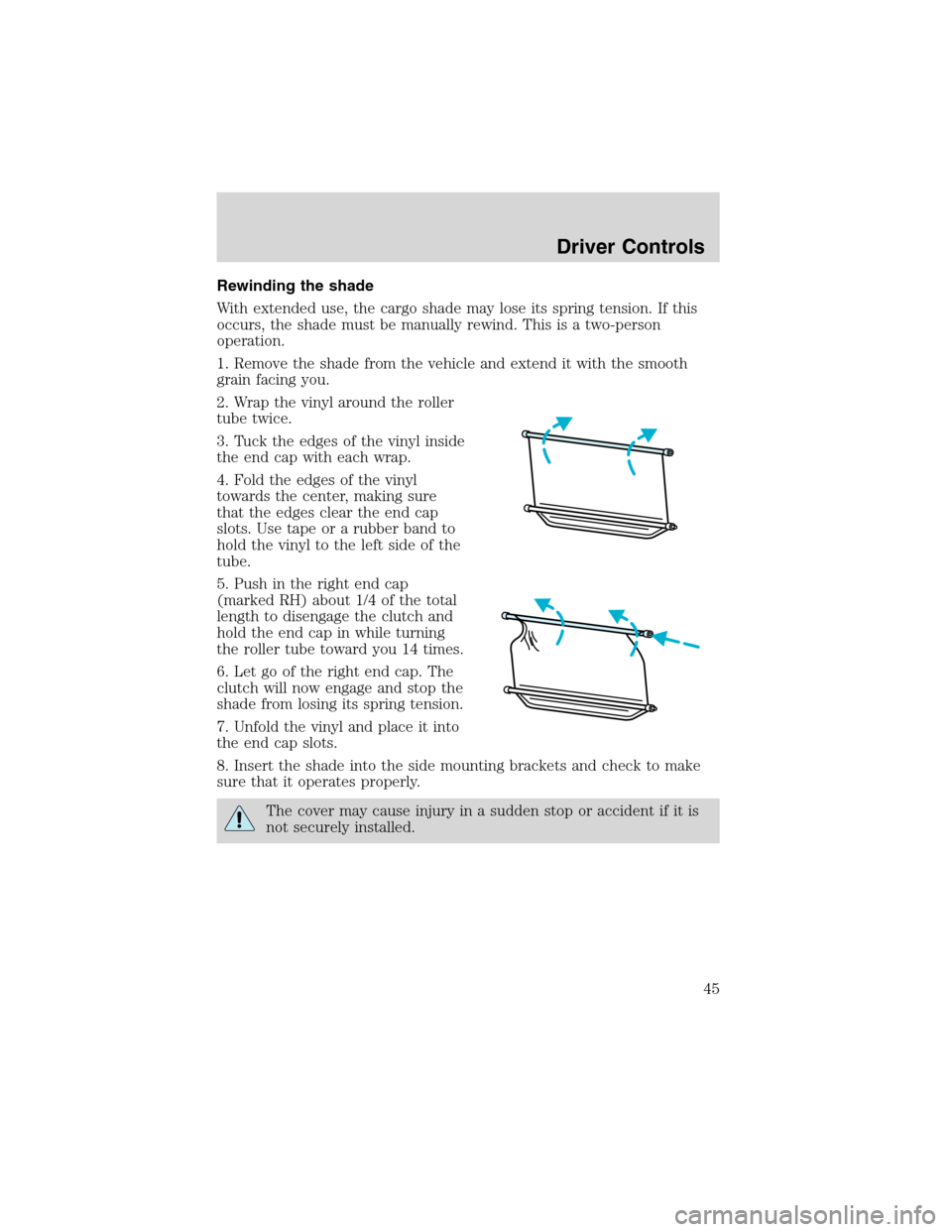
Rewinding the shade
With extended use, the cargo shade may lose its spring tension. If this
occurs, the shade must be manually rewind. This is a two-person
operation.
1. Remove the shade from the vehicle and extend it with the smooth
grain facing you.
2. Wrap the vinyl around the roller
tube twice.
3. Tuck the edges of the vinyl inside
the end cap with each wrap.
4. Fold the edges of the vinyl
towards the center, making sure
that the edges clear the end cap
slots. Use tape or a rubber band to
hold the vinyl to the left side of the
tube.
5. Push in the right end cap
(marked RH) about 1/4 of the total
length to disengage the clutch and
hold the end cap in while turning
the roller tube toward you 14 times.
6. Let go of the right end cap. The
clutch will now engage and stop the
shade from losing its spring tension.
7. Unfold the vinyl and place it into
the end cap slots.
8. Insert the shade into the side mounting brackets and check to make
sure that it operates properly.
The cover may cause injury in a sudden stop or accident if it is
not securely installed.
Driver Controls
45
Page 88 of 184
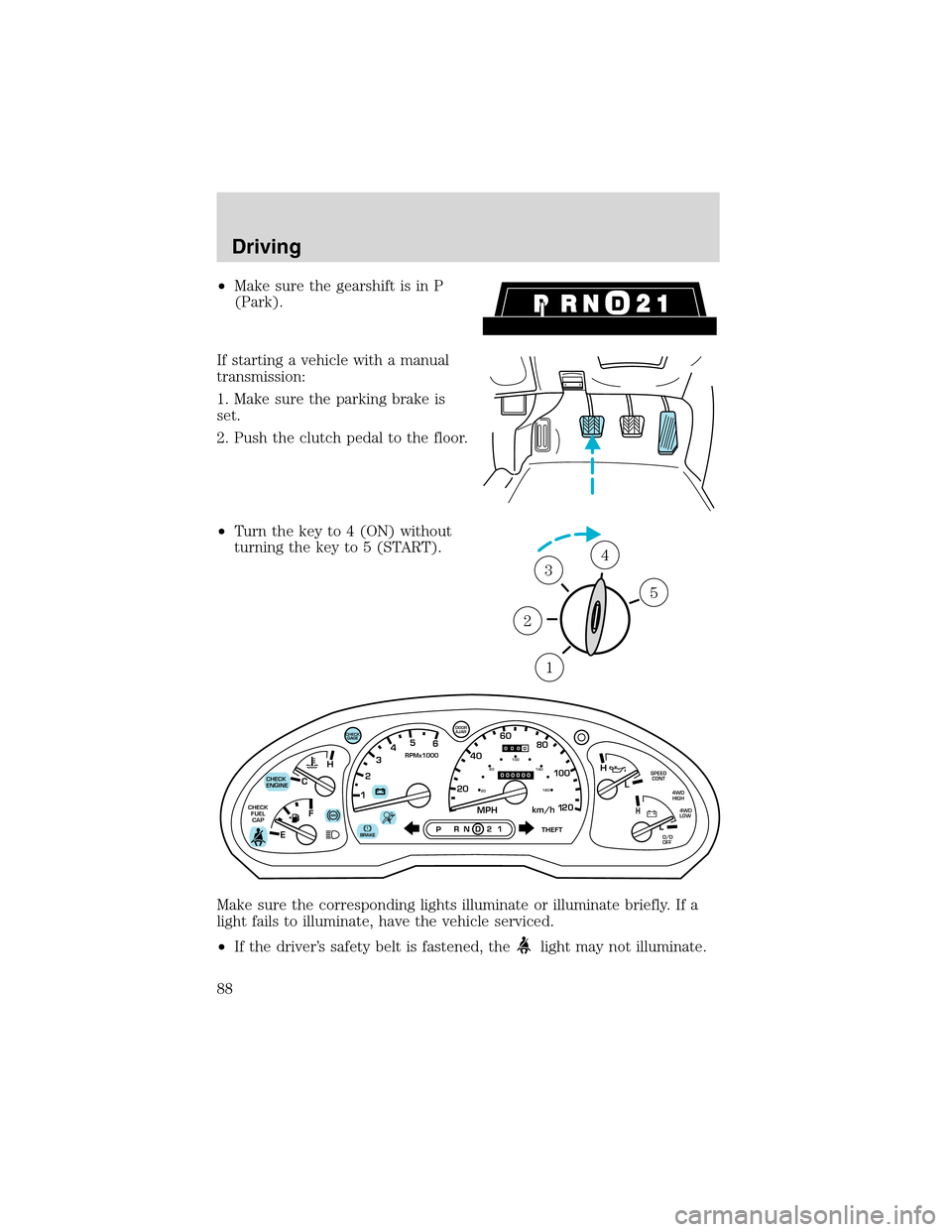
•Make sure the gearshift is in P
(Park).
If starting a vehicle with a manual
transmission:
1. Make sure the parking brake is
set.
2. Push the clutch pedal to the floor.
•Turn the key to 4 (ON) without
turning the key to 5 (START).
Make sure the corresponding lights illuminate or illuminate briefly. If a
light fails to illuminate, have the vehicle serviced.
•If the driver’s safety belt is fastened, the
light may not illuminate.
1
2
34
5
C12345
6
RPMx1000
ABS
CHECK
ENGINE
EFH
H
H
PRN D 2 1THEFT
SPEED
CONT
4WD
HIGH
4WD
LOW
O/D
OFFL
L
MPH 2060
4080
km/h
00
1
20
160100
140
180
20
DOOR
AJAR
CHECK
GAGE
!
BRAKE
CHECK
FUEL
CAP
Driving
88
Page 96 of 184
MANUAL TRANSMISSION OPERATION (IF EQUIPPED)
Using the clutch
A starter interlock prevents cranking the engine unless the clutch pedal
is fully depressed.
When starting a vehicle with a manual transmission, make sure the
parking brake is set, press the clutch pedal to the floor and put the
gearshift in N (Neutral).
1. Start the engine, then depress the
brake pedal.
2. Release the parking brake.
3. Move the gearshift lever to the
desired gear, then release the brake
pedal.
4. Slowly release the clutch pedal
while slowly pressing down on the
accelerator pedal.
Don’t drive with your foot resting on the clutch pedal and do not use the
clutch to hold your vehicle at a standstill. These actions will greatly
reduce clutch life.
Recommended shift speeds
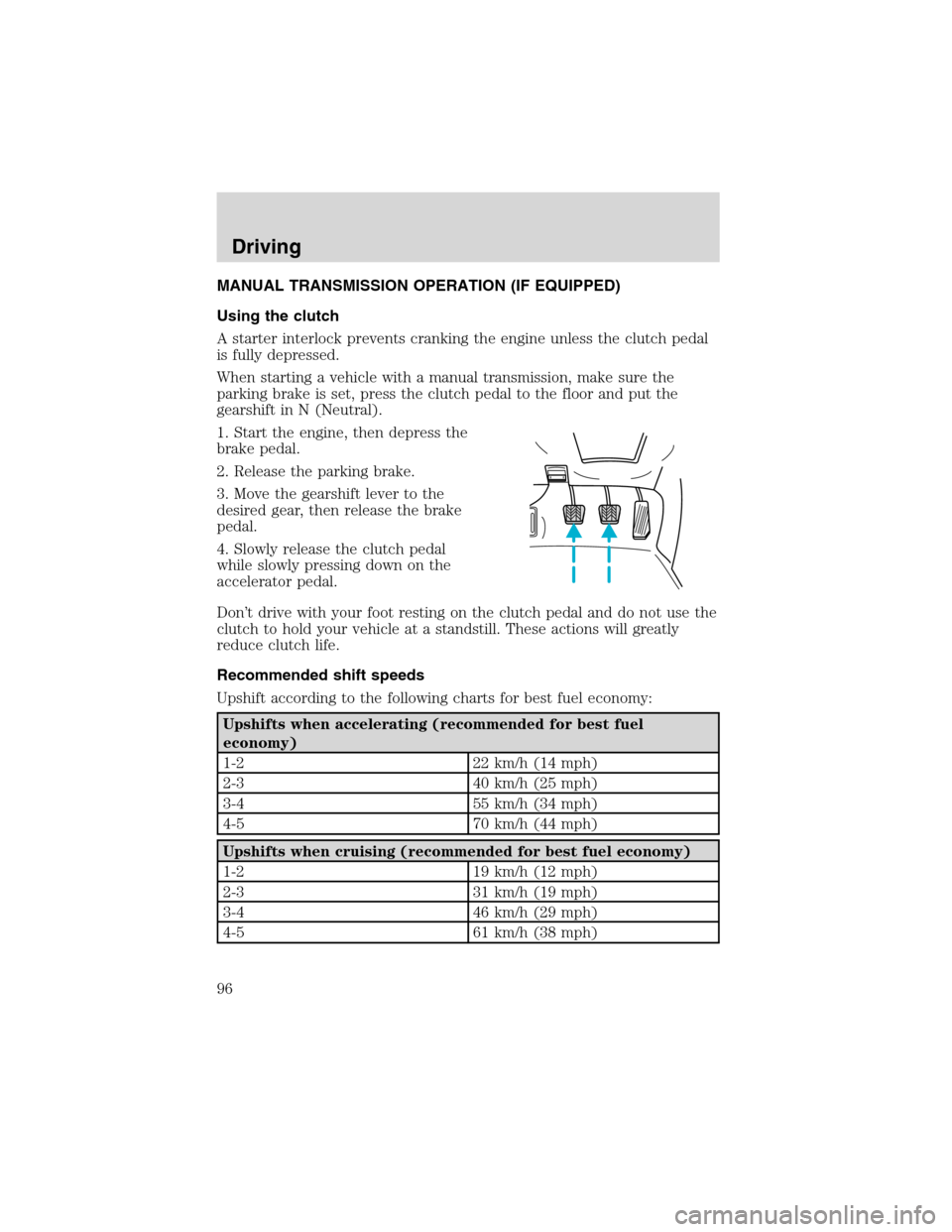
Upshift according to the following charts for best fuel economy:
Upshifts when accelerating (recommended for best fuel
economy)
1-2 22 km/h (14 mph)
2-3 40 km/h (25 mph)
3-4 55 km/h (34 mph)
4-5 70 km/h (44 mph)
Upshifts when cruising (recommended for best fuel economy)
1-2 19 km/h (12 mph)
2-3 31 km/h (19 mph)
3-4 46 km/h (29 mph)
4-5 61 km/h (38 mph)
Driving
96
Page 97 of 184
Reverse
Make sure that your vehicle is at a complete stop before you shift into R
(Reverse). You can shift into R (Reverse) only by moving the gearshift
lever from left of 3 (Third) and 4 (Fourth) gears before you shift into R
(Reverse). This is a special lockout feature that protects the transmission
from accidentally being shifted into R (Reverse) when you downshift
from 5th.
Parking your vehicle
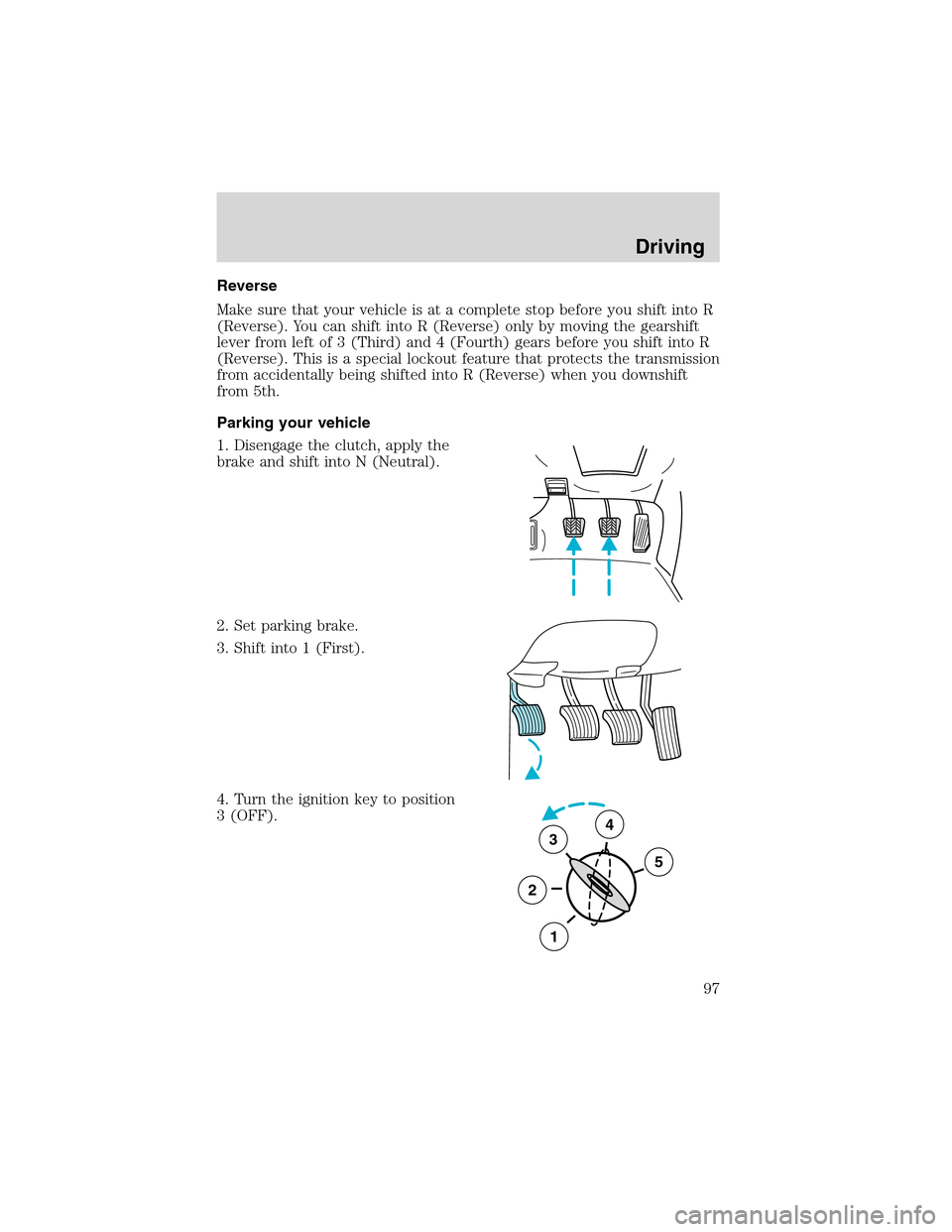
1. Disengage the clutch, apply the
brake and shift into N (Neutral).
2. Set parking brake.
3. Shift into 1 (First).
4. Turn the ignition key to position
3 (OFF).
3
2
1
5
4
Driving
97
Page 99 of 184
vehicle is moving; this is normal and should be no reason for concern.
Refer toShifting to/from 4X4 LOWfor proper operation.
Shifting between 2WD and 4X4 HIGH
•Move the 4WD control between 2WD and 4X4 HIGH at any forward
speed.
Note:Do not perform this operation if the rear wheels are slipping.
Shifting to/from 4X4 LOW
1. Bring the vehicle to a complete stop
2. Depress the brake
3. On vehicles equipped with an automatic transmission, place the
transmission in N (Neutral); on vehicles equipped with a manual
transmission, depress the clutch.
4. Move the 4WD control to the desired position.
•If shifting into 4WD LOW, wait for the 4X4 LOW light in the
instrument cluster to turnonindicating the shift is complete.
•If shifting out of 4WD LOW, wait for the 4X4 LOW light in the
instrument cluster turn turnoffindicating the shift is complete.
Driving off-road with truck and utility vehicles
Basic operating principles
Maintain steering wheel control at all times, especially in rough terrain;
sudden changes in terrain can result in abrupt steering wheel motion. Do
not use 4WD on dry, hard surfaced roads (except models equipped with
Auto 4WD).
If your vehicle goes off the edge of the pavement
Slow down and don’t slam on the brakes. Ease the vehicle back onto the
pavement only after reducing your speed.
Do not turn the steering wheel sharply while returning to the
road as this may cause you to lose control of the vehicle.
It may be safer to stay on the shoulder of the road and slow down before
returning to the pavement.
If your vehicle gets stuck
The vehicle may be rocked out by shifting from forward and reverse
gears, stopping between shifts, in a steady pattern. Press lightly on the
Driving
99
Page 119 of 184
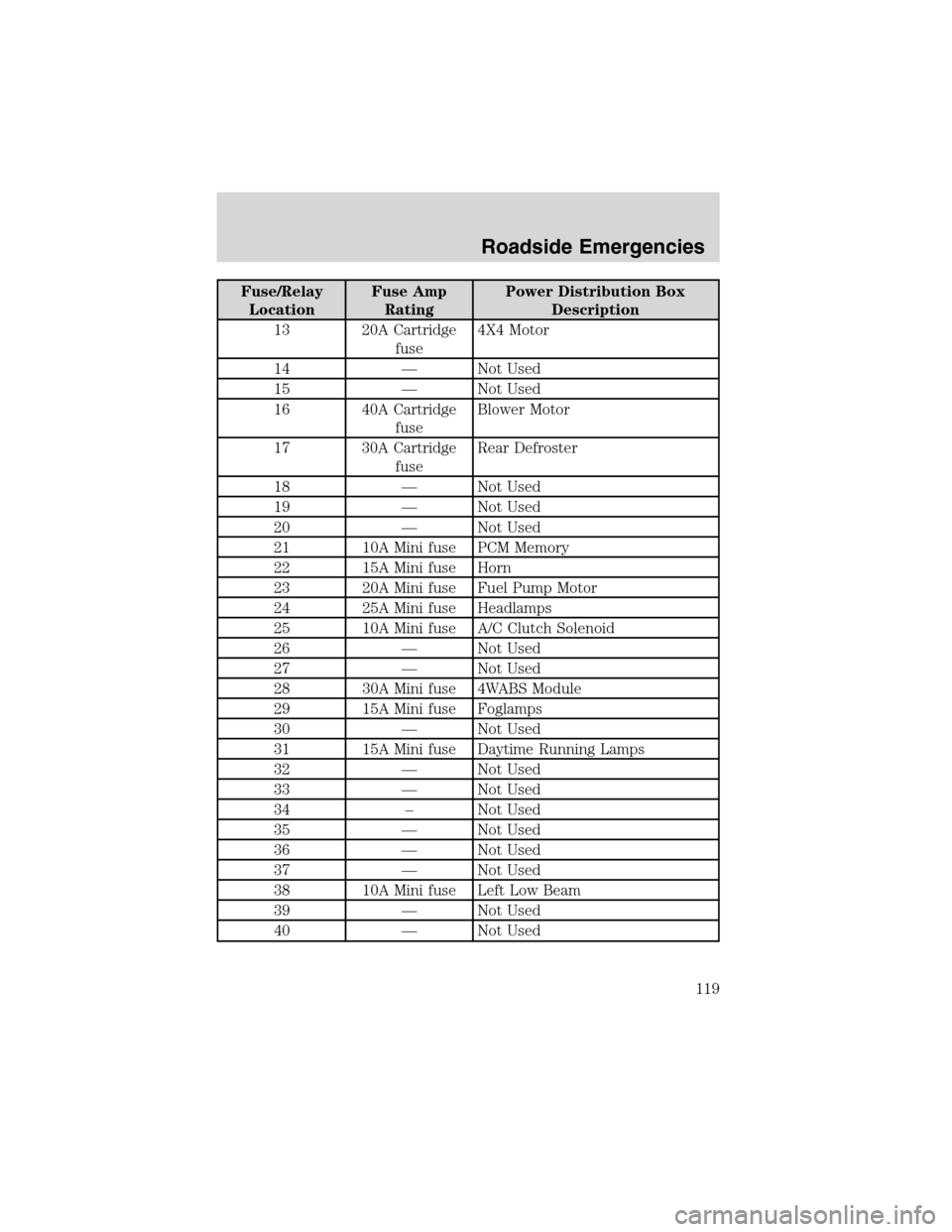
Fuse/Relay
LocationFuse Amp
RatingPower Distribution Box
Description
13 20A Cartridge
fuse4X4 Motor
14—Not Used
15—Not Used
16 40A Cartridge
fuseBlower Motor
17 30A Cartridge
fuseRear Defroster
18—Not Used
19—Not Used
20—Not Used
21 10A Mini fuse PCM Memory
22 15A Mini fuse Horn
23 20A Mini fuse Fuel Pump Motor
24 25A Mini fuse Headlamps
25 10A Mini fuse A/C Clutch Solenoid
26—Not Used
27—Not Used
28 30A Mini fuse 4WABS Module
29 15A Mini fuse Foglamps
30—Not Used
31 15A Mini fuse Daytime Running Lamps
32—Not Used
33—Not Used
34–Not Used
35—Not Used
36—Not Used
37—Not Used
38 10A Mini fuse Left Low Beam
39—Not Used
40—Not Used
Roadside Emergencies
119
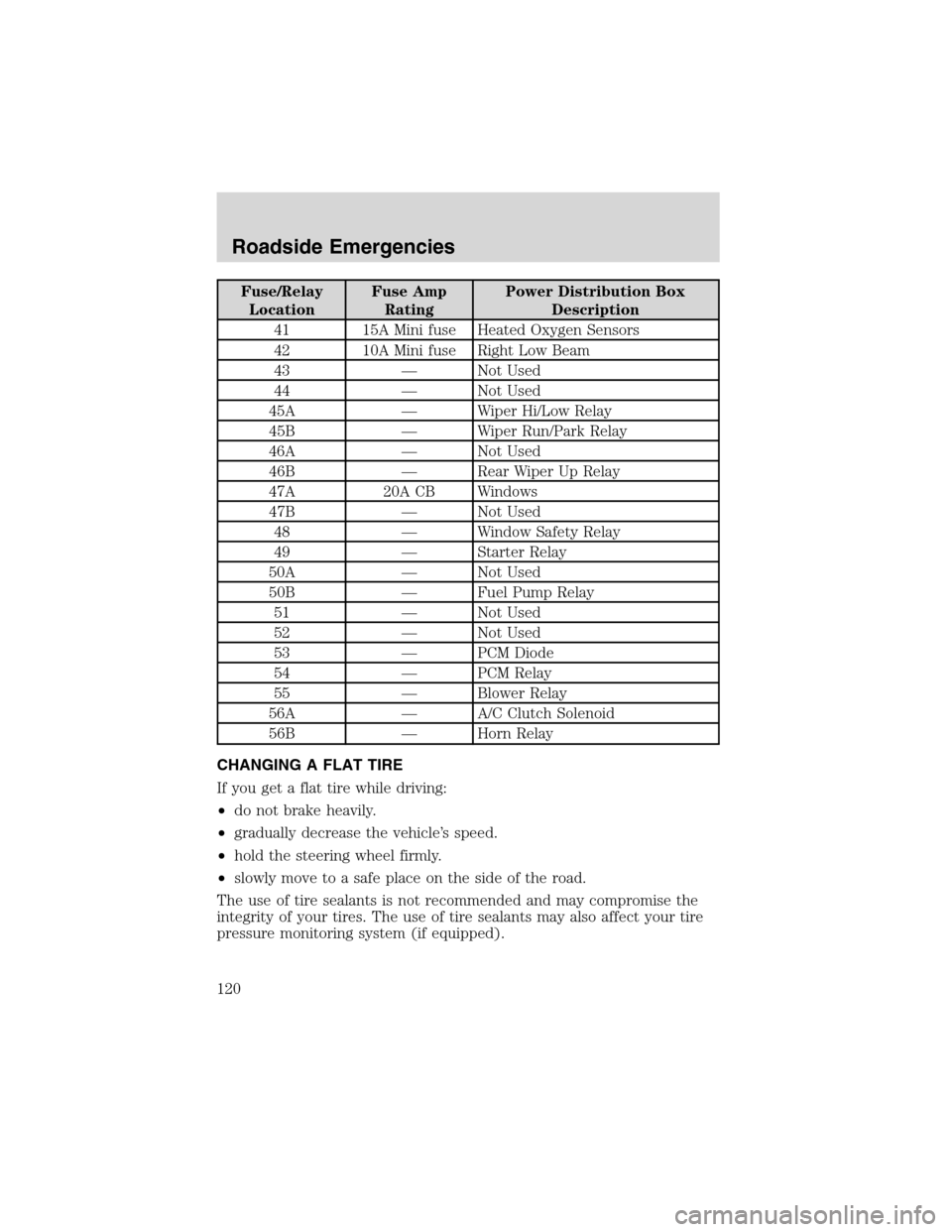
Page 120 of 184
Fuse/Relay
LocationFuse Amp
RatingPower Distribution Box
Description
41 15A Mini fuse Heated Oxygen Sensors
42 10A Mini fuse Right Low Beam
43—Not Used
44—Not Used
45A—Wiper Hi/Low Relay
45B—Wiper Run/Park Relay
46A—Not Used
46B—Rear Wiper Up Relay
47A 20A CB Windows
47B—Not Used
48—Window Safety Relay
49—Starter Relay
50A—Not Used
50B—Fuel Pump Relay
51—Not Used
52—Not Used
53—PCM Diode
54—PCM Relay
55—Blower Relay
56A—A/C Clutch Solenoid
56B—Horn Relay
CHANGING A FLAT TIRE
If you get a flat tire while driving:
•do not brake heavily.
•gradually decrease the vehicle’s speed.
•hold the steering wheel firmly.
•slowly move to a safe place on the side of the road.
The use of tire sealants is not recommended and may compromise the
integrity of your tires. The use of tire sealants may also affect your tire
pressure monitoring system (if equipped).
Roadside Emergencies
120