Page 88 of 184
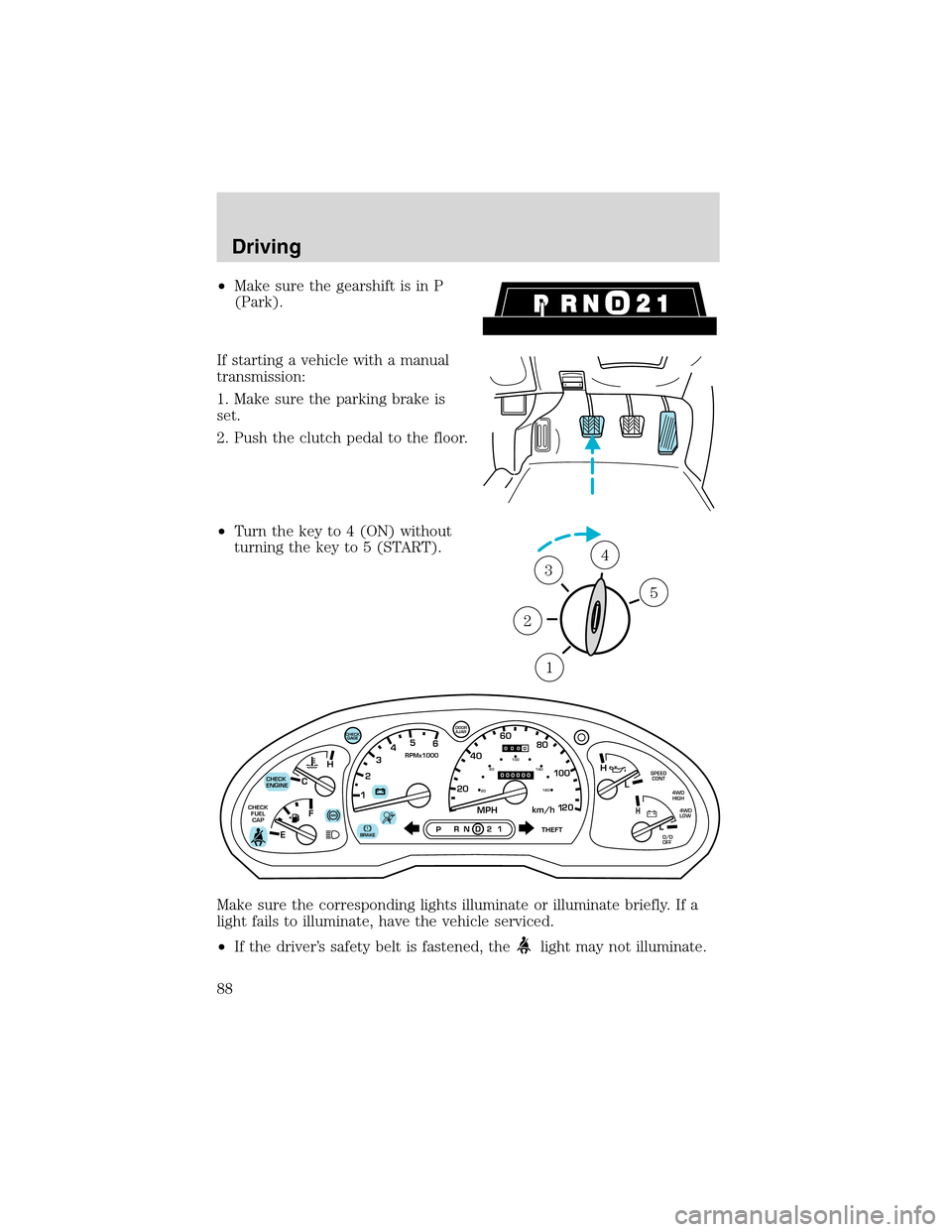
•Make sure the gearshift is in P
(Park).
If starting a vehicle with a manual
transmission:
1. Make sure the parking brake is
set.
2. Push the clutch pedal to the floor.
•Turn the key to 4 (ON) without
turning the key to 5 (START).
Make sure the corresponding lights illuminate or illuminate briefly. If a
light fails to illuminate, have the vehicle serviced.
•If the driver’s safety belt is fastened, the
light may not illuminate.
1
2
34
5
C12345
6
RPMx1000
ABS
CHECK
ENGINE
EFH
H
H
PRN D 2 1THEFT
SPEED
CONT
4WD
HIGH
4WD
LOW
O/D
OFFL
L
MPH 2060
4080
km/h
00
1
20
160100
140
180
20
DOOR
AJAR
CHECK
GAGE
!
BRAKE
CHECK
FUEL
CAP
Driving
88
Page 92 of 184
If the power steering system breaks down (or if the engine is turned
off), you can steer the vehicle manually, but it takes more effort.
If the steering wanders or pulls, check for:
•an underinflated tire
•uneven tire wear
•loose or worn suspension components
•loose or worn steering components
•improper steering alignment
TRACTION-LOK AXLE (IF EQUIPPED)
This axle provides added traction on slippery surfaces, particularly when
one wheel is on a poor traction surface. Under normal conditions, the
Traction-Lok axle functions like a standard rear axle.
To reduce the risk of injury, never run the engine with one wheel
off the ground, such as when changing a tire.
PREPARING TO DRIVE YOUR VEHICLE
Utility vehicles have a significantly higher rollover rate than
other types of vehicles.
In a rollover crash, an unbelted person is significantly more likely
to die than a person wearing a safety belt.
Your vehicle has larger tires and increased ground clearance, giving the
vehicle a higher center of gravity than a passenger car.
Vehicles with a higher center of gravity such as utility and
four-wheel drive vehicles handle differently than vehicles with a
lower center of gravity. Utility and four-wheel drive vehicles arenot
designed for cornering at speeds as high as passenger cars any more
than low-slung sports cars are designed to perform satisfactorily under
off-road conditions. Avoid sharp turns, excessive speed and abrupt
maneuvers in these vehicles. Failure to drive cautiously could result in
an increased risk of loss of vehicle control, vehicle rollover, personal
injury and death.
Driving
92
Page 109 of 184
Driving while you tow
When towing a trailer:
•Turn off your speed control. The speed control may shut off
automatically when you are towing on long, steep grades.
•Consult your local motor vehicle speed regulations for towing a trailer.
•Use a lower gear when towing up or down steep hills.
•Anticipate stops and brake gradually.
Servicing after towing
If you tow a trailer for long distances, your vehicle will require more
frequent service intervals. Refer to your scheduled maintenance guide for
more information.
Trailer towing tips
•Practice turning, stopping and backing up before starting on a trip to
get the feel of the vehicle/trailer combination. When turning, make
wider turns so the trailer wheels will clear curbs and other obstacles.
•Allow more distance for stopping with a trailer attached.
•The trailer tongue weight should be no more than 10–15% of the
loaded trailer weight.
•After you have traveled 80 km (50 miles), thoroughly check your
hitch, electrical connections and trailer wheel lug nuts.
•When stopped in traffic for long periods of time in hot weather, place
the gearshift in P (Park) (automatic transmissions) or N (Neutral)
(manual transmissions). This aids engine cooling and air conditioner
efficiency.
•Vehicles with trailers should not be parked on a grade. If you must
park on a grade, place wheel chocks under the trailer’s wheels.
Launching or retrieving a boat
When backing down a ramp during boat launching or retrieval:
•do not allow the static water level to rise above the bottom edge of
the rear bumper.
•do not allow waves to break higher than 15 cm (6 inches) above the
bottom edge of the rear bumper.
Exceeding these limits may allow water to enter critical vehicle
components, adversely affecting driveability, emissions, reliability and
Driving
109
Page 145 of 184
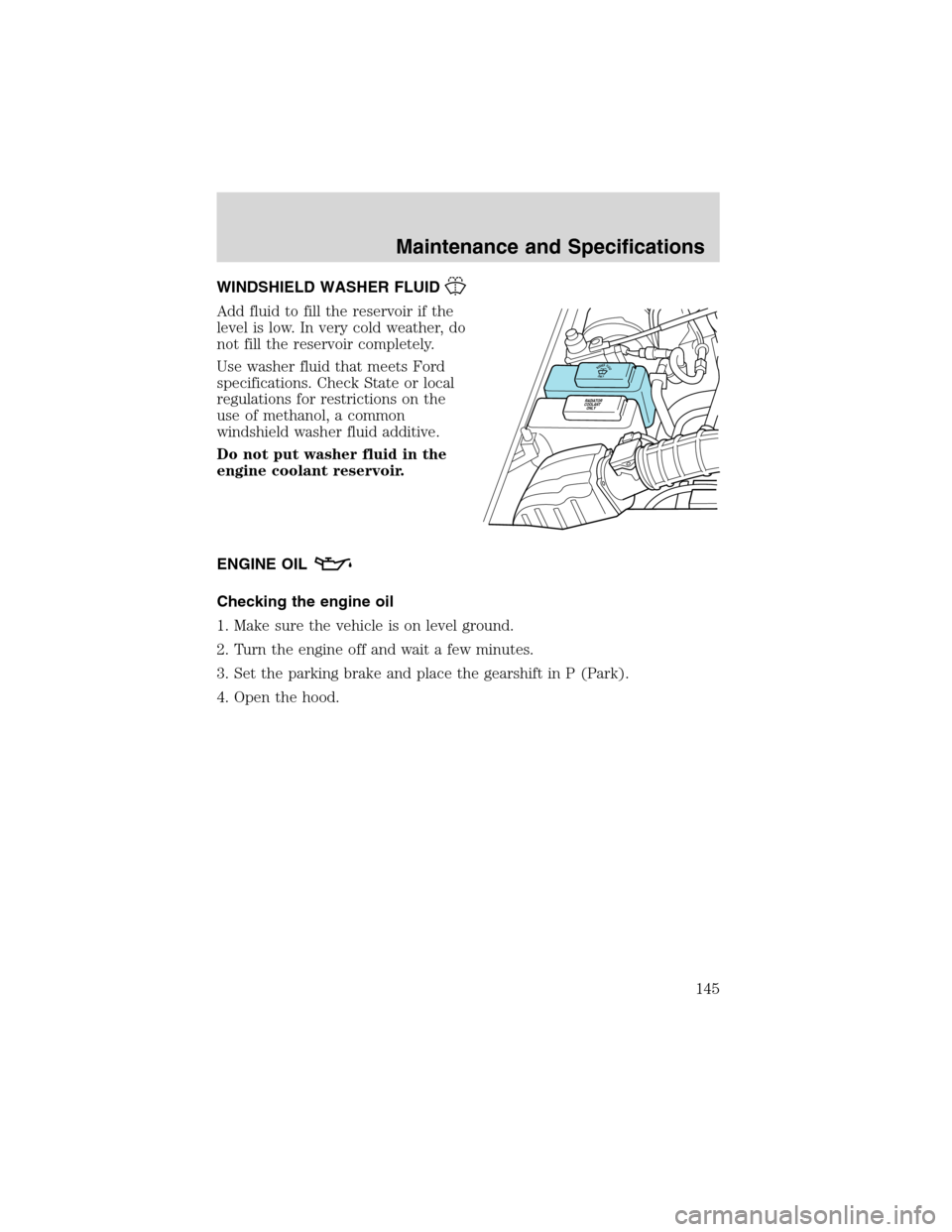
WINDSHIELD WASHER FLUID
Add fluid to fill the reservoir if the
level is low. In very cold weather, do
not fill the reservoir completely.
Use washer fluid that meets Ford
specifications. Check State or local
regulations for restrictions on the
use of methanol, a common
windshield washer fluid additive.
Do not put washer fluid in the
engine coolant reservoir.
ENGINE OIL
Checking the engine oil
1. Make sure the vehicle is on level ground.
2. Turn the engine off and wait a few minutes.
3. Set the parking brake and place the gearshift in P (Park).
4. Open the hood.
RADIATOR
COOLANT
ONLY
WASHERFLUIDONLY
Maintenance and Specifications
145
Page 146 of 184
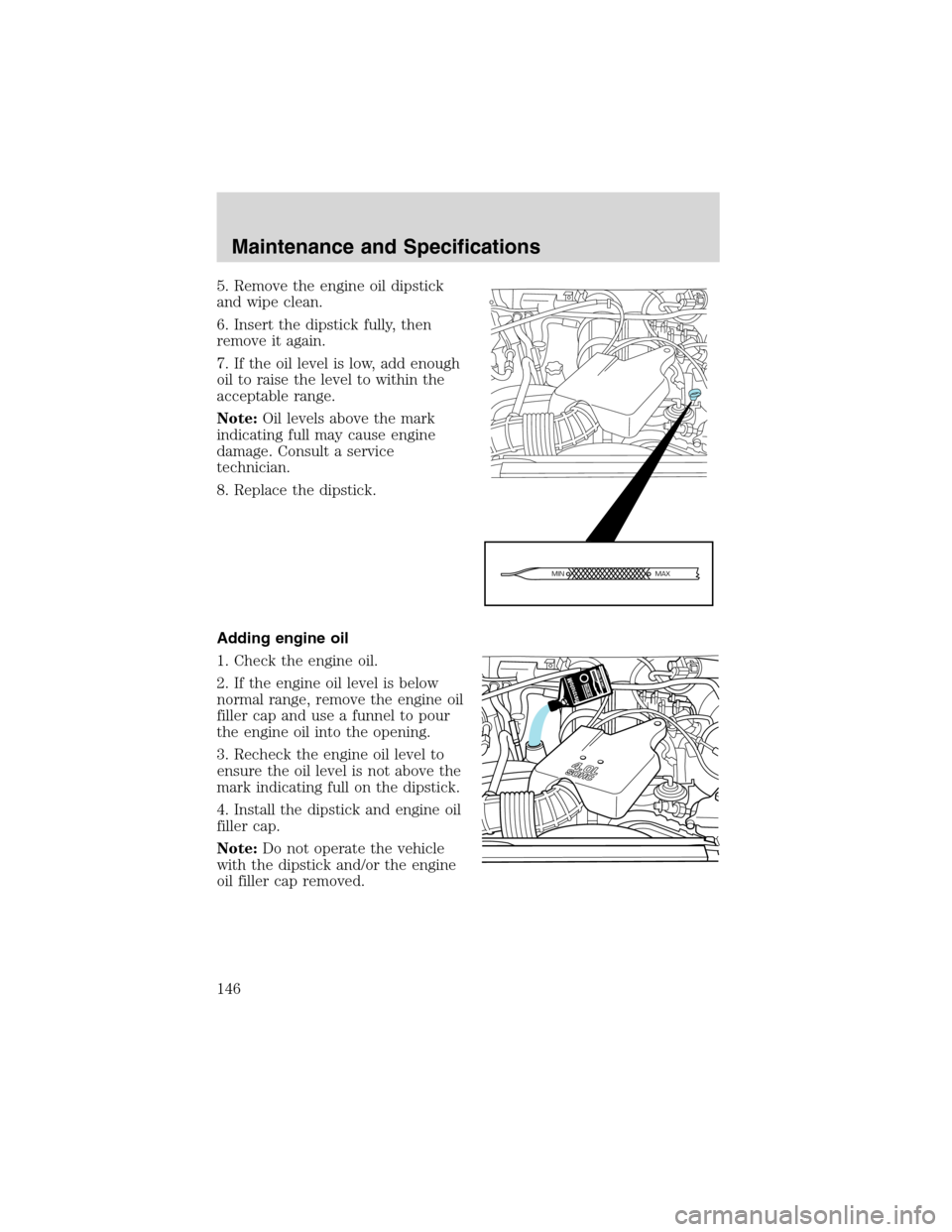
5. Remove the engine oil dipstick
and wipe clean.
6. Insert the dipstick fully, then
remove it again.
7. If the oil level is low, add enough
oil to raise the level to within the
acceptable range.
Note:Oil levels above the mark
indicating full may cause engine
damage. Consult a service
technician.
8. Replace the dipstick.
Adding engine oil
1. Check the engine oil.
2. If the engine oil level is below
normal range, remove the engine oil
filler cap and use a funnel to pour
the engine oil into the opening.
3. Recheck the engine oil level to
ensure the oil level is not above the
mark indicating full on the dipstick.
4. Install the dipstick and engine oil
filler cap.
Note:Do not operate the vehicle
with the dipstick and/or the engine
oil filler cap removed.
MAX MIN
Maintenance and Specifications
146
Page 147 of 184
SAE 5W-30 engine oil recommendation
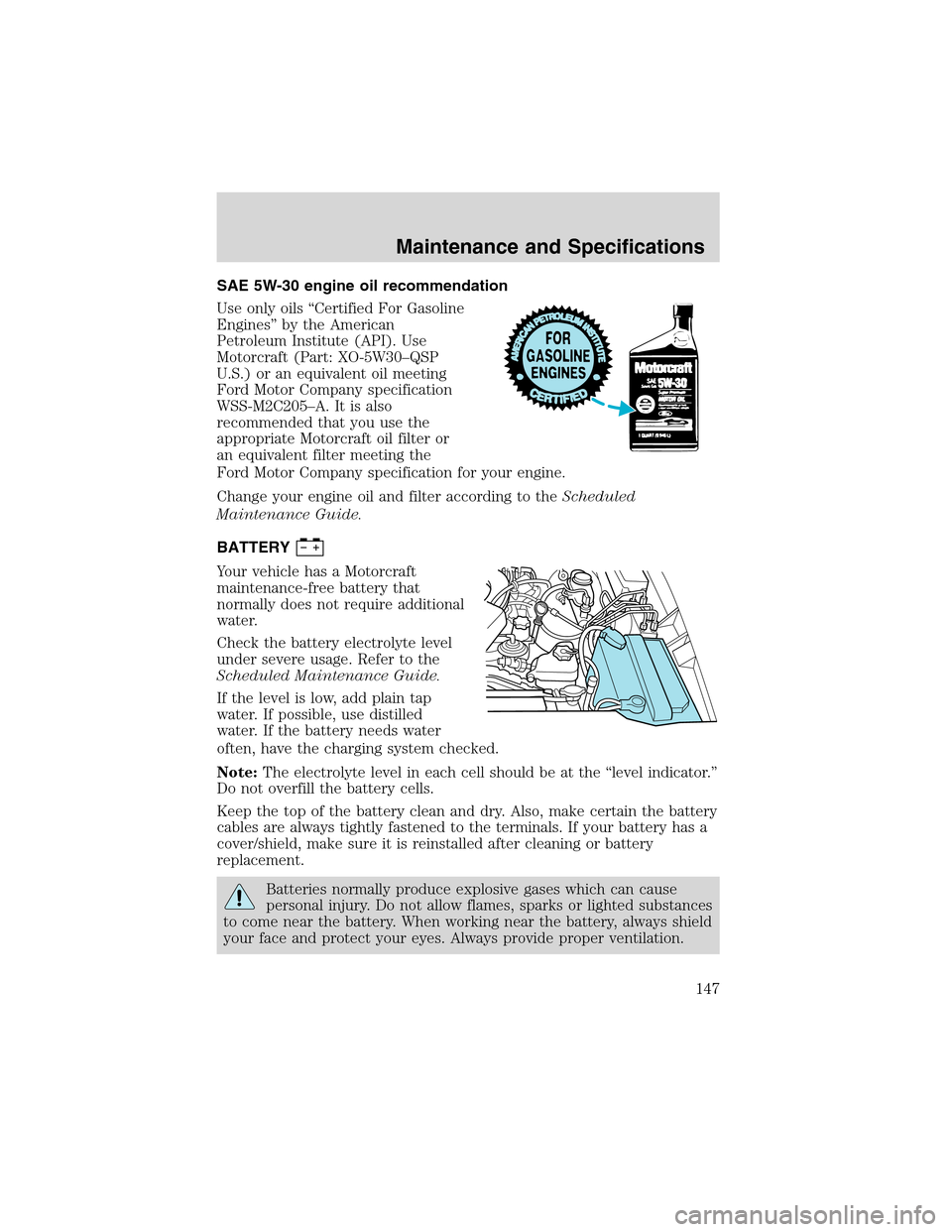
Use only oils“Certified For Gasoline
Engines”by the American
Petroleum Institute (API). Use
Motorcraft (Part: XO-5W30–QSP
U.S.) or an equivalent oil meeting
Ford Motor Company specification
WSS-M2C205–A. It is also
recommended that you use the
appropriate Motorcraft oil filter or
an equivalent filter meeting the
Ford Motor Company specification for your engine.
Change your engine oil and filter according to theScheduled
Maintenance Guide.
BATTERY
Your vehicle has a Motorcraft
maintenance-free battery that
normally does not require additional
water.
Check the battery electrolyte level
under severe usage. Refer to the
Scheduled Maintenance Guide.
If the level is low, add plain tap
water. If possible, use distilled
water. If the battery needs water
often, have the charging system checked.
Note:The electrolyte level in each cell should be at the“level indicator.”
Do not overfill the battery cells.
Keep the top of the battery clean and dry. Also, make certain the battery
cables are always tightly fastened to the terminals. If your battery has a
cover/shield, make sure it is reinstalled after cleaning or battery
replacement.
Batteries normally produce explosive gases which can cause
personal injury. Do not allow flames, sparks or lighted substances
to come near the battery. When working near the battery, always shield
your face and protect your eyes. Always provide proper ventilation.
Maintenance and Specifications
147
Page 149 of 184
ENGINE COOLANT
Checking engine coolant
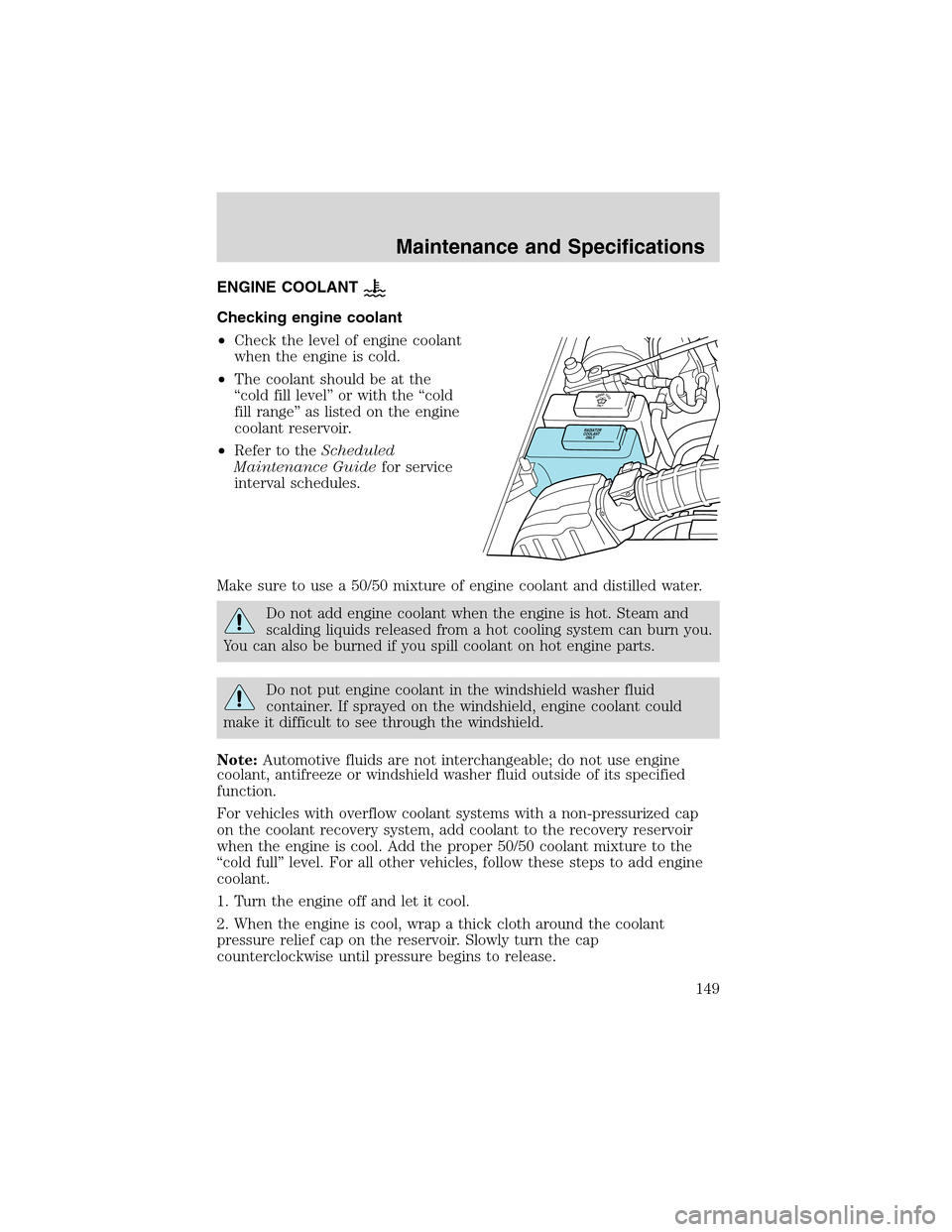
•Check the level of engine coolant
when the engine is cold.
•The coolant should be at the
“cold fill level”or with the“cold
fill range”as listed on the engine
coolant reservoir.
•Refer to theScheduled
Maintenance Guidefor service
interval schedules.
Make sure to use a 50/50 mixture of engine coolant and distilled water.
Do not add engine coolant when the engine is hot. Steam and
scalding liquids released from a hot cooling system can burn you.
You can also be burned if you spill coolant on hot engine parts.
Do not put engine coolant in the windshield washer fluid
container. If sprayed on the windshield, engine coolant could
make it difficult to see through the windshield.
Note:Automotive fluids are not interchangeable; do not use engine
coolant, antifreeze or windshield washer fluid outside of its specified
function.
For vehicles with overflow coolant systems with a non-pressurized cap
on the coolant recovery system, add coolant to the recovery reservoir
when the engine is cool. Add the proper 50/50 coolant mixture to the
“cold full”level. For all other vehicles, follow these steps to add engine
coolant.
1. Turn the engine off and let it cool.
2. When the engine is cool, wrap a thick cloth around the coolant
pressure relief cap on the reservoir. Slowly turn the cap
counterclockwise until pressure begins to release.
RADIATOR
COOLANT
ONLY
WASHERFLUIDONLY
Maintenance and Specifications
149
Page 150 of 184
3. Step back until all of the pressure has been released.
4. Use the cloth to finish removing the cap.
5. Fill the reservoir with the proper coolant mixture to within the“cold
fill range”or the“cold full”level. If you removed the radiator cap in an
overflow system, fill the radiator until the coolant is visible and the
radiator is almost full.
6. Replace the cap. Turn until tightly installed.
After adding engine coolant, the level in the reservoir should be checked
the next few times you drive the vehicle. If you add more than 1.0 litre
(1 quart) of engine coolant per month, have your dealership check the
engine cooling system.
Engine coolant specifications
The cooling system in your vehicle is filled with eithergreen-colored
Motorcraft Premium Engine coolant meeting Ford Motor
Company specification ESE-M97B44–A or yellow-colored
Motorcraft Premium Gold Engine Coolant meeting Ford Motor
Company specification WSS-M97B51–A1. To determine your vehicle’s
coolant type (color) check the coolant reservoir or contact your dealer.
Use only the appropriate coolant mixture when filling your coolant
reservoir.
•A large amount of water may be added in an emergency. In this case,
the system should be drained and refilled with a 50/50 mixture as
soon as possible.
•Do not add extra inhibitors or additives to the coolant.
•Do not use alcohol, methanol or brine or any engine coolants mixed
with alcohol or methanol antifreeze (coolant).
•Do not mix with recycled coolant unless from a Ford-approved
recycling process (seeRecycled Engine Coolant).
Recycled engine coolant
•Motorcraft Premium Engine Coolant (green-colored):For
vehicles equipped with this coolant, use only recycled engine coolant
produced by a Ford Motor Company approved process and meeting
specification ESE-M97B44–A.
•Motorcraft Premium Gold Engine Coolant yellow-colored):For
vehicles equipped with this coolant, do NOT use recycled engine
coolant since a Ford Motor Company approved recycling process is
not yet available.
Maintenance and Specifications
150