Page 123 of 184
To change the tire:
Note:Passengers should not remain in the vehicle when the vehicle is
being jacked.
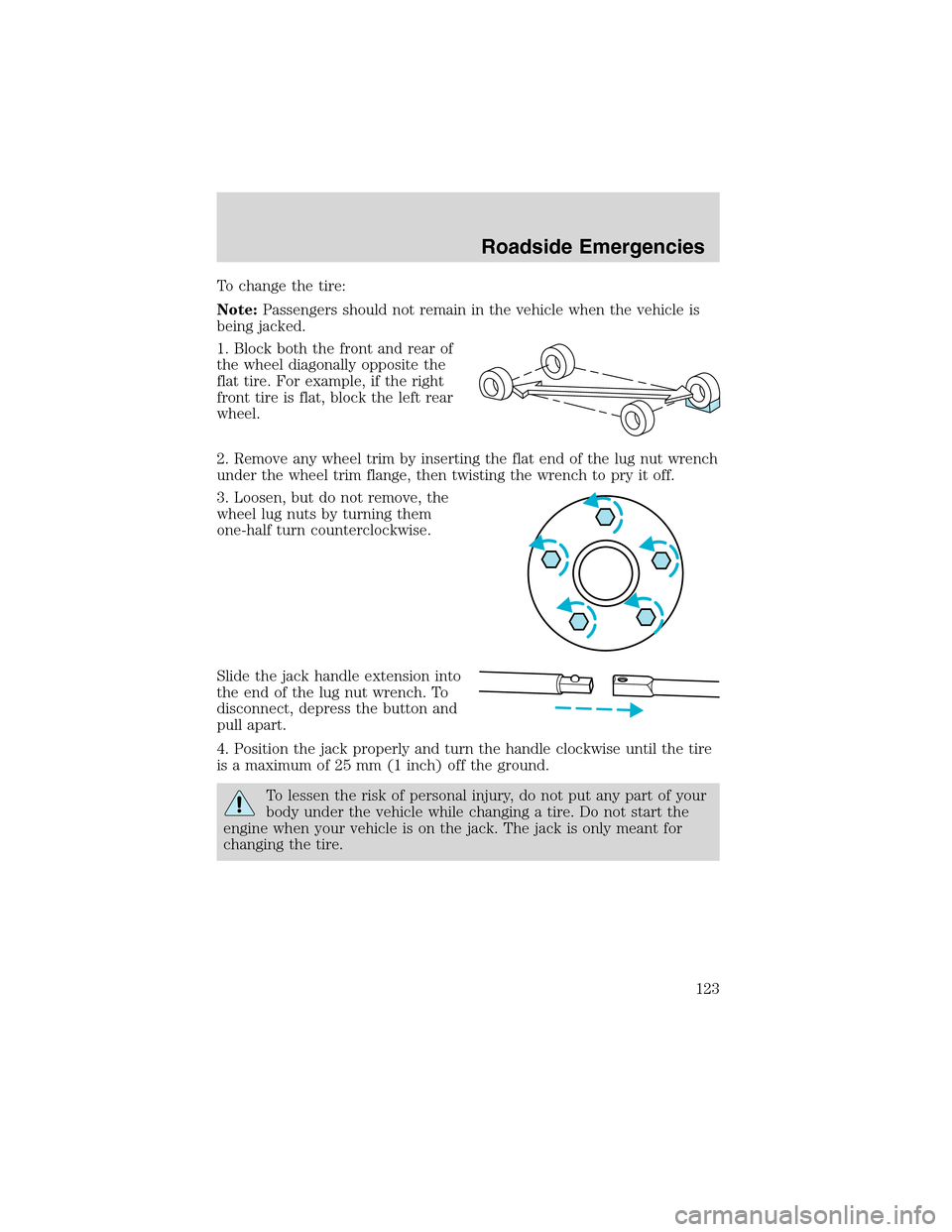
1. Block both the front and rear of
the wheel diagonally opposite the
flat tire. For example, if the right
front tire is flat, block the left rear
wheel.
2. Remove any wheel trim by inserting the flat end of the lug nut wrench
under the wheel trim flange, then twisting the wrench to pry it off.
3. Loosen, but do not remove, the
wheel lug nuts by turning them
one-half turn counterclockwise.
Slide the jack handle extension into
the end of the lug nut wrench. To
disconnect, depress the button and
pull apart.
4. Position the jack properly and turn the handle clockwise until the tire
is a maximum of 25 mm (1 inch) off the ground.
To lessen the risk of personal injury, do not put any part of your
body under the vehicle while changing a tire. Do not start the
engine when your vehicle is on the jack. The jack is only meant for
changing the tire.
Roadside Emergencies
123
Page 125 of 184
To lessen the risk of
personal injury, do not put
any part of your body under the
vehicle while changing a tire. Do
not start the engine when your
vehicle is on the jack. The jack is
only meant for changing the tire.
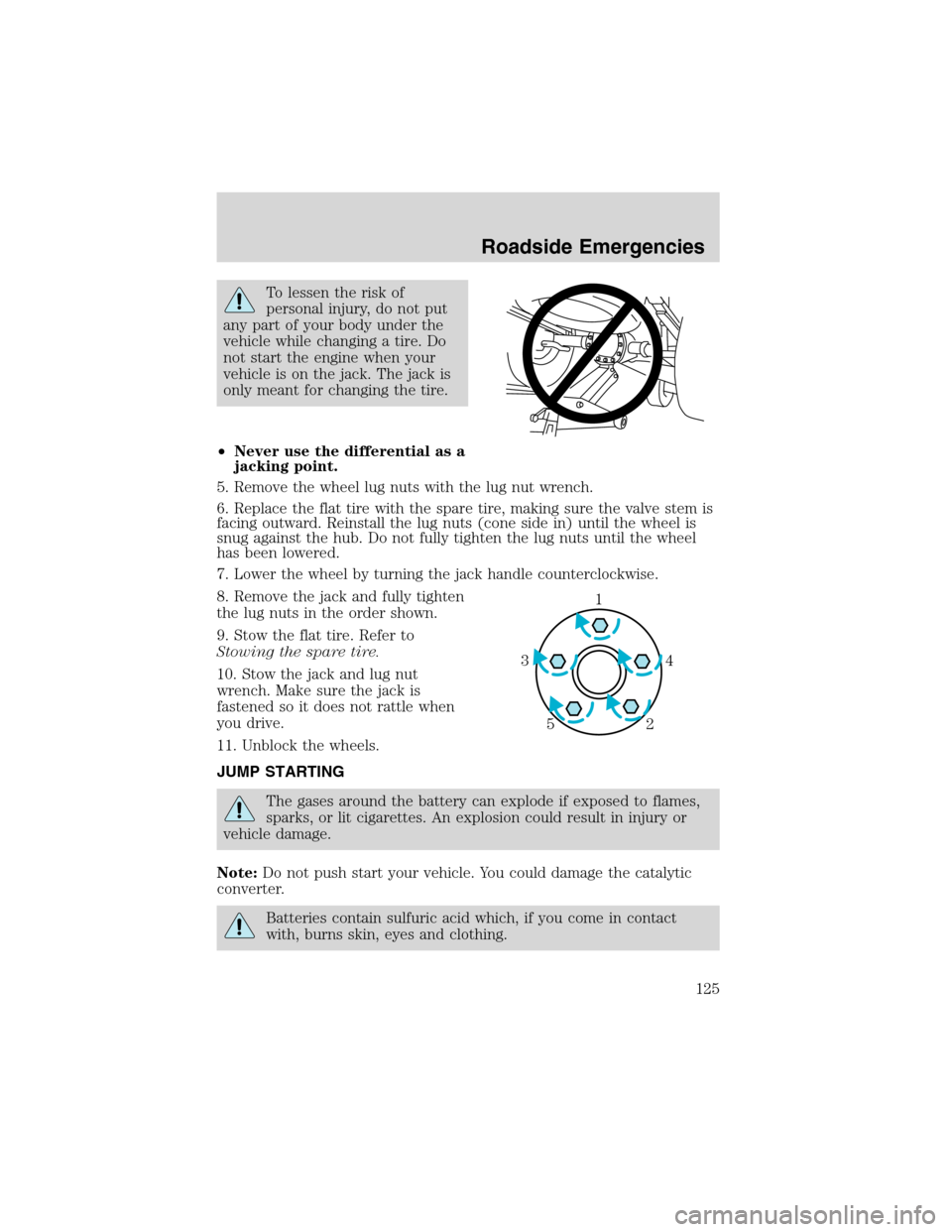
•Never use the differential as a
jacking point.
5. Remove the wheel lug nuts with the lug nut wrench.
6. Replace the flat tire with the spare tire, making sure the valve stem is
facing outward. Reinstall the lug nuts (cone side in) until the wheel is
snug against the hub. Do not fully tighten the lug nuts until the wheel
has been lowered.
7. Lower the wheel by turning the jack handle counterclockwise.
8. Remove the jack and fully tighten
the lug nuts in the order shown.
9. Stow the flat tire. Refer to
Stowing the spare tire.
10. Stow the jack and lug nut
wrench. Make sure the jack is
fastened so it does not rattle when
you drive.
11. Unblock the wheels.
JUMP STARTING
The gases around the battery can explode if exposed to flames,
sparks, or lit cigarettes. An explosion could result in injury or
vehicle damage.
Note:Do not push start your vehicle. You could damage the catalytic
converter.
Batteries contain sulfuric acid which, if you come in contact
with, burns skin, eyes and clothing.
1
4 3
2 5
Roadside Emergencies
125
Page 149 of 184
ENGINE COOLANT
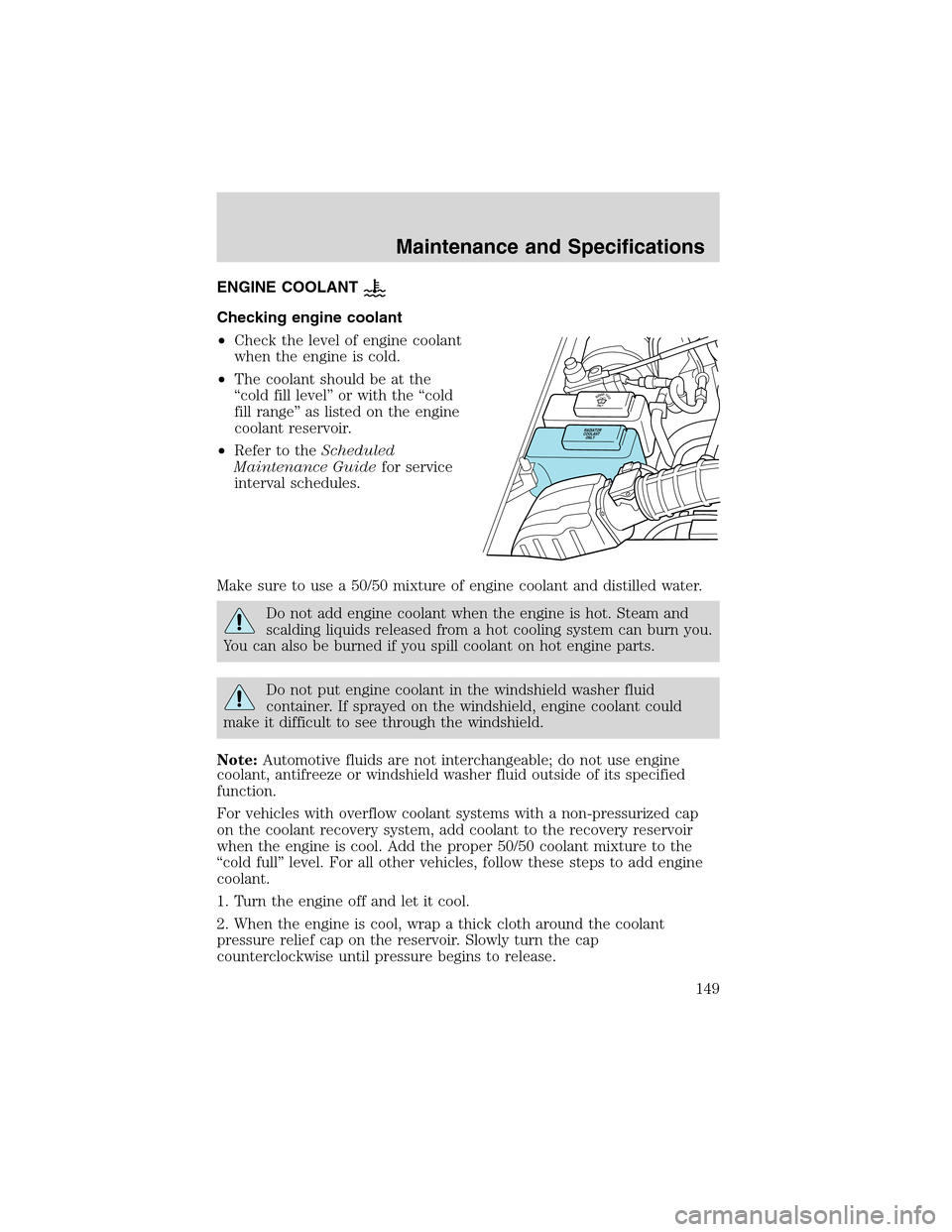
Checking engine coolant
•Check the level of engine coolant
when the engine is cold.
•The coolant should be at the
“cold fill level”or with the“cold
fill range”as listed on the engine
coolant reservoir.
•Refer to theScheduled
Maintenance Guidefor service
interval schedules.
Make sure to use a 50/50 mixture of engine coolant and distilled water.
Do not add engine coolant when the engine is hot. Steam and
scalding liquids released from a hot cooling system can burn you.
You can also be burned if you spill coolant on hot engine parts.
Do not put engine coolant in the windshield washer fluid
container. If sprayed on the windshield, engine coolant could
make it difficult to see through the windshield.
Note:Automotive fluids are not interchangeable; do not use engine
coolant, antifreeze or windshield washer fluid outside of its specified
function.
For vehicles with overflow coolant systems with a non-pressurized cap
on the coolant recovery system, add coolant to the recovery reservoir
when the engine is cool. Add the proper 50/50 coolant mixture to the
“cold full”level. For all other vehicles, follow these steps to add engine
coolant.
1. Turn the engine off and let it cool.
2. When the engine is cool, wrap a thick cloth around the coolant
pressure relief cap on the reservoir. Slowly turn the cap
counterclockwise until pressure begins to release.
RADIATOR
COOLANT
ONLY
WASHERFLUIDONLY
Maintenance and Specifications
149
Page 154 of 184
Running out of fuel
Running out of fuel may have an adverse affect on powertrain
components.
•You may need to cycle the ignition from off to on several times after
refueling to allow the fuel system to pump the fuel from the tank to
the engine.
•Your“Check Engine”indicator may come on.
Fuel filler cap
When fueling:
1. Turn the engine off.
2. Carefully turn the filler cap counterclockwise 1/8 of a turn until it
stops.
3. Pull to remove the cap.
4. To install the cap, align the tabs on the cap with the notches on the
filler pipe.
5. Turn the filler cap clockwise 1/8 of a turn until it stops.
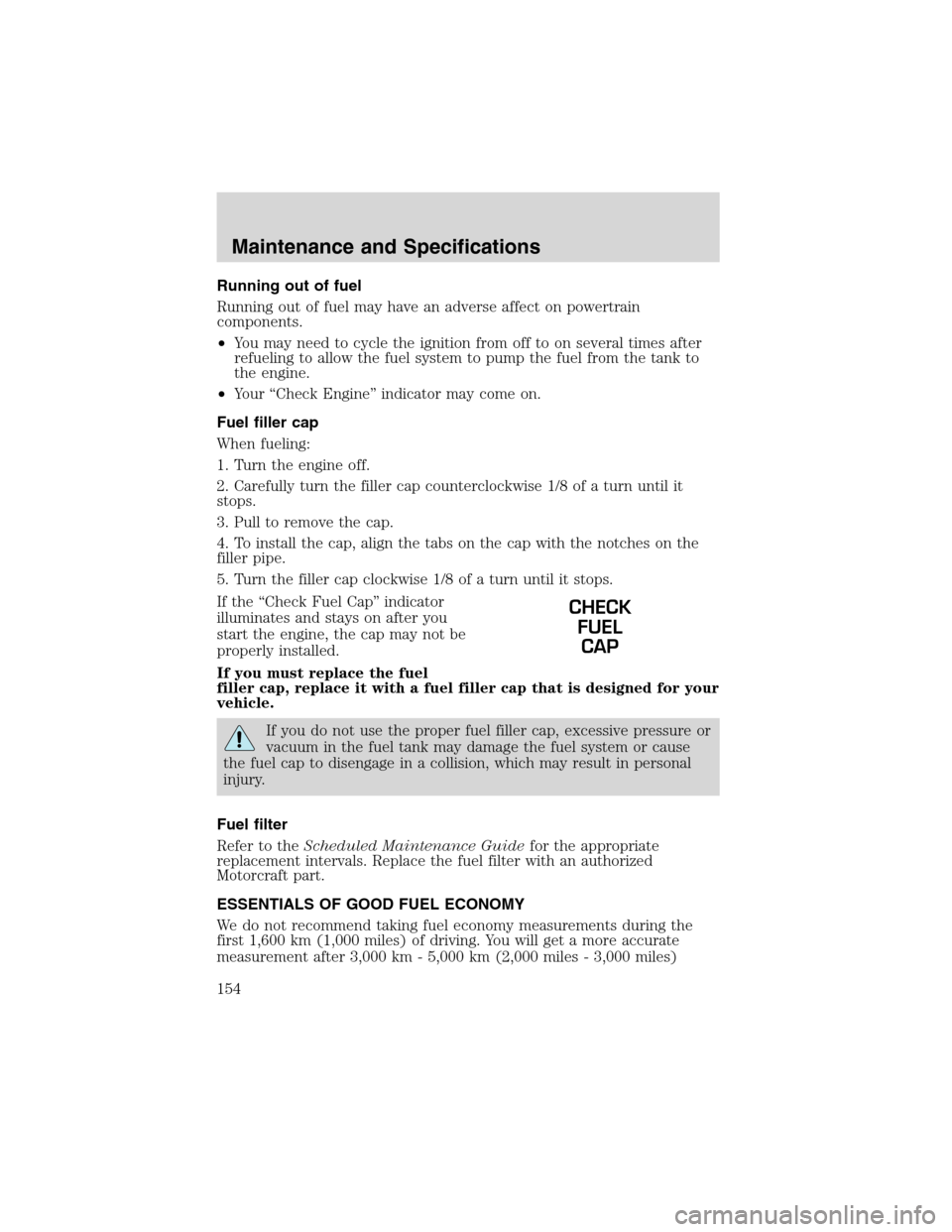
If the“Check Fuel Cap”indicator
illuminates and stays on after you
start the engine, the cap may not be
properly installed.
If you must replace the fuel
filler cap, replace it with a fuel filler cap that is designed for your
vehicle.
If you do not use the proper fuel filler cap, excessive pressure or
vacuum in the fuel tank may damage the fuel system or cause
the fuel cap to disengage in a collision, which may result in personal
injury.
Fuel filter
Refer to theScheduled Maintenance Guidefor the appropriate
replacement intervals. Replace the fuel filter with an authorized
Motorcraft part.
ESSENTIALS OF GOOD FUEL ECONOMY
We do not recommend taking fuel economy measurements during the
first 1,600 km (1,000 miles) of driving. You will get a more accurate
measurement after 3,000 km - 5,000 km (2,000 miles - 3,000 miles)
CHECK
FUEL
CAP
Maintenance and Specifications
154