2002 FORD ESCAPE light
[x] Cancel search: lightPage 245 of 280
The fuel system may be under pressure. If the fuel filler cap is
venting vapor or if you hear a hissing sound, wait until it stops
before completely removing the fuel filler cap. Otherwise, fuel may
spray out and injure you or others.
If you do not use the proper fuel filler cap, excessive pressure or
vacuum in the fuel tank may damage the fuel system or cause
the fuel cap to disengage in a collision, which may result in possible
personal injury.
Choosing the right fuel
Use only UNLEADED FUEL. The use of leaded fuel is prohibited by law
and could damage your vehicle.
Do not use fuel containing methanol. It can damage critical fuel system
components.
Your vehicle was not designed to use fuel or fuel additives with metallic
compounds, including manganese-based compounds containing MMT.
Repairs to correct the effects of using a fuel for which your vehicle was
not designed may not be covered by your warranty.
Octane recommendations
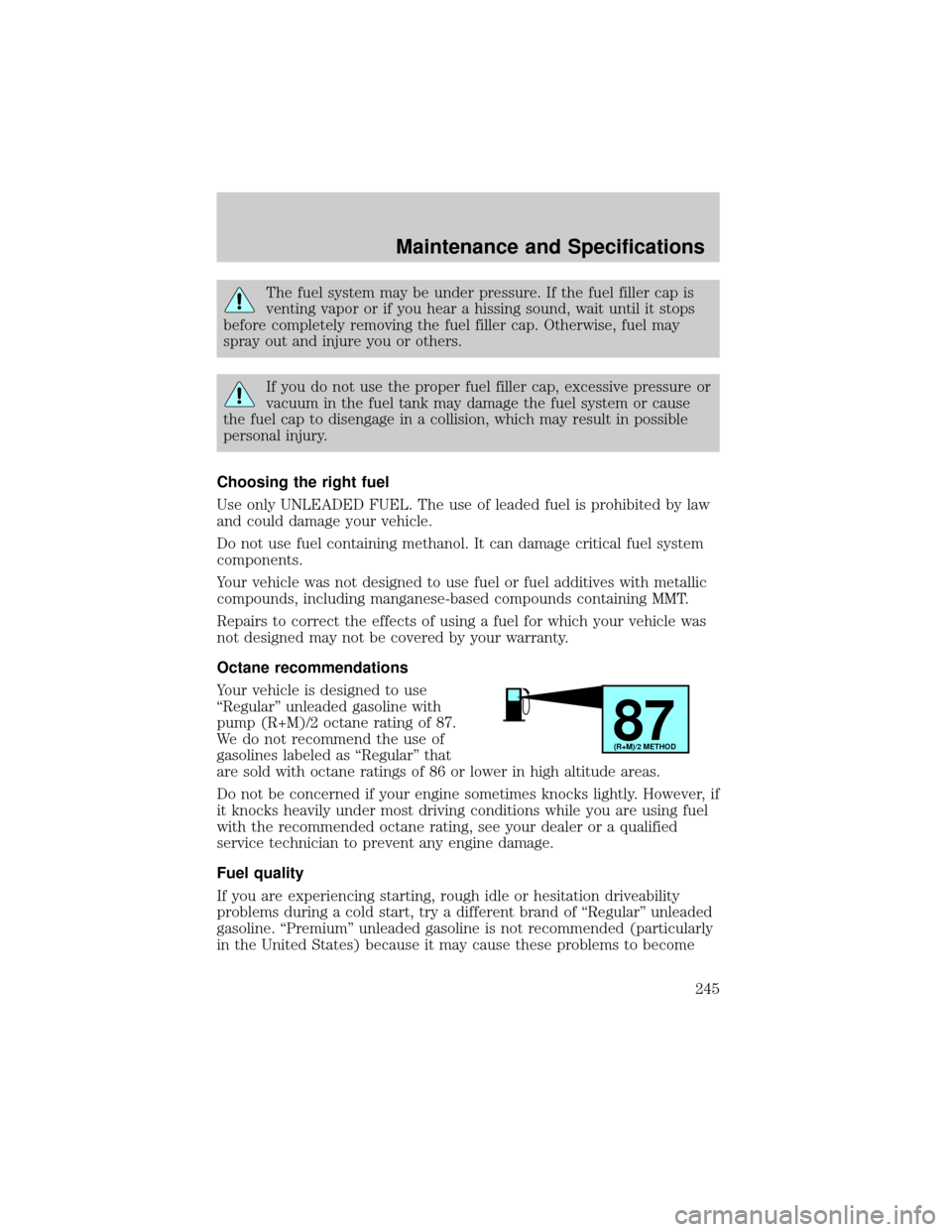
Your vehicle is designed to use
ªRegularº unleaded gasoline with
pump (R+M)/2 octane rating of 87.
We do not recommend the use of
gasolines labeled as ªRegularº that
are sold with octane ratings of 86 or lower in high altitude areas.
Do not be concerned if your engine sometimes knocks lightly. However, if
it knocks heavily under most driving conditions while you are using fuel
with the recommended octane rating, see your dealer or a qualified
service technician to prevent any engine damage.
Fuel quality
If you are experiencing starting, rough idle or hesitation driveability
problems during a cold start, try a different brand of ªRegularº unleaded
gasoline. ªPremiumº unleaded gasoline is not recommended (particularly
in the United States) because it may cause these problems to become
87(R+M)/2 METHOD
Maintenance and Specifications
245
Page 249 of 280
![FORD ESCAPE 2002 1.G Owners Manual ²Sudden or hard accelerations may reduce fuel economy.
²Slow down gradually.
²Driving at reasonable speeds (traveling at 88 km/h [55 mph] uses 15%
less fuel than traveling at 105 km/h [65 mph]).
²](/manual-img/11/4853/w960_4853-248.png "FORD ESCAPE 2002 1.G Owners Manual ²Sudden or hard accelerations may reduce fuel economy.
²Slow down gradually.
²Driving at reasonable speeds (traveling at 88 km/h [55 mph] uses 15%
less fuel than traveling at 105 km/h [65 mph]).
²")
²Sudden or hard accelerations may reduce fuel economy.
²Slow down gradually.
²Driving at reasonable speeds (traveling at 88 km/h [55 mph] uses 15%
less fuel than traveling at 105 km/h [65 mph]).
²Revving the engine before turning it off may reduce fuel economy.
²Using the air conditioner or defroster may reduce fuel economy.
²You may want to turn off the speed control in hilly terrain if
unnecessary shifting between third and fourth gear occurs.
Unnecessary shifting of this type could result in reduced fuel
economy.
²Warming up a vehicle on cold mornings is not required and may
reduce fuel economy.
²Resting your foot on the brake pedal while driving may reduce fuel
economy.
²Combine errands and minimize stop-and-go driving.
Maintenance
²Keep tires properly inflated and use only recommended size.
²Operating a vehicle with the wheels out of alignment will reduce fuel
economy.
²Use recommended engine oil. Refer toLubricant specificationsin
this chapter.
²Perform all regularly scheduled maintenance items. Follow the
recommended maintenance schedule and owner maintenance checks
found in your vehicle scheduled maintenance guide.
Conditions
²Heavily loading a vehicle or towing a trailer may reduce fuel economy
at any speed.
²Carrying unnecessary weight may reduce fuel economy (approximately
0.4 km/L [1 mpg] is lost for every 180 kg [400 lb] of weight carried).
²Adding certain accessories to your vehicle (for example bug
deflectors, rollbars/light bars, running boards, ski/luggage racks) may
reduce fuel economy.
²Using fuel blended with alcohol may lower fuel economy.
Maintenance and Specifications
249
Page 251 of 280

Do not park, idle, or drive your vehicle in dry grass or other dry
ground cover. The emission system heats up the engine
compartment and exhaust system, which can start a fire.
Illumination of the
indicator, charging system warning light or the
temperature warning light, fluid leaks, strange odors, smoke or loss of
engine power, could indicate that the emission control system is not
working properly.
Exhaust leaks may result in entry of harmful and potentially
lethal fumes into the passenger compartment.
Do not make any unauthorized changes to your vehicle or engine. By
law, vehicle owners and anyone who manufactures, repairs, services,
sells, leases, trades vehicles, or supervises a fleet of vehicles are not
permitted to intentionally remove an emission control device or prevent
it from working. Information about your vehicle's emission system is on
the Vehicle Emission Control Information Decal located on or near the
engine. This decal identifies engine displacement and gives some tune up
specifications.
Please consult yourWarranty Guidefor complete emission warranty
information.
Readiness for Inspection/Maintenance (I/M) testing
In some localities, it may be a legal requirement to pass an I/M test of
the on-board diagnostics system. If your
indicator is on, refer to the
description in theWarning lights and chimessection of the
Instrument Clusterchapter. Your vehicle may not pass the I/M test with
the
indicator on.
If the vehicle's powertrain system or its battery has just been serviced,
the on-board diagnostics system is reset to a ªnot ready for I/M testº
condition. To ready the on-board diagnostics system for I/M testing, a
minimum of 30 minutes of city and highway driving is necessary as
described below:
²First, at least 10 minutes of driving on an expressway or highway.
²Next, at least 20 minutes driving in stop-and-go, city-type traffic with
at least four idle periods.
Allow the vehicle to sit for at least eight hours without starting the
engine. Then, start the engine and complete the above driving cycle. The
Maintenance and Specifications
251
Page 272 of 280

Floor cargo net
Tire step
Travel equipment
Auto headlamps with DRL (Daytime Running Lights)
Console
Daytime running lights
Factory luggage rack adaptors
Hitch mounted bike rack
Mirror I/S electrochromic compass with and without temperature display
Pet guard
Removable luggage rack (Track riders)
Removable luggage rack adapters
Running boards and running bars
Soft luggage cover
Trailer hitch (Class II)
Trailer hitch bars and balls
Trailer hitch wiring adaptor
Protection and appearance equipment
Air bag anti-theft locks
Car/truck covers
Cargo liners, interior (soft and rigid)
Carpet floor mats
Door edge guards
Front end covers (full and mini)
Grill guard
Hood deflectors
Molded splash guards
Molded vinyl floor mats
Moonroof deflector
Rear air deflectors
Accessories
272
Page 274 of 280

A
ABS (see Brakes) .....................159
Air bag supplemental restraint
system ........................136±137, 141
and child safety seats ............139
description ......................137, 141
disposal ....................................144
driver air bag ..................139, 142
indicator light ...........12, 141, 143
operation .........................139, 142
passenger air bag ...........139, 142
side air bag ..............................141
Air cleaner filter .......256±257, 262
Air conditioning
manual heating and air
conditioning system .................63
All Wheel Drive (AWD),
driving off road .........................169
Ambulance packages ....................7
Antifreeze
(see Engine coolant) ................237
Anti-lock brake system
(see Brakes) ..............................159
Anti-theft system ......................111
arming the system ..................111
disarming a triggered
system .....................................112
warning light .............................14
Audio system (see Radio) ...25, 46
Automatic transaxle .................163
driving with .............................166
fluid, adding ............................254
fluid, checking ........................254
Automatic transmission
fluid, refill capacities ..............262
fluid, specification ..................267Auxiliary power point .................83
Axle
lubricant specifications ..265, 267
refill capacities ........................262
B
Battery .......................................235
acid, treating emergencies .....235
charging system
warning light .............................12
jumping a disabled battery ....200
maintenance-free ....................235
replacement, specifications ...262
servicing ..................................235
BeltMinder .................................132
Brakes ........................................158
anti-lock ...................................159
anti-lock brake system
(ABS) warning light .........12, 160
brake warning light ..................11
fluid, checking and adding ....253
fluid, refill capacities ..............262
fluid, specifications .........265, 267
lubricant specifications ..265, 267
parking ....................................160
shift interlock ..........................163
Break-in period .............................5
Bulbs ............................................73
C
Capacities for refilling fluids ....262
Cargo cover .................................91
Cargo net .....................................91
CD-single .....................................18
CD-single premium .....................25
Certification Label ....................269
Index
274
Page 276 of 280

E
Emergencies, roadside
jump-starting ..........................200
Emission control system ..........250
Engine ........................................267
check engine/service engine
soon light ..................................10
cleaning ...................................219
coolant .....................................237
idle speed control ...................235
lubrication
specifications ..................265, 267
refill capacities ........................262
service points ..................229±230
starting after a collision .........187
Engine block heater .................157
Engine oil ..................................231
checking and adding ..............231
dipstick ....................................231
filter, specifications ........234, 262
recommendations ...................234
refill capacities ........................262
specifications ..................265, 267
Exhaust fumes ..........................158
F
Fluid capacities .........................262
Foglamps .....................................68
Four-Wheel Drive vehicles
description ..............................169
driving off road .......................171
indicator light ...................14, 170
preparing to drive your
vehicle .....................................162
Fuel ............................................242
calculating fuel economy .......247
cap .....................................14, 244capacity ...................................262
choosing the right fuel ...........245
comparisons with EPA fuel
economy estimates .................250
detergent in fuel .....................246
filling your vehicle
with fuel ..................242, 244, 247
filter, specifications ........246, 262
fuel pump shut-off switch .....187
gauge .........................................16
improving fuel economy ........247
low fuel warning light ..............13
octane rating ...................245, 267
quality ......................................245
running out of fuel .................246
safety information relating to
automotive fuels .....................242
Fuses ..................................189±190
G
Garage door opener ....................82
Gas cap (see Fuel cap) ......14, 244
Gas mileage
(see Fuel economy) .................247
Gauges .........................................15
engine coolant temperature
gauge .........................................15
fuel gauge ..................................16
odometer ...................................17
speedometer .............................16
tachometer ................................17
GAWR (Gross Axle
Weight Rating) ..........................178
calculating ...............................180
definition .................................178
driving with a heavy load ......178
location ....................................178
Index
276
Page 277 of 280

GVWR (Gross Vehicle
Weight Rating) ..........................178
calculating .......................178, 180
definition .................................178
driving with a heavy load ......178
location ....................................178
H
Hazard flashers .........................187
Head restraints .........................115
Headlamps ...................................68
aiming ........................................70
bulb specifications ....................73
daytime running lights .............68
flash to pass ..............................69
high beam ...........................13, 69
replacing bulbs .........................74
turning on and off ....................68
warning chime ..........................15
Heating
heater only system ...................62
heating and air conditioning
system .......................................63
Hood ..........................................227
I
Ignition ...............................154, 267
Infant seats
(see Safety seats) .............145±146
Inspection/maintenance (I/M)
testing ........................................251
Instrument panel
cleaning ...................................222
cluster ................................10, 223
lighting up panel and
interior .......................................69J
Jack ............................................195
positioning ...............................195
storage .....................................195
Jump-starting your vehicle ......200
K
Keys ...................................107±109
key in ignition chime ...............15
positions of the ignition .........154
L
Lamps
bulb replacement
specifications chart ..................73
cargo lamps ...............................69
daytime running light ...............68
fog lamps ...................................68
headlamps .................................68
headlamps, flash to pass ..........69
instrument panel, dimming .....69
interior lamps ...............71±72, 74
replacing bulbs ...................73±77
Lane change indicator
(see Turn signal) ........................71
Liftgate ........................................90
Lights, warning and indicator ....10
air bag ........................................12
anti-lock brakes (ABS) ....12, 160
anti-theft ...................................14
brake ..........................................11
charging system ........................12
cruise indicator .........................13
door ajar ....................................13
fuel cap light .............................14
high beam .................................13
low coolant ................................14
Index
277
Page 279 of 280

S
Safety belts (see Safety
restraints) ....................15, 125±129
Safety defects, reporting ..........217
Safety restraints ................125±130
belt minder .............................132
cleaning the safety
belts .................................135, 224
extension assembly ................131
for adults .........................126±129
for children .....................144±145
lap belt ....................................130
warning light and
chime ...................12, 14, 131±132
Safety seats for children ..145±146
Seat belts
(see Safety restraints) .............125
Seats ..........................................113
child safety seats ............145±146
cleaning ...................................224
SecuriLock passive
anti-theft system ...............107±109
Servicing your vehicle ..............226
Snowplowing .................................7
Spare tire (see Changing
the Tire) ....................................195
Spark plugs,
specifications .....................262, 267
Special notice
ambulance conversions ..............7
utility-type vehicles ....................6
Specification chart,
lubricants ...........................265, 267
Speed control ..............................86
Speedometer ...............................16Starting your
vehicle ........................154±155, 157
jump starting ..........................200
Steering wheel
controls ......................................86
T
Tachometer .................................17
Temperature control
(see Climate control) .................62
Tires ...........................195, 258±259
changing ..........................195±196
checking the pressure ............259
replacing ..................................260
rotating ....................................260
snow tires and chains ............261
tire grades ...............................259
treadwear ................................258
Towing .......................................181
recreational towing .................185
trailer towing ..........................181
wrecker ....................................206
Transaxle
automatic operation ...............163
fluid, checking and adding
(manual) .................................256
Transmission
fluid, checking and adding
(automatic) .............................254
fluid, refill capacities ..............262
lubricant specifications ..265, 267
Turn signal ............................13, 71
V
Vehicle dimensions ...................267
Vehicle Identification Number
(VIN) ..........................................269
Index
279