2002 DODGE RAM warning light
[x] Cancel search: warning lightPage 2115 of 2255
INSTALLATION
WARNING: Allow the urethane at least 24 hours to
cure before returning the vehicle to use.
CAUTION: Roll down the left and right front door
glass and open the rear glass slider (if available)
before installing windshield to avoid pressurizing
the passenger compartment if a door is slammed
before urethane is cured. Water leaks can result.
The windshield fence should be cleaned of most of its
old urethane bonding material. A small amount of old
urethane, approximately 1-2 mm in height, shouldremain on the fence. Do not grind off or completely
remove all old urethane from the fence, the paint finish
and bonding strength will be adversely affected.
(1) Place replacement windshield into windshield
opening and position glass in the center of the open-
ing against the support spacers. Mark the outside
surface of the glass at the support spacers with a
grease pencil or pieces of masking tape and ink pen
to use as a reference for installation. Remove replace-
ment windshield from windshield opening (Fig. 9).
(2) Position the windshield inside up on a suitable
work surface with two padded, wood 10 cm by 10 cm
by 50 cm (4 in. by 4 in. by 20 in.) blocks, placed par-
allel 75 cm (2.5 ft.) apart (Fig. 10).
(3) Clean inside of windshield with MOPAR Glass
Cleaner and lint-free cloth.
(4) Apply clear glass primer 25 mm (1 in.) wide
around perimeter of windshield and wipe with a new
clean and dry lint- free cloth.
(5) Apply the molding to the windshield:
(a) Press the upper corners of the molding onto
the windshield.
(b) Press the header section onto the windshield.
(c)
Press the A-Pillar sections onto the windshield.
(6) Apply black-out primer onto the glass using the
windshield molding as a guide. The primer should be
15 mm (5/8 in.) wide on the top and sides of the glass
and 25 mm (1 in.) on the bottom of windshield. Allow
at least three minutes drying time.
(7) Locatenewsupport spacers on support brack-
ets and adjust to lowest height.
(8)
Position one 5 mm (3/16 in.) soft spacer (p/n
55028214) at the bottom of the windshield fence (Fig. 11).
(9) Apply a 13mm (1/2 in.) high and 10mm (3/8 in.)
wide bead of urethane around the perimeter of wind-
shield. At the bottom, apply the bead 7 mm (1/4 in.)
inboard from the glass edge. On the three sides
where the molding is on the glass, follow the edge of
molding. The urethane bead should be shaped in a
triangular cross-section, this can be achieved by
notching the tip of the applicator (Fig. 12).
(10) With the aid of a helper, position the wind-
shield over the windshield opening. Align the refer-
ence marks at the bottom of the windshield to the
support spacers.
(11)
Slowly lower windshield glass to the fence open-
ing guiding the lower corners into proper position.
Beginning at the bottom and continuing to the top, push
glass onto fence along the A-Pillars. Push windshield
inward to the fence at the bottom corners (Fig. 13).
(12) Push windshield upward, snug with roof and
ratchet up the adjustable support brackets. Discard
tab from support spacer.
(13) Using clean water, lightly mist the support
spacers.
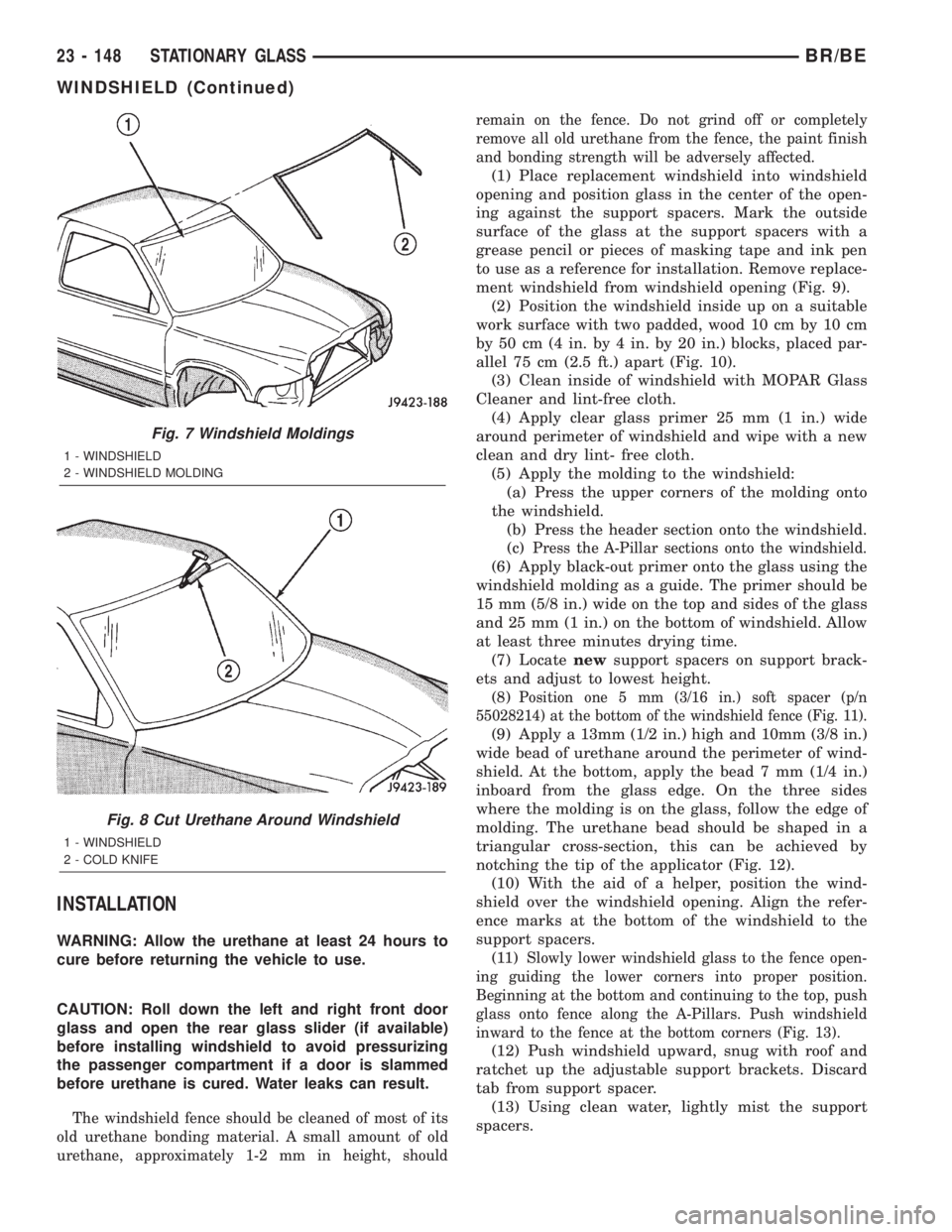
Fig. 7 Windshield Moldings
1 - WINDSHIELD
2 - WINDSHIELD MOLDING
Fig. 8 Cut Urethane Around Windshield
1 - WINDSHIELD
2 - COLD KNIFE
23 - 148 STATIONARY GLASSBR/BE
WINDSHIELD (Continued)
Page 2161 of 2255
PLUMBING
TABLE OF CONTENTS
page page
PLUMBING
DESCRIPTION..........................40
OPERATION............................41
WARNING..............................42
CAUTION..............................42
DIAGNOSIS AND TESTING
DIAGNOSIS AND TESTING - REFRIGERANT
SYSTEM LEAKS.......................43
STANDARD PROCEDURE
STANDARD PROCEDURE - A/C LINE
COUPLERS...........................44
STANDARD PROCEDURE - REFRIGERANT
SYSTEM SERVICE EQUIPMENT...........45
STANDARD PROCEDURE - REFRIGERANT
RECOVERY...........................45
STANDARD PROCEDURE - REFRIGERANT
SYSTEM EVACUATE....................46
STANDARD PROCEDURE - REFRIGERANT
SYSTEM CHARGE......................46
SPECIFICATIONS........................46
A/C COMPRESSOR
DESCRIPTION..........................46
OPERATION............................46
DIAGNOSIS AND TESTING
DIAGNOSIS AND TESTING - A/C
COMPRESSOR........................47
REMOVAL..............................47
INSTALLATION..........................48
A/C CONDENSER
DESCRIPTION..........................49
OPERATION............................49
REMOVAL..............................49
INSTALLATION..........................50
SUCTION AND DISCHARGE LINE
REMOVAL..............................51
INSTALLATION..........................52LIQUID LINE
REMOVAL..............................52
INSTALLATION..........................52
A/C EVAPORATOR
DESCRIPTION..........................53
OPERATION............................53
REMOVAL..............................53
INSTALLATION..........................53
A/C ORIFICE TUBE
DESCRIPTION..........................54
OPERATION............................54
DIAGNOSIS AND TESTING
DIAGNOSIS AND TESTING - FIXED
ORIFICE TUBE.........................54
REMOVAL..............................54
INSTALLATION..........................54
ACCUMULATOR
DESCRIPTION..........................55
OPERATION............................55
REMOVAL..............................55
INSTALLATION..........................55
HEATER CORE
DESCRIPTION..........................56
OPERATION............................56
REMOVAL..............................56
INSTALLATION..........................56
REFRIGERANT
DESCRIPTION..........................56
OPERATION............................57
REFRIGERANT OIL
DESCRIPTION..........................57
OPERATION............................57
STANDARD PROCEDURE
STANDARD PROCEDURE - REFRIGERANT
OIL LEVEL............................57
PLUMBING
DESCRIPTION - A/C LINE COUPLERS
Spring-lock type refrigerant line couplers are used
to connect many of the refrigerant lines and other
components to the refrigerant system. These couplers
require a special tool for disengaging the two coupler
halves.
DESCRIPTION- REFRIGERANT LINES
The refrigerant lines and hoses are used to carry
the refrigerant between the various air conditioning
system components. A barrier hose design with a
nylon tube, which is sandwiched between rubber lay-
ers, is used for the R-134a air conditioning system on
this vehicle. This nylon tube helps to further contain
the R-134a refrigerant, which has a smaller molecu-
lar structure than R-12 refrigerant. The ends of the
refrigerant hoses are made from lightweight alumi-
num or steel, and commonly use braze-less fittings.
24 - 40 PLUMBINGBR/BE
Page 2164 of 2255
CAUTION - REFRIGERANT HOSES/LINES/
TUBES PRECAUTIONS
Kinks or sharp bends in the refrigerant plumbing
will reduce the capacity of the entire system. High
pressures are produced in the system when it is oper-
ating. Extreme care must be exercised to make sure
that all refrigerant system connections are pressure
tight.
A good rule for the flexible hose refrigerant lines is
to keep the radius of all bends at least ten times the
diameter of the hose. Sharp bends will reduce the
flow of refrigerant. The flexible hose lines should be
routed so they are at least 80 millimeters (3 inches)
from the exhaust manifold. It is a good practice to
inspect all flexible refrigerant system hose lines at
least once a year to make sure they are in good con-
dition and properly routed.
There are two types of refrigerant fittings:
²All fittings with O-rings need to be coated with
refrigerant oil before installation. Use only O-rings
that are the correct size and approved for use with
R-134a refrigerant. Failure to do so may result in a
leak.
²Unified plumbing connections with gaskets can-
not be serviced with O-rings. The gaskets are not
reusable and new gaskets do not require lubrication
before installing.
Using the proper tools when making a refrigerant
plumbing connection is very important. Improper
tools or improper use of the tools can damage the
refrigerant fittings. Always use two wrenches when
loosening or tightening tube fittings. Use one wrench
to hold one side of the connection stationary, while
loosening or tightening the other side of the connec-
tion with a second wrench.
The refrigerant must be recovered completely from
the system before opening any fitting or connection.
Open the fittings with caution, even after the refrig-
erant has been recovered. If any pressure is noticed
as a fitting is loosened, tighten the fitting and
recover the refrigerant from the system again.
Do not discharge refrigerant into the atmosphere.
Use an R-134a refrigerant recovery/recycling device
that meets SAE Standard J2210.
The refrigerant system will remain chemically sta-
ble as long as pure, moisture-free R-134a refrigerant
and refrigerant oil is used. Dirt, moisture, or air can
upset this chemical stability. Operational troubles or
serious damage can occur if foreign material is
present in the refrigerant system.
When it is necessary to open the refrigerant sys-
tem, have everything needed to service the system
ready. The refrigerant system should not be left open
to the atmosphere any longer than necessary. Cap or
plug all lines and fittings as soon as they are opened
to prevent the entrance of dirt and moisture. All linesand components in parts stock should be capped or
sealed until they are to be installed.
All tools, including the refrigerant recycling equip-
ment, the manifold gauge set, and test hoses should
be kept clean and dry. All tools and equipment must
be designed for R-134a refrigerant.
DIAGNOSIS AND TESTING - REFRIGERANT
SYSTEM LEAKS
WARNING: (Refer to 24 - HEATING & AIR CONDI-
TIONING/PLUMBING - WARNING) (Refer to 24 -
HEATING & AIR CONDITIONING/PLUMBING - CAU-
TION) BEFORE PERFORMING THE FOLLOWING
OPERATION.
If the air conditioning system is not cooling prop-
erly, determine if the refrigerant system is fully-
charged. (Refer to 24 - HEATING & AIR
CONDITIONING - DIAGNOSIS AND TESTING -
A/C PERFORMANCE) If the refrigerant system is
low or empty; a leak at a refrigerant line, connector
fitting, component, or component seal is likely.
An electronic leak detector designed for R-134a
refrigerant, or a fluorescent R-134a leak detection
dye and a black light are recommended for locating
and confirming refrigerant system leaks. Refer to the
operating instructions supplied by the equipment
manufacturer for proper care and use of this equip-
ment.
An oily residue on or near refrigerant system lines,
connector fittings, components, or component seals
can indicate the general location of a possible refrig-
erant leak. However, the exact leak location should
be confirmed with an electronic leak detector prior to
component repair or replacement.
To detect a leak in the refrigerant system with an
electronic leak detector, perform one of the following
procedures:
SYSTEM EMPTY
(1) Evacuate the refrigerant system. (Refer to 24 -
HEATING & AIR CONDITIONING/PLUMBING -
STANDARD PROCEDURE - REFRIGERANT SYS-
TEM EVACUATE)
(2) Connect and dispense 0.283 kilograms (0.625
pounds or 10 ounces) of R-134a refrigerant into the
evacuated refrigerant system. (Refer to 24 - HEAT-
ING & AIR CONDITIONING/PLUMBING - STAN-
DARD PROCEDURE - REFRIGERANT SYSTEM
CHARGE)
(3) Position the vehicle in a wind-free work area.
This will aid in detecting small leaks.
(4) With the engine not running, use a electronic
R-134a leak detector and search for leaks. Because
R-134a refrigerant is heavier than air, the leak detec-
BR/BEPLUMBING 24 - 43
PLUMBING (Continued)
Page 2175 of 2255
(2) Reassemble and reinstall the HVAC housing in
the vehicle. (Refer to 24 - HEATING & AIR CONDI-
TIONING/DISTRIBUTION/HVAC HOUSING -
ASSEMBLY) (Refer to 24 - HEATING & AIR CON-
DITIONING/DISTRIBUTION/HVAC HOUSING -
INSTALLATION)
NOTE: If the evaporator is replaced, add 60 millili-
ters (2 fluid ounces) of refrigerant oil to the refrig-
erant system.
A/C ORIFICE TUBE
DESCRIPTION
The fixed orifice tube is installed in the liquid line
between the outlet of the condenser and the inlet of
the evaporator. The fixed orifice tube is only serviced
as an integral part of the liquid line.
OPERATION
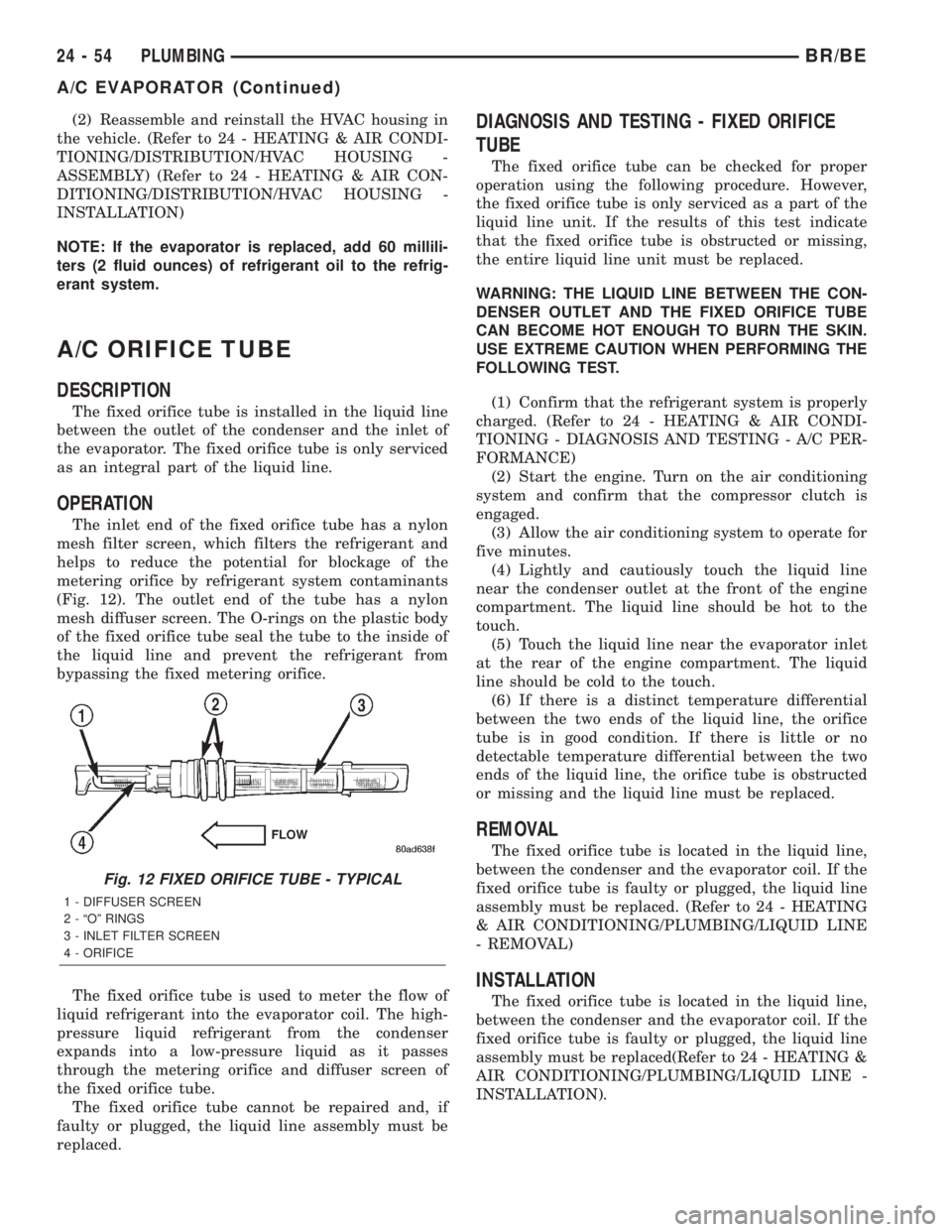
The inlet end of the fixed orifice tube has a nylon
mesh filter screen, which filters the refrigerant and
helps to reduce the potential for blockage of the
metering orifice by refrigerant system contaminants
(Fig. 12). The outlet end of the tube has a nylon
mesh diffuser screen. The O-rings on the plastic body
of the fixed orifice tube seal the tube to the inside of
the liquid line and prevent the refrigerant from
bypassing the fixed metering orifice.
The fixed orifice tube is used to meter the flow of
liquid refrigerant into the evaporator coil. The high-
pressure liquid refrigerant from the condenser
expands into a low-pressure liquid as it passes
through the metering orifice and diffuser screen of
the fixed orifice tube.
The fixed orifice tube cannot be repaired and, if
faulty or plugged, the liquid line assembly must be
replaced.
DIAGNOSIS AND TESTING - FIXED ORIFICE
TUBE
The fixed orifice tube can be checked for proper
operation using the following procedure. However,
the fixed orifice tube is only serviced as a part of the
liquid line unit. If the results of this test indicate
that the fixed orifice tube is obstructed or missing,
the entire liquid line unit must be replaced.
WARNING: THE LIQUID LINE BETWEEN THE CON-
DENSER OUTLET AND THE FIXED ORIFICE TUBE
CAN BECOME HOT ENOUGH TO BURN THE SKIN.
USE EXTREME CAUTION WHEN PERFORMING THE
FOLLOWING TEST.
(1) Confirm that the refrigerant system is properly
charged. (Refer to 24 - HEATING & AIR CONDI-
TIONING - DIAGNOSIS AND TESTING - A/C PER-
FORMANCE)
(2) Start the engine. Turn on the air conditioning
system and confirm that the compressor clutch is
engaged.
(3) Allow the air conditioning system to operate for
five minutes.
(4) Lightly and cautiously touch the liquid line
near the condenser outlet at the front of the engine
compartment. The liquid line should be hot to the
touch.
(5) Touch the liquid line near the evaporator inlet
at the rear of the engine compartment. The liquid
line should be cold to the touch.
(6) If there is a distinct temperature differential
between the two ends of the liquid line, the orifice
tube is in good condition. If there is little or no
detectable temperature differential between the two
ends of the liquid line, the orifice tube is obstructed
or missing and the liquid line must be replaced.
REMOVAL
The fixed orifice tube is located in the liquid line,
between the condenser and the evaporator coil. If the
fixed orifice tube is faulty or plugged, the liquid line
assembly must be replaced. (Refer to 24 - HEATING
& AIR CONDITIONING/PLUMBING/LIQUID LINE
- REMOVAL)
INSTALLATION
The fixed orifice tube is located in the liquid line,
between the condenser and the evaporator coil. If the
fixed orifice tube is faulty or plugged, the liquid line
assembly must be replaced(Refer to 24 - HEATING &
AIR CONDITIONING/PLUMBING/LIQUID LINE -
INSTALLATION).
Fig. 12 FIXED ORIFICE TUBE - TYPICAL
1 - DIFFUSER SCREEN
2 - ªOº RINGS
3 - INLET FILTER SCREEN
4 - ORIFICE
24 - 54 PLUMBINGBR/BE
A/C EVAPORATOR (Continued)
Page 2223 of 2255
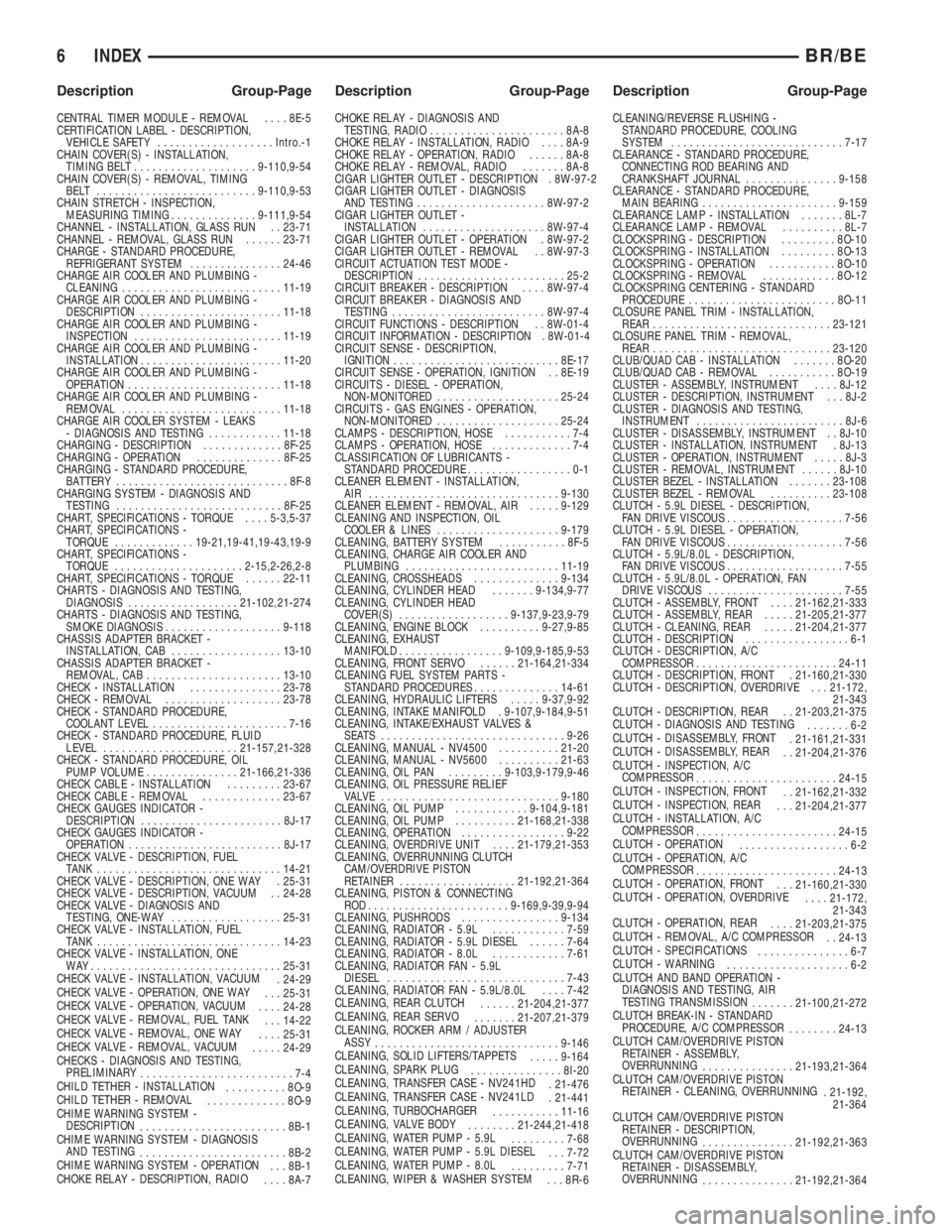
CENTRAL TIMER MODULE - REMOVAL....8E-5
CERTIFICATION LABEL - DESCRIPTION,
VEHICLE SAFETY...................Intro.-1
CHAIN COVER(S) - INSTALLATION,
TIMING BELT....................9-110,9-54
CHAIN COVER(S) - REMOVAL, TIMING
BELT ..........................9-110,9-53
CHAIN STRETCH - INSPECTION,
MEASURING TIMING..............9-111,9-54
CHANNEL - INSTALLATION, GLASS RUN . . 23-71
CHANNEL - REMOVAL, GLASS RUN......23-71
CHARGE - STANDARD PROCEDURE,
REFRIGERANT SYSTEM...............24-46
CHARGE AIR COOLER AND PLUMBING -
CLEANING..........................11-19
CHARGE AIR COOLER AND PLUMBING -
DESCRIPTION.......................11-18
CHARGE AIR COOLER AND PLUMBING -
INSPECTION........................11-19
CHARGE AIR COOLER AND PLUMBING -
INSTALLATION.......................11-20
CHARGE AIR COOLER AND PLUMBING -
OPERATION.........................11-18
CHARGE AIR COOLER AND PLUMBING -
REMOVAL..........................11-18
CHARGE AIR COOLER SYSTEM - LEAKS
- DIAGNOSIS AND TESTING............11-18
CHARGING - DESCRIPTION.............8F-25
CHARGING - OPERATION..............8F-25
CHARGING - STANDARD PROCEDURE,
BATTERY............................8F-8
CHARGING SYSTEM - DIAGNOSIS AND
TESTING...........................8F-25
CHART, SPECIFICATIONS - TORQUE....5-3,5-37
CHART, SPECIFICATIONS -
TORQUE.............19-21,19-41,19-43,19-9
CHART, SPECIFICATIONS -
TORQUE.....................2-15,2-26,2-8
CHART, SPECIFICATIONS - TORQUE......22-11
CHARTS - DIAGNOSIS AND TESTING,
DIAGNOSIS..................21-102,21-274
CHARTS - DIAGNOSIS AND TESTING,
SMOKE DIAGNOSIS...................9-118
CHASSIS ADAPTER BRACKET -
INSTALLATION, CAB..................13-10
CHASSIS ADAPTER BRACKET -
REMOVAL, CAB......................13-10
CHECK - INSTALLATION...............23-78
CHECK - REMOVAL...................23-78
CHECK - STANDARD PROCEDURE,
COOLANT LEVEL......................7-16
CHECK - STANDARD PROCEDURE, FLUID
LEVEL......................21-157,21-328
CHECK - STANDARD PROCEDURE, OIL
PUMP VOLUME...............21-166,21-336
CHECK CABLE - INSTALLATION.........23-67
CHECK CABLE - REMOVAL.............23-67
CHECK GAUGES INDICATOR -
DESCRIPTION.......................8J-17
CHECK GAUGES INDICATOR -
OPERATION.........................8J-17
CHECK VALVE - DESCRIPTION, FUEL
TANK ..............................14-21
CHECK VALVE - DESCRIPTION, ONE WAY . 25-31
CHECK VALVE - DESCRIPTION, VACUUM . . 24-28
CHECK VALVE - DIAGNOSIS AND
TESTING, ONE-WAY..................25-31
CHECK VALVE - INSTALLATION, FUEL
TANK ..............................14-23
CHECK VALVE - INSTALLATION, ONE
WAY...............................25-31
CHECK VALVE - INSTALLATION, VACUUM
. 24-29
CHECK VALVE - OPERATION, ONE WAY
. . . 25-31
CHECK VALVE - OPERATION, VACUUM
....24-28
CHECK VALVE - REMOVAL, FUEL TANK
. . . 14-22
CHECK VALVE - REMOVAL, ONE WAY
....25-31
CHECK VALVE - REMOVAL, VACUUM
.....24-29
CHECKS - DIAGNOSIS AND TESTING,
PRELIMINARY
.........................7-4
CHILD TETHER - INSTALLATION
..........8O-9
CHILD TETHER - REMOVAL
.............8O-9
CHIME WARNING SYSTEM -
DESCRIPTION
........................8B-1
CHIME WARNING SYSTEM - DIAGNOSIS
AND TESTING
........................8B-2
CHIME WARNING SYSTEM - OPERATION
. . . 8B-1
CHOKE RELAY - DESCRIPTION, RADIO
....8A-7CHOKE RELAY - DIAGNOSIS AND
TESTING, RADIO......................8A-8
CHOKE RELAY - INSTALLATION, RADIO....8A-9
CHOKE RELAY - OPERATION, RADIO......8A-8
CHOKE RELAY - REMOVAL, RADIO.......8A-8
CIGAR LIGHTER OUTLET - DESCRIPTION . 8W-97-2
CIGAR LIGHTER OUTLET - DIAGNOSIS
AND TESTING.....................8W-97-2
CIGAR LIGHTER OUTLET -
INSTALLATION....................8W-97-4
CIGAR LIGHTER OUTLET - OPERATION . 8W-97-2
CIGAR LIGHTER OUTLET - REMOVAL . . 8W-97-3
CIRCUIT ACTUATION TEST MODE -
DESCRIPTION........................25-2
CIRCUIT BREAKER - DESCRIPTION....8W-97-4
CIRCUIT BREAKER - DIAGNOSIS AND
TESTING.........................8W-97-4
CIRCUIT FUNCTIONS - DESCRIPTION . . 8W-01-4
CIRCUIT INFORMATION - DESCRIPTION . 8W-01-4
CIRCUIT SENSE - DESCRIPTION,
IGNITION...........................8E-17
CIRCUIT SENSE - OPERATION, IGNITION . . 8E-19
CIRCUITS - DIESEL - OPERATION,
NON-MONITORED....................25-24
CIRCUITS - GAS ENGINES - OPERATION,
NON-MONITORED....................25-24
CLAMPS - DESCRIPTION, HOSE...........7-4
CLAMPS - OPERATION, HOSE.............7-4
CLASSIFICATION OF LUBRICANTS -
STANDARD PROCEDURE..................0-1
CLEANER ELEMENT - INSTALLATION,
AIR ...............................9-130
CLEANER ELEMENT - REMOVAL, AIR.....9-129
CLEANING AND INSPECTION, OIL
COOLER & LINES....................9-179
CLEANING, BATTERY SYSTEM...........8F-5
CLEANING, CHARGE AIR COOLER AND
PLUMBING.........................11-19
CLEANING, CROSSHEADS..............9-134
CLEANING, CYLINDER HEAD.......9-134,9-77
CLEANING, CYLINDER HEAD
COVER(S)..................9-137,9-23,9-79
CLEANING, ENGINE BLOCK..........9-27,9-85
CLEANING, EXHAUST
MANIFOLD.................9-109,9-185,9-53
CLEANING, FRONT SERVO......21-164,21-334
CLEANING FUEL SYSTEM PARTS -
STANDARD PROCEDURES..............14-61
CLEANING, HYDRAULIC LIFTERS.....9-37,9-92
CLEANING, INTAKE MANIFOLD . 9-107,9-184,9-51
CLEANING, INTAKE/EXHAUST VALVES &
SEATS ..............................9-26
CLEANING, MANUAL - NV4500..........21-20
CLEANING, MANUAL - NV5600..........21-63
CLEANING, OIL PAN.........9-103,9-179,9-46
CLEANING, OIL PRESSURE RELIEF
VALVE .............................9-180
CLEANING, OIL PUMP............9-104,9-181
CLEANING, OIL PUMP..........21-168,21-338
CLEANING, OPERATION.................9-22
CLEANING, OVERDRIVE UNIT....21-179,21-353
CLEANING, OVERRUNNING CLUTCH
CAM/OVERDRIVE PISTON
RETAINER...................21-192,21-364
CLEANING, PISTON & CONNECTING
ROD.......................9-169,9-39,9-94
CLEANING, PUSHRODS................9-134
CLEANING, RADIATOR - 5.9L............7-59
CLEANING, RADIATOR - 5.9L DIESEL......7-64
CLEANING, RADIATOR - 8.0L............7-61
CLEANING, RADIATOR FAN - 5.9L
DIESEL.............................7-43
CLEANING, RADIATOR FAN - 5.9L/8.0L....7-42
CLEANING, REAR CLUTCH
......21-204,21-377
CLEANING, REAR SERVO
.......21-207,21-379
CLEANING, ROCKER ARM / ADJUSTER
ASSY
..............................9-146
CLEANING, SOLID LIFTERS/TAPPETS
.....9-164
CLEANING, SPARK PLUG
...............8I-20
CLEANING, TRANSFER CASE - NV241HD
. 21-476
CLEANING, TRANSFER CASE - NV241LD
. 21-441
CLEANING, TURBOCHARGER
...........11-16
CLEANING, VALVE BODY
........21-244,21-418
CLEANING, WATER PUMP - 5.9L
.........7-68
CLEANING, WATER PUMP - 5.9L DIESEL
. . . 7-72
CLEANING, WATER PUMP - 8.0L
.........7-71
CLEANING, WIPER & WASHER SYSTEM
. . . 8R-6CLEANING/REVERSE FLUSHING -
STANDARD PROCEDURE, COOLING
SYSTEM............................7-17
CLEARANCE - STANDARD PROCEDURE,
CONNECTING ROD BEARING AND
CRANKSHAFT JOURNAL...............9-158
CLEARANCE - STANDARD PROCEDURE,
MAIN BEARING......................9-159
CLEARANCE LAMP - INSTALLATION.......8L-7
CLEARANCE LAMP - REMOVAL..........8L-7
CLOCKSPRING - DESCRIPTION.........8O-10
CLOCKSPRING - INSTALLATION.........8O-13
CLOCKSPRING - OPERATION...........8O-10
CLOCKSPRING - REMOVAL............8O-12
CLOCKSPRING CENTERING - STANDARD
PROCEDURE........................8O-11
CLOSURE PANEL TRIM - INSTALLATION,
REAR.............................23-121
CLOSURE PANEL TRIM - REMOVAL,
REAR.............................23-120
CLUB/QUAD CAB - INSTALLATION.......8O-20
CLUB/QUAD CAB - REMOVAL...........8O-19
CLUSTER - ASSEMBLY, INSTRUMENT....8J-12
CLUSTER - DESCRIPTION, INSTRUMENT . . . 8J-2
CLUSTER - DIAGNOSIS AND TESTING,
INSTRUMENT........................8J-6
CLUSTER - DISASSEMBLY, INSTRUMENT . . 8J-10
CLUSTER - INSTALLATION, INSTRUMENT . 8J-13
CLUSTER - OPERATION, INSTRUMENT.....8J-3
CLUSTER - REMOVAL, INSTRUMENT......8J-10
CLUSTER BEZEL - INSTALLATION.......23-108
CLUSTER BEZEL - REMOVAL..........23-108
CLUTCH - 5.9L DIESEL - DESCRIPTION,
FAN DRIVE VISCOUS...................7-56
CLUTCH - 5.9L DIESEL - OPERATION,
FAN DRIVE VISCOUS...................7-56
CLUTCH - 5.9L/8.0L - DESCRIPTION,
FAN DRIVE VISCOUS...................7-55
CLUTCH - 5.9L/8.0L - OPERATION, FAN
DRIVE VISCOUS......................7-55
CLUTCH - ASSEMBLY, FRONT....21-162,21-333
CLUTCH - ASSEMBLY, REAR.....21-205,21-377
CLUTCH - CLEANING, REAR.....21-204,21-377
CLUTCH - DESCRIPTION.................6-1
CLUTCH - DESCRIPTION, A/C
COMPRESSOR.......................24-11
CLUTCH - DESCRIPTION, FRONT . 21-160,21-330
CLUTCH - DESCRIPTION, OVERDRIVE . . . 21-172,
21-343
CLUTCH - DESCRIPTION, REAR . . 21-203,21-375
CLUTCH - DIAGNOSIS AND TESTING
.......6-2
CLUTCH - DISASSEMBLY, FRONT
. 21-161,21-331
CLUTCH - DISASSEMBLY, REAR
. . 21-204,21-376
CLUTCH - INSPECTION, A/C
COMPRESSOR
.......................24-15
CLUTCH - INSPECTION, FRONT
. . 21-162,21-332
CLUTCH - INSPECTION, REAR
. . . 21-204,21-377
CLUTCH - INSTALLATION, A/C
COMPRESSOR
.......................24-15
CLUTCH - OPERATION
..................6-2
CLUTCH - OPERATION, A/C
COMPRESSOR
.......................24-13
CLUTCH - OPERATION, FRONT
. . . 21-160,21-330
CLUTCH - OPERATION, OVERDRIVE
....21-172,
21-343
CLUTCH - OPERATION, REAR
....21-203,21-375
CLUTCH - REMOVAL, A/C COMPRESSOR
. . 24-13
CLUTCH - SPECIFICATIONS
...............6-7
CLUTCH - WARNING
....................6-2
CLUTCH AND BAND OPERATION -
DIAGNOSIS AND TESTING, AIR
TESTING TRANSMISSION
.......21-100,21-272
CLUTCH BREAK-IN - STANDARD
PROCEDURE, A/C COMPRESSOR
........24-13
CLUTCH CAM/OVERDRIVE PISTON
RETAINER - ASSEMBLY,
OVERRUNNING
...............21-193,21-364
CLUTCH CAM/OVERDRIVE PISTON
RETAINER - CLEANING, OVERRUNNING
. 21-192,
21-364
CLUTCH CAM/OVERDRIVE PISTON
RETAINER - DESCRIPTION,
OVERRUNNING
...............21-192,21-363
CLUTCH CAM/OVERDRIVE PISTON
RETAINER - DISASSEMBLY,
OVERRUNNING
...............21-192,21-364
6 INDEXBR/BE
Description Group-Page Description Group-Page Description Group-Page