2002 DODGE RAM length
[x] Cancel search: lengthPage 2030 of 2255
DECKLID/HATCH/LIFTGATE/TAILGATE
TABLE OF CONTENTS
page page
APPLIQUE
REMOVAL.............................63
INSTALLATION.........................63
DECALS
REMOVAL.............................64
INSTALLATION.........................64
HANDLE ESCUTCHEON
REMOVAL.............................64
INSTALLATION.........................64
LATCH
REMOVAL.............................65
INSTALLATION.........................65
LATCH HANDLE
REMOVAL.............................66INSTALLATION.........................66
LATCH STRIKER
REMOVAL.............................66
INSTALLATION.........................66
SLAM BUMPER
REMOVAL.............................67
INSTALLATION.........................67
CHECK CABLE
REMOVAL.............................67
INSTALLATION.........................67
TAILGATE
REMOVAL.............................67
INSTALLATION.........................67
APPLIQUE
REMOVAL
(1) Apply a length of masking tape on the body,
parallel to the top edge of the applique to use as a
guide, if necessary.
(2) Warm the tailgate applique and tailgate metal
to approximately 38ÉC (100ÉF) using a suitable heat
lamp or heat gun.
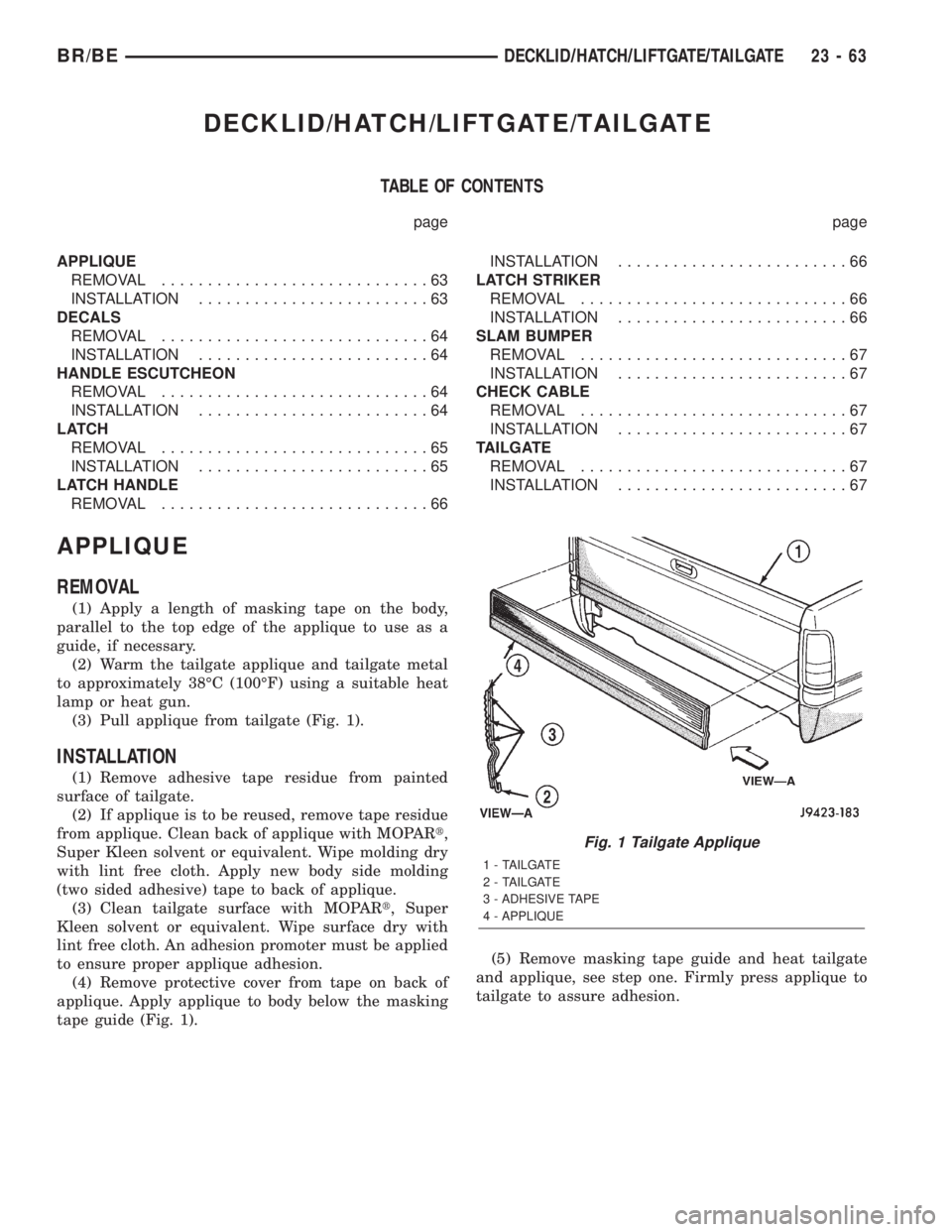
(3) Pull applique from tailgate (Fig. 1).
INSTALLATION
(1) Remove adhesive tape residue from painted
surface of tailgate.
(2) If applique is to be reused, remove tape residue
from applique. Clean back of applique with MOPARt,
Super Kleen solvent or equivalent. Wipe molding dry
with lint free cloth. Apply new body side molding
(two sided adhesive) tape to back of applique.
(3) Clean tailgate surface with MOPARt, Super
Kleen solvent or equivalent. Wipe surface dry with
lint free cloth. An adhesion promoter must be applied
to ensure proper applique adhesion.
(4) Remove protective cover from tape on back of
applique. Apply applique to body below the masking
tape guide (Fig. 1).(5) Remove masking tape guide and heat tailgate
and applique, see step one. Firmly press applique to
tailgate to assure adhesion.
Fig. 1 Tailgate Applique
1 - TAILGATE
2 - TAILGATE
3 - ADHESIVE TAPE
4 - APPLIQUE
BR/BEDECKLID/HATCH/LIFTGATE/TAILGATE 23 - 63
Page 2054 of 2255
INSTALLATION
(1) Clean body surface with MOPARtSuper Kleen
solvent or equivalent. Wipe surface dry with lint free
cloth.
(2) Apply a length of masking tape on the body,
parallel to the top edge of the molding to use as a
guide, if necessary.
(3) Remove protective cover from tape on back of
molding. Apply molding to body below the masking
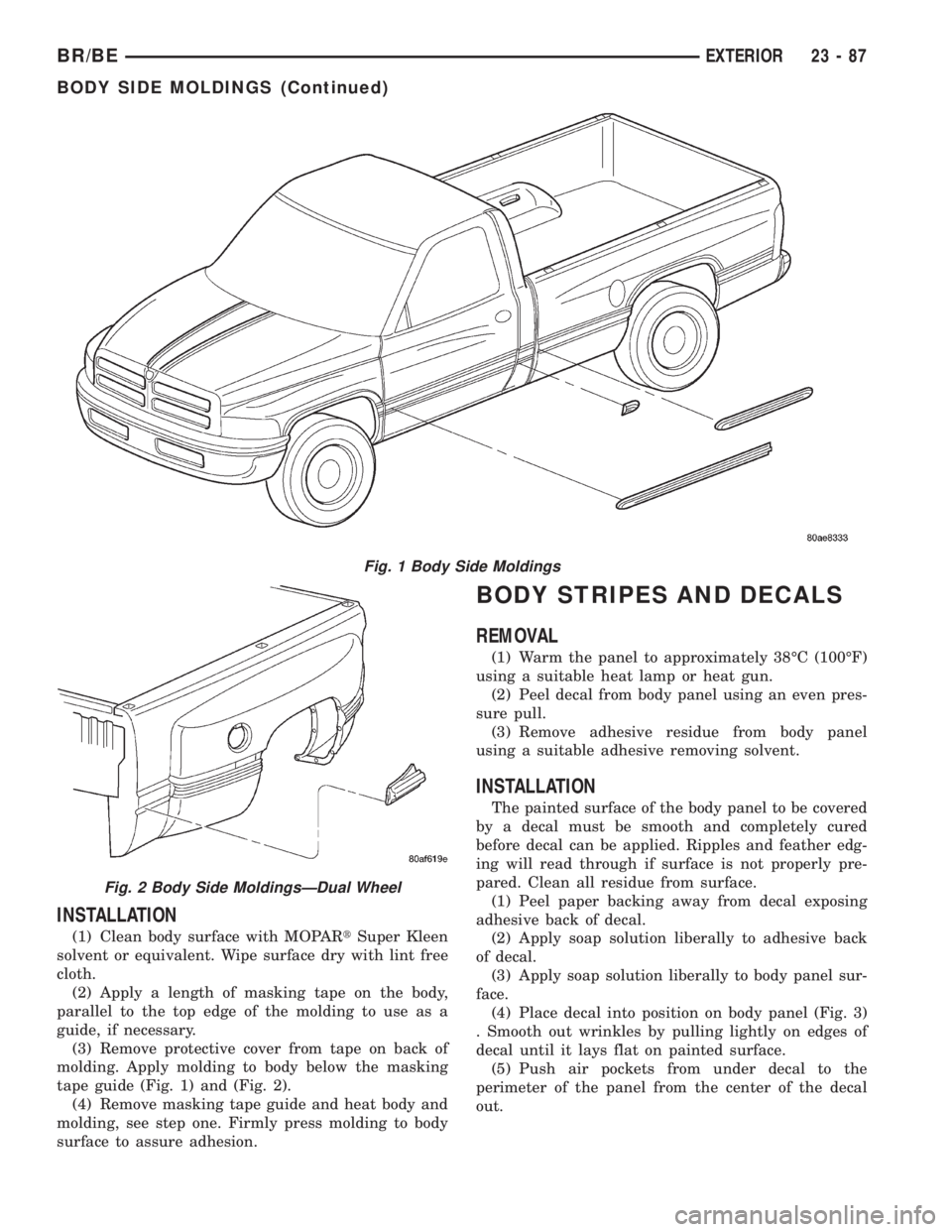
tape guide (Fig. 1) and (Fig. 2).
(4) Remove masking tape guide and heat body and
molding, see step one. Firmly press molding to body
surface to assure adhesion.
BODY STRIPES AND DECALS
REMOVAL
(1) Warm the panel to approximately 38ÉC (100ÉF)
using a suitable heat lamp or heat gun.
(2) Peel decal from body panel using an even pres-
sure pull.
(3) Remove adhesive residue from body panel
using a suitable adhesive removing solvent.
INSTALLATION
The painted surface of the body panel to be covered
by a decal must be smooth and completely cured
before decal can be applied. Ripples and feather edg-
ing will read through if surface is not properly pre-
pared. Clean all residue from surface.
(1) Peel paper backing away from decal exposing
adhesive back of decal.
(2) Apply soap solution liberally to adhesive back
of decal.
(3) Apply soap solution liberally to body panel sur-
face.
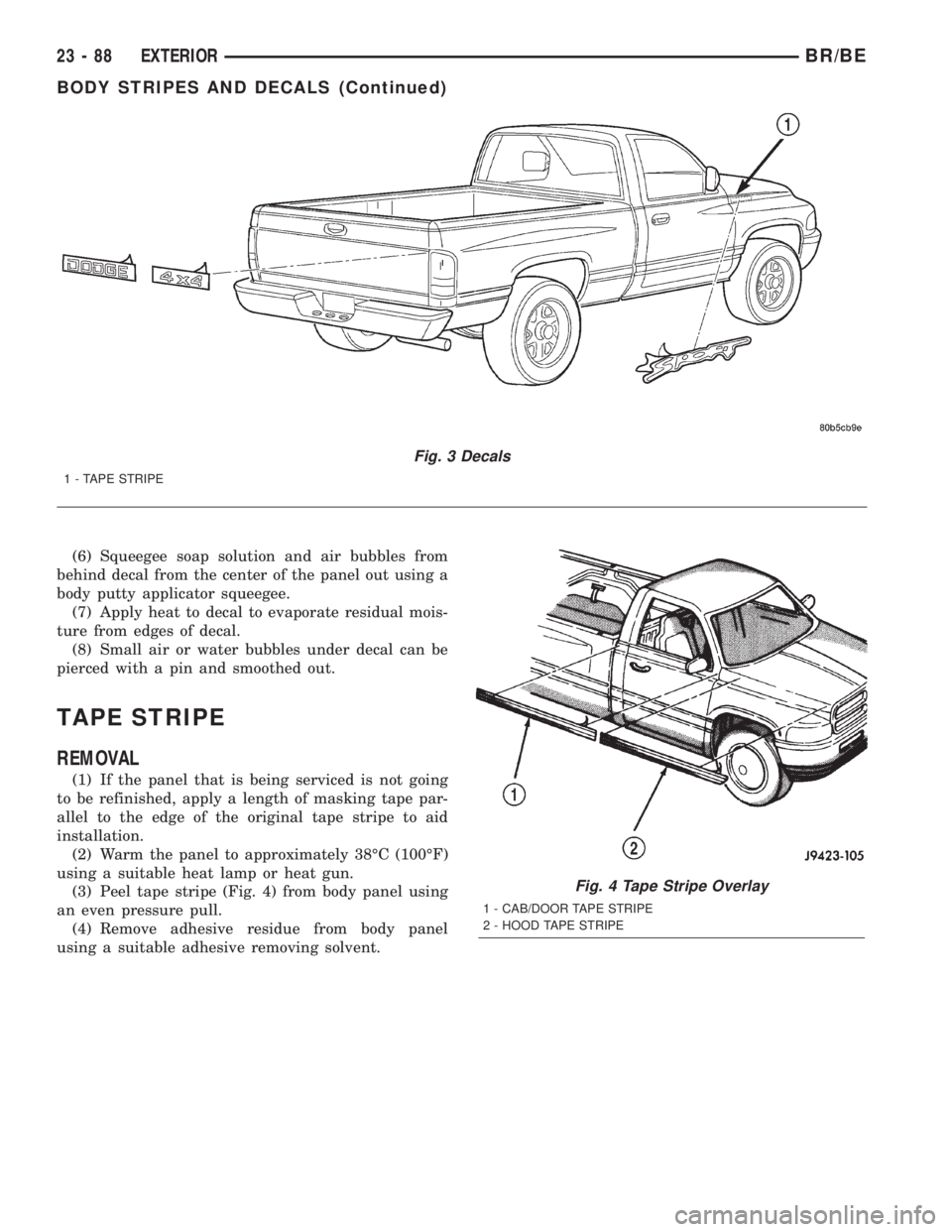
(4) Place decal into position on body panel (Fig. 3)
. Smooth out wrinkles by pulling lightly on edges of
decal until it lays flat on painted surface.
(5) Push air pockets from under decal to the
perimeter of the panel from the center of the decal
out.
Fig. 1 Body Side Moldings
Fig. 2 Body Side MoldingsÐDual Wheel
BR/BEEXTERIOR 23 - 87
BODY SIDE MOLDINGS (Continued)
Page 2055 of 2255
(6) Squeegee soap solution and air bubbles from
behind decal from the center of the panel out using a
body putty applicator squeegee.
(7) Apply heat to decal to evaporate residual mois-
ture from edges of decal.
(8) Small air or water bubbles under decal can be
pierced with a pin and smoothed out.
TAPE STRIPE
REMOVAL
(1) If the panel that is being serviced is not going
to be refinished, apply a length of masking tape par-
allel to the edge of the original tape stripe to aid
installation.
(2) Warm the panel to approximately 38ÉC (100ÉF)
using a suitable heat lamp or heat gun.
(3) Peel tape stripe (Fig. 4) from body panel using
an even pressure pull.
(4) Remove adhesive residue from body panel
using a suitable adhesive removing solvent.
Fig. 3 Decals
1 - TAPE STRIPE
Fig. 4 Tape Stripe Overlay
1 - CAB/DOOR TAPE STRIPE
2 - HOOD TAPE STRIPE
23 - 88 EXTERIORBR/BE
BODY STRIPES AND DECALS (Continued)
Page 2056 of 2255
INSTALLATION
The painted surface of the body panel to be covered
by a tape stripe overlay must be smooth and com-
pletely cured before overlay can be applied. If painted
surface is not smooth, wet sand with 600 grit wet/dry
sand paper until surface is smooth. Ripples and
feather edging will read through overlay if surface is
not properly prepared. Clean all residue from sur-
face.
Installation equipment:
²Pail filled with mild dish soap solution.
²Lint free applicator cloth or sponge.
²Body putty applicator squeegee.
²Heat gun or sun lamp.
²Razor knife.
(1) Spread replacement tape stripe overlay across
a smooth flat work surface, finish side down.
(2) Peel paper backing away from overlay exposing
adhesive back of overlay.
(3) Apply soap solution liberally to adhesive back
of overlay.
(4) Apply soap solution liberally to body panel sur-
face.
(5) Place overlay into position on body panel.
Smooth out wrinkles by pulling lightly on edges of
overlay until it lays flat on painted surface.
(6) Push air pockets from under overlay to the
perimeter of the panel from the center of the overlay
out.
(7) Squeegee soap solution and air bubbles from
behind overlay from the center of the panel out using
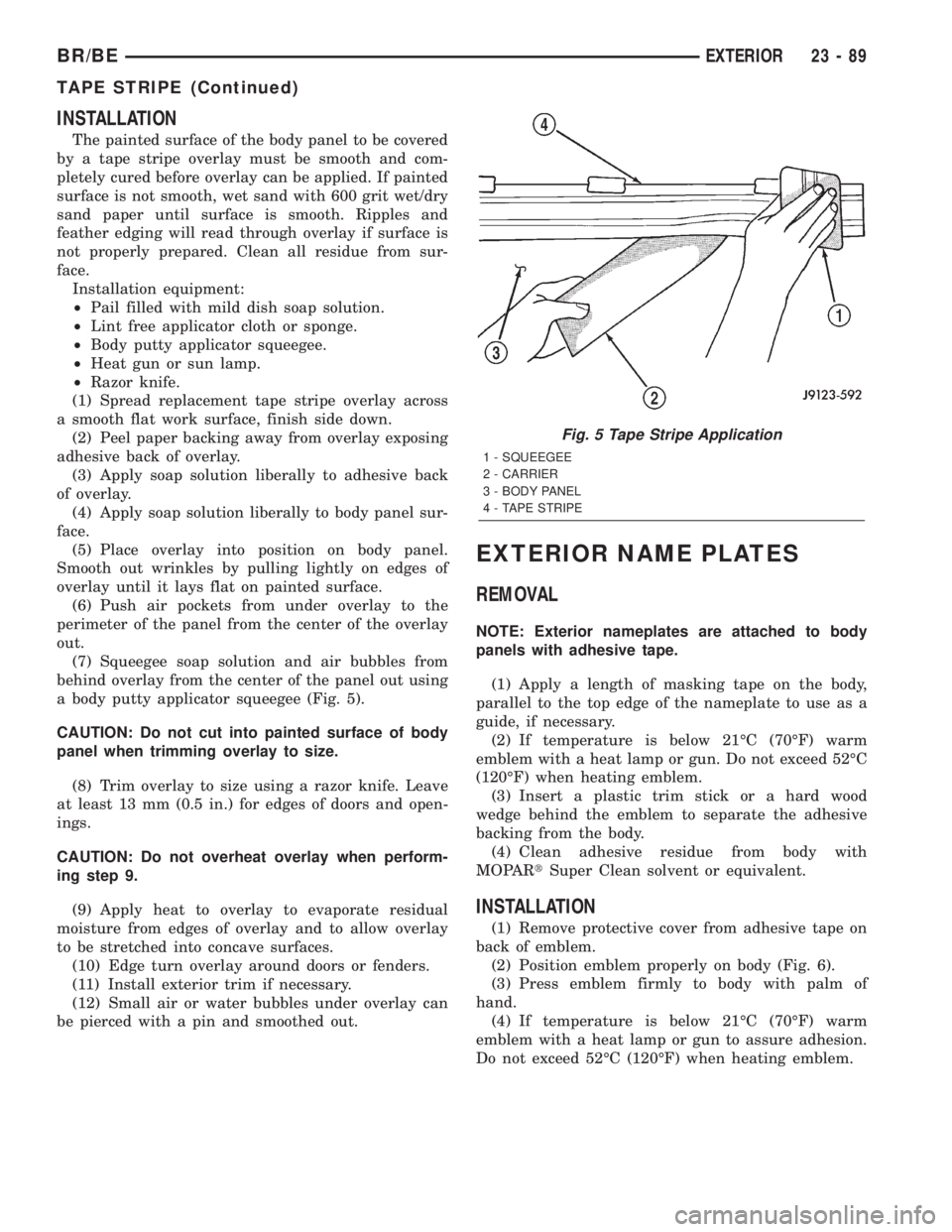
a body putty applicator squeegee (Fig. 5).
CAUTION: Do not cut into painted surface of body
panel when trimming overlay to size.
(8) Trim overlay to size using a razor knife. Leave
at least 13 mm (0.5 in.) for edges of doors and open-
ings.
CAUTION: Do not overheat overlay when perform-
ing step 9.
(9) Apply heat to overlay to evaporate residual
moisture from edges of overlay and to allow overlay
to be stretched into concave surfaces.
(10) Edge turn overlay around doors or fenders.
(11) Install exterior trim if necessary.
(12) Small air or water bubbles under overlay can
be pierced with a pin and smoothed out.
EXTERIOR NAME PLATES
REMOVAL
NOTE: Exterior nameplates are attached to body
panels with adhesive tape.
(1) Apply a length of masking tape on the body,
parallel to the top edge of the nameplate to use as a
guide, if necessary.
(2) If temperature is below 21ÉC (70ÉF) warm
emblem with a heat lamp or gun. Do not exceed 52ÉC
(120ÉF) when heating emblem.
(3) Insert a plastic trim stick or a hard wood
wedge behind the emblem to separate the adhesive
backing from the body.
(4) Clean adhesive residue from body with
MOPARtSuper Clean solvent or equivalent.
INSTALLATION
(1) Remove protective cover from adhesive tape on
back of emblem.
(2) Position emblem properly on body (Fig. 6).
(3) Press emblem firmly to body with palm of
hand.
(4) If temperature is below 21ÉC (70ÉF) warm
emblem with a heat lamp or gun to assure adhesion.
Do not exceed 52ÉC (120ÉF) when heating emblem.
Fig. 5 Tape Stripe Application
1 - SQUEEGEE
2 - CARRIER
3 - BODY PANEL
4 - TAPE STRIPE
BR/BEEXTERIOR 23 - 89
TAPE STRIPE (Continued)
Page 2113 of 2255
(2) If necessary, apply black-out primer to outer
edge of replacement backlite frame.
(3) If black-out primer was pre-applied on backlite,
clean bonding surface with Isopropyl alcohol and
clean lint free cloth. Allow 3 minutes for drying time.
(4) Apply black-out primer to backlite opening
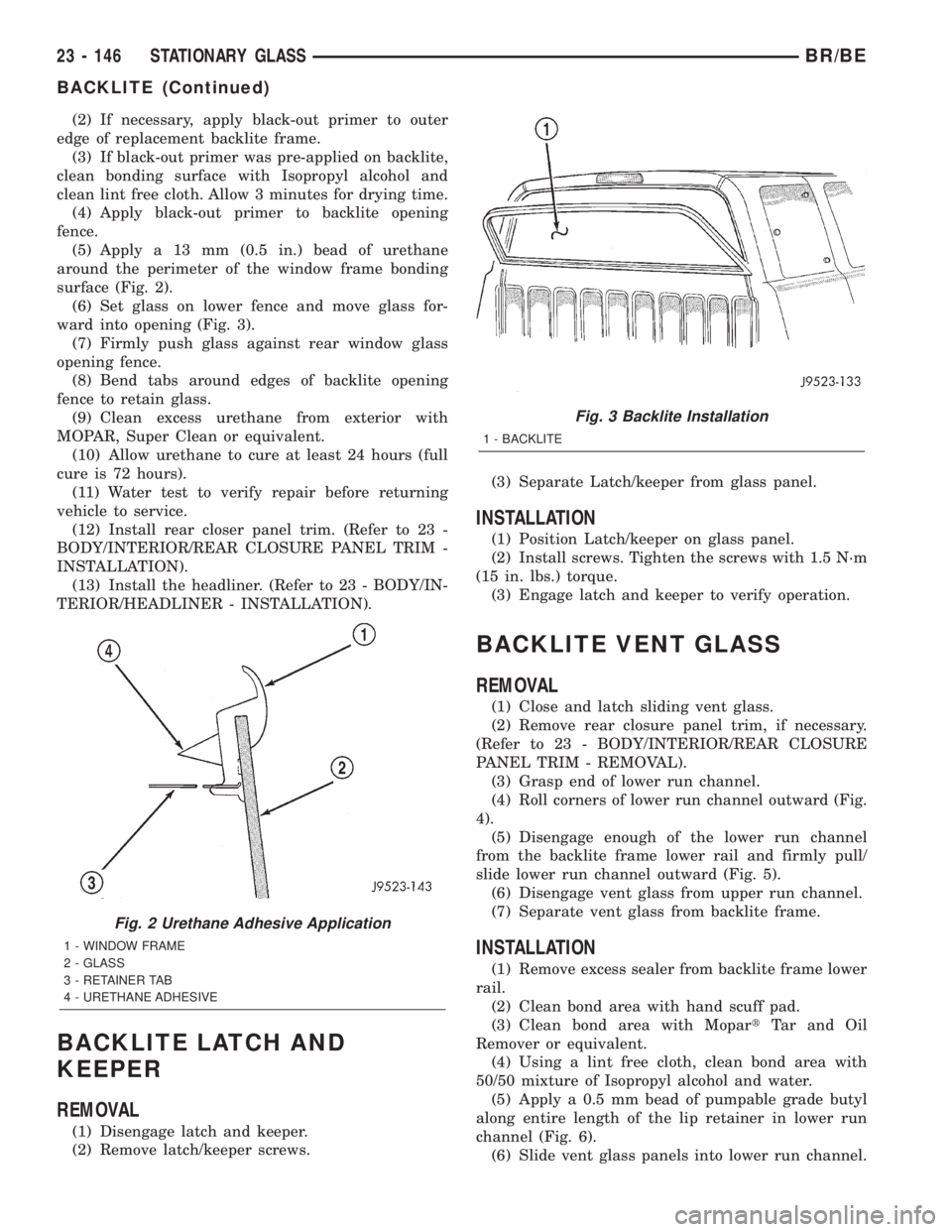
fence.
(5) Apply a 13 mm (0.5 in.) bead of urethane
around the perimeter of the window frame bonding
surface (Fig. 2).
(6) Set glass on lower fence and move glass for-
ward into opening (Fig. 3).
(7) Firmly push glass against rear window glass
opening fence.
(8) Bend tabs around edges of backlite opening
fence to retain glass.
(9) Clean excess urethane from exterior with
MOPAR, Super Clean or equivalent.
(10) Allow urethane to cure at least 24 hours (full
cure is 72 hours).
(11) Water test to verify repair before returning
vehicle to service.
(12) Install rear closer panel trim. (Refer to 23 -
BODY/INTERIOR/REAR CLOSURE PANEL TRIM -
INSTALLATION).
(13) Install the headliner. (Refer to 23 - BODY/IN-
TERIOR/HEADLINER - INSTALLATION).
BACKLITE LATCH AND
KEEPER
REMOVAL
(1) Disengage latch and keeper.
(2) Remove latch/keeper screws.(3) Separate Latch/keeper from glass panel.
INSTALLATION
(1) Position Latch/keeper on glass panel.
(2) Install screws. Tighten the screws with 1.5 N´m
(15 in. lbs.) torque.
(3) Engage latch and keeper to verify operation.
BACKLITE VENT GLASS
REMOVAL
(1) Close and latch sliding vent glass.
(2) Remove rear closure panel trim, if necessary.
(Refer to 23 - BODY/INTERIOR/REAR CLOSURE
PANEL TRIM - REMOVAL).
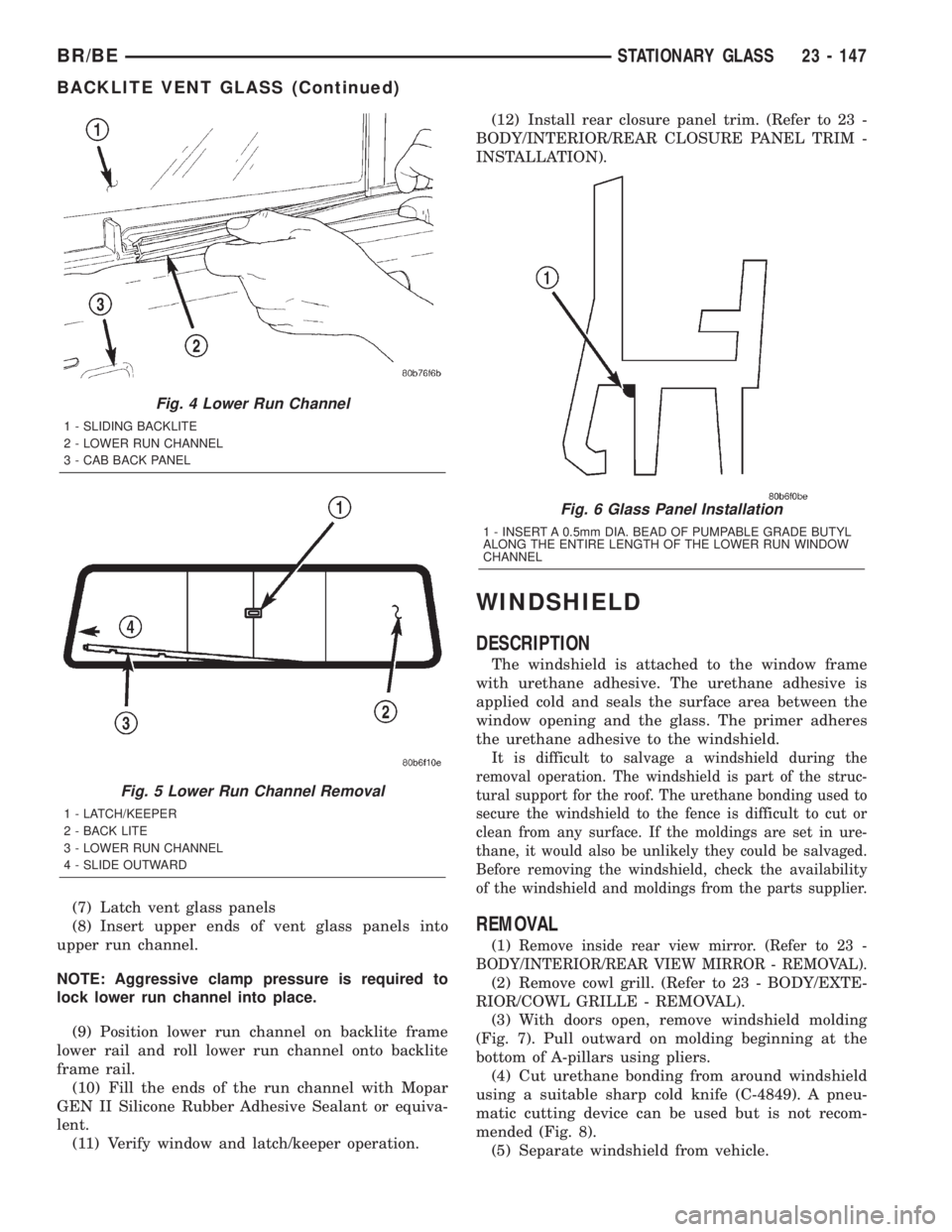
(3) Grasp end of lower run channel.
(4) Roll corners of lower run channel outward (Fig.
4).
(5) Disengage enough of the lower run channel
from the backlite frame lower rail and firmly pull/
slide lower run channel outward (Fig. 5).
(6) Disengage vent glass from upper run channel.
(7) Separate vent glass from backlite frame.
INSTALLATION
(1) Remove excess sealer from backlite frame lower
rail.
(2) Clean bond area with hand scuff pad.
(3) Clean bond area with MopartTar and Oil
Remover or equivalent.
(4) Using a lint free cloth, clean bond area with
50/50 mixture of Isopropyl alcohol and water.
(5) Apply a 0.5 mm bead of pumpable grade butyl
along entire length of the lip retainer in lower run
channel (Fig. 6).
(6) Slide vent glass panels into lower run channel.
Fig. 2 Urethane Adhesive Application
1 - WINDOW FRAME
2 - GLASS
3 - RETAINER TAB
4 - URETHANE ADHESIVE
Fig. 3 Backlite Installation
1 - BACKLITE
23 - 146 STATIONARY GLASSBR/BE
BACKLITE (Continued)
Page 2114 of 2255
(7) Latch vent glass panels
(8) Insert upper ends of vent glass panels into
upper run channel.
NOTE: Aggressive clamp pressure is required to
lock lower run channel into place.
(9) Position lower run channel on backlite frame
lower rail and roll lower run channel onto backlite
frame rail.
(10) Fill the ends of the run channel with Mopar
GEN II Silicone Rubber Adhesive Sealant or equiva-
lent.
(11) Verify window and latch/keeper operation.(12) Install rear closure panel trim. (Refer to 23 -
BODY/INTERIOR/REAR CLOSURE PANEL TRIM -
INSTALLATION).
WINDSHIELD
DESCRIPTION
The windshield is attached to the window frame
with urethane adhesive. The urethane adhesive is
applied cold and seals the surface area between the
window opening and the glass. The primer adheres
the urethane adhesive to the windshield.
It is difficult to salvage a windshield during the
removal operation. The windshield is part of the struc-
tural support for the roof. The urethane bonding used to
secure the windshield to the fence is difficult to cut or
clean from any surface. If the moldings are set in ure-
thane, it would also be unlikely they could be salvaged.
Before removing the windshield, check the availability
of the windshield and moldings from the parts supplier.
REMOVAL
(1)Remove inside rear view mirror. (Refer to 23 -
BODY/INTERIOR/REAR VIEW MIRROR - REMOVAL).
(2) Remove cowl grill. (Refer to 23 - BODY/EXTE-
RIOR/COWL GRILLE - REMOVAL).
(3) With doors open, remove windshield molding
(Fig. 7). Pull outward on molding beginning at the
bottom of A-pillars using pliers.
(4) Cut urethane bonding from around windshield
using a suitable sharp cold knife (C-4849). A pneu-
matic cutting device can be used but is not recom-
mended (Fig. 8).
(5) Separate windshield from vehicle.
Fig. 4 Lower Run Channel
1 - SLIDING BACKLITE
2 - LOWER RUN CHANNEL
3 - CAB BACK PANEL
Fig. 5 Lower Run Channel Removal
1 - LATCH/KEEPER
2 - BACK LITE
3 - LOWER RUN CHANNEL
4 - SLIDE OUTWARD
Fig. 6 Glass Panel Installation
1 - INSERT A 0.5mm DIA. BEAD OF PUMPABLE GRADE BUTYL
ALONG THE ENTIRE LENGTH OF THE LOWER RUN WINDOW
CHANNEL
BR/BESTATIONARY GLASS 23 - 147
BACKLITE VENT GLASS (Continued)
Page 2116 of 2255
(14) Clean excess urethane from exterior with
MOPARtSuper Clean or equivalent.
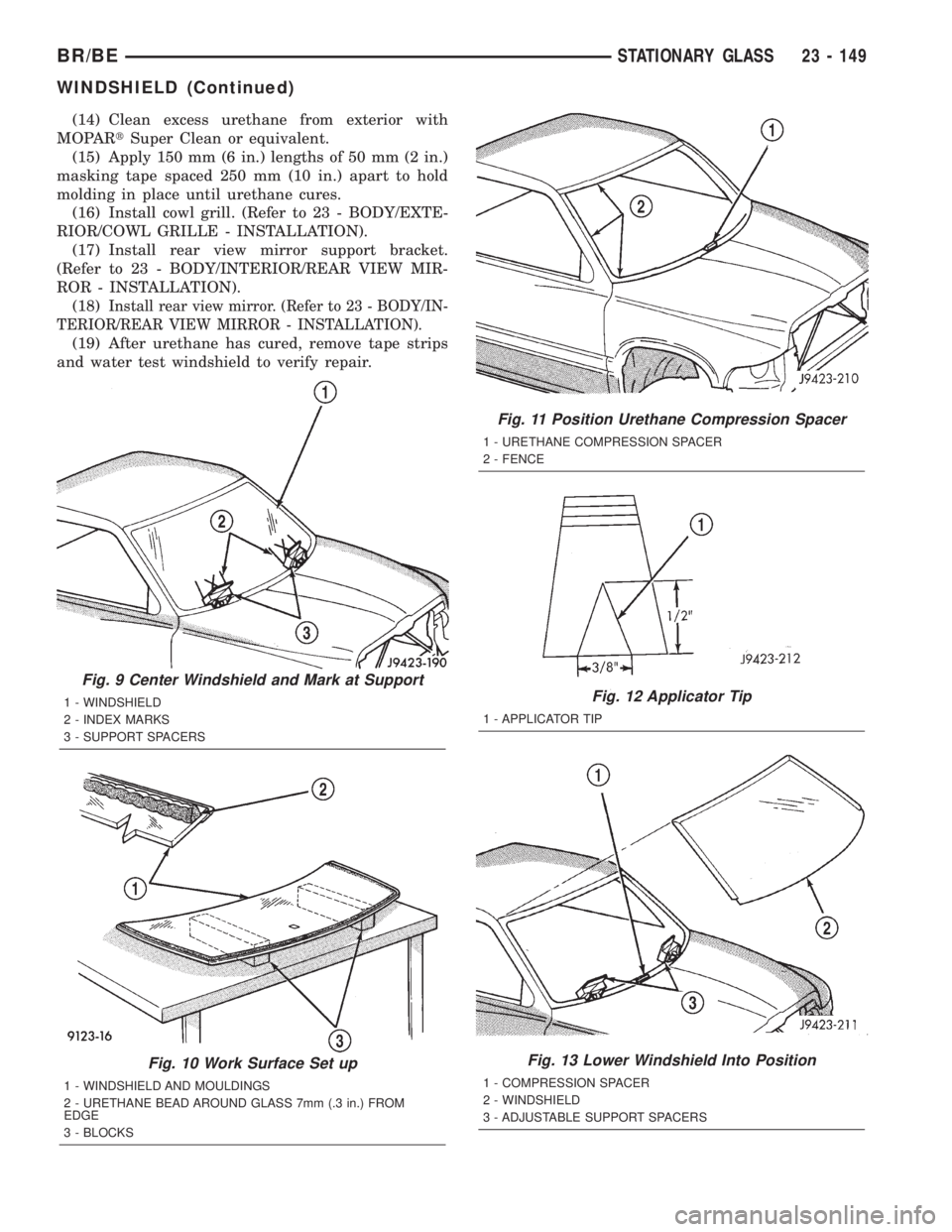
(15) Apply 150 mm (6 in.) lengths of 50 mm (2 in.)
masking tape spaced 250 mm (10 in.) apart to hold
molding in place until urethane cures.
(16) Install cowl grill. (Refer to 23 - BODY/EXTE-
RIOR/COWL GRILLE - INSTALLATION).
(17) Install rear view mirror support bracket.
(Refer to 23 - BODY/INTERIOR/REAR VIEW MIR-
ROR - INSTALLATION).
(18)
Install rear view mirror. (Refer to 23 - BODY/IN-
TERIOR/REAR VIEW MIRROR - INSTALLATION).
(19) After urethane has cured, remove tape strips
and water test windshield to verify repair.
Fig. 9 Center Windshield and Mark at Support
1 - WINDSHIELD
2 - INDEX MARKS
3 - SUPPORT SPACERS
Fig. 10 Work Surface Set up
1 - WINDSHIELD AND MOULDINGS
2 - URETHANE BEAD AROUND GLASS 7mm (.3 in.) FROM
EDGE
3 - BLOCKS
Fig. 11 Position Urethane Compression Spacer
1 - URETHANE COMPRESSION SPACER
2 - FENCE
Fig. 12 Applicator Tip
1 - APPLICATOR TIP
Fig. 13 Lower Windshield Into Position
1 - COMPRESSION SPACER
2 - WINDSHIELD
3 - ADJUSTABLE SUPPORT SPACERS
BR/BESTATIONARY GLASS 23 - 149
WINDSHIELD (Continued)
Page 2132 of 2255
LOCATING VACUUM LEAKS
WARNING: ON VEHICLES EQUIPPED WITH AIR-
BAGS, DISABLE THE AIRBAG SYSTEM BEFORE
ATTEMPTING ANY STEERING WHEEL, STEERING
COLUMN, OR INSTRUMENT PANEL COMPONENT
DIAGNOSIS OR SERVICE. DISCONNECT AND ISO-
LATE THE BATTERY NEGATIVE (GROUND) CABLE,
THEN WAIT TWO MINUTES FOR THE AIRBAG SYS-
TEM CAPACITOR TO DISCHARGE BEFORE PER-
FORMING FURTHER DIAGNOSIS OR SERVICE. THIS
IS THE ONLY SURE WAY TO DISABLE THE AIRBAG
SYSTEM. FAILURE TO TAKE THE PROPER PRE-
CAUTIONS COULD RESULT IN AN ACCIDENTAL
AIRBAG DEPLOYMENT AND POSSIBLE PERSONAL
INJURY.
(1) Disconnect the vacuum harness connector
located between the a/c heater control and the HVAC
housing under the instrument panel.
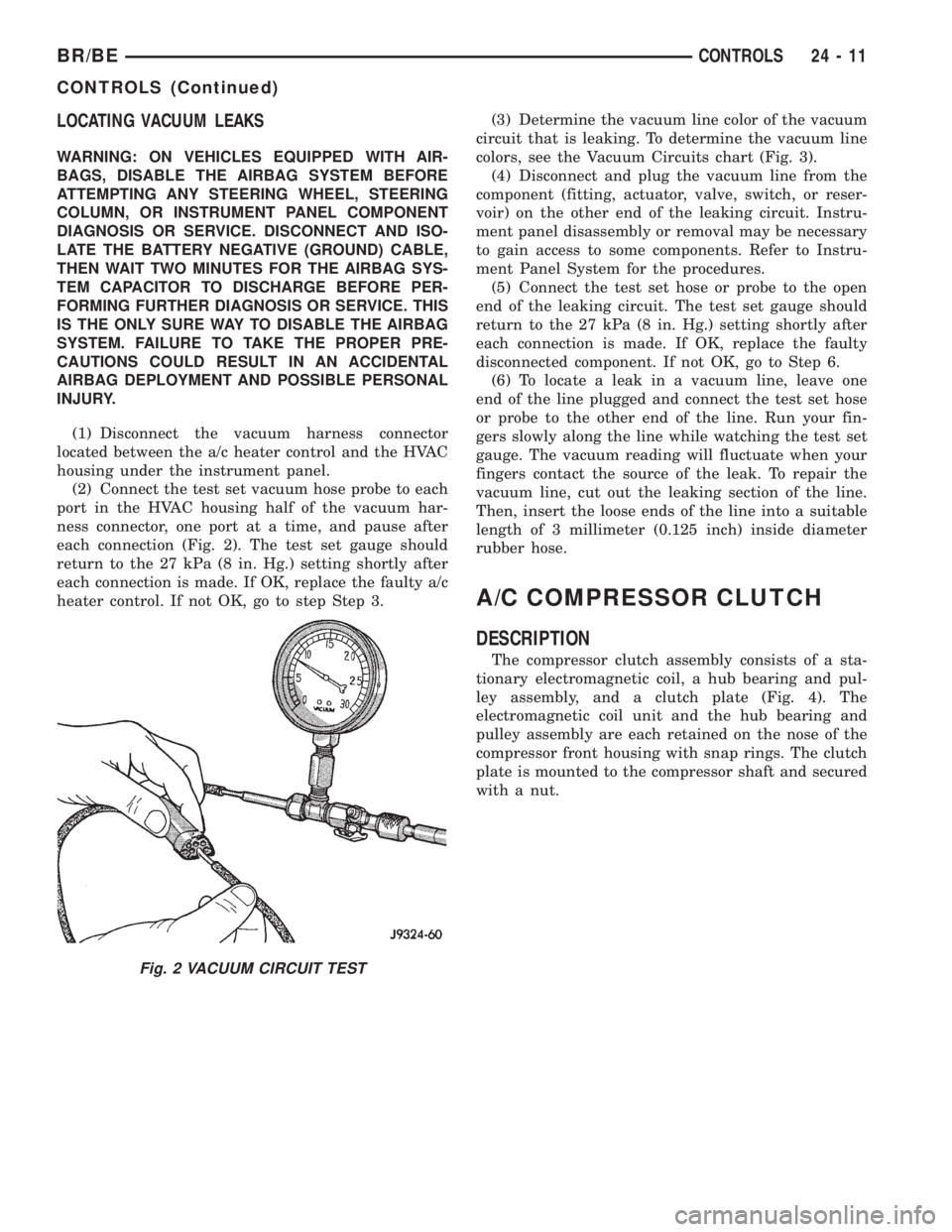
(2) Connect the test set vacuum hose probe to each
port in the HVAC housing half of the vacuum har-
ness connector, one port at a time, and pause after
each connection (Fig. 2). The test set gauge should
return to the 27 kPa (8 in. Hg.) setting shortly after
each connection is made. If OK, replace the faulty a/c
heater control. If not OK, go to step Step 3.(3) Determine the vacuum line color of the vacuum
circuit that is leaking. To determine the vacuum line
colors, see the Vacuum Circuits chart (Fig. 3).
(4) Disconnect and plug the vacuum line from the
component (fitting, actuator, valve, switch, or reser-
voir) on the other end of the leaking circuit. Instru-
ment panel disassembly or removal may be necessary
to gain access to some components. Refer to Instru-
ment Panel System for the procedures.
(5) Connect the test set hose or probe to the open
end of the leaking circuit. The test set gauge should
return to the 27 kPa (8 in. Hg.) setting shortly after
each connection is made. If OK, replace the faulty
disconnected component. If not OK, go to Step 6.
(6) To locate a leak in a vacuum line, leave one
end of the line plugged and connect the test set hose
or probe to the other end of the line. Run your fin-
gers slowly along the line while watching the test set
gauge. The vacuum reading will fluctuate when your
fingers contact the source of the leak. To repair the
vacuum line, cut out the leaking section of the line.
Then, insert the loose ends of the line into a suitable
length of 3 millimeter (0.125 inch) inside diameter
rubber hose.
A/C COMPRESSOR CLUTCH
DESCRIPTION
The compressor clutch assembly consists of a sta-
tionary electromagnetic coil, a hub bearing and pul-
ley assembly, and a clutch plate (Fig. 4). The
electromagnetic coil unit and the hub bearing and
pulley assembly are each retained on the nose of the
compressor front housing with snap rings. The clutch
plate is mounted to the compressor shaft and secured
with a nut.
Fig. 2 VACUUM CIRCUIT TEST
BR/BECONTROLS 24 - 11
CONTROLS (Continued)