2002 DODGE RAM ac compressor
[x] Cancel search: ac compressorPage 1340 of 2255
To make the IAC go in the opposite direction, the
PCM just reverses polarity on both windings. If only
1 wire is open, the IAC can only be moved 1 step
(increment) in either direction. To keep the IAC
motor in position when no movement is needed, the
PCM will energize both windings at the same time.
This locks the IAC motor in place.
In the IAC motor system, the PCM will count
every step that the motor is moved. This allows the
PCM to determine the motor pintle position. If the
memory is cleared, the PCM no longer knows the
position of the pintle. So at the first key ON, the
PCM drives the IAC motor closed, regardless of
where it was before. This zeros the counter. From
this point the PCM will back out the IAC motor and
keep track of its position again.
When engine rpm is above idle speed, the IAC is
used for the following:
²Off-idle dashpot (throttle blade will close quickly
but idle speed will not stop quickly)
²Deceleration air flow control
²A/C compressor load control (also opens the pas-
sage slightly before the compressor is engaged so
that the engine rpm does not dip down when the
compressor engages)
²Power steering load control
The PCM can control polarity of the circuit to con-
trol direction of the stepper motor.
IAC Stepper Motor Program:The PCM is also
equipped with a memory program that records the
number of steps the IAC stepper motor most recently
advanced to during a certain set of parameters. For
example: The PCM was attempting to maintain a
1000 rpm target during a cold start-up cycle. The last
recorded number of steps for that may have been
125. That value would be recorded in the memory
cell so that the next time the PCM recognizes the
identical conditions, the PCM recalls that 125 steps
were required to maintain the target. This program
allows for greater customer satisfaction due to
greater control of engine idle.
Another function of the memory program, which
occurs when the power steering switch (if equipped),
or the A/C request circuit, requires that the IAC step-
per motor control engine rpm, is the recording of the
last targeted steps into the memory cell. The PCM
can anticipate A/C compressor loads. This is accom-
plished by delaying compressor operation for approx-
imately 0.5 seconds until the PCM moves the IAC
stepper motor to the recorded steps that were loaded
into the memory cell. Using this program helps elim-
inate idle-quality changes as loads change. Finally,
the PCM incorporates a9No-Load9engine speed lim-
iter of approximately 1800 - 2000 rpm, when it rec-
ognizes that the TPS is indicating an idle signal and
IAC motor cannot maintain engine idle.A (factory adjusted) set screw is used to mechani-
cally limit the position of the throttle body throttle
plate.Never attempt to adjust the engine idle
speed using this screw.All idle speed functions are
controlled by the IAC motor through the PCM.
REMOVAL
REMOVAL - 5.9L
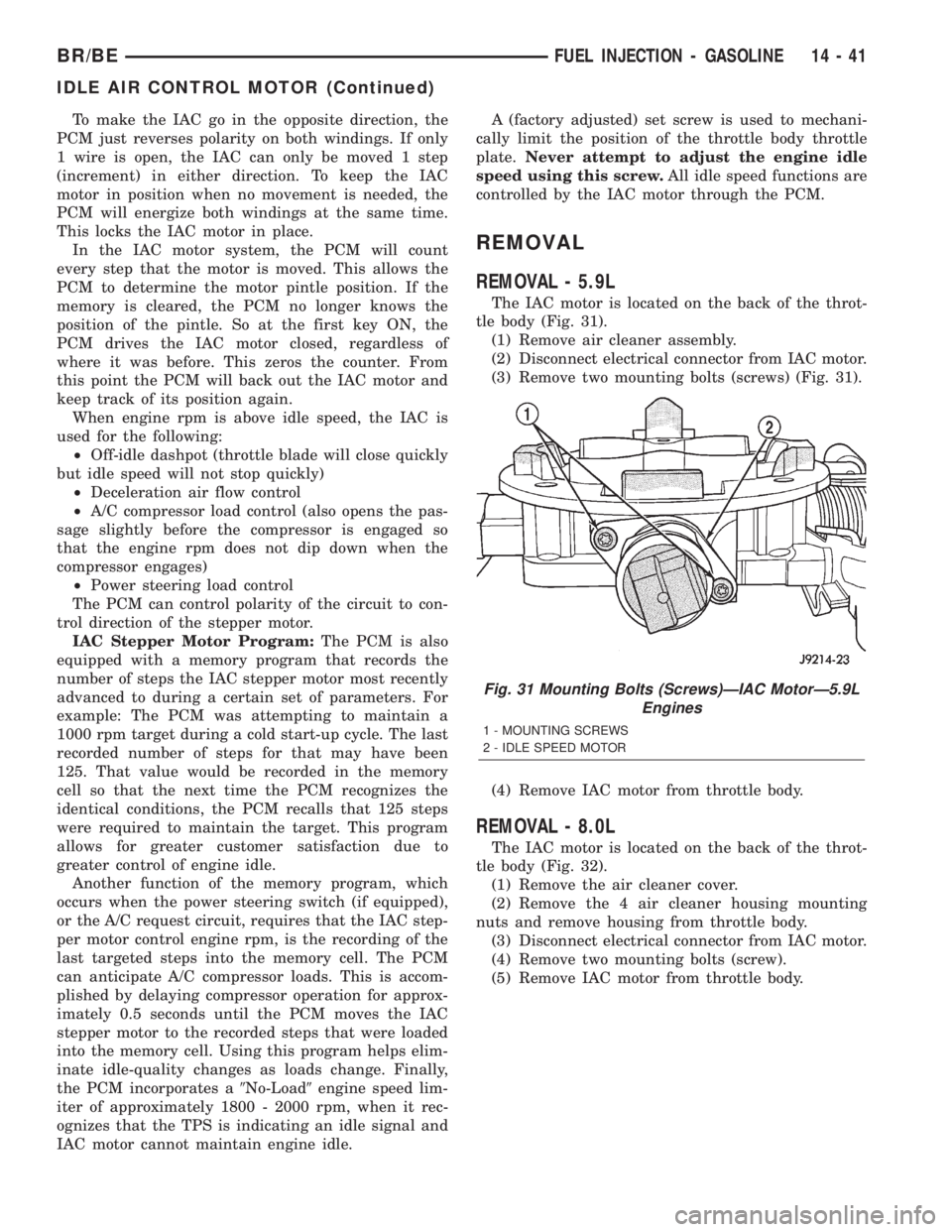
The IAC motor is located on the back of the throt-
tle body (Fig. 31).
(1) Remove air cleaner assembly.
(2) Disconnect electrical connector from IAC motor.
(3) Remove two mounting bolts (screws) (Fig. 31).
(4) Remove IAC motor from throttle body.
REMOVAL - 8.0L
The IAC motor is located on the back of the throt-
tle body (Fig. 32).
(1) Remove the air cleaner cover.
(2) Remove the 4 air cleaner housing mounting
nuts and remove housing from throttle body.
(3) Disconnect electrical connector from IAC motor.
(4) Remove two mounting bolts (screw).
(5) Remove IAC motor from throttle body.
Fig. 31 Mounting Bolts (Screws)ÐIAC MotorÐ5.9L
Engines
1 - MOUNTING SCREWS
2 - IDLE SPEED MOTOR
BR/BEFUEL INJECTION - GASOLINE 14 - 41
IDLE AIR CONTROL MOTOR (Continued)
Page 1573 of 2255
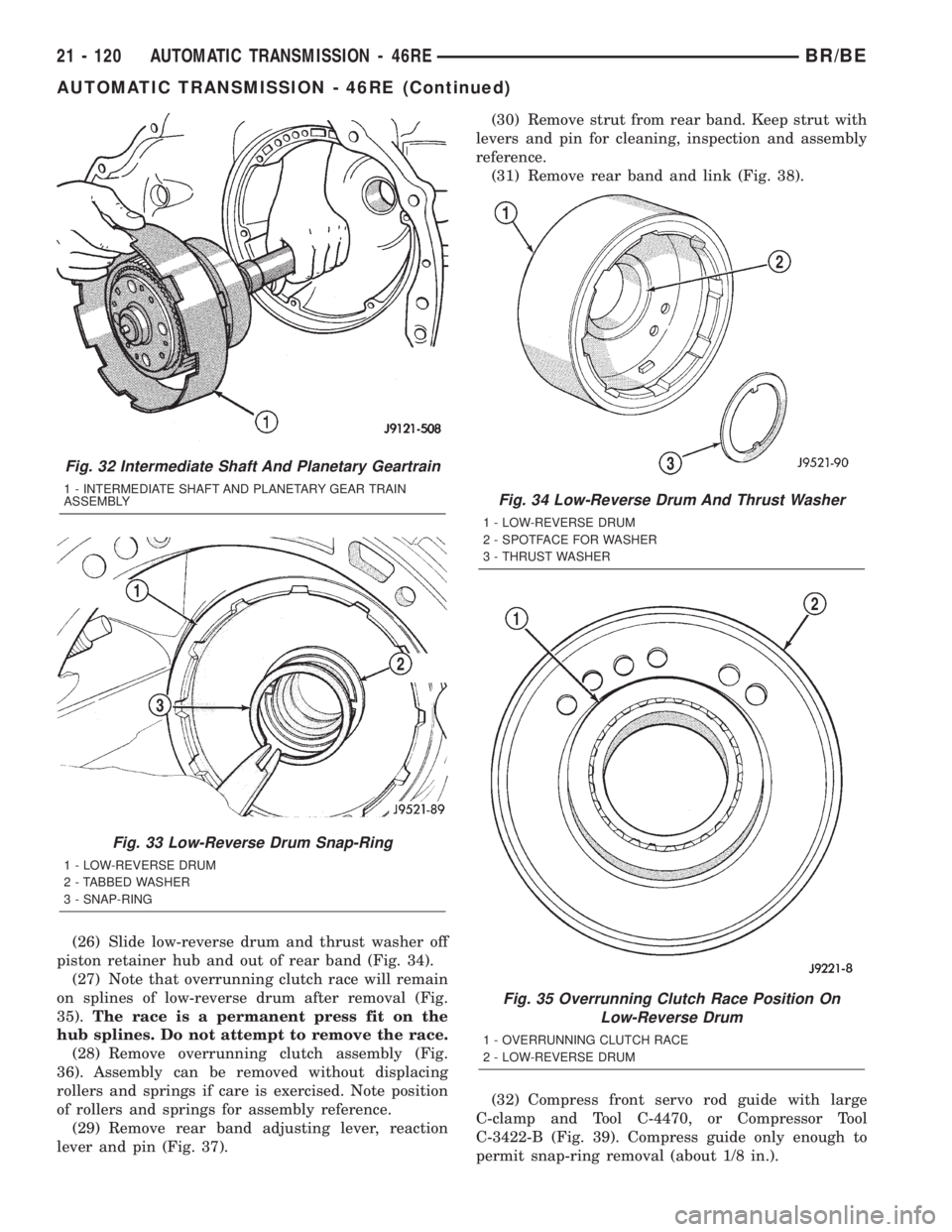
(26) Slide low-reverse drum and thrust washer off
piston retainer hub and out of rear band (Fig. 34).
(27) Note that overrunning clutch race will remain
on splines of low-reverse drum after removal (Fig.
35).The race is a permanent press fit on the
hub splines. Do not attempt to remove the race.
(28) Remove overrunning clutch assembly (Fig.
36). Assembly can be removed without displacing
rollers and springs if care is exercised. Note position
of rollers and springs for assembly reference.
(29) Remove rear band adjusting lever, reaction
lever and pin (Fig. 37).(30) Remove strut from rear band. Keep strut with
levers and pin for cleaning, inspection and assembly
reference.
(31) Remove rear band and link (Fig. 38).
(32) Compress front servo rod guide with large
C-clamp and Tool C-4470, or Compressor Tool
C-3422-B (Fig. 39). Compress guide only enough to
permit snap-ring removal (about 1/8 in.).
Fig. 32 Intermediate Shaft And Planetary Geartrain
1 - INTERMEDIATE SHAFT AND PLANETARY GEAR TRAIN
ASSEMBLY
Fig. 33 Low-Reverse Drum Snap-Ring
1 - LOW-REVERSE DRUM
2 - TABBED WASHER
3 - SNAP-RING
Fig. 34 Low-Reverse Drum And Thrust Washer
1 - LOW-REVERSE DRUM
2 - SPOTFACE FOR WASHER
3 - THRUST WASHER
Fig. 35 Overrunning Clutch Race Position On
Low-Reverse Drum
1 - OVERRUNNING CLUTCH RACE
2 - LOW-REVERSE DRUM
21 - 120 AUTOMATIC TRANSMISSION - 46REBR/BE
AUTOMATIC TRANSMISSION - 46RE (Continued)
Page 1574 of 2255
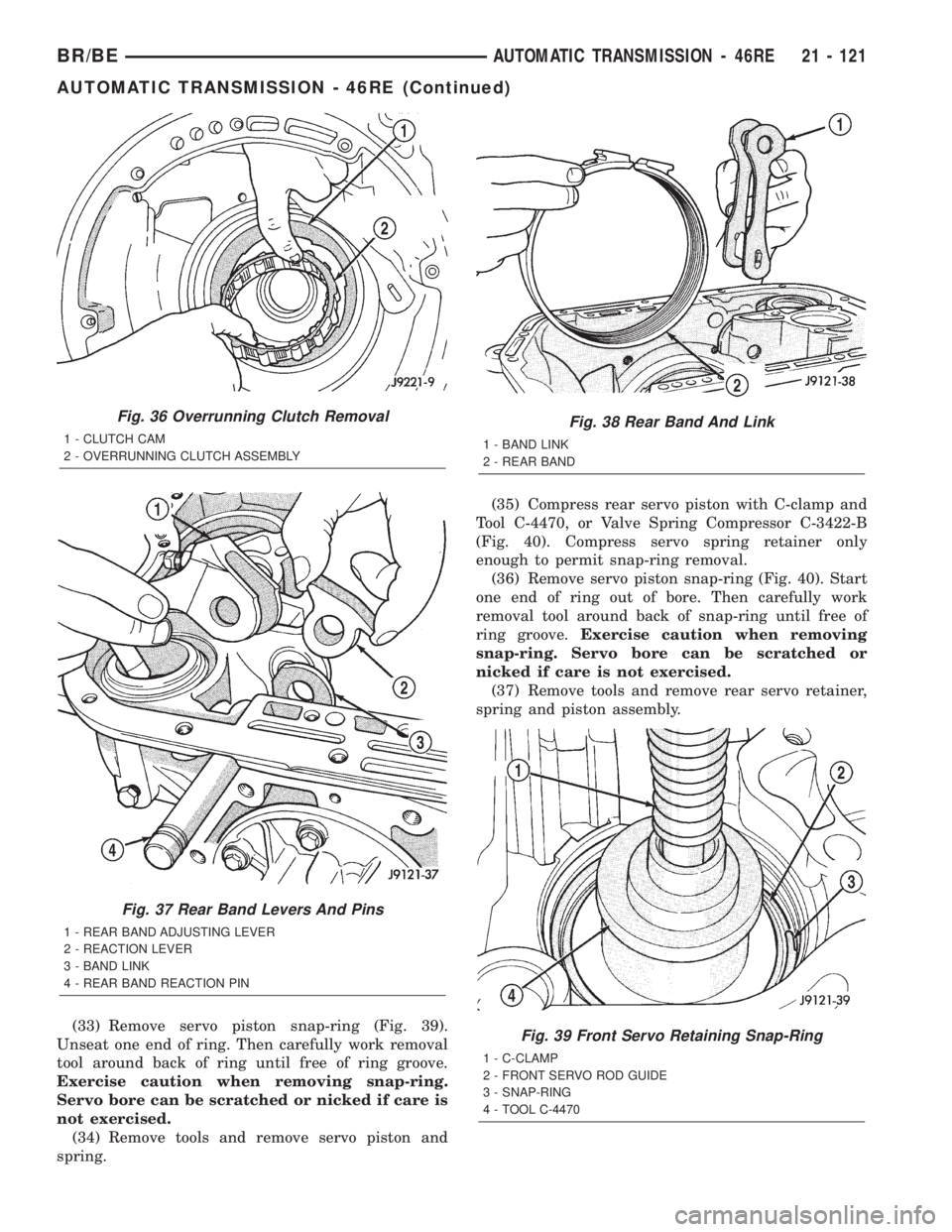
(33) Remove servo piston snap-ring (Fig. 39).
Unseat one end of ring. Then carefully work removal
tool around back of ring until free of ring groove.
Exercise caution when removing snap-ring.
Servo bore can be scratched or nicked if care is
not exercised.
(34) Remove tools and remove servo piston and
spring.(35) Compress rear servo piston with C-clamp and
Tool C-4470, or Valve Spring Compressor C-3422-B
(Fig. 40). Compress servo spring retainer only
enough to permit snap-ring removal.
(36) Remove servo piston snap-ring (Fig. 40). Start
one end of ring out of bore. Then carefully work
removal tool around back of snap-ring until free of
ring groove.Exercise caution when removing
snap-ring. Servo bore can be scratched or
nicked if care is not exercised.
(37) Remove tools and remove rear servo retainer,
spring and piston assembly.
Fig. 36 Overrunning Clutch Removal
1 - CLUTCH CAM
2 - OVERRUNNING CLUTCH ASSEMBLY
Fig. 37 Rear Band Levers And Pins
1 - REAR BAND ADJUSTING LEVER
2 - REACTION LEVER
3 - BAND LINK
4 - REAR BAND REACTION PIN
Fig. 38 Rear Band And Link
1 - BAND LINK
2 - REAR BAND
Fig. 39 Front Servo Retaining Snap-Ring
1 - C-CLAMP
2 - FRONT SERVO ROD GUIDE
3 - SNAP-RING
4 - TOOL C-4470
BR/BEAUTOMATIC TRANSMISSION - 46RE 21 - 121
AUTOMATIC TRANSMISSION - 46RE (Continued)
Page 1576 of 2255
The planetary geartrain, front/rear clutch assem-
blies and oil pump are all much easier to install
when the transmission case is upright. Either tilt the
case upward with wood blocks, or cut a hole in the
bench large enough for the intermediate shaft and
rear support. Then lower the shaft and support into
the hole and support the rear of the case directly on
the bench.
FRONT/REAR SERVO
(1) Lubricate rear servo piston seal with Mopart
Door Ease or ATF +4. Lubricate servo bore in case
with ATF +4.
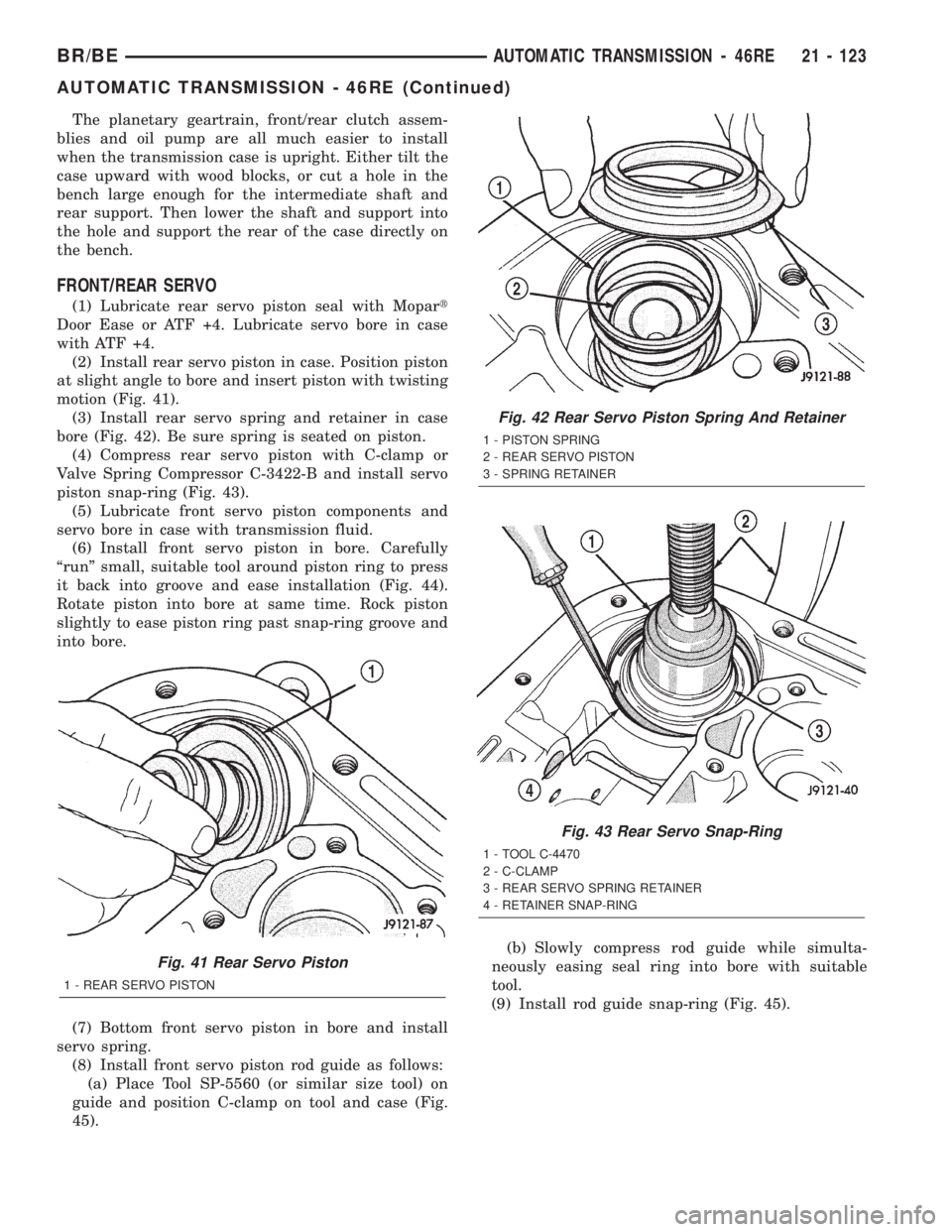
(2) Install rear servo piston in case. Position piston
at slight angle to bore and insert piston with twisting
motion (Fig. 41).
(3) Install rear servo spring and retainer in case
bore (Fig. 42). Be sure spring is seated on piston.
(4) Compress rear servo piston with C-clamp or
Valve Spring Compressor C-3422-B and install servo
piston snap-ring (Fig. 43).
(5) Lubricate front servo piston components and
servo bore in case with transmission fluid.
(6) Install front servo piston in bore. Carefully
ªrunº small, suitable tool around piston ring to press
it back into groove and ease installation (Fig. 44).
Rotate piston into bore at same time. Rock piston
slightly to ease piston ring past snap-ring groove and
into bore.
(7) Bottom front servo piston in bore and install
servo spring.
(8) Install front servo piston rod guide as follows:
(a) Place Tool SP-5560 (or similar size tool) on
guide and position C-clamp on tool and case (Fig.
45).(b) Slowly compress rod guide while simulta-
neously easing seal ring into bore with suitable
tool.
(9) Install rod guide snap-ring (Fig. 45).
Fig. 41 Rear Servo Piston
1 - REAR SERVO PISTON
Fig. 42 Rear Servo Piston Spring And Retainer
1 - PISTON SPRING
2 - REAR SERVO PISTON
3 - SPRING RETAINER
Fig. 43 Rear Servo Snap-Ring
1 - TOOL C-4470
2 - C-CLAMP
3 - REAR SERVO SPRING RETAINER
4 - RETAINER SNAP-RING
BR/BEAUTOMATIC TRANSMISSION - 46RE 21 - 123
AUTOMATIC TRANSMISSION - 46RE (Continued)
Page 1599 of 2255
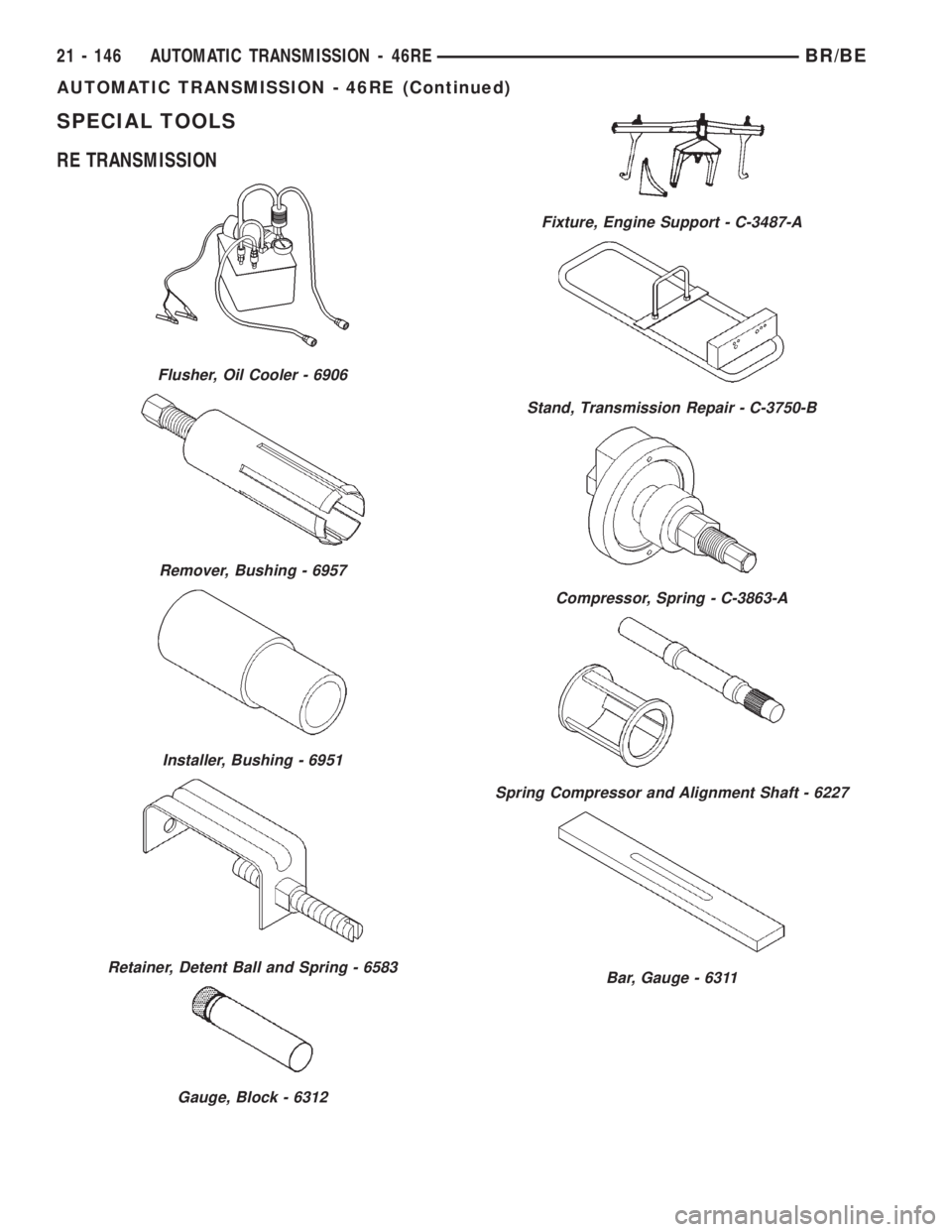
SPECIAL TOOLS
RE TRANSMISSION
Flusher, Oil Cooler - 6906
Remover, Bushing - 6957
Installer, Bushing - 6951
Retainer, Detent Ball and Spring - 6583
Gauge, Block - 6312
Fixture, Engine Support - C-3487-A
Stand, Transmission Repair - C-3750-B
Compressor, Spring - C-3863-A
Spring Compressor and Alignment Shaft - 6227
Bar, Gauge - 6311
21 - 146 AUTOMATIC TRANSMISSION - 46REBR/BE
AUTOMATIC TRANSMISSION - 46RE (Continued)
Page 1600 of 2255
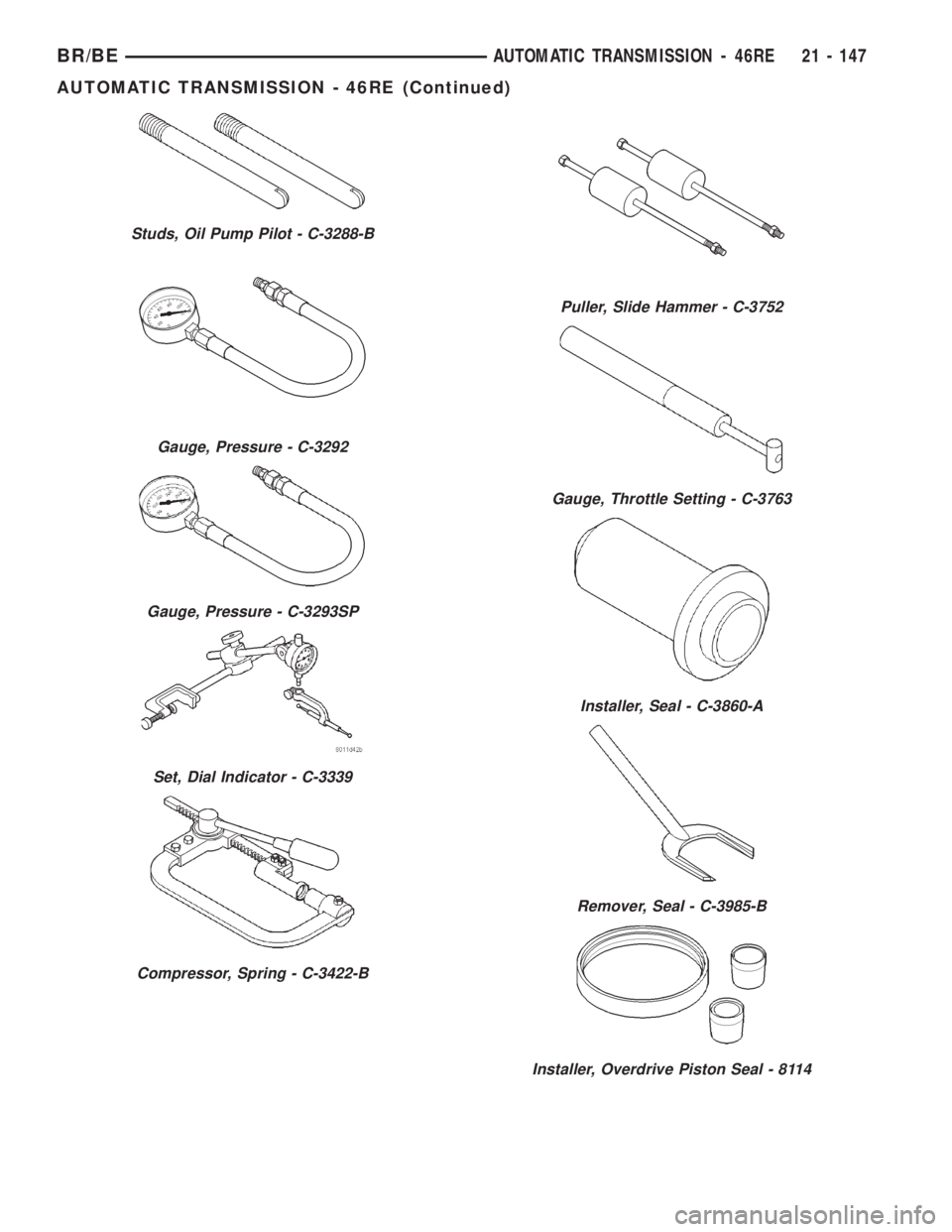
Studs, Oil Pump Pilot - C-3288-B
Gauge, Pressure - C-3292
Gauge, Pressure - C-3293SP
Set, Dial Indicator - C-3339
Compressor, Spring - C-3422-B
Puller, Slide Hammer - C-3752
Gauge, Throttle Setting - C-3763
Installer, Seal - C-3860-A
Remover, Seal - C-3985-B
Installer, Overdrive Piston Seal - 8114
BR/BEAUTOMATIC TRANSMISSION - 46RE 21 - 147
AUTOMATIC TRANSMISSION - 46RE (Continued)
Page 1614 of 2255
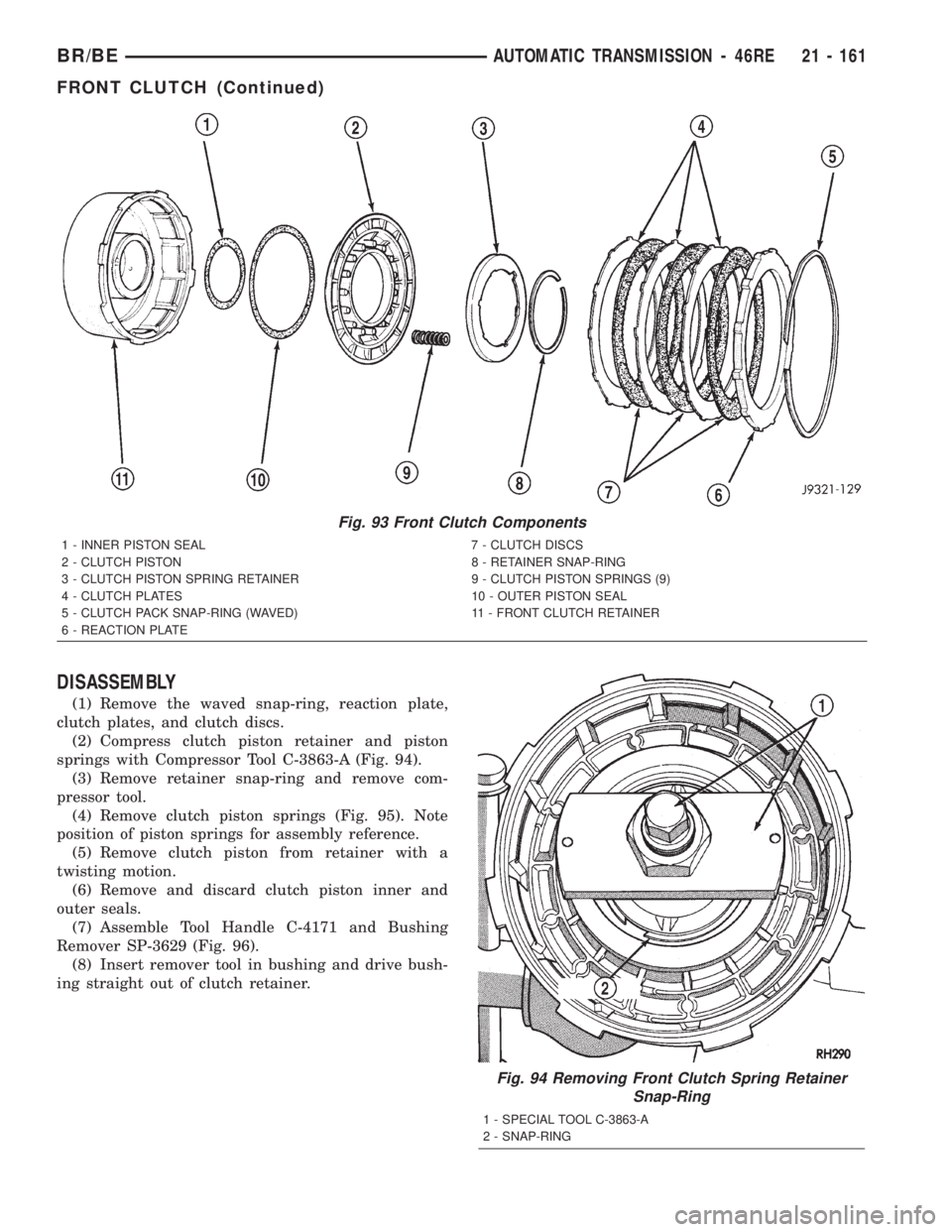
DISASSEMBLY
(1) Remove the waved snap-ring, reaction plate,
clutch plates, and clutch discs.
(2) Compress clutch piston retainer and piston
springs with Compressor Tool C-3863-A (Fig. 94).
(3) Remove retainer snap-ring and remove com-
pressor tool.
(4) Remove clutch piston springs (Fig. 95). Note
position of piston springs for assembly reference.
(5) Remove clutch piston from retainer with a
twisting motion.
(6) Remove and discard clutch piston inner and
outer seals.
(7) Assemble Tool Handle C-4171 and Bushing
Remover SP-3629 (Fig. 96).
(8) Insert remover tool in bushing and drive bush-
ing straight out of clutch retainer.
Fig. 93 Front Clutch Components
1 - INNER PISTON SEAL 7 - CLUTCH DISCS
2 - CLUTCH PISTON 8 - RETAINER SNAP-RING
3 - CLUTCH PISTON SPRING RETAINER 9 - CLUTCH PISTON SPRINGS (9)
4 - CLUTCH PLATES 10 - OUTER PISTON SEAL
5 - CLUTCH PACK SNAP-RING (WAVED) 11 - FRONT CLUTCH RETAINER
6 - REACTION PLATE
Fig. 94 Removing Front Clutch Spring Retainer
Snap-Ring
1 - SPECIAL TOOL C-3863-A
2 - SNAP-RING
BR/BEAUTOMATIC TRANSMISSION - 46RE 21 - 161
FRONT CLUTCH (Continued)
Page 1616 of 2255
CAUTION: Never push the clutch piston straight in.
This will fold the seals over causing leakage and
clutch slip. In addition, never use any type of metal
tool to help ease the piston seals into place. Metal
tools will cut, shave, or score the seals.
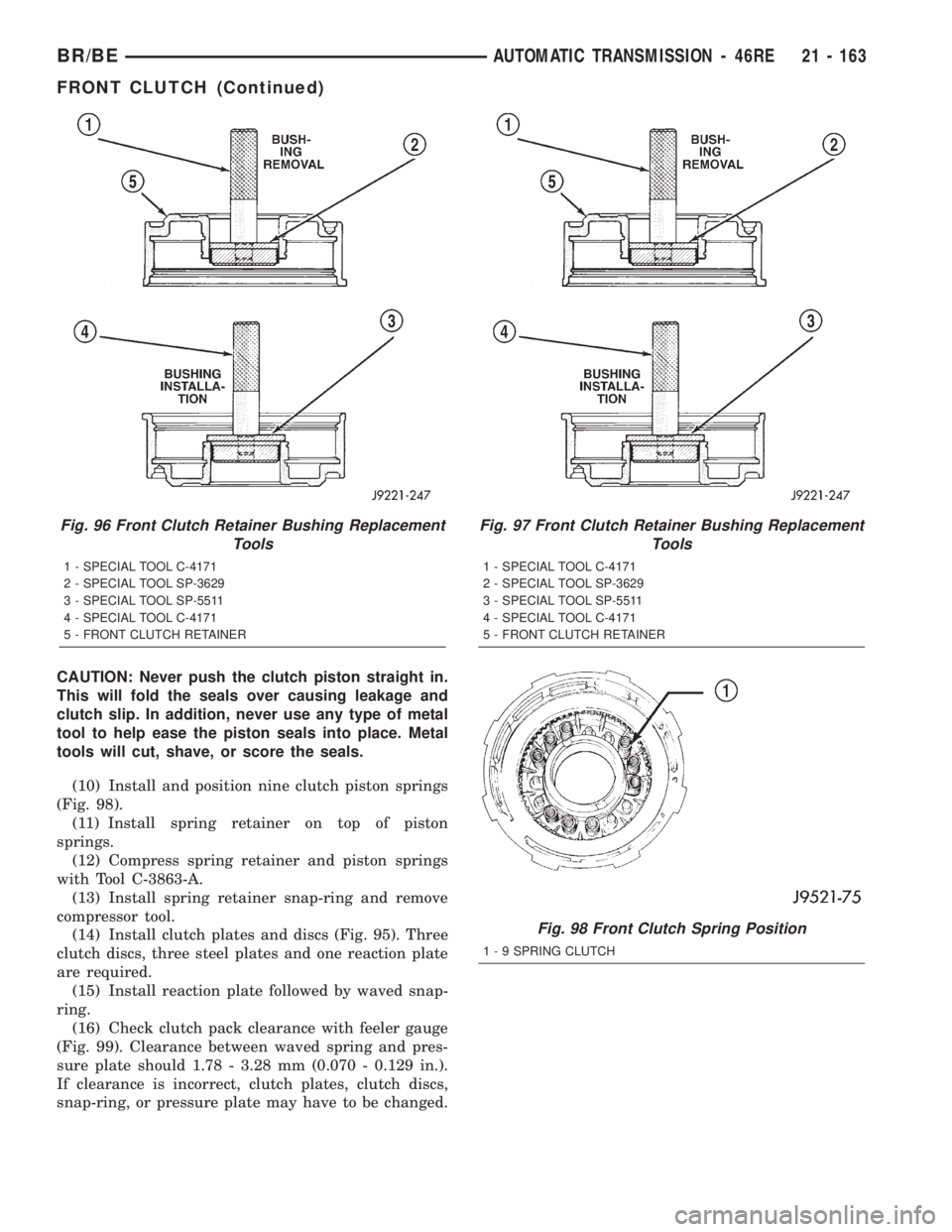
(10) Install and position nine clutch piston springs
(Fig. 98).
(11) Install spring retainer on top of piston
springs.
(12) Compress spring retainer and piston springs
with Tool C-3863-A.
(13) Install spring retainer snap-ring and remove
compressor tool.
(14) Install clutch plates and discs (Fig. 95). Three
clutch discs, three steel plates and one reaction plate
are required.
(15) Install reaction plate followed by waved snap-
ring.
(16) Check clutch pack clearance with feeler gauge
(Fig. 99). Clearance between waved spring and pres-
sure plate should 1.78 - 3.28 mm (0.070 - 0.129 in.).
If clearance is incorrect, clutch plates, clutch discs,
snap-ring, or pressure plate may have to be changed.
Fig. 96 Front Clutch Retainer Bushing Replacement
Tools
1 - SPECIAL TOOL C-4171
2 - SPECIAL TOOL SP-3629
3 - SPECIAL TOOL SP-5511
4 - SPECIAL TOOL C-4171
5 - FRONT CLUTCH RETAINER
Fig. 97 Front Clutch Retainer Bushing Replacement
Tools
1 - SPECIAL TOOL C-4171
2 - SPECIAL TOOL SP-3629
3 - SPECIAL TOOL SP-5511
4 - SPECIAL TOOL C-4171
5 - FRONT CLUTCH RETAINER
Fig. 98 Front Clutch Spring Position
1 - 9 SPRING CLUTCH
BR/BEAUTOMATIC TRANSMISSION - 46RE 21 - 163
FRONT CLUTCH (Continued)