2002 DODGE RAM power
[x] Cancel search: powerPage 2073 of 2255
²Glove Box- The hinged bin-type glove box in
the passenger side of the instrument panel features a
recessed paddle-operated latch handle. Three molded
hook formations on the lower edge of the glove box
door are engaged with and pivot on three hinge pins
integral to the lower edge of the instrument panel
support structure. The glove box door also serves as
the passenger side knee blocker. A honeycomb struc-
ture between the inner and outer glove box door pan-
els helps to absorb the impact load and distribute it
to the instrument panel structure.
²Steering Column Opening Cover- The steer-
ing column opening cover serves as the driver side
knee blocker. This molded plastic cover has an inte-
gral ribbed plastic liner concealed behind it, for
increased strength and integrity. The steering column
opening cover transfers impact loads to the instru-
ment panel structural support.
²Top Cover- The instrument panel top cover or
base trim is the molded, grained, and color impreg-
nated plastic outer skin of the instrument panel
structural support.
Hard wired circuitry connects the electrical compo-
nents on the instrument panel to each other through
the electrical system of the vehicle. These hard wired
circuits are integral to several wire harnesses, which
are routed throughout the vehicle and retained by
many different methods. These circuits may be con-
nected to each other, to the vehicle electrical system
and to the instrument panel components through the
use of a combination of soldered splices, splice block
connectors and many different types of wire harness
terminal connectors and insulators. Refer to the
appropriate wiring information. The wiring informa-
tion includes complete circuit diagrams, proper wire
and connector repair procedures, further details on
wire harness routing and retention, as well as pin-
out and location views for the various wire harness
connectors, splices, and grounds.
OPERATION
The instrument panel serves as the command cen-
ter of the vehicle, which necessarily makes it a very
complex unit. The instrument panel is designed to
house the controls and monitors for standard and
optional powertrains, climate control systems, audio
systems, safety systems, and many other comfort or
convenience items. When the components of the
instrument panel structural support are properly
assembled and secured in the vehicle they provide
superior instrument panel stiffness and integrity to
help reduce buzzes, squeaks, and rattles. This type of
construction also provides improved energy absorp-
tion which, in conjunction with the dual airbags and
seat belts, helps to improve occupant protection.The instrument panel is also designed so that all of
the various controls can be safely reached and the
monitors can be easily viewed by the vehicle operator
when driving, while still allowing relative ease of
access to each of these items for service. Modular
instrument panel construction allows all of the
gauges and controls to be serviced from the front of
the panel. In addition, most of the instrument panel
electrical components can be accessed without com-
plete instrument panel removal. However, if neces-
sary, the instrument panel can be removed from the
vehicle as an assembly.
The steering column opening cover with its inte-
gral knee blocker located on the driver side of the
instrument panel works in conjunction with the air-
bag system in a frontal vehicle impact to keep the
driver properly positioned for an airbag deployment.
In addition, removal of this component provides
access to the steering column mounts, the steering
column wiring, the Junction Block (JB) (removal of a
snap-fit fuse access panel on the left end of the
instrument panel allows access to the fuses and cir-
cuit breakers), the Central Timer Module (CTM), the
Infinity speaker filter choke and relay unit, much of
the instrument panel wiring, and the gear selector
indicator cable (automatic transmission).
In a frontal collision, the glove box door on the pas-
senger side of the instrument panel provides the
same function for the front seat passenger as the
knee blocker does for the driver. The glove box door
also incorporates a recessed latch handle. Removal of
the glove box provides access to the passenger airbag,
the glove box lamp and switch, the radio antenna
coaxial cable, the heating and air conditioning vac-
uum harness connector, and additional instrument
panel wiring.
Removal of the instrument panel cluster bezel
allows access to the headlamp switch, instrument
cluster, radio, passenger airbag on-off switch, heated
seat switches (if equipped), and the heating and air
conditioning control. Removal of the instrument clus-
ter allows access to the cluster illumination and indi-
cator bulbs, and more of the instrument panel
wiring. Complete instrument panel removal is
required for service of most components internal to
the heating and air conditioning system housing,
including the heater core and the evaporator.
See the owner's manual in the vehicle glove box for
more information on the features, use and operation
of all of the components and systems mounted on or
in the instrument panel.
23 - 106 INSTRUMENT PANEL SYSTEMBR/BE
INSTRUMENT PANEL SYSTEM (Continued)
Page 2090 of 2255
(4) Install the screws attaching the console to
mounting brackets.
(5) Install the transmission shifter boot, (Refer to
23 - BODY/INTERIOR/SHIFT BOOT - INSTALLA-
TION).
(6) Install the transfer case shifter boot, if
equipped. (Refer to 23 - BODY/INTERIOR/SHIFT
BOOT - INSTALLATION).
(7) Install cup holder in console, if equipped.
CARPETS AND FLOOR MATS
REMOVAL
STANDARD CAB
(1) Remove seat (Refer to 23 - BODY/SEATS/SEAT
- BENCH SEAT - REMOVAL) or(Refer to 23 - BODY/
SEATS/SEAT - SPLIT BENCH - REMOVAL).
(2) Remove door sill covers (Refer to 23 - BODY/
INTERIOR/DOOR SILL TRIM - REMOVAL).
(3) Remove cowl trim covers (Refer to 23 - BODY/
INTERIOR/COWL TRIM COVER - REMOVAL).
(4) Remove center console, if equipped.(Refer to 23
- BODY/INTERIOR/CENTER CONSOLE -
REMOVAL)
(5) If not equipped with a center console remove
the transfer case shifter boot (Refer to 23 - BODY/IN-
TERIOR/SHIFT BOOT/TRANSFER CASE - REMOV-
AL).
(6) Remove rear stowage tray (Refer to 23 - BODY/
INTERIOR/REAR FLOOR STOWAGE TRAY -
REMOVAL).
(7) Remove rear closure panel trim (Refer to 23 -
BODY/INTERIOR/REAR CLOSURE PANEL TRIM -
REMOVAL).
(8) Fold carpet or mat toward center of cab.
(9) Remove carpet or mat through door opening
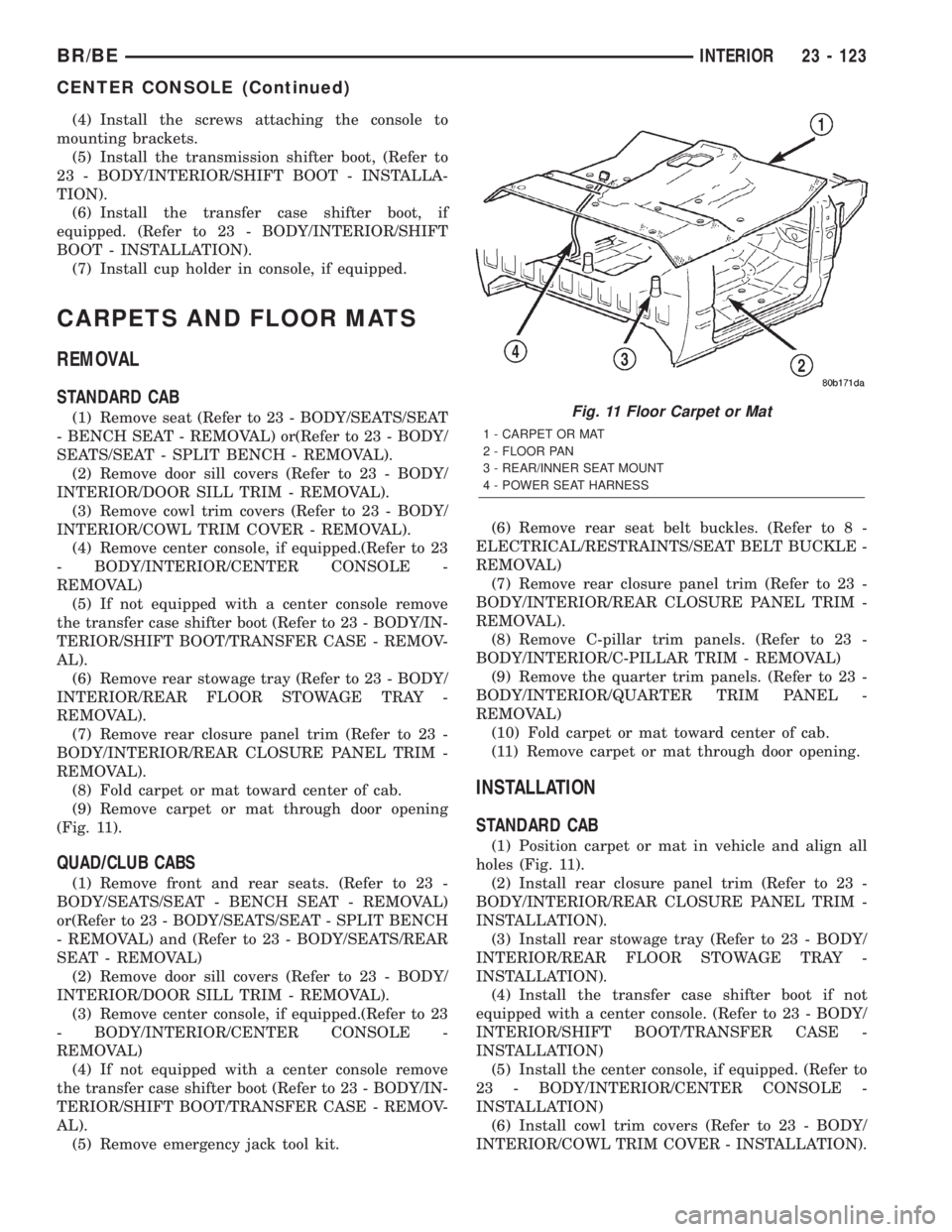
(Fig. 11).
QUAD/CLUB CABS
(1) Remove front and rear seats. (Refer to 23 -
BODY/SEATS/SEAT - BENCH SEAT - REMOVAL)
or(Refer to 23 - BODY/SEATS/SEAT - SPLIT BENCH
- REMOVAL) and (Refer to 23 - BODY/SEATS/REAR
SEAT - REMOVAL)
(2) Remove door sill covers (Refer to 23 - BODY/
INTERIOR/DOOR SILL TRIM - REMOVAL).
(3) Remove center console, if equipped.(Refer to 23
- BODY/INTERIOR/CENTER CONSOLE -
REMOVAL)
(4) If not equipped with a center console remove
the transfer case shifter boot (Refer to 23 - BODY/IN-
TERIOR/SHIFT BOOT/TRANSFER CASE - REMOV-
AL).
(5) Remove emergency jack tool kit.(6) Remove rear seat belt buckles. (Refer to 8 -
ELECTRICAL/RESTRAINTS/SEAT BELT BUCKLE -
REMOVAL)
(7) Remove rear closure panel trim (Refer to 23 -
BODY/INTERIOR/REAR CLOSURE PANEL TRIM -
REMOVAL).
(8) Remove C-pillar trim panels. (Refer to 23 -
BODY/INTERIOR/C-PILLAR TRIM - REMOVAL)
(9) Remove the quarter trim panels. (Refer to 23 -
BODY/INTERIOR/QUARTER TRIM PANEL -
REMOVAL)
(10) Fold carpet or mat toward center of cab.
(11) Remove carpet or mat through door opening.
INSTALLATION
STANDARD CAB
(1) Position carpet or mat in vehicle and align all
holes (Fig. 11).
(2) Install rear closure panel trim (Refer to 23 -
BODY/INTERIOR/REAR CLOSURE PANEL TRIM -
INSTALLATION).
(3) Install rear stowage tray (Refer to 23 - BODY/
INTERIOR/REAR FLOOR STOWAGE TRAY -
INSTALLATION).
(4) Install the transfer case shifter boot if not
equipped with a center console. (Refer to 23 - BODY/
INTERIOR/SHIFT BOOT/TRANSFER CASE -
INSTALLATION)
(5) Install the center console, if equipped. (Refer to
23 - BODY/INTERIOR/CENTER CONSOLE -
INSTALLATION)
(6) Install cowl trim covers (Refer to 23 - BODY/
INTERIOR/COWL TRIM COVER - INSTALLATION).
Fig. 11 Floor Carpet or Mat
1 - CARPET OR MAT
2 - FLOOR PAN
3 - REAR/INNER SEAT MOUNT
4 - POWER SEAT HARNESS
BR/BEINTERIOR 23 - 123
CENTER CONSOLE (Continued)
Page 2098 of 2255
SEATS
TABLE OF CONTENTS
page page
SEATS
DESCRIPTION........................131
OPERATION..........................131
CENTER CONSOLE LID
REMOVAL............................131
INSTALLATION........................132
CENTER SEAT ARMREST/CONSOLE
REMOVAL............................132
INSTALLATION........................132
CENTER SEAT ARMREST/LATCH COVER
REMOVAL............................132
INSTALLATION........................132
LUMBAR SUPPORT
REMOVAL............................132
INSTALLATION........................133
SEAT - BENCH SEAT
REMOVAL............................133
INSTALLATION........................133
SEAT - SPLIT BENCH
REMOVAL............................133
INSTALLATION........................134
SEAT BACK - BENCH SEAT
REMOVAL............................135
INSTALLATION........................135
SEAT BACK - SPLIT BENCH
REMOVAL............................135
INSTALLATION........................136
SEAT BACK COVER
REMOVAL............................137
INSTALLATION........................137
SEAT BACK COVER - SPLIT BENCH
REMOVAL............................137
INSTALLATION........................137SEAT BACK RECLINER
REMOVAL............................138
INSTALLATION........................138
SEAT CUSHION
REMOVAL............................138
INSTALLATION........................138
SEAT CUSHION COVER
REMOVAL............................139
INSTALLATION........................139
SEAT CUSHION COVER - SPLIT BENCH
REMOVAL............................139
INSTALLATION........................140
SEAT RISER
REMOVAL............................141
INSTALLATION........................141
SEAT TRACK
REMOVAL............................141
INSTALLATION........................141
SEAT TRACK - SPLIT BENCH
REMOVAL............................142
INSTALLATION........................142
EASY ENTRY SEAT TRACK
REMOVAL............................143
INSTALLATION........................143
SEAT TRACK ADJUSTER
REMOVAL............................143
INSTALLATION........................143
STANCHION COVER
REMOVAL............................143
INSTALLATION........................143
REAR SEAT
REMOVAL............................144
INSTALLATION........................144
SEATS
DESCRIPTION
Seat modules are made up of a seat frame, seat
cushion, seat back cushion, a covering material, and
the electrical components used for power operation, if
equipped. Some seat systems also contain seat belt
components and supplemental restraint systems.
OPERATION
Seat assemblies transport the occupants in comfort
and safety. Seat assemblies also help position occupants
correctly in the event of airbag deployment. Seat cush-
ions, coverings, and electrical components are service-
able. Refer to the appropriate group in this manual.
CENTER CONSOLE LID
REMOVAL
(1) Open console lid.
(2) Using a small flat blade screwdriver, disengage
locking tabs located under the console lid trim bezel.
(3) Separate bezel from lid.
(4) Move driver and passenger seat to full forward
position.
(5) Using a small drift and hammer, tap out con-
sole lid hinge pin.
(6) Separate lid from console.
BR/BESEATS 23 - 131
Page 2100 of 2255
INSTALLATION
(1) Position the lumbar assembly on the seat back
frame.
(2) Engage the retaining clips on the seat frame.
(3) Route the lumbar wire harness through seat
assembly.
(4) Engage the heated seat wire connectors.
(5) Install the seat back cover. (Refer to 23 -
BODY/SEATS/SEAT BACK COVER - INSTALLA-
TION).
(6) Perform a function check on the seat opera-
tions.
SEAT - BENCH SEAT
REMOVAL
(1) Move seat track to forward position.
(2) Hinge seat backs forward.
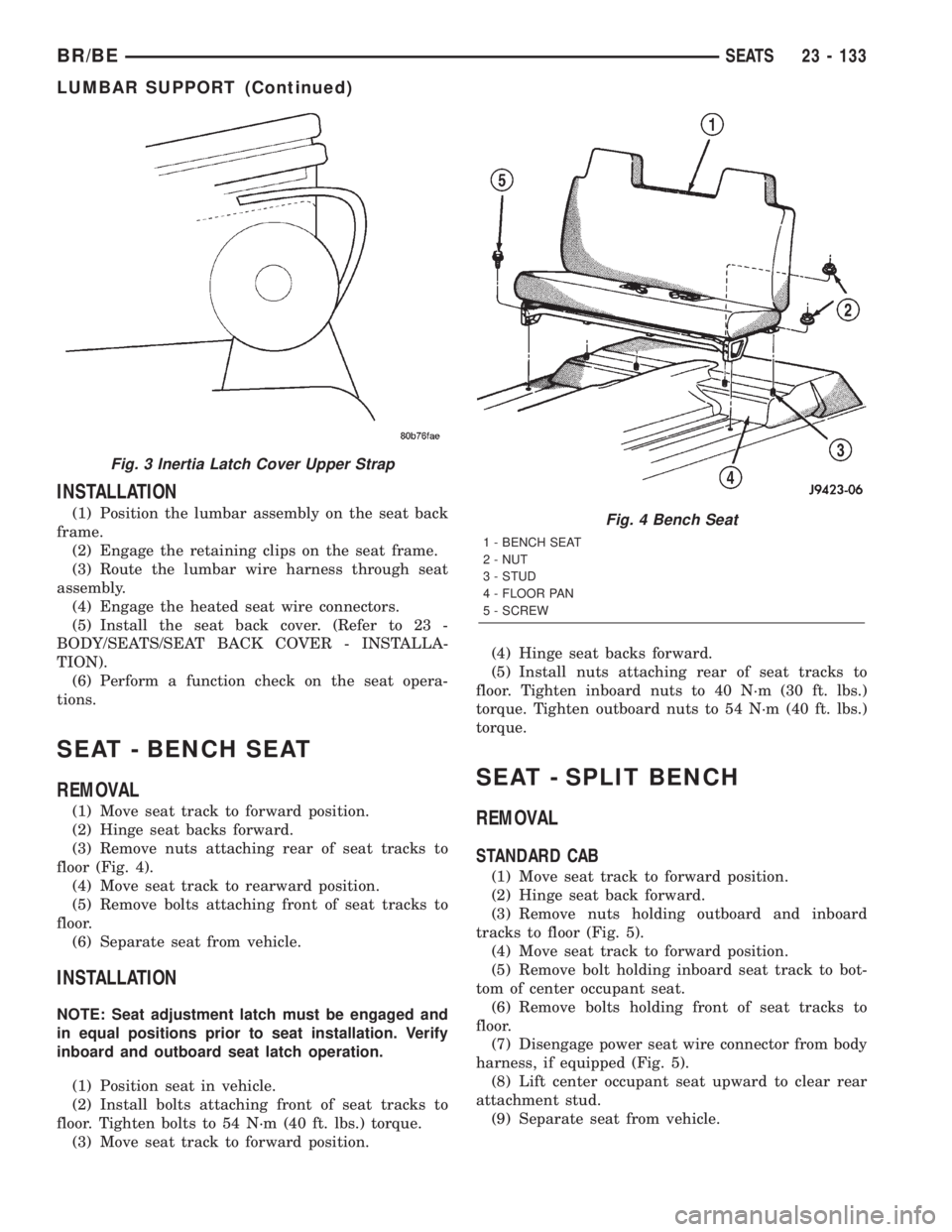
(3) Remove nuts attaching rear of seat tracks to
floor (Fig. 4).
(4) Move seat track to rearward position.
(5) Remove bolts attaching front of seat tracks to
floor.
(6) Separate seat from vehicle.
INSTALLATION
NOTE: Seat adjustment latch must be engaged and
in equal positions prior to seat installation. Verify
inboard and outboard seat latch operation.
(1) Position seat in vehicle.
(2) Install bolts attaching front of seat tracks to
floor. Tighten bolts to 54 N´m (40 ft. lbs.) torque.
(3) Move seat track to forward position.(4) Hinge seat backs forward.
(5) Install nuts attaching rear of seat tracks to
floor. Tighten inboard nuts to 40 N´m (30 ft. lbs.)
torque. Tighten outboard nuts to 54 N´m (40 ft. lbs.)
torque.
SEAT - SPLIT BENCH
REMOVAL
STANDARD CAB
(1) Move seat track to forward position.
(2) Hinge seat back forward.
(3) Remove nuts holding outboard and inboard
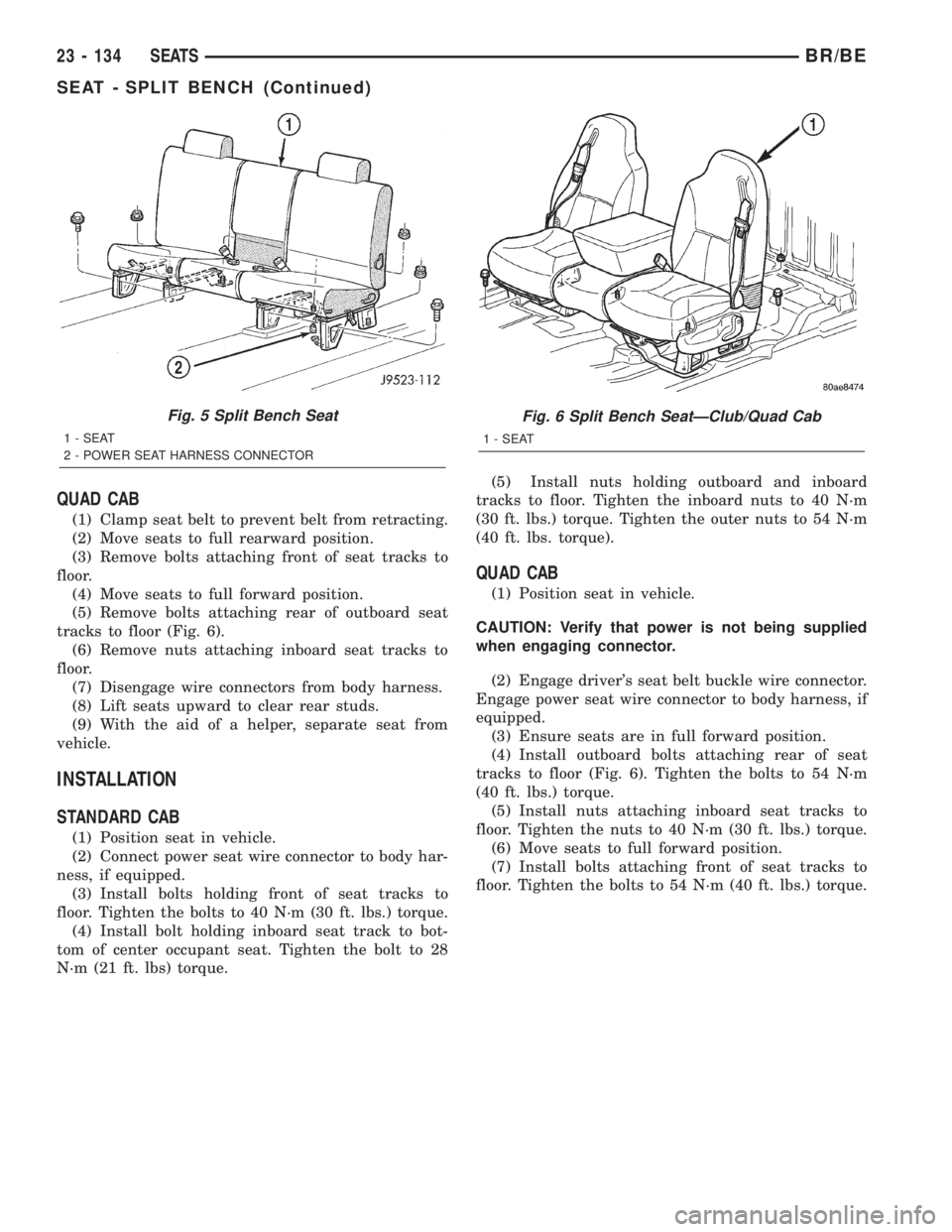
tracks to floor (Fig. 5).
(4) Move seat track to forward position.
(5) Remove bolt holding inboard seat track to bot-
tom of center occupant seat.
(6) Remove bolts holding front of seat tracks to
floor.
(7) Disengage power seat wire connector from body
harness, if equipped (Fig. 5).
(8) Lift center occupant seat upward to clear rear
attachment stud.
(9) Separate seat from vehicle.
Fig. 3 Inertia Latch Cover Upper Strap
Fig. 4 Bench Seat
1 - BENCH SEAT
2 - NUT
3 - STUD
4 - FLOOR PAN
5 - SCREW
BR/BESEATS 23 - 133
LUMBAR SUPPORT (Continued)
Page 2101 of 2255
QUAD CAB
(1) Clamp seat belt to prevent belt from retracting.
(2) Move seats to full rearward position.
(3) Remove bolts attaching front of seat tracks to
floor.
(4) Move seats to full forward position.
(5) Remove bolts attaching rear of outboard seat
tracks to floor (Fig. 6).
(6) Remove nuts attaching inboard seat tracks to
floor.
(7) Disengage wire connectors from body harness.
(8) Lift seats upward to clear rear studs.
(9) With the aid of a helper, separate seat from
vehicle.
INSTALLATION
STANDARD CAB
(1) Position seat in vehicle.
(2) Connect power seat wire connector to body har-
ness, if equipped.
(3) Install bolts holding front of seat tracks to
floor. Tighten the bolts to 40 N´m (30 ft. lbs.) torque.
(4) Install bolt holding inboard seat track to bot-
tom of center occupant seat. Tighten the bolt to 28
N´m (21 ft. lbs) torque.(5) Install nuts holding outboard and inboard
tracks to floor. Tighten the inboard nuts to 40 N´m
(30 ft. lbs.) torque. Tighten the outer nuts to 54 N´m
(40 ft. lbs. torque).
QUAD CAB
(1) Position seat in vehicle.
CAUTION: Verify that power is not being supplied
when engaging connector.
(2) Engage driver's seat belt buckle wire connector.
Engage power seat wire connector to body harness, if
equipped.
(3) Ensure seats are in full forward position.
(4) Install outboard bolts attaching rear of seat
tracks to floor (Fig. 6). Tighten the bolts to 54 N´m
(40 ft. lbs.) torque.
(5) Install nuts attaching inboard seat tracks to
floor. Tighten the nuts to 40 N´m (30 ft. lbs.) torque.
(6) Move seats to full forward position.
(7) Install bolts attaching front of seat tracks to
floor. Tighten the bolts to 54 N´m (40 ft. lbs.) torque.
Fig. 5 Split Bench Seat
1 - SEAT
2 - POWER SEAT HARNESS CONNECTOR
Fig. 6 Split Bench SeatÐClub/Quad Cab
1 - SEAT
23 - 134 SEATSBR/BE
SEAT - SPLIT BENCH (Continued)
Page 2102 of 2255
SEAT BACK - BENCH SEAT
REMOVAL
(1) Move seat to the full forward position.
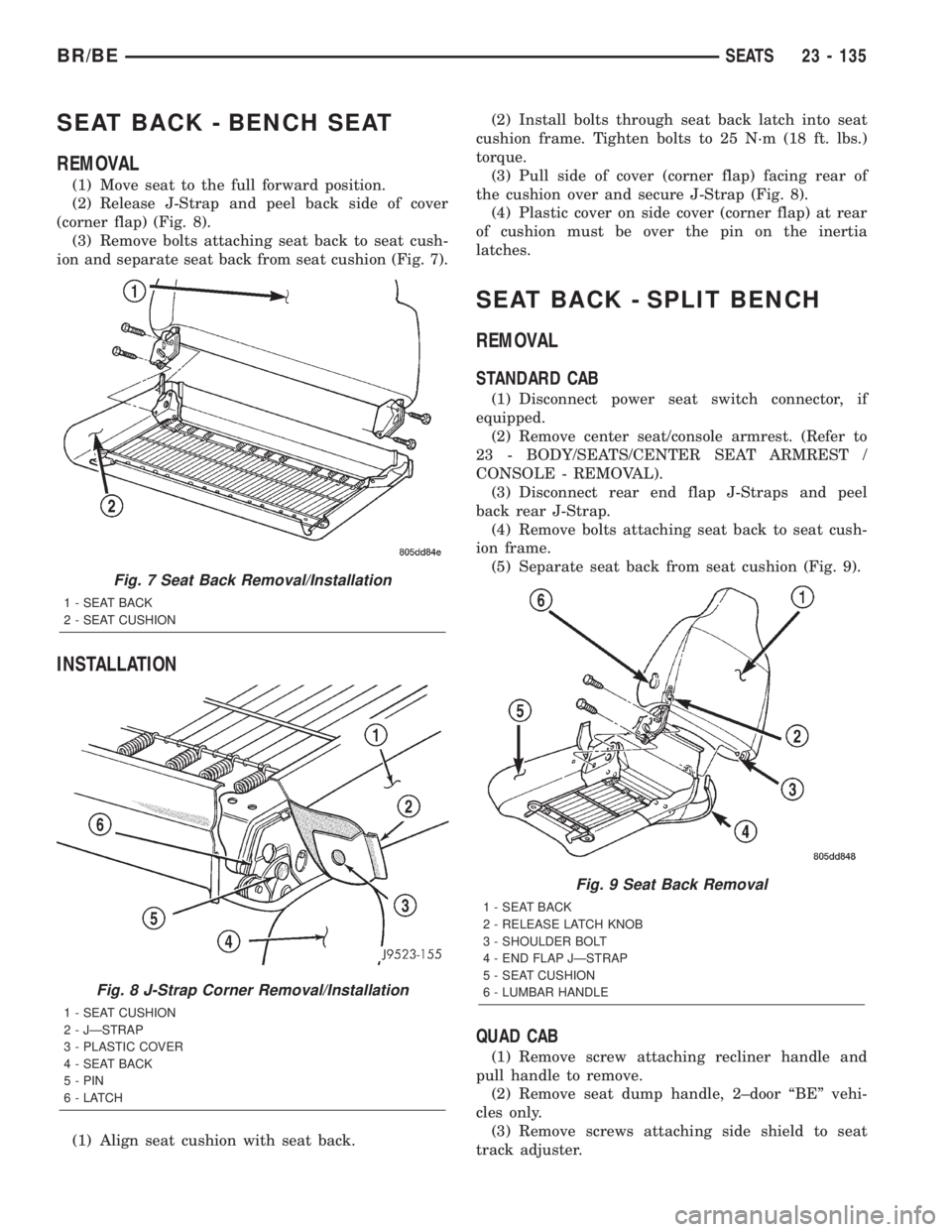
(2) Release J-Strap and peel back side of cover
(corner flap) (Fig. 8).
(3) Remove bolts attaching seat back to seat cush-
ion and separate seat back from seat cushion (Fig. 7).
INSTALLATION
(1) Align seat cushion with seat back.(2) Install bolts through seat back latch into seat
cushion frame. Tighten bolts to 25 N´m (18 ft. lbs.)
torque.
(3) Pull side of cover (corner flap) facing rear of
the cushion over and secure J-Strap (Fig. 8).
(4) Plastic cover on side cover (corner flap) at rear
of cushion must be over the pin on the inertia
latches.
SEAT BACK - SPLIT BENCH
REMOVAL
STANDARD CAB
(1) Disconnect power seat switch connector, if
equipped.
(2) Remove center seat/console armrest. (Refer to
23 - BODY/SEATS/CENTER SEAT ARMREST /
CONSOLE - REMOVAL).
(3) Disconnect rear end flap J-Straps and peel
back rear J-Strap.
(4) Remove bolts attaching seat back to seat cush-
ion frame.
(5) Separate seat back from seat cushion (Fig. 9).
QUAD CAB
(1) Remove screw attaching recliner handle and
pull handle to remove.
(2) Remove seat dump handle, 2±door ªBEº vehi-
cles only.
(3) Remove screws attaching side shield to seat
track adjuster.
Fig. 7 Seat Back Removal/Installation
1 - SEAT BACK
2 - SEAT CUSHION
Fig. 8 J-Strap Corner Removal/Installation
1 - SEAT CUSHION
2 - JÐSTRAP
3 - PLASTIC COVER
4 - SEAT BACK
5 - PIN
6-LATCH
Fig. 9 Seat Back Removal
1 - SEAT BACK
2 - RELEASE LATCH KNOB
3 - SHOULDER BOLT
4 - END FLAP JÐSTRAP
5 - SEAT CUSHION
6 - LUMBAR HANDLE
BR/BESEATS 23 - 135
Page 2103 of 2255
(4) Remove seat dump handle.
(5) Pull shoulder belt out completely and clamp
shoulder belt to prevent shoulder belt from retracting
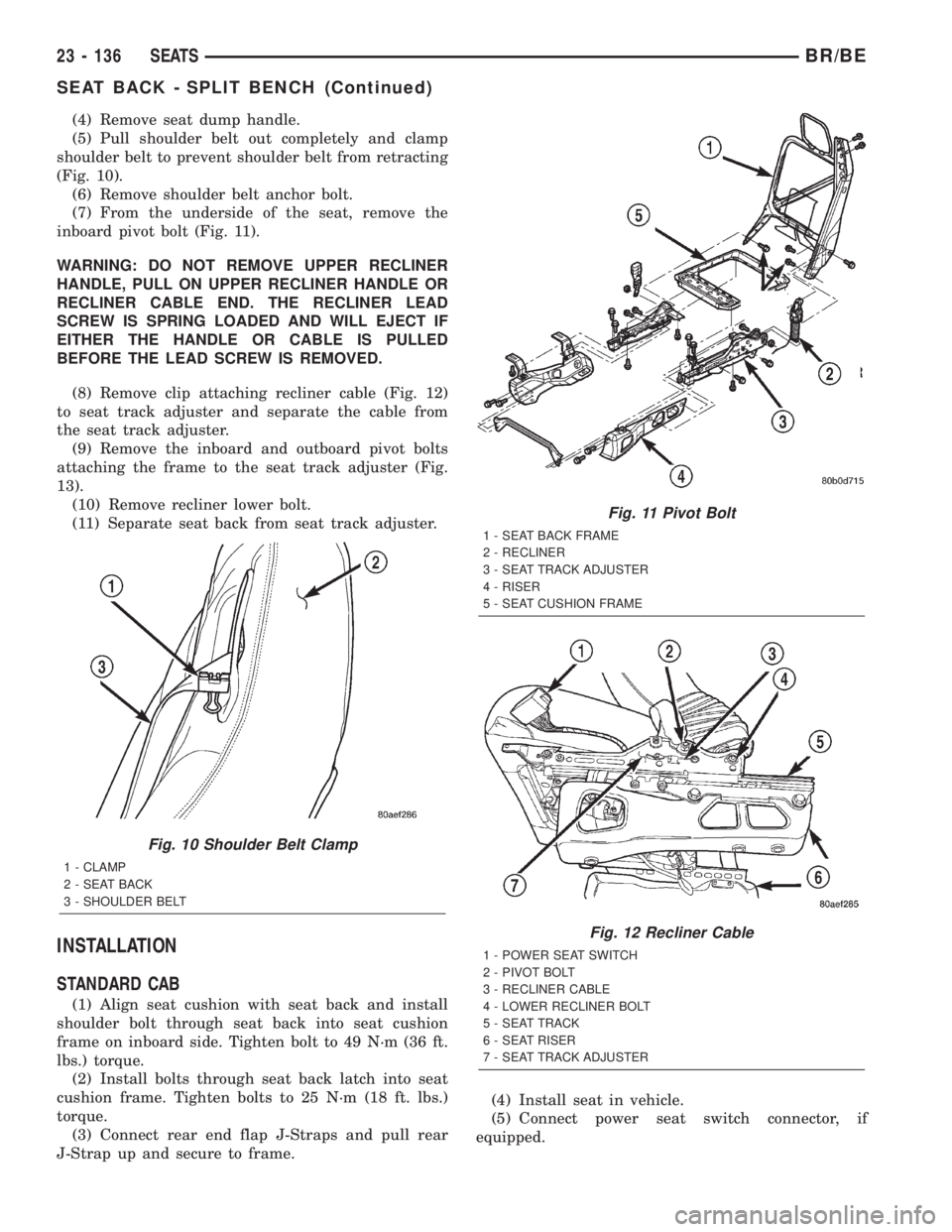
(Fig. 10).
(6) Remove shoulder belt anchor bolt.
(7) From the underside of the seat, remove the
inboard pivot bolt (Fig. 11).
WARNING: DO NOT REMOVE UPPER RECLINER
HANDLE, PULL ON UPPER RECLINER HANDLE OR
RECLINER CABLE END. THE RECLINER LEAD
SCREW IS SPRING LOADED AND WILL EJECT IF
EITHER THE HANDLE OR CABLE IS PULLED
BEFORE THE LEAD SCREW IS REMOVED.
(8) Remove clip attaching recliner cable (Fig. 12)
to seat track adjuster and separate the cable from
the seat track adjuster.
(9) Remove the inboard and outboard pivot bolts
attaching the frame to the seat track adjuster (Fig.
13).
(10) Remove recliner lower bolt.
(11) Separate seat back from seat track adjuster.
INSTALLATION
STANDARD CAB
(1) Align seat cushion with seat back and install
shoulder bolt through seat back into seat cushion
frame on inboard side. Tighten bolt to 49 N´m (36 ft.
lbs.) torque.
(2) Install bolts through seat back latch into seat
cushion frame. Tighten bolts to 25 N´m (18 ft. lbs.)
torque.
(3) Connect rear end flap J-Straps and pull rear
J-Strap up and secure to frame.(4) Install seat in vehicle.
(5) Connect power seat switch connector, if
equipped.
Fig. 10 Shoulder Belt Clamp
1 - CLAMP
2 - SEAT BACK
3 - SHOULDER BELT
Fig. 11 Pivot Bolt
1 - SEAT BACK FRAME
2 - RECLINER
3 - SEAT TRACK ADJUSTER
4 - RISER
5 - SEAT CUSHION FRAME
Fig. 12 Recliner Cable
1 - POWER SEAT SWITCH
2 - PIVOT BOLT
3 - RECLINER CABLE
4 - LOWER RECLINER BOLT
5 - SEAT TRACK
6 - SEAT RISER
7 - SEAT TRACK ADJUSTER
23 - 136 SEATSBR/BE
SEAT BACK - SPLIT BENCH (Continued)
Page 2109 of 2255
SEAT TRACK - SPLIT BENCH
REMOVAL
(1) Remove seat from vehicle. (Refer to 23 -
BODY/SEATS/SEAT - SPLIT BENCH - REMOVAL)
(2) Remove bolts from crossbrace to seat cushion
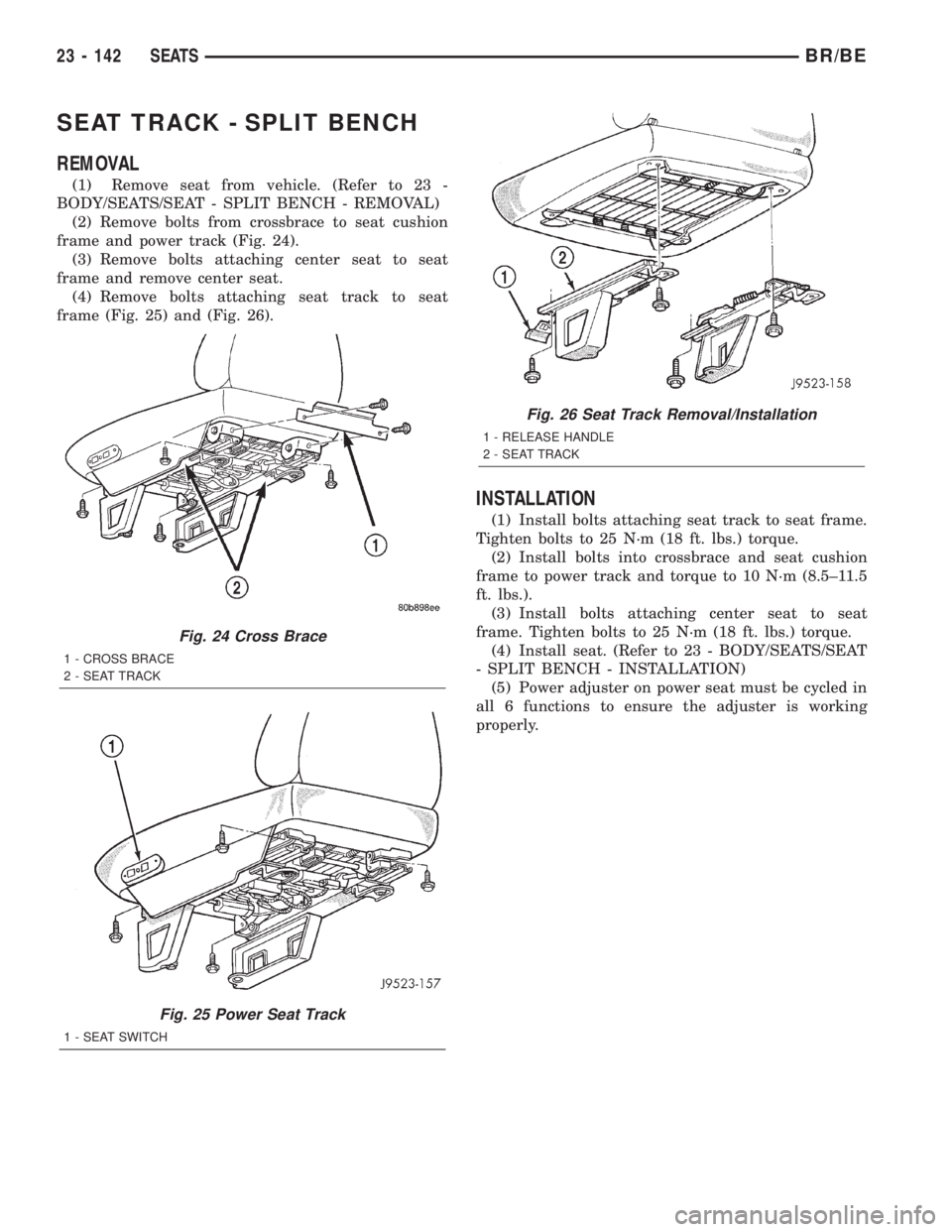
frame and power track (Fig. 24).
(3) Remove bolts attaching center seat to seat
frame and remove center seat.
(4) Remove bolts attaching seat track to seat
frame (Fig. 25) and (Fig. 26).
INSTALLATION
(1) Install bolts attaching seat track to seat frame.
Tighten bolts to 25 N´m (18 ft. lbs.) torque.
(2) Install bolts into crossbrace and seat cushion
frame to power track and torque to 10 N´m (8.5±11.5
ft. lbs.).
(3) Install bolts attaching center seat to seat
frame. Tighten bolts to 25 N´m (18 ft. lbs.) torque.
(4) Install seat. (Refer to 23 - BODY/SEATS/SEAT
- SPLIT BENCH - INSTALLATION)
(5) Power adjuster on power seat must be cycled in
all 6 functions to ensure the adjuster is working
properly.
Fig. 24 Cross Brace
1 - CROSS BRACE
2 - SEAT TRACK
Fig. 25 Power Seat Track
1 - SEAT SWITCH
Fig. 26 Seat Track Removal/Installation
1 - RELEASE HANDLE
2 - SEAT TRACK
23 - 142 SEATSBR/BE