Page 367 of 486

5-34
Storing the Spare Tire and Tools
1. Lay the tire near the rear of the vehicle with the
valve stem down.
2. If the vehicle has aluminum wheels, remove the
small center cap by tapping the back of the cap with
the extension of the shaft.
3. Slide the cable retainer through the center of the
wheel and start to raise the tire.
Make sure the retainer is fully seated across the
underside of the wheel.
4. When the tire is almost in the stored position,
turn the tire so the valve is towards the rear of
the vehicle.
This will help when you check and maintain tire
pressure in the spare.
5. Raise the tire fully against the underside of the
vehicle. Continue turning the folding wrench until
you feel more than two clicks. This indicates that the
compact spare tire is secure and the cable is tight.
The spare tire hoist cannot be overtightened.
6. Make sure the tire is stored securely. Push, pull, and
then try to rotate or turn the tire. If the tire moves,
use the folding wrench to tighten the cable.
Put back all jacking tools as they were stored in the jack
storage compartment and put the compartment cover
back on.
To put the cover back on, line up the tabs on the right of
the cover with the slots in the cover opening. Push the
cover in place and push down the tab so that it rests in
the groove. This secures the cover in place.
Page 369 of 486
5-36
A. Cable
B. Liftgate Hinges
C. Door Striker
4. Pull the cable through the door striker and the center
of the wheel.
5. Hook the cable onto the
outside portion of the
liftgate hinges.
6. Pull on the cable to make sure it is secure.
7. Make sure the metal
tube is centered at the
striker. Push the tube
towards the front of
the vehicle.
8. Close the liftgate and make sure that it is latched.
Page 390 of 486
6-18
Checking or Replacing the Engine Air Cleaner/Filter
1. Remove the two clamps on the duct.
2. Remove the duct.
3. Unlatch the two hooks on top of the engine air
cleaner/filter housing.
4. Remove and replace the engine air cleaner/filter.
5. Align the tabs located on the bottom of the panel
with the slots at the bottom of the housing.
6. Latch the hooks to secure the panel in place. If the
panel moves easily, check that the tabs are seated
correctly in the slots.
7. Put the duct back on and reinstall the clamps.
CAUTION:
Operating the engine with the air cleaner/filter
off can cause you or others to be burned. The air
cleaner not only cleans the air, it stops flame if
the engine backfires. If it isn't there, and the
engine backfires, you could be burned. Don't
drive with it off, and be careful working on the
engine with the air cleaner/filter off.
NOTICE:
If the air cleaner/filter is off, a backfire can
cause a damaging engine fire. And, dirt can easily
get into your engine, which will damage it.
Always have the air cleaner/filter in place
when you're driving.
Page 415 of 486

6-43
5. Replace the bulb by pulling the old bulb out
and gently pushing the new bulb into the bulb
holder socket.
6. Snap the bulb holder back into place, making sure all
retaining tabs are properly over the bulb holder tabs.
7. Reinstall the taillamp assembly by inserting the
outboard locating/retaining pins until the lamp is
seated. Secure with the inboard screws.Windshield Wiper Blade Replacement
Windshield wiper blades should be inspected at least
twice a year for wear or cracking. See ªWiper Blade
Checkº in the Index for more information.
Replacement blades come in different types and are
removed in different ways. For proper type and length,
see ªNormal Maintenance Replacement Partsº in
the Index.
To remove the windshield wiper blade(s) do
the following:
1. Turn the wipers on to the lowest intermittent setting.
2. Turn the ignition to OFF while the wipers are at the
outer position of the wipe pattern. The blades are
more accessible for removal/replacement while in
this position.
3. Pull the windshield wiper arm away from the
windshield or backglass.
Page 416 of 486
6-44
4. While holding the
wiper arm away from
the glass, push the
release clip from
under the blade.
5. Push the release clip at the connecting point of
the blade and the arm up. Then pull the blade
assembly down toward the glass to remove it
from the wiper arm.
6. Push the new wiper blade securely on the wiper arm
until you hear the release clip ªclickº into place.
7. Push the release clip, from Step 4, down to secure
the wiper blade into place.
Page 419 of 486
6-47 Tire Inspection and Rotation
Tires should be rotated every 6,000 to 8,000 miles
(10 000 to 13 000 km). Any time you notice unusual
wear, rotate your tires as soon as possible and check
wheel alignment. Also check for damaged tires or
wheels. See ªWhen It's Time for New Tiresº and
ªWheel Replacementº later in this section for more
information. Make sure the spare tire is stored securely.
Push, pull, and then try to rotate or turn the tire. If it
moves, use the folding wrench to tighten the cable. See
ªStoring a Flat or Spare Tire and Toolsº in the Index.
The purpose of regular rotation is to achieve more uniform
wear for all tires on the vehicle. The first rotation is the
most important. See ªScheduled Maintenance Servicesº in
the Index for scheduled rotation intervals.
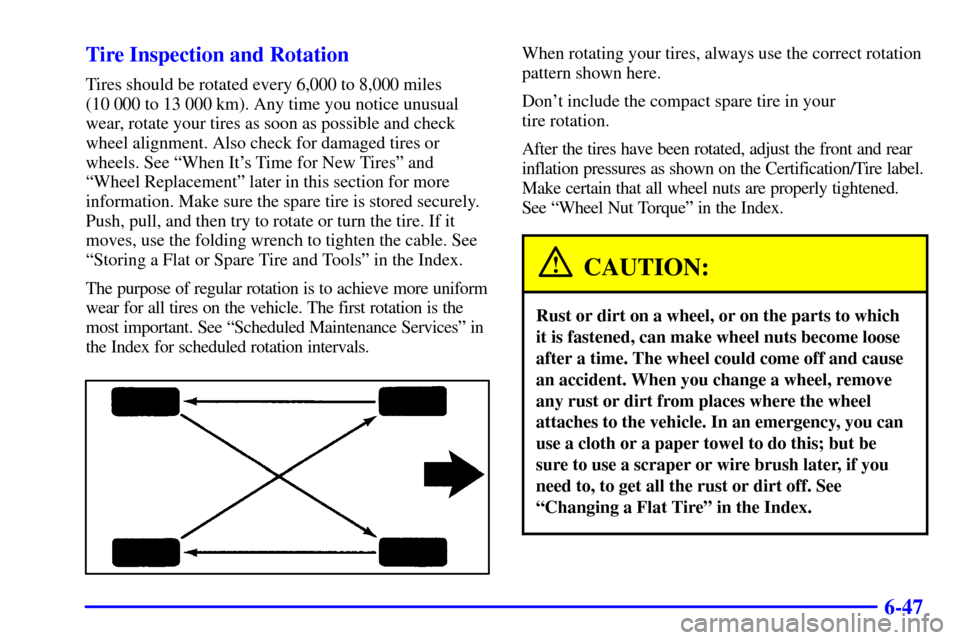
When rotating your tires, always use the correct rotation
pattern shown here.
Don't include the compact spare tire in your
tire rotation.
After the tires have been rotated, adjust the front and rear
inflation pressures as shown on the Certification/Tire label.
Make certain that all wheel nuts are properly tightened.
See ªWheel Nut Torqueº in the Index.
CAUTION:
Rust or dirt on a wheel, or on the parts to which
it is fastened, can make wheel nuts become loose
after a time. The wheel could come off and cause
an accident. When you change a wheel, remove
any rust or dirt from places where the wheel
attaches to the vehicle. In an emergency, you can
use a cloth or a paper towel to do this; but be
sure to use a scraper or wire brush later, if you
need to, to get all the rust or dirt off. See
ªChanging a Flat Tireº in the Index.
Page 425 of 486
6-53
Used Replacement Wheels
CAUTION:
Putting a used wheel on your vehicle is
dangerous. You can't know how it's been used or
how far it's been driven. It could fail suddenly
and cause a crash. If you have to replace a wheel,
use a new GM original equipment wheel.
Tire Chains
NOTICE:
Use tire chains only where legal and only when
you must. Use only SAE Class ªSº type chains
that are the proper size for your tires. Install
them on the front tires and tighten them as
tightly as possible with the ends securely
fastened. Drive slowly and follow the chain
manufacturer's instructions. If you can hear the
chains contacting your vehicle, stop and retighten
them. If the contact continues, slow down until it
stops. Driving too fast or spinning the wheels
with chains on will damage your vehicle.
Page 443 of 486
6-71
Micro Relays Usage
13 A/C Clutch
14 Fuel Pump
15 Not Used
16 Horn
17 Left Fog Lamp, Right Fog Lamp,
Fog Lamp Indicator
Mini Fuse Usage
18 Fuel Injectors 1
-6
19 Not Used
20 Not Used
21 Evaporative Emissions (EVAP)
Canister Purge Valve, Heated
Oxygen Sensors 1 and 2, Mass Air
Flow (MAF) Sensor
22 Not Used
23 Not Used
24 Not UsedMini Fuse Usage
25 Ignition Control Module (ICM)
26 Not Used
27 Transaxle Range Switch
to Back
-up Lamps
28 A/C Clutch Relay to A/C
Compressor Clutch Oil
29 Driver Information Display,
Heater A/C Control, Radio, Rear
Side Door Actuator Control
Motor, Remote Control Door Lock
Receiver (RCDLR), Security
Indicator Lamp and
Theft
-Deterrent Shock Sensor
30 Generator
31 Automatic Transaxle (Torque
Converter Clutch Solenoids)
Stoplamp Switch to Powertrain
Control Module
32 Fuel Pump Relay