Page 5 of 486
iv
Vehicle Damage Warnings
Also, in this book you will find these notices:
NOTICE:
These mean there is something that could damage
your vehicle.
In the notice area, we tell you about something that
can damage your vehicle. Many times, this damage
would not be covered by your warranty, and it could
be costly. But the notice will tell you what to do to help
avoid the damage.
When you read other manuals, you might see
CAUTION and NOTICE warnings in different
colors or in different words.
You'll also see warning labels on your vehicle.
They use the same words, CAUTION or NOTICE.
Vehicle Symbols
Your vehicle may be equipped with components and
labels that use symbols instead of text. Symbols,
used on your vehicle, are shown along with the text
describing the operation or information relating to a
specific component, control, message, gage or indicator.
If you need help figuring out a specific name of a
component, gage or indicator reference the following
topics in the Index:
�ªEngine Compartment Overviewº
�ªInstrument Panelº
�ªComfort Controlsº
�ªAudio Systemsº
Also see ªWarning Lights and Gagesº in the Index.
Page 78 of 486
1-72
CAUTION:
Using the vehicle's regular safety belts on a child
seated on the child restraint cushion can cause
serious injury to the child in a sudden stop or
crash. If a child is the proper size for the built
-in
child restraint, secure the child using the child
restraint's harness. But children who are too
large for the built
-in child restraint should sit on
the vehicle's regular seat and use the vehicle's
adult safety belts.
WARNING! FAILURE TO FOLLOW THE
MANUFACTURER'S INSTRUCTIONS ON THE
USE OF THIS CHILD RESTRAINT SYSTEM
CAN RESULT IN YOUR CHILD STRIKING THE
VEHICLE'S INTERIOR DURING A SUDDEN
STOP OR CRASH. SNUGLY ADJUST THE
BELTS PROVIDED WITH THIS CHILD
RESTRAINT AROUND YOUR CHILD.
4. Before placing the child in the child restraint, add
slack to the shoulder harness. Pull the black shoulder
harness release strap firmly. At the same time pull
both shoulder harness straps through the slots in the
seatback as shown.
5. Place the child on the child restraint cushion.
Page 109 of 486
2-
2-1
Section 2 Features and Controls
Here you can learn about the many standard and optional features on your vehicle, and information on starting,
shifting and braking. Also explained are the instrument panel and the warning systems that tell you if everything is
working properly
-- and what to do if you have a problem.
2
-2 Windows
2
-5 Keys
2-7 Door Locks
2-10 Remote Keyless Entry System (Option)
2-17 Multifunction Alarm Locks and
Lighting Choices
2
-27 Dual Sliding Doors
2
-29 Power Sliding Door (Option)
2
-36 Liftgate
2
-37 Theft
2
-38 Content Theft-Deterrent (Option)
2
-40 PASS-Key� III
2
-43 New Vehicle ªBreak-Inº
2-43 Ignition Positions
2
-45 Starting Your Engine
2
-46 Engine Coolant Heater (If Equipped)
2
-47 Automatic Transaxle Operation
2
-52 Parking Brake
2
-53 Shifting Into PARK (P)2
-56 Shifting Out of PARK (P)
2
-57 Parking Over Things That Burn
2
-57 Engine Exhaust
2
-58 Running Your Engine While You're Parked
2
-59 Turn Signal/Multifunction Lever
2
-67 Exterior Lamps
2-68 Interior Lamps
2-74 Storage Compartments
2-87 Accessory Inflator System (Option)
2
-89 Accessory Power Outlets
2
-90 OnStar� System (If Equipped)
2
-94 HomeLink� Transmitter (Option)
2
-98 The Instrument Panel -- Your
Information System
2
-102 Warning Lights, Gages, Messages
and Indicators
2
-112 Message Center
2-120 Driver Information Center (DIC) (Option)
2-123 Rear Parking Assist (Option)
Page 139 of 486
2-31
To open or close the sliding door(s), press and release
one of the following power door switches.
This switch(es) is located in the overhead
console switchbank.
This switch is located in
front of the driver's or
the passenger's side
sliding door.
The power sliding door override switch(es) will also
stop the door(s) immediately, while the door(s) is
opening or closing, when the override switch(es) is
turned on.
The power sliding door(s) will only open if the transaxle
is in PARK (P). The transaxle does not have to be in
PARK (P) to close the door.
If the power sliding door(s) is open or in the process of
closing when you shift out of PARK (P), a buzzer will
sound. This is a warning that the sliding door(s) is not
completely closed.
If the power to the sliding door(s) is turned off, the
buzzer will not sound indicating the door(s) is not
completely closed.
Page 152 of 486
2-44
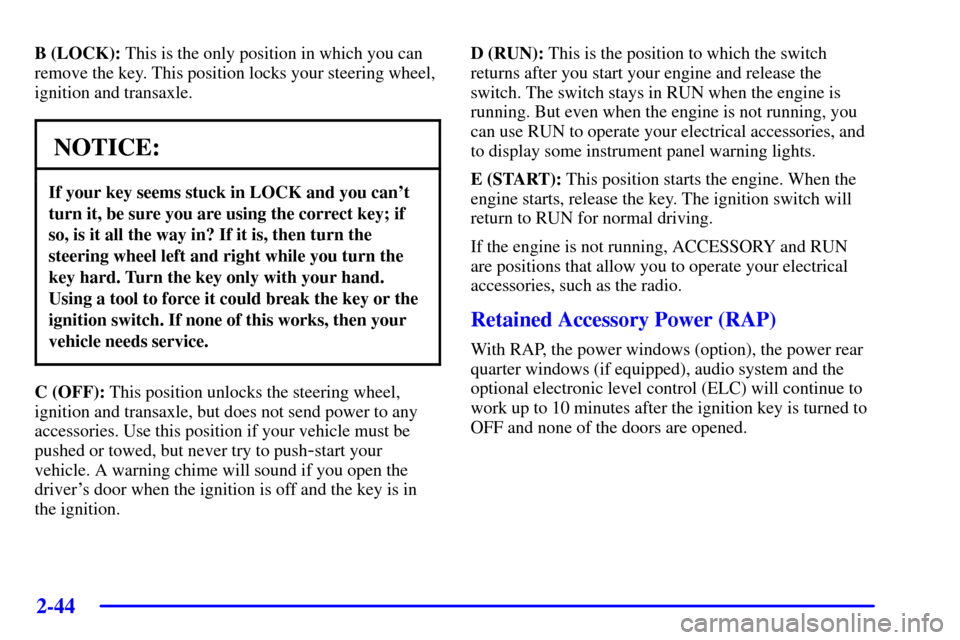
B (LOCK): This is the only position in which you can
remove the key. This position locks your steering wheel,
ignition and transaxle.
NOTICE:
If your key seems stuck in LOCK and you can't
turn it, be sure you are using the correct key; if
so, is it all the way in? If it is, then turn the
steering wheel left and right while you turn the
key hard. Turn the key only with your hand.
Using a tool to force it could break the key or the
ignition switch. If none of this works, then your
vehicle needs service.
C (OFF): This position unlocks the steering wheel,
ignition and transaxle, but does not send power to any
accessories. Use this position if your vehicle must be
pushed or towed, but never try to push
-start your
vehicle. A warning chime will sound if you open the
driver's door when the ignition is off and the key is in
the ignition.D (RUN): This is the position to which the switch
returns after you start your engine and release the
switch. The switch stays in RUN when the engine is
running. But even when the engine is not running, you
can use RUN to operate your electrical accessories, and
to display some instrument panel warning lights.
E (START): This position starts the engine. When the
engine starts, release the key. The ignition switch will
return to RUN for normal driving.
If the engine is not running, ACCESSORY and RUN
are positions that allow you to operate your electrical
accessories, such as the radio.
Retained Accessory Power (RAP)
With RAP, the power windows (option), the power rear
quarter windows (if equipped), audio system and the
optional electronic level control (ELC) will continue to
work up to 10 minutes after the ignition key is turned to
OFF and none of the doors are opened.
Page 160 of 486
2-52
FIRST (1): This position gives you even more power
(but lower fuel economy) than SECOND (2). You can
use it on very steep hills, or in deep snow or mud. If the
shift lever is put in FIRST (1), the transaxle won't
downshift into first gear until the vehicle is going
slow enough.
NOTICE:
If your front wheels can't turn, don't try to drive.
This might happen if you were stuck in very deep
sand or mud or were up against a solid object.
You could damage your transaxle.
Also, if you stop when going uphill, don't hold
your vehicle there with only the accelerator
pedal. This could overheat and damage the
transaxle. Use your brakes or shift into PARK (P)
to hold your vehicle in position on a hill.
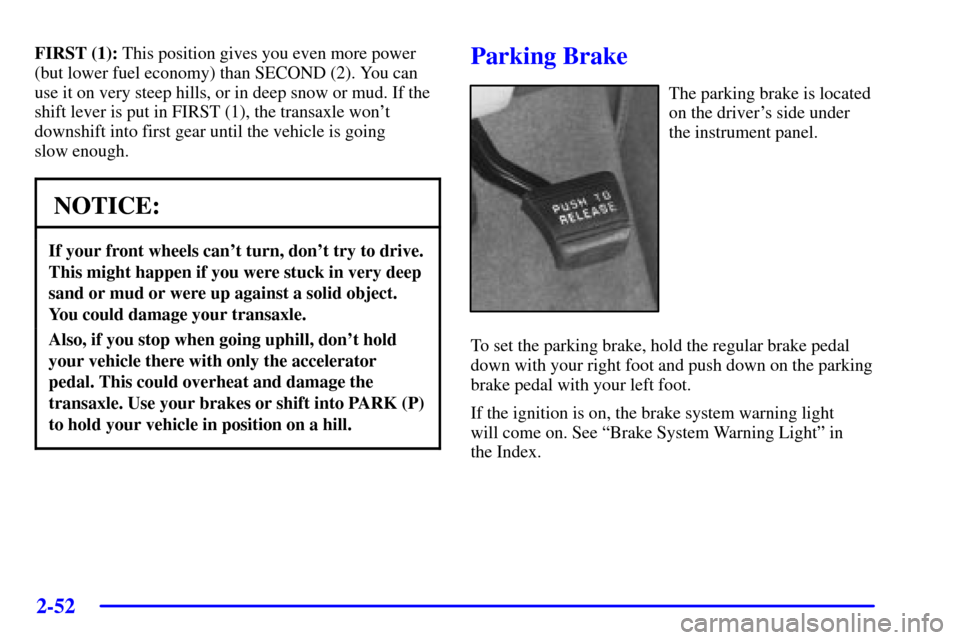
Parking Brake
The parking brake is located
on the driver's side under
the instrument panel.
To set the parking brake, hold the regular brake pedal
down with your right foot and push down on the parking
brake pedal with your left foot.
If the ignition is on, the brake system warning light
will come on. See ªBrake System Warning Lightº in
the Index.
Page 175 of 486
2-67
Exterior LampsThe control to the left of the steering column operates
the exterior lamps.
(Off/Auto): Turning the control to this setting will
activate the automatic headlamps when it is dark enough
outside and turn off all the lamps and lights during the
day except the Daytime Running Lamps (DRL).
(Parking Lamps): Turning the control to
this setting turns on the parking lamps together with
the following:
�Sidemarker Lamps
�Taillamps
�Instrument Panel Lights
(Headlamps): Turning the control to this setting
turns on the headlamps, together with the previously
listed lamps and lights.
Lamps on Reminder
If the driver's door is opened and you turn the ignition
to OFF or LOCK while leaving the lamps on, you will
hear a warning chime.
Page 207 of 486
2-99
The main components of the instrument panel are the following:
A. Side Vents
B. Front Vents
C. Turn Signal/Multifunction Lever
D. Hazard Warning Flasher Switch
E. Instrument Panel Cluster
F. Center Vents
G. Audio System
H. Side Vents
I. Exterior Lamps Control
J. Hood Release
K. HornL. Ignition Switch
M. Climate Controls
N. Rear Fan Controls (Option)
O. Cupholder Tray
P. Accessory Power Outlet
Q. Storage Bin
R. Instrument Panel Switchbank
S. Glove Box
T. Front Vents
U. Instrument Panel Fuse Block