Page 207 of 486
2-99
The main components of the instrument panel are the following:
A. Side Vents
B. Front Vents
C. Turn Signal/Multifunction Lever
D. Hazard Warning Flasher Switch
E. Instrument Panel Cluster
F. Center Vents
G. Audio System
H. Side Vents
I. Exterior Lamps Control
J. Hood Release
K. HornL. Ignition Switch
M. Climate Controls
N. Rear Fan Controls (Option)
O. Cupholder Tray
P. Accessory Power Outlet
Q. Storage Bin
R. Instrument Panel Switchbank
S. Glove Box
T. Front Vents
U. Instrument Panel Fuse Block
Page 338 of 486

5-5
The terminal is located
under a tethered cap
at the front of the
underhood fuse and
relay center. See
ªEngine Compartment
Overviewº in the Index
for more information
on location.
Squeeze the tabs and pull up on the cap to access the
remote positive (+) terminal. You should always use
the remote positive (+) terminal instead of the
positive (+) terminal on your battery.
CAUTION:
An electric fan can start up even when the engine
is not running and can injure you. Keep hands,
clothing and tools away from any underhood
electric fan.
CAUTION:
Using a match near a battery can cause battery
gas to explode. People have been hurt doing this,
and some have been blinded. Use a flashlight if
you need more light.
Be sure the battery has enough water. You don't
need to add water to the ACDelco� battery
installed in every new GM vehicle. But if a
battery has filler caps, be sure the right amount
of fluid is there. If it is low, add water to take
care of that first. If you don't, explosive gas could
be present.
Battery fluid contains acid that can burn you.
Don't get it on you. If you accidentally get it in
your eyes or on your skin, flush the place with
water and get medical help immediately.
Page 375 of 486
6-3
CAUTION:
You can be injured and your vehicle could be
damaged if you try to do service work on a
vehicle without knowing enough about it.
�Be sure you have sufficient knowledge,
experience, the proper replacement parts
and tools before you attempt any vehicle
maintenance task.
�Be sure to use the proper nuts, bolts and
other fasteners. ªEnglishº and ªmetricº
fasteners can be easily confused. If you use
the wrong fasteners, parts can later break
or fall off. You could be hurt.
Adding Equipment to the Outside of
Your Vehicle
Things you might add to the outside of your vehicle can
affect the airflow around it. This may cause wind noise
and affect windshield washer performance. Check with
your dealer before adding equipment to the outside of
your vehicle.
Fuel
Gasoline Octane
Use regular unleaded gasoline with a posted octane of
87 or higher. If the octane is less than 87, you may get a
heavy knocking noise when you drive. If it is bad
enough, it can damage your engine. A little pinging
noise when you accelerate or drive uphill is considered
normal. This does not indicate a problem exists or that a
higher
-octane fuel is necessary.
Page 383 of 486
6-11 Engine Compartment Overview
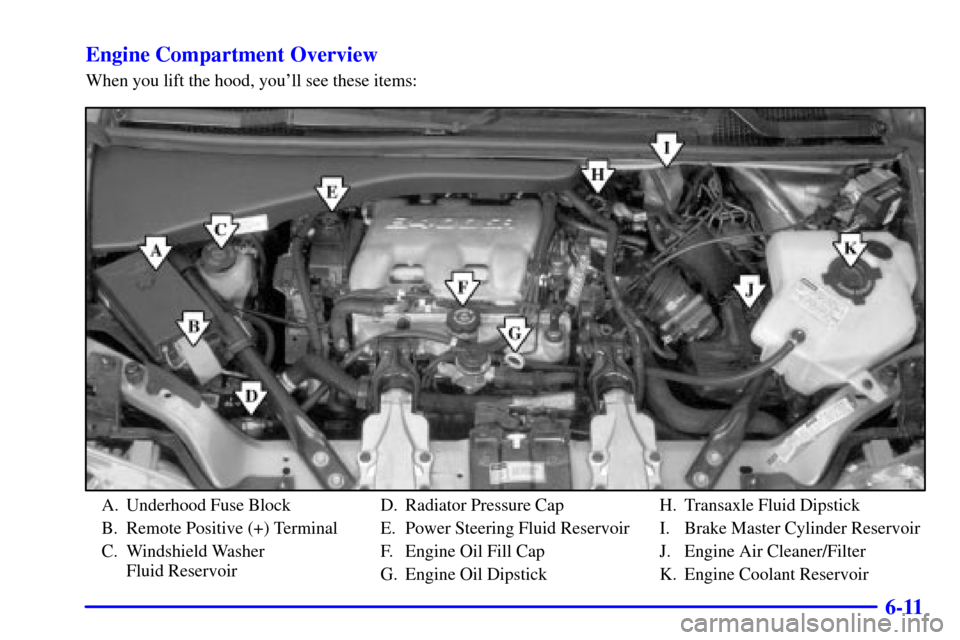
When you lift the hood, you'll see these items:
A. Underhood Fuse Block
B. Remote Positive (+) Terminal
C. Windshield Washer
Fluid ReservoirD. Radiator Pressure Cap
E. Power Steering Fluid Reservoir
F. Engine Oil Fill Cap
G. Engine Oil DipstickH. Transaxle Fluid Dipstick
I. Brake Master Cylinder Reservoir
J. Engine Air Cleaner/Filter
K. Engine Coolant Reservoir
Page 436 of 486
6-64
Electrical System
Add-On Electrical Equipment
NOTICE:
Don't add anything electrical to your vehicle
unless you check with your dealer first. Some
electrical equipment can damage your vehicle
and the damage wouldn't be covered by your
warranty. Some add
-on electrical equipment
can keep other components from working as
they should.
Your vehicle has an air bag system. Before attempting to
add anything electrical to your vehicle, see ªServicing
Your Air Bag
-Equipped Vehicleº in the Index.
Headlamp Wiring
The headlamp wiring is protected by an internal circuit
breaker in the instrument panel fuse panel. An electrical
overload will cause the lamps to go on and off, or in
some cases to remain off. If this happens, have your
headlamp wiring checked right away.
Windshield Wipers
The windshield wiper motor is protected by an internal
circuit breaker and a fuse. If the motor overheats due to
heavy snow, etc., the wiper will stop until the motor
cools. If the overload is caused by some electrical
problem, be sure to get it fixed.
Power Windows and Other Power Options
Circuit breakers in the instrument panel fuse panel
protect the power windows and other power accessories.
When the current load is too heavy, the circuit breaker
opens and closes, protecting the circuit until the problem
is fixed.
Page 437 of 486
6-65 Fuses and Circuit Breakers
The wiring circuits in your vehicle are protected from
short circuits by a combination of fuses, circuit breakers
and fusible thermal links.
Look at the silver
-colored band inside the fuse. If the
band is broken or melted, replace the fuse. Be sure you
replace a bad fuse with a new one of the identical size
and rating.
If you ever have a problem on the road and don't have a
spare fuse, you can borrow one that has the same
amperage or use one of the spare fuses in the underhood
fuse block. Just pick some feature of your vehicle that
you can get along without
-- like the radio or cigarette
lighter
-- and use its fuse, if it is the right amperage.
Replace it as soon as you can.
There are two fuse blocks in your vehicle: the
instrument panel fuse block and the underhood
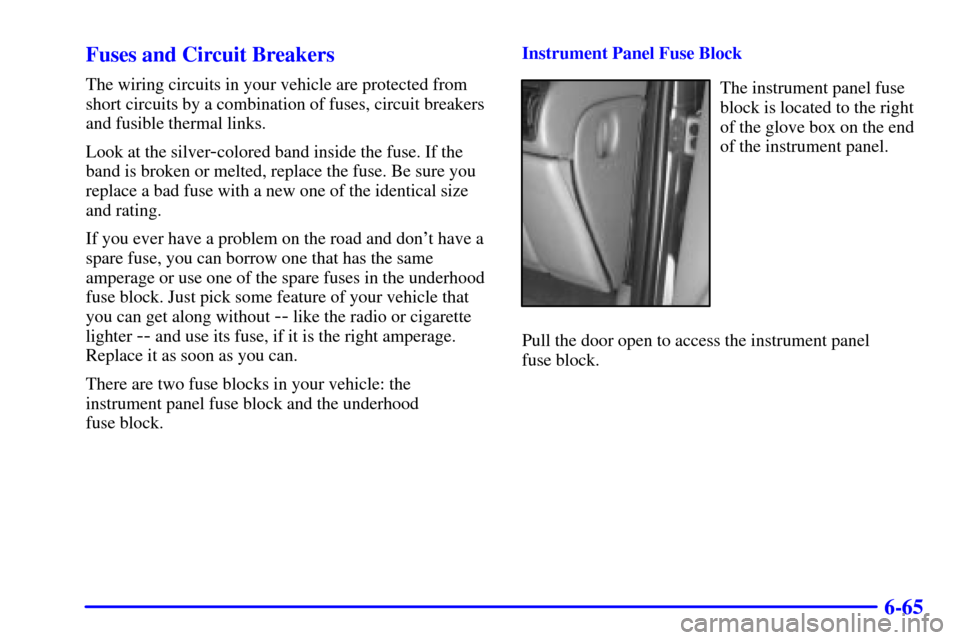
fuse block.Instrument Panel Fuse Block
The instrument panel fuse
block is located to the right
of the glove box on the end
of the instrument panel.
Pull the door open to access the instrument panel
fuse block.
Page 438 of 486
6-66
Circuit Breakers Usage
HEADLAMP Daytime Running Lamps (DRL)
Control Module, Headlamp and
Instrument Panel Dimmer Switch
PWR SLD DR Power Sliding Door
PWR WDO Front Power WindowsCircuit Breakers Usage
PWR/HEATED
SEAT PSDSix
-Way Power Seats and Rear
Side Door Actuator Motor
FRT HVAC
HI BLWRBlower Motor Hi Speed
Relay Module
Fuses Usage
SWC
BACKLIGHTSteering Wheel Radio Control
Switches (Illumination)
PCM/PASS
KEY/CLUSTERInstrument Cluster to
PRNDL Indicators
PWR MIRROR Power Remote Control
Mirror Switch
CRUISE Cruise Control Module, Switch
and Release Switch
Blank Not Used
PCM/CRANK Powertrain Control Module
(PCM), Ignition Crank
PASS KEY PASS
-Key� III System
Page 439 of 486

6-67
Fuses Usage
PWR LOCK Power Door Locks
HTD MIRROR Heated Mirrors
RH T/LP Driver's Side Taillamp
RR FOG LP Fog Lamps
CIGAR/DIC/APO
FRTCigarette Lighter, DIC, Front
Auxiliary Power Outlets
T/SIG Turn Signal Switch
PWR QTR VENT Interior Lamp and Multifunction
Switch (Power Vent Switch)
FRT/WPR/WSHR Windshield Wiper/Washer Motor
and Switch
HAZARD Hazard Switch
RR PWR SCKT Rear Electric Accessory
Plug Housing
DRL Daytime Running Lamp
Control Module
LH T/LP Passenger's Side TaillampFuses Usage
RR DEFOG/HTD
MIRRORRear Window Defogger Relay,
Heated Mirrors
ON STAR OnStar
�
SIR Inflatable Restraint
Control Module
HVAC BLOWER Heater
-A/C Control
MALL
CLUSTERInstrument Cluster, Body Control
Module, Electronic Level
Control (ELC) Sensor and Relay
STOP LAMP Stoplamp Switch
CLUSTER BATT Module/Electronic Brake
Control Module/Electronic
Brake Traction Control
Module (EBCM/EBTCM)
ENHANCED
EVAP/AWDEvaporative Emissions (EVAP)
Canister Vent Solenoid Valve,
All
-Wheel Drive (AWD)
Blank Not Used
ELC/TRAILER ELC Air Compressor and ELC
Relay, Trailer Harness