Page 95 of 390

2-30
Shifting Into PARK (P)
(Automatic Transmission Only)
CAUTION:
It can be dangerous to get out of your vehicle if
the shift lever is not fully in PARK (P) with the
parking brake firmly set. Your vehicle can roll.
If you have left the engine running, the vehicle
can move suddenly. You or others could be
injured. To be sure your vehicle won't move,
even when you're on fairly level ground, use the
steps that follow. With four
-wheel drive if your
transfer case is in NEUTRAL, your vehicle
will be free to roll, even if your shift lever is in
PARK (P). So, be sure the transfer case is in a
drive gear
-- not in NEUTRAL. If you're pulling
a trailer, see ªTowing a Trailerº in the Index.
1. Hold the brake pedal down with your right foot and
set the parking brake.
2. Move the shift lever into PARK (P) by holding in the
button on the lever and pushing the lever all the way
toward the front of your vehicle.
3. If you have four
-wheel drive, be sure the transfer
case is in a drive gear
-- not in NEUTRAL (N).
4. Move the key to LOCK.
5. Remove the key and take it with you. If you can
leave your vehicle with the key in your hand,
your vehicle is in PARK (P).
Page 96 of 390

2-31 Leaving Your Vehicle With the Engine
Running (Automatic Transmission Only)
CAUTION:
It can be dangerous to leave your vehicle with
the engine running. Your vehicle could move
suddenly if the shift lever is not fully in PARK (P)
with the parking brake firmly set. If you have
four
-wheel drive and your transfer case is in
NEUTRAL, your vehicle will be free to roll,
even if your shift lever is in PARK (P). So be
sure the transfer case is in a drive gear
-- not in
NEUTRAL. And, if you leave the vehicle with the
engine running, it could overheat and even catch
fire. You or others could be injured. Don't leave
your vehicle with the engine running unless you
have to.
Torque Lock (Automatic Transmission)
If you are parking on a hill and you don't shift your
transmission into PARK (P) properly, the weight of the
vehicle may put too much force on the parking pawl in
the transmission. You may find it difficult to pull the
shift lever out of PARK (P). This is called ªtorque lock.º
To prevent torque lock, set the parking brake and then
shift into PARK (P) properly before you leave the
driver's seat. To find out how, see ªShifting Into
PARK (P)º in the Index.
When you are ready to drive, move the shift lever out of
PARK (P) before you release the parking brake.
If torque lock does occur, you may need to have another
vehicle push yours a little uphill to take some of the
pressure from the parking pawl in the transmission,
so you can pull the shift lever out of PARK (P).
Page 98 of 390
2-33
3. Find the access hole cover on the driver's side of the
console, near the shift lever.
4. Remove the screw and cover.
5. Inside, you'll see the return plate. Using your finger,
move the return plate toward the rear of the vehicle
until it stops.
6. Move the shift lever into the gear you want.
7. Have the vehicle fixed as soon as possible.Parking Your Vehicle (Manual
Transmission Models Only)
Before you get out of your vehicle, put your shift lever
in REVERSE (R) and firmly apply the parking brake.
Once the shift lever has been placed into REVERSE (R)
with the clutch pedal pressed in, you can turn the ignition
key to OFF, remove the key and release the clutch.
If you have four
-wheel drive, be sure your transfer case
is in a drive gear. Your vehicle could roll if it isn't.
If you are towing a trailer, see ªTowing a Trailerº in
the Index.
Page 100 of 390

2-35
Running Your Engine While You're
Parked (Automatic Transmission)
It's better not to park with the engine running. But if you
ever have to, here are some things to know.
CAUTION:
Idling the engine with the climate control
system off could allow dangerous exhaust into
your vehicle. See the earlier Caution under
ªEngine Exhaust.º
Also, idling in a closed-in place can let deadly
carbon monoxide (CO) into your vehicle even
if the fan is at the highest setting. One place
this can happen is a garage. Exhaust
-- with
CO
-- can come in easily. NEVER park in a
garage with the engine running.
Another closed-in place can be a blizzard.
See ªBlizzardº in the Index.
CAUTION:
It can be dangerous to get out of your vehicle if
the shift lever is not fully in PARK (P) with the
parking brake firmly set. Your vehicle can roll.
Don't leave your vehicle when the engine is
running unless you have to. If you've left the
engine running, the vehicle can move suddenly.
You or others could be injured. To be sure your
vehicle won't move, even when you're on fairly
level ground, always set your parking brake and
move the shift lever to PARK (P).
Four-wheel drive vehicles with the transfer case
in NEUTRAL will allow the vehicle to roll,
even if your shift lever is in PARK (P). So, be
sure the transfer case is in a drive gear
-- not in
NEUTRAL. Always set your parking brake.
Follow the proper steps to be sure your vehicle won't
move. See ªShifting Into PARK (P)º in the Index.
If you're pulling a trailer, see ªTowing a Trailerº in
the Index.
Page 101 of 390
2-36
Horn
To sound the horn, press the portion of your steering
wheel marked with the horn symbol.
Tilt Wheel (If Equipped)
A tilt wheel allows you to adjust the steering wheel before
you drive. You can raise it to the highest level to give your
legs more room when you exit and enter your vehicle.
The lever that allows you to tilt the steering wheel is
located on the left side of the steering wheel column.To tilt the wheel, hold the wheel and move the lever
down. Then move the wheel to a comfortable position
and release the lever to lock the wheel in place.
Turn Signal/Multifunction Lever
The lever on the left side of the steering column
includes the following:
�Turn and Lane
-Change Signals
�Headlamp High/Low
-Beam Changer
�Flash
-to-Pass Feature
For information on exterior lamps, see ªExterior
Lampsº later in this section.
Page 105 of 390
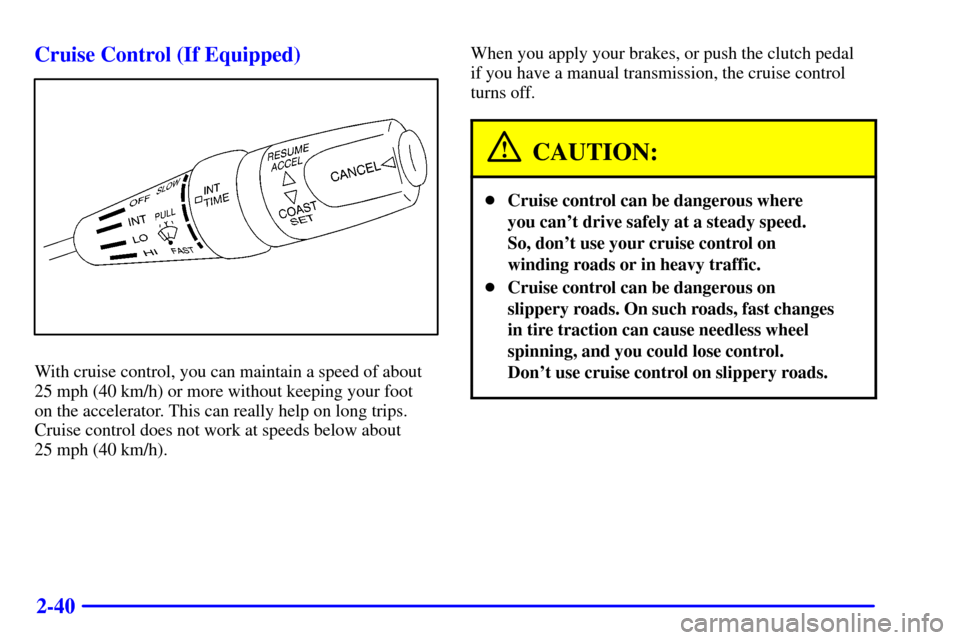
2-40 Cruise Control (If Equipped)
With cruise control, you can maintain a speed of about
25 mph (40 km/h) or more without keeping your foot
on the accelerator. This can really help on long trips.
Cruise control does not work at speeds below about
25 mph (40 km/h).When you apply your brakes, or push the clutch pedal
if you have a manual transmission, the cruise control
turns off.
CAUTION:
�Cruise control can be dangerous where
you can't drive safely at a steady speed.
So, don't use your cruise control on
winding roads or in heavy traffic.
�Cruise control can be dangerous on
slippery roads. On such roads, fast changes
in tire traction can cause needless wheel
spinning, and you could lose control.
Don't use cruise control on slippery roads.
Page 111 of 390
2-46
Interior Lamps
Instrument Panel Brightness Control
This feature controls the brightness of the instrument
panel lights.
The thumbwheel for this
feature is located to the left
of the steering wheel on the
instrument panel.
Move the thumbwheel upward to brighten the lights or
downward to dim them.
Dome Lamp
The dome lamp has a three-position switch.
Page 114 of 390

2-49
Storage Compartments
Glove Box
To open the glove box, pull the latch toward you.
Use your key to lock and unlock the glove box.
The glove box has a two
-position detent for opening the
door. Lower the door to the first detent for access to the
glove box. Pull it to the next detent for further access.
Door Storage
Each side door has a storage compartment.
Coinholder
Your instrument panel has two coinholders located to
the left of the steering wheel.
Cupholder
Two cupholders are on the center console next to the
parking brake lever.
Convenience Net (If Equipped)
You may have a convenience net in the rear of your
vehicle to help keep small items, like gloves and light
clothing, in place during sharp turns or quick stops
and starts.
The net is not designed to retain these items during
off
-road use. The net is not for larger, heavier items.
Attach the loops to the hooks located along the sides
of the rear cargo area. You may attach the convenience
net loops to either the forward or the rear hooks.