Page 293 of 384
6-21 How to Add Fluid
Here's how to add fluid. Refer to the Maintenance
Schedule to determine what kind of fluid to use.
See ªRecommended Fluids and Lubricantsº in
the Index.
1. Remove the filler plug.
2. Add fluid at the filler plug hole. Add only enough
fluid to bring the fluid level up to the bottom of the
filler plug hole.
3. Install the filler plug. Be sure the plug is fully seated.
4. Tighten the plug to 20 lb
-ft (27 N´m).
Hydraulic Clutch
The hydraulic clutch linkage in your vehicle is
self
-adjusting. The clutch master cylinder reservoir is
filled with hydraulic clutch fluid.
It is not necessary to regularly check clutch fluid unless
you suspect there is a leak in the system. Adding fluid
won't correct a leak.
A fluid loss in this system could indicate a problem.
Have the system inspected and repaired.
When to Check and What to Use
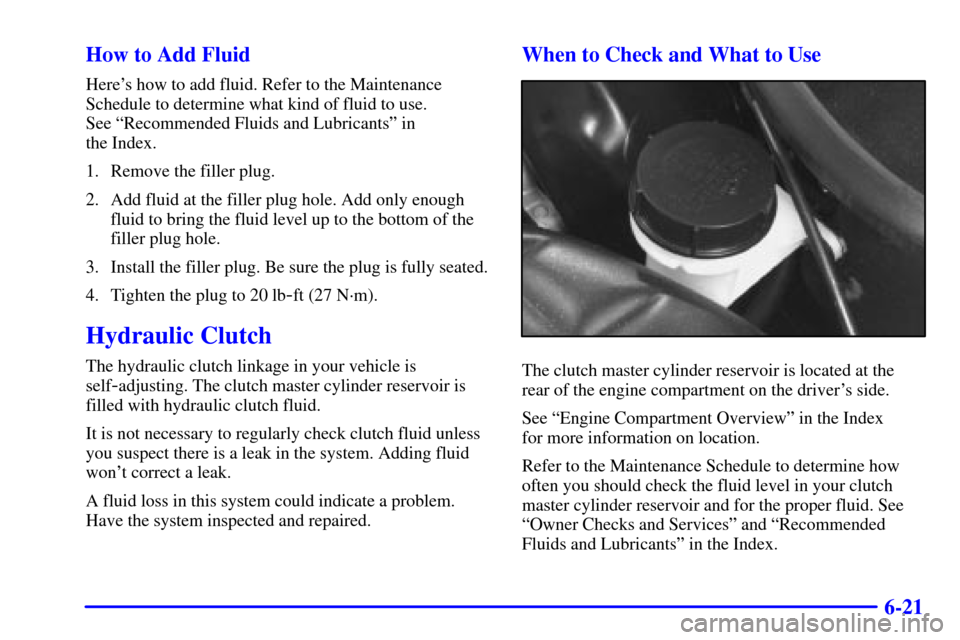
The clutch master cylinder reservoir is located at the
rear of the engine compartment on the driver's side.
See ªEngine Compartment Overviewº in the Index
for more information on location.
Refer to the Maintenance Schedule to determine how
often you should check the fluid level in your clutch
master cylinder reservoir and for the proper fluid. See
ªOwner Checks and Servicesº and ªRecommended
Fluids and Lubricantsº in the Index.
Page 294 of 384
6-22 How to Check and Add Fluid
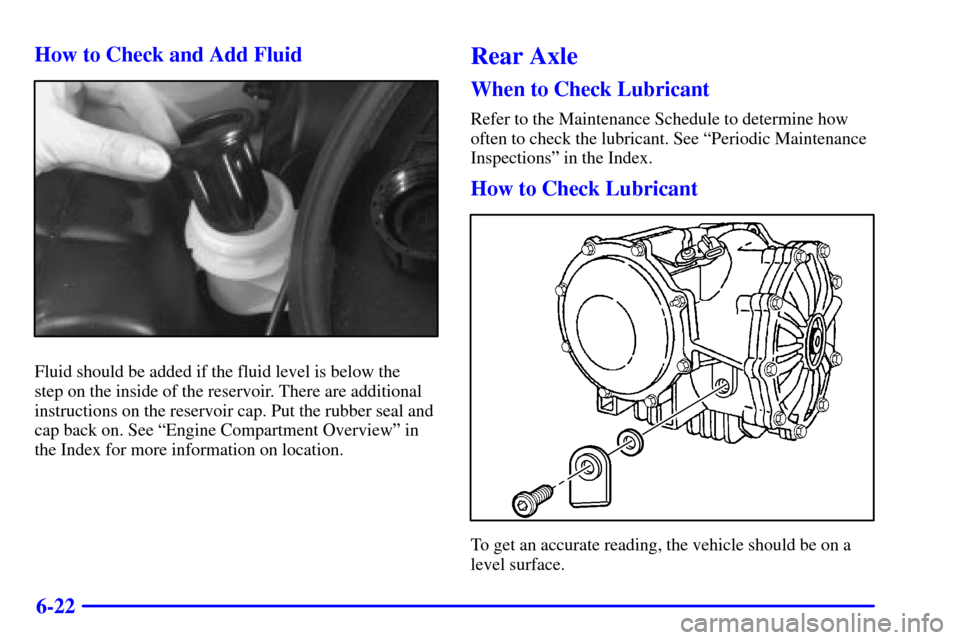
Fluid should be added if the fluid level is below the
step on the inside of the reservoir. There are additional
instructions on the reservoir cap. Put the rubber seal and
cap back on. See ªEngine Compartment Overviewº in
the Index for more information on location.
Rear Axle
When to Check Lubricant
Refer to the Maintenance Schedule to determine how
often to check the lubricant. See ªPeriodic Maintenance
Inspectionsº in the Index.
How to Check Lubricant
To get an accurate reading, the vehicle should be on a
level surface.
Page 296 of 384
6-24 What to Use
Use a mixture of one-half clean, drinkable water and
one
-half DEX-COOL� coolant which won't damage
aluminum parts. If you use this coolant mixture, you
don't need to add anything else.
CAUTION:
Adding only plain water to your cooling system
can be dangerous. Plain water, or some other
liquid such as alcohol, can boil before the proper
coolant mixture will. Your vehicle's coolant
warning system is set for the proper coolant
mixture. With plain water or the wrong mixture,
your engine could get too hot but you wouldn't
get the overheat warning. Your engine could
catch fire and you or others could be burned.
Use a 50/50 mixture of clean, drinkable water
and DEX
-COOL� coolant.
NOTICE:
If you use an improper coolant mixture, your
engine could overheat and be badly damaged.
The repair cost wouldn't be covered by your
warranty. Too much water in the mixture can
freeze and crack the engine, radiator, heater core
and other parts.
If you have to add coolant more than four times a year,
have your dealer check your cooling system.
NOTICE:
If you use the proper coolant, you don't have to
add extra inhibitors or additives which claim to
improve the system. These can be harmful.
Page 297 of 384
6-25 Checking Coolant
The coolant surge tank is located in the engine
compartment behind the passenger's side headlamp.
See ªEngine Compartment Overviewº in the Index
for more information on location.
CAUTION:
Turning the surge tank pressure cap when the
engine and radiator are hot can allow steam and
scalding liquids to blow out and burn you badly.
Never turn the surge tank pressure cap
-- even
a little
-- when the engine and radiator are hot.
The vehicle must be on a level surface. When your
engine is cold, the coolant level should be at the FULL
COLD mark. The FULL COLD mark is on the front
of the coolant surge tank. Don't overfill the surge tank.
Too much coolant can result in an overflow when the
fluid is hot.
Page 299 of 384

6-27
Power Steering Fluid
When to Check Power Steering Fluid
It is not necessary to regularly check power steering
fluid unless you suspect there is a leak in the system or
you hear an unusual noise. A fluid loss in this system
could indicate a problem. Have the system inspected and
repaired. See ªEngine Compartment Overviewº in the
Index for reservoir location.
How to Check Power Steering Fluid
Turn the key off, let the engine compartment cool down,
wipe the cap and the top of the reservoir clean, then
unscrew the cap and wipe the dipstick with a clean rag.
Replace the cap and completely tighten it. Then remove
the cap again and look at the fluid level on the dipstick.
The level should be at the FULL COLD mark. If necessary,
add only enough fluid to bring the level up to the mark.
�When the engine
compartment is hot,
the level should be at
the HOT mark.
�When the engine
compartment is cool,
the level should be at
the FULL COLD mark.
What to Use
To determine what kind of fluid to use, see ªRecommended
Fluids and Lubricantsº in the Index. Always use the proper
fluid. Failure to use the proper fluid can cause leaks and
damage hoses and seals.
Page 301 of 384

6-29
Brakes
Brake Fluid
Your brake master cylinder reservoir is on the driver's
side of the engine compartment. It is filled with DOT
-3
brake fluid. See ªEngine Compartment Overviewº in
the Index.
There are only two reasons why the brake fluid level in
the reservoir might go down. The first is that the brake
fluid goes down to an acceptable level during normal
brake lining wear.When new linings are put in, the fluid level goes back up.
The other reason is that fluid is leaking out of the brake
system. If it is, you should have your brake system fixed,
since a leak means that sooner or later your brakes won't
work well, or won't work at all.
So, it isn't a good idea to ªtop offº your brake fluid.
Adding brake fluid won't correct a leak. If you add fluid
when your linings are worn, then you'll have too much
fluid when you get new brake linings. You should add
(or remove) brake fluid, as necessary, only when work is
done on the brake hydraulic system.
CAUTION:
If you have too much brake fluid, it can spill on
the engine. The fluid will burn if the engine is hot
enough. You or others could be burned, and your
vehicle could be damaged. Add brake fluid only
when work is done on the brake hydraulic system.
See ªChecking Brake Fluidºin this section.
Page 302 of 384

6-30
Refer to the Maintenance Schedule to determine when
to check your brake fluid. See ªPeriodic Maintenance
Inspectionsº in the Index.
Checking Brake Fluid
You can check the brake fluid without taking off the
cap. Just look at the brake fluid reservoir. The fluid level
should be above the MIN mark on the reservoir. If it isn't,
have your brake system checked to see if there is a leak.
After work is done on the brake hydraulic system, make
sure the level is between the MIN and MAX marks.
What to Add
When you do need brake fluid, use only DOT
-3 brake
fluid. Use new brake fluid from a sealed container only.
See ªRecommended Fluids and Lubricantsº in the Index.
Always clean the brake fluid reservoir cap and the area
around the cap before removing it. This will help keep
dirt from entering the reservoir.
CAUTION:
With the wrong kind of fluid in your brake
system, your brakes may not work well, or they
may not even work at all. This could cause a
crash. Always use the proper brake fluid.
NOTICE:
�Using the wrong fluid can badly damage
brake system parts. For example, just a few
drops of mineral
-based oil, such as engine
oil, in your brake system can damage brake
system parts so badly that they'll have to
be replaced. Don't let someone put in the
wrong kind of fluid.
�If you spill brake fluid on your vehicle's
painted surfaces, the paint finish can be
damaged. Be careful not to spill brake
fluid on your vehicle. If you do, wash it
off immediately. See ªAppearance Careº
in the Index.
Page 347 of 384

6-75
Maxi-Fuse Usage
46 Cooling Fan 2
47 Blank
48 Blank
49 Cooling Fan 1
50 Air Pump
51 Blank
52 Anti
-Lock Brakes
53 Selective Real Time Damping
Electronics
54 Fuse Puller
Replacement Bulbs
High-Beam Headlamp 9005. . . . . . . . . . . . . . . . . . . .
Low
-Beam Headlamp 9006. . . . . . . . . . . . . . . . . . . .
Back
-Up 2057. . . . . . . . . . . . . . . . . . . . . . . . . . . . . . .
Rear Stop/Tail and Turn Signal 3057. . . . . . . . . . . . .
For any bulb replacements or procedures not listed here,
please consult your dealer.
Capacities and Specifications
The following approximate capacities are given in
English and metric conversions.
Please refer to ªRecommended Fluids and Lubricantsº
in the Index for more information.
Automatic Transmission
Drain and Refill 5.0 quarts (4.7 L). . . . . . . . . . . . . .
Overhaul 10.8 quarts (10.2 L). . . . . . . . . . . . . . . . .
Cooling System12.6 quarts (11.9 L) . . . . . . . . . . . . . .
Engine Oil with Filter6.5 quarts (6.1 L) . . . . . . . . .
Fuel Tank18.5 U.S. gallons (70.0 L) . . . . . . . . . . . .
Manual Transmission
(Overhaul)4.1 quarts (3.8 L) . . . . . . . . . . . . . . . . .
Wheel Nut Torque100 lb
-ft (140 N´m) . . . . . . . . . .
All capacities are approximate. When adding, be sure
to fill to the appropriate level, as recommended in this
manual. Recheck fluid level after filling.
Engine Specifications
Type5.7L V8 . . . . . . . . . . . . . . . . . . . . . . . . . . . . . . . .
VIN Engine Code
LS1 G. . . . . . . . . . . . . . . . . . . . . . . . . . . . . . . . . . . .
LS6 S. . . . . . . . . . . . . . . . . . . . . . . . . . . . . . . . . . . .