Page 236 of 384

4-25
Here are some things you can check before a trip:
�Windshield Washer Fluid: Is the reservoir full?
Are all windows clean inside and outside?
�Wiper Blades: Are they in good shape?
�Fuel, Engine Oil, Other Fluids: Have you checked
all levels?
�Lamps: Are they all working? Are the lenses clean?
�Tires: They are vitally important to a safe,
trouble
-free trip. Is the tread good enough for
long
-distance driving? Are the tires all inflated
to the recommended pressure?
�Weather Forecasts: What's the weather outlook
along your route? Should you delay your trip a
short time to avoid a major storm system?
�Maps: Do you have up
-to-date maps?
Highway Hypnosis
Is there actually such a condition as ªhighway hypnosisº?
Or is it just plain falling asleep at the wheel? Call it
highway hypnosis, lack of awareness, or whatever.
There is something about an easy stretch of road with the
same scenery, along with the hum of the tires on the road,
the drone of the engine, and the rush of the wind against
the vehicle that can make you sleepy. Don't let it happen
to you! If it does, your vehicle can leave the road in less
than a second, and you could crash and be injured.
What can you do about highway hypnosis?
First, be aware that it can happen.
Then here are some tips:
�Make sure your vehicle is well ventilated,
with a comfortably cool interior.
�Keep your eyes moving. Scan the road ahead
and to the sides. Check your rearview mirrors
and your instruments frequently.
�If you get sleepy, pull off the road into a rest,
service or parking area and take a nap, get some
exercise, or both. For safety, treat drowsiness on
the highway as an emergency.
Page 237 of 384
4-26
Hill and Mountain Roads
Driving on steep hills or mountains is different from
driving in flat or rolling terrain.If you drive regularly in steep country, or if you're
planning to visit there, here are some tips that can
make your trips safer and more enjoyable.
�Keep your vehicle in good shape. Check all fluid
levels and also the brakes, tires, cooling system
and transmission. These parts can work hard on
mountain roads.
�Know how to go down hills. The most important
thing to know is this: let your engine do some of
the slowing down. Shift to a lower gear when you
go down a steep or long hill.
CAUTION:
If you don't shift down, your brakes could get so
hot that they wouldn't work well. You would then
have poor braking or even none going down a hill.
You could crash. Shift down to let your engine
assist your brakes on a steep downhill slope.
Page 242 of 384
4-31
�Tie a red cloth to your vehicle to alert police that
you've been stopped by the snow.
�Put on extra clothing or wrap a blanket around you.
If you have no blankets or extra clothing, make body
insulators from newspapers, burlap bags, rags, floor
mats
-- anything you can wrap around yourself or
tuck under your clothing to keep warm.
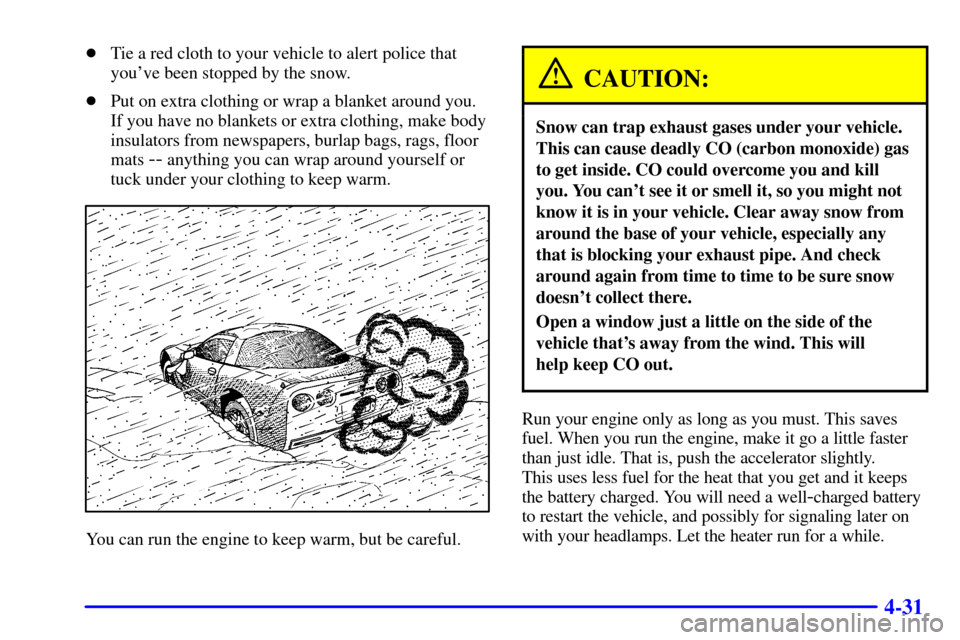
You can run the engine to keep warm, but be careful.
CAUTION:
Snow can trap exhaust gases under your vehicle.
This can cause deadly CO (carbon monoxide) gas
to get inside. CO could overcome you and kill
you. You can't see it or smell it, so you might not
know it is in your vehicle. Clear away snow from
around the base of your vehicle, especially any
that is blocking your exhaust pipe. And check
around again from time to time to be sure snow
doesn't collect there.
Open a window just a little on the side of the
vehicle that's away from the wind. This will
help keep CO out.
Run your engine only as long as you must. This saves
fuel. When you run the engine, make it go a little faster
than just idle. That is, push the accelerator slightly.
This uses less fuel for the heat that you get and it keeps
the battery charged. You will need a well
-charged battery
to restart the vehicle, and possibly for signaling later on
with your headlamps. Let the heater run for a while.
Page 250 of 384
5-5
CAUTION:
Using a match near a battery can cause battery
gas to explode. People have been hurt doing this,
and some have been blinded. Use a flashlight if
you need more light.
Be sure the battery has enough water. You don't
need to add water to the ACDelco� battery
installed in every new GM vehicle. But if a
battery has filler caps, be sure the right amount
of fluid is there. If it is low, add water to take
care of that first. If you don't, explosive gas
could be present.
Battery fluid contains acid that can burn you.
Don't get it on you. If you accidentally get it in
your eyes or on your skin, flush the place with
water and get medical help immediately.
CAUTION:
Fans or other moving engine parts can injure you
badly. Keep your hands away from moving parts
once the engine is running.
5. Check that the jumper cables don't have loose or
missing insulation. If they do, you could get a shock.
The vehicles could be damaged, too.
Before you connect the cables, here are some basic
things you should know. Positive (+) will go to
positive (+) or to a remote positive (+) terminal
if the vehicle has one. Negative (
-) will go to a
heavy, unpainted metal engine part or to a remote
negative (
-) terminal if the vehicle has one.
Don't connect positive (+) to negative (
-) or you'll
get a short that would damage the battery and maybe
other parts, too. And don't connect the negative (
-)
cable to the negative (
-) terminal on the dead battery
because this can cause sparks.
Page 254 of 384
5-9
Engine Overheating
You will find an engine coolant temperature gage on the
instrument panel cluster and a COOLANT OVER
TEMP message on the Driver Information Center (DIC).
See ªEngine Coolant Temperature Gageº and ªCoolant
Over Temp DIC Messageº in the Index.
Overheated Engine Protection
Operating Mode
If an overheated engine condition exists and the messages
COOLANT OVER TEMP and REDUCED ENGINE
POWER are displayed, along with the Check Engine
light, an overheat protection mode which alternates
firing groups of cylinders helps prevent engine damage. In this mode, you will notice a loss in power and engine
performance. This operating mode allows your vehicle to
be driven to a safe place in an emergency; you may drive
up to 50 miles (80 km).
NOTICE:
After driving in the overheated engine protection
operating mode, to avoid engine damage, allow
the engine to cool before attempting any repair.
The engine oil will be severely degraded. Repair
the cause of coolant loss, change the oil and reset
the oil life system. See ªEngine Oilº in the Index.
Page 258 of 384
5-13
The coolant level should be at or above the FULL COLD
mark. If it isn't, you may have a leak at the pressure cap
or in the radiator hoses, heater hoses, radiator, water
pump or somewhere else in the cooling system.
CAUTION:
Heater and radiator hoses, and other engine
parts, can be very hot. Don't touch them.
If you do, you can be burned.
Don't run the engine if there is a leak. If you run
the engine, it could lose all coolant. That could
cause an engine fire, and you could be burned.
Get any leak fixed before you drive the vehicle.
If there seems to be no leak, with the engine on,
check to see if the electric engine cooling fans are
running. If the engine is overheating, both fans should
be running. If they aren't, your vehicle needs service.
NOTICE:
Engine damage from running your engine
without coolant isn't covered by your warranty.
See ªOverheated Engine Protection Operating
Modeº in the Index for information on driving to
a safe place in an emergency.
Page 259 of 384
5-14
NOTICE:
When adding coolant, it is important that you
use only DEX
-COOL� (silicate-free) coolant.
If coolant other than DEX-COOL is added to
the system, premature engine, heater core or
radiator corrosion may result. In addition, the
engine coolant will require change sooner
-- at
30,000 miles (50 000 km) or 24 months,
whichever occurs first. Damage caused by the
use of coolant other than DEX
-COOL� is not
covered by your new vehicle warranty.
How to Add Coolant to the Coolant
Surge Tank
If you haven't found a problem yet, check to see if
coolant is visible in the surge tank. If coolant is visible
but the coolant level isn't at the FULL COLD mark on
the coolant surge tank, add a 50/50 mixture of clean,
drinkable water and DEX
-COOL� coolant at the
coolant surge tank, but be sure the cooling system,
including the coolant surge tank pressure cap, is cool
before you do it. See ªEngine Coolantº in the Index
for more information.
Page 265 of 384
5-20
Z06 models do not have Extended Mobility Tires.
If a Z06 model tire goes flat, avoid further tire and
wheel damage by driving slowly to a level place and
stopping. Then do this:
1. Turn on the hazard warning flashers.
2. Set the parking brake firmly.
3. Put the shift lever (manual transmission)
in REVERSE (R).
4. Turn off the engine.
5. Inspect the flat tire.
If the tire has been separated from the wheel or has
damaged sidewalls or large tears that allow rapid air
loss, call a tire repair facility. See ªRoadside Assistanceº
in the Index.
If the flat tire is due to a slow leak caused by a nail or
other similar road hazard, the tire inflator kit may be
used to repair the damaged tire temporarily. The kit uses
a liquid tire sealant to seal small punctures in the tread
area of the tire. The flat tire is then inflated to at least 26 psi (179 kPa)
and driven to evenly distribute the tire sealant. The tire
pressure is checked after driving for a maximum of
10 minutes to see if the slow leak has been stopped.
If the tire pressure is 19 psi (131 kPa) or more, inflate
the tire up to the standard operating pressure as shown
on the Tire Pressure Label found on the rear edge of the
driver's door. See ªTires, Pressureº in the Index.
You should have the damaged tire repaired as soon
as possible. The tire sealant is a temporary repair only.
For more information regarding the tire inflator kit see
ªTire Inflator Kitº following this section.
NOTICE:
If the tire pressure has dropped below 19 psi
(131 kPa), the vehicle should not be driven
further. Damage to the tire may be severe
and the sealant will not be effective. Contact
Roadside Assistance. See ªRoadside Assistanceº
in the Index.


