Page 215 of 331
6-20 How to Add Fluid
Refer to the Maintenance Schedule to determine what
kind of transmission fluid to use. See ªRecommended
Fluids and Lubricantsº in the Index.
Add fluid only after checking the transmission fluid
while it is hot. (A cold check is used only as a
reference.) If the fluid level is low, add only enough of
the proper fluid to bring the level up to the HOT area'
for a hot check. It doesn't take much fluid, generally
less than one pint (0.5 L). Don't overfill.
NOTICE:
We recommend you use only fluid labeled
DEXRON�-III, because fluid with that label is
made especially for your automatic transmission.
Damage caused by fluid other than DEXRON
�-III
is not covered by your new vehicle warranty.
�After adding fluid, recheck the fluid level as
described under ªHow to Check.º
�When the correct fluid level is obtained, push the
dipstick back in all the way; then flip the handle
down to lock the dipstick in place.
Manual Transmission Fluid
When to Check
A good time to have it checked is when the engine
oil is changed. However, the fluid in your manual
transmission doesn't require changing.
How to Check
Because this operation can be a little difficult, you
may choose to have this done at your GM dealership
service department.
If you do it yourself, be sure to follow all the
instructions here, or you could get a false reading.
NOTICE:
Too much or too little fluid can damage your
transmission. Too much can mean that some of
the fluid could come out and fall on hot engine
parts or exhaust system parts, starting a fire.
Too little fluid could cause the transmission to
overheat. Be sure to get an accurate reading if
you check your transmission fluid.
Page 232 of 331
6-37 Front Parking/Turn Signal Lamps
(Sealed-Beam Headlamps)
1. Remove the screws at
the inside edge of the
parking/turn signal
lamp assembly.
2. Remove the lamp assembly by swinging it out from
the inside edge and sliding it out at the outside edge.
3. Squeeze the tab on the side of the lamp socket while
turning the socket counterclockwise.
4. Pull the socket out of the
lamp assembly.
5. Push in gently on the bulb, turn it counterclockwise
and remove it from the socket.
6. Put the new bulb into the socket, gently press in on
the bulb and turn it clockwise until it is tight.
7. Put the socket back into the lamp assembly and turn
it clockwise until it locks.
8. Put the parking/turn signal lamp assembly back into
the vehicle and tighten the screws.
Page 233 of 331
6-38 Roof Marker Lamps
1. Remove the screws and lift off the lens.
2. Pull the bulb straight out of the socket.
3. Put a new bulb into the socket and push it in until
it is tight.
4. Reinstall the lens and tighten the screws.
Taillamps
1. Using your hands, peel the rubber seal away from
the lens.
2. Lift the lens off the
lamp assembly.3. Slide the socket out of the lamp assembly.
4. Push in gently on
the bulb, turn it
counterclockwise
and remove it from
the socket.
5. Put in a new bulb and, pushing in gently, turn it
clockwise until it is tight.
6. Put the socket back in the lamp assembly and
reinstall the lens and lens seal.
Page 256 of 331
6-61 Fuses and Circuit Breakers
The wiring circuits in your vehicle are protected from
short circuits by a combination of fuses, circuit breakers
and fusible thermal links. This greatly reduces the
chance of fires caused by electrical problems.
Look at the silver
-colored band inside the fuse. If the
band is broken or melted, replace the fuse. Be sure you
replace a bad fuse with a new one of the identical size
and rating.
If you ever have a problem on the road and don't have
a spare fuse, you can borrow one that has the same
amperage. Just pick some feature of your vehicle that
you can get along without
-- like the radio or cigarette
lighter
-- and use its fuse, if it is the correct amperage.
Replace it as soon as you can.Instrument Panel Fuse Block
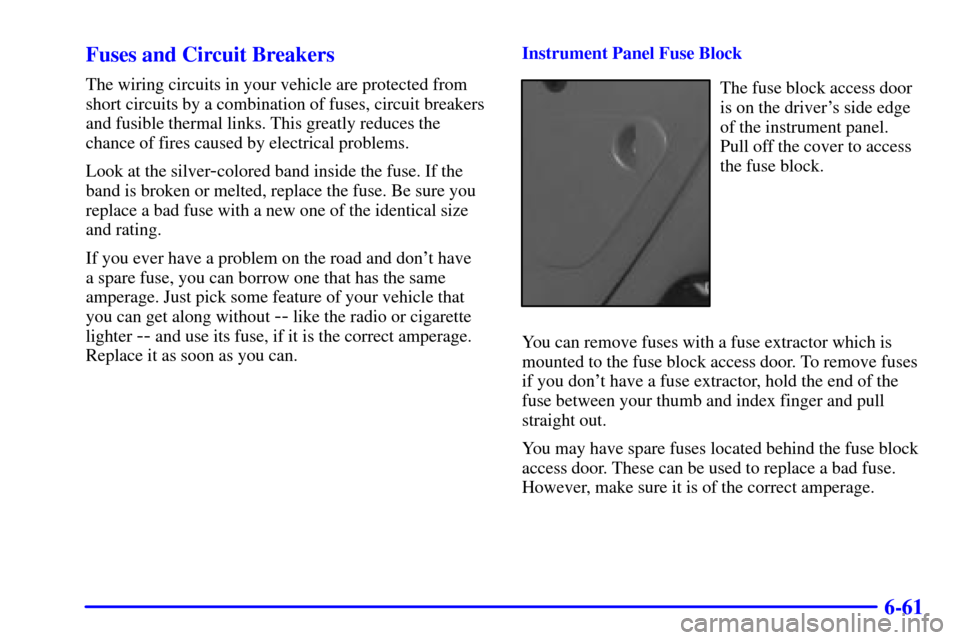
The fuse block access door
is on the driver's side edge
of the instrument panel.
Pull off the cover to access
the fuse block.
You can remove fuses with a fuse extractor which is
mounted to the fuse block access door. To remove fuses
if you don't have a fuse extractor, hold the end of the
fuse between your thumb and index finger and pull
straight out.
You may have spare fuses located behind the fuse block
access door. These can be used to replace a bad fuse.
However, make sure it is of the correct amperage.
Page 258 of 331
6-63
Fuse/Circuit
BreakerUsage
9 License Lamp, Parking Lamps,
Taillamps, Roof Marker
Lamps, Front Sidemarkers,
Door Switch Illumination,
Headlamp Switch Illumination
10 Not Used
11 Wiper Motor, Washer Pump
12 A/C, A/C Blower,
High Blower Relay
13 Power Amp, Cigarette Lighter,
Door Lock Relay
14 Cluster, Comfort Controls,
Instrument Switches, Radio
Illumination, Chime Module
15 DRL Relay
16 Front and Rear Turn Signals,
Back
-Up LampsFuse/Circuit
BreakerUsage
17 Radio (Ignition)
18 4WAL/VCM, Antilock Braking
System, Cruise Control
19 Radio (Battery)
20 PRNDL, Automatic Transmission,
Speedometer, Check Gages
Warning Light
21 Security/Steering
22 Not Used
23 Not Used
24 TP2 Relay (Gasoline Engine)
A Power Door Lock, Keyless
Entry Module
B Power Windows
Page 259 of 331
6-64
Underhood Fuse Block
The underhood fuse block is located in the rear of the
engine compartment near the brake fluid reservoir.
See ªEngine Compartment Overviewº in the Index
for more information on location. Move the retainer
clips for the cover to access the fuse block.
You can remove fuses with a fuse extractor which is
mounted to the interior fuse block. To remove fuses
if you don't have a fuse extractor, hold the end of the
fuse between your thumb and index finger and pull
straight out.
Name Usage
Starter Relay Starter
A/C Relay Air Conditioning
Fuel Pump Relay Fuel Pump
Brake Lamp
RelayBrake Lamp
Blank Not Used
Page 260 of 331
6-65
Name Usage
Horn Relay Horn
ECM
-B Fuel Pump, PCM/VCM
RR DEFOG Not Used
IGN
-E A/C Compressor Relay,
Dual Tanks
Blank Not Used
Blank Not Used
Blank Not Used
HORN Horn, Underhood Lamps
AUX FAN Not Used
ECM
-1 Injectors, PCM/VCM, Fuel
Solenoid (Diesel Engine) Fuel
Control Module (Diesel Engine)
HTD ST
-FR Not Used
Blank Not Used
Blank Not Used
A/C Air Conditioning
PTO PTO RelayName Usage
ENG
-1 Ignition Switch, Exhaust Gas
Recirculation, Canister Purge,
EVRV Idle Coast Solenoid, MAF,
Heated O
2, Fuel Heater (Diesel
Engine), Water Sensor (Diesel
Engine), Boost Solenoid (Diesel
Engine), EPR (Diesel Engine)
HTD ST
-RR Not Used
Blank Not Used
Diode Not Used
LIGHTING Headlamp and Panel Dimmer
Switch, Fog and Courtesy Fuses
BATT Battery, Fuse Block Busbar
IGN A Ignition Switch
IGN B Ignition Switch
ABS Anti
-Lock Brake Module
BLOWER High Blower Relay
STOP/HAZ Stoplamps
HEATED
SEATSNot Used
Page 309 of 331
7-46
Automatic Transmission Check
Check the transmission fluid level; add if needed. See
ªAutomatic Transmission Fluidº in the Index. A fluid
loss may indicate a problem. Check the system and
repair if needed.
Hydraulic Clutch System Check
Check the fluid level in the clutch reservoir. See
ªHydraulic Clutch Fluidº in the Index. A fluid loss in
this system could indicate a problem. Have the system
inspected and repaired at once.
At Least Once a Year
Key Lock Cylinders Service
Lubricate the key lock cylinders with the lubricant
specified in Part D.
Body Lubrication Service
Lubricate all body hood and body door hinges, latches,
locks and folding seat hardware. Part D tells you what to
use. More frequent lubrication may be required when
exposed to a corrosive environment.Starter Switch Check
CAUTION:
When you are doing this check, the vehicle could
move suddenly. If it does, you or others could be
injured. Follow the steps below.
1. Before you start, be sure you have enough room
around the vehicle.
2. Firmly apply both the parking brake and the regular
brake. See ªParking Brakeº in the Index if necessary.
Do not use the accelerator pedal, and be ready to turn
off the engine immediately if it starts.
3. On automatic transmission vehicles, try to start the
engine in each gear. The starter should work only in
PARK (P) or NEUTRAL (N). If the starter works in
any other position, your vehicle needs service.
On manual transmission vehicles, put the shift lever
in NEUTRAL (N), push the clutch down halfway
and try to start the engine. The starter should work
only when the clutch is pushed down all the way to
the floor. If the starter works when the clutch isn't
pushed all the way down, your vehicle needs service.