Page 2 of 331
i
1-1 Seats and Restraint Systems
Page 8 of 331
1-
1-1
Section 1 Seats and Restraint Systems
Here you'll find information about the seats in your vehicle and how to use your safety belts properly. You can also
learn about some things you should not do with safety belts.
1
-2 Seats and Seat Controls
1
-6 Safety Belts: They're for Everyone
1
-10 Here Are Questions Many People Ask
About Safety Belts
-- and the Answers
1
-11 How to Wear Safety Belts Properly
1
-11 Driver Position
1
-19 Safety Belt Use During Pregnancy
1
-20 Right Front Passenger Position1
-20 Center Passenger Position
1
-21 Children
1
-24 Restraint Systems for Children
1
-33 Older Children
1
-36 Safety Belt Extender
1
-36 Checking Your Restraint Systems
1
-36 Replacing Restraint System Parts
After a Crash
Page 9 of 331
1-2
Seats and Seat Controls
This section tells you about the seats -- how to adjust
them, and fold them up and down. It also tells you about
reclining front seatbacks and head restraints.
Manual Front Seat
CAUTION:
You can lose control of the vehicle if you try to
adjust a manual driver's seat while the vehicle is
moving. The sudden movement could startle and
confuse you, or make you push a pedal when you
don't want to. Adjust the driver's seat only when
the vehicle is not moving.
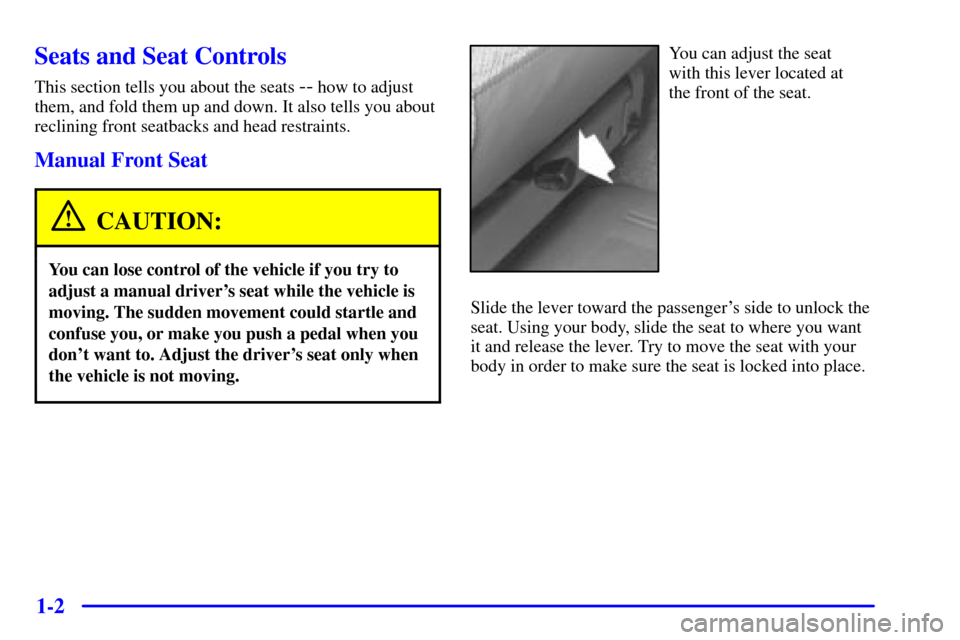
You can adjust the seat
with this lever located at
the front of the seat.
Slide the lever toward the passenger's side to unlock the
seat. Using your body, slide the seat to where you want
it and release the lever. Try to move the seat with your
body in order to make sure the seat is locked into place.
Page 10 of 331
1-3 Power Lumbar Control (If Equipped)
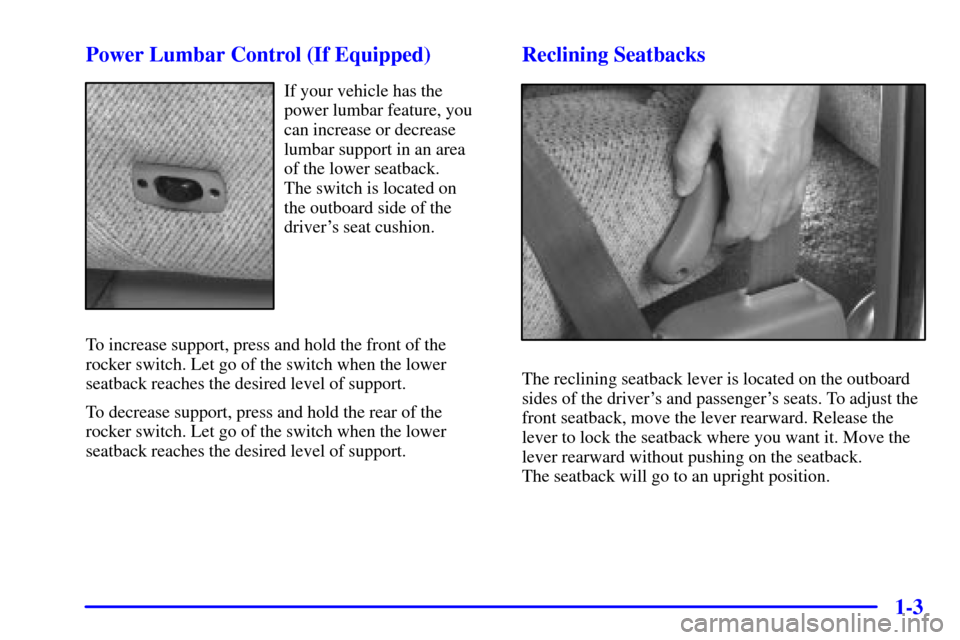
If your vehicle has the
power lumbar feature, you
can increase or decrease
lumbar support in an area
of the lower seatback.
The switch is located on
the outboard side of the
driver's seat cushion.
To increase support, press and hold the front of the
rocker switch. Let go of the switch when the lower
seatback reaches the desired level of support.
To decrease support, press and hold the rear of the
rocker switch. Let go of the switch when the lower
seatback reaches the desired level of support.
Reclining Seatbacks
The reclining seatback lever is located on the outboard
sides of the driver's and passenger's seats. To adjust the
front seatback, move the lever rearward. Release the
lever to lock the seatback where you want it. Move the
lever rearward without pushing on the seatback.
The seatback will go to an upright position.
Page 13 of 331
1-6
Safety Belts: They're for Everyone
This part of the manual tells you how to use safety belts
properly. It also tells you some things you should not do
with safety belts.
CAUTION:
Don't let anyone ride where he or she can't wear
a safety belt properly. If you are in a crash and
you're not wearing a safety belt, your injuries
can be much worse. You can hit things inside the
vehicle or be ejected from it. You can be seriously
injured or killed. In the same crash, you might
not be if you are buckled up. Always fasten your
safety belt, and check that your passengers' belts
are fastened properly too.
CAUTION:
It is extremely dangerous to ride in a cargo area,
inside or outside of a vehicle. In a collision,
people riding in these areas are more likely to be
seriously injured or killed. Do not allow people
to ride in any area of your vehicle that is not
equipped with seats and safety belts. Be sure
everyone in your vehicle is in a seat and using a
safety belt properly.
Your vehicle has a light
that comes on as a reminder
to buckle up. See ªSafety
Belt Reminder Lightº in
the Index.
Page 18 of 331
1-11
Q:If I'm a good driver, and I never drive far from
home, why should I wear safety belts?
A:You may be an excellent driver, but if you're in
an accident
-- even one that isn't your fault -- you
and your passengers can be hurt. Being a good
driver doesn't protect you from things beyond your
control, such as bad drivers.
Most accidents occur within 25 miles (40 km)
of home. And the greatest number of serious
injuries and deaths occur at speeds of less than
40 mph (65 km/h).
Safety belts are for everyone.
How to Wear Safety Belts Properly
Adults
This part is only for people of adult size.
Be aware that there are special things to know about
safety belts and children. And there are different
rules for smaller children and babies. If a child will be
riding in your vehicle, see the part of this manual called
ªChildren.º Follow those rules for everyone's protection.
First, you'll want to know which restraint systems your
vehicle has.
We'll start with the driver position.
Driver Position
This part describes the driver's restraint system.
Lap-Shoulder Belt
The driver has a lap-shoulder belt. Here's how to
wear it properly.
1. Close and lock the door.
2. Adjust the seat so you can sit up straight.
To see how, see ªSeatsº in the Index.
Page 33 of 331
1-26
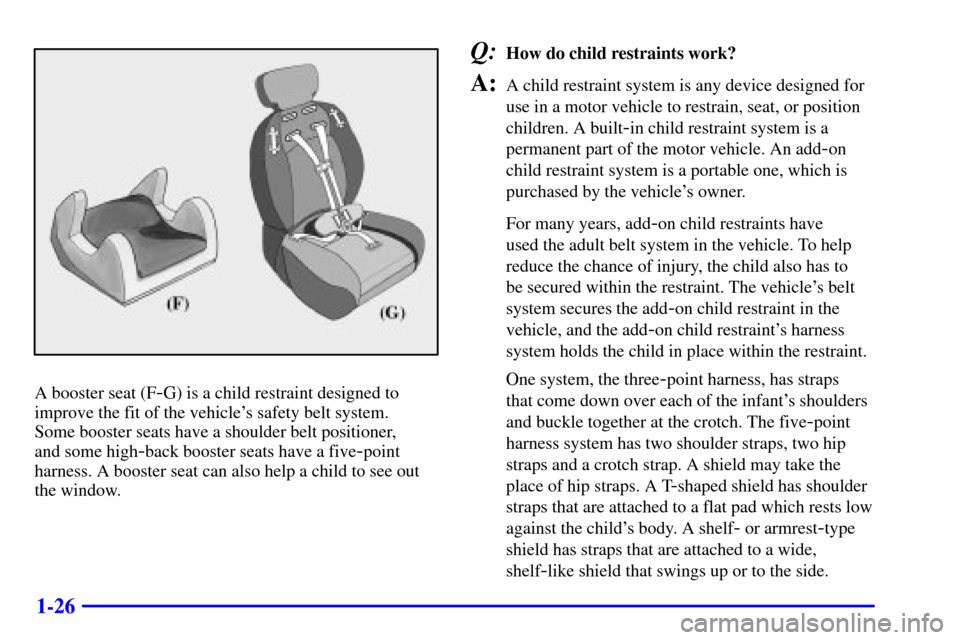
A booster seat (F-G) is a child restraint designed to
improve the fit of the vehicle's safety belt system.
Some booster seats have a shoulder belt positioner,
and some high
-back booster seats have a five-point
harness. A booster seat can also help a child to see out
the window.
Q:How do child restraints work?
A:A child restraint system is any device designed for
use in a motor vehicle to restrain, seat, or position
children. A built
-in child restraint system is a
permanent part of the motor vehicle. An add
-on
child restraint system is a portable one, which is
purchased by the vehicle's owner.
For many years, add
-on child restraints have
used the adult belt system in the vehicle. To help
reduce the chance of injury, the child also has to
be secured within the restraint. The vehicle's belt
system secures the add
-on child restraint in the
vehicle, and the add
-on child restraint's harness
system holds the child in place within the restraint.
One system, the three
-point harness, has straps
that come down over each of the infant's shoulders
and buckle together at the crotch. The five
-point
harness system has two shoulder straps, two hip
straps and a crotch strap. A shield may take the
place of hip straps. A T
-shaped shield has shoulder
straps that are attached to a flat pad which rests low
against the child's body. A shelf
- or armrest-type
shield has straps that are attached to a wide,
shelf
-like shield that swings up or to the side.
Page 40 of 331
1-33
Older Children
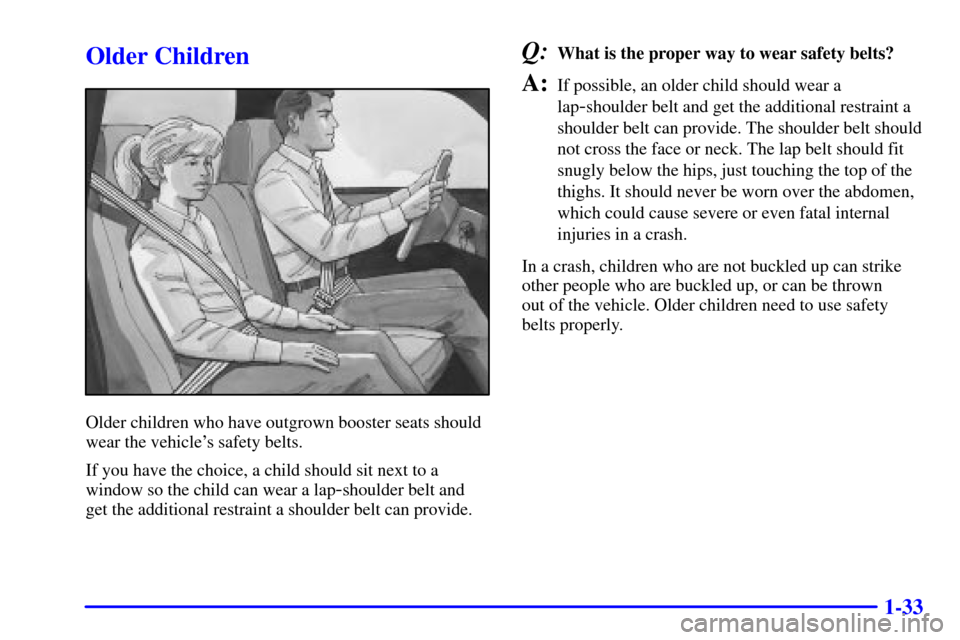
Older children who have outgrown booster seats should
wear the vehicle's safety belts.
If you have the choice, a child should sit next to a
window so the child can wear a lap
-shoulder belt and
get the additional restraint a shoulder belt can provide.
Q:What is the proper way to wear safety belts?
A:If possible, an older child should wear a
lap
-shoulder belt and get the additional restraint a
shoulder belt can provide. The shoulder belt should
not cross the face or neck. The lap belt should fit
snugly below the hips, just touching the top of the
thighs. It should never be worn over the abdomen,
which could cause severe or even fatal internal
injuries in a crash.
In a crash, children who are not buckled up can strike
other people who are buckled up, or can be thrown
out of the vehicle. Older children need to use safety
belts properly.