Page 290 of 488

4-45
In rare cases when it's unavoidable and your vehicle
must be towed with all four wheels on the ground, the
propeller shaft to axle yoke orientation should be
marked and the propeller shaft removed following the
applicable service manual removal/installation
procedure. See ªService and Owner Publicationsº in
the Index.
Dust or dirt can enter the back of the transmission
through the opening created by removing the propeller
shaft if proper protection is not provided. Also, check
the transmission fluid level before driving the vehicle.
When towing your vehicle, turn the ignition to OFF.
To prevent your battery from draining while towing,
remove the RDO BATT and CLSTR fuses from the
instrument panel fuse block. Be sure to replace the fuse
when you reach your destination. See ªFuses and Circuit
Breakersº in the Index.Be sure to use the proper towing equipment designed for
recreational vehicle towing. Follow the instructions for
the towing equipment.
CAUTION:
Shifting a four-wheel-drive vehicle's transfer
case into NEUTRAL can cause your vehicle to
roll even if the transmission is in Park (P), for an
automatic transmission, or if your vehicle is in
gear, for a manual transmission. You or others
could be injured. Make sure the parking brake
is firmly set before you shift the transfer case
to NEUTRAL.
If your vehicle has four-wheel-drive it cannot be dinghy
towed. A four
-wheel-drive vehicle must be towed
by flatbed.
Page 297 of 488

4-52
Tow/Haul Mode (V6 Engine, Automatic
Transmission Equipped Models) (If Equipped)
The tow/haul mode is a feature that assists when pulling
a heavy trailer. The purpose of the tow/haul mode is:
�Reduce the frequency of shifts when pulling a
heavy trailer,
�provide the same shift feel when pulling a heavy
trailer as when the vehicle is unloaded, and
�reduce the need to change throttle position when
pulling a heavy trailer.
This feature is turned on or off by pressing a button
on the floor console or the shift knob. When the feature
is on, a light located on the instrument panel cluster
will illuminate to indicate that the tow/haul mode has
been selected.
See ªTow/Haul Mode Lightº in the Index. The tow/haul
mode is automatically turned off each time the vehicle
is started.The tow/haul mode is most effective when the vehicle
and trailer combined weight is at least 75% of the Gross
Combination Weight Rating (GCWR).
The tow/haul mode for hauling a heavy trailer is most
useful under the following conditions:
�When driving through hilly terrain at speeds below
55 mph (88 km/h),
�when driving in low speed or stop and go traffic
below 55 mph (88 km/h), and
�when driving in parking lots.
Operating in the tow/haul mode when not pulling a
heavy trailer will not cause damage to the vehicle, but
you may experience reduced fuel economy and
undesirable performance from the engine and
transmission. The tow/haul mode should be used only
when pulling a heavy trailer.
Page 305 of 488
4-60 Turn Signals When Towing a Trailer
When you tow a trailer, your vehicle has to have extra
wiring and a heavy
-duty turn signal flasher (included in
the optional trailering package).
The arrows on your instrument panel will flash
whenever you signal a turn or lane change. Properly
hooked up, the trailer lamps will also flash, telling other
drivers you're about to turn, change lanes or stop.
When towing a trailer, the arrows on your instrument
panel will flash for turns even if the bulbs on the trailer
are burned out. Thus, you may think drivers behind you
are seeing your signal when they are not. It's important
to check occasionally to be sure the trailer bulbs are
still working.
Driving On Grades
Reduce speed and shift to a lower gear before you start
down a long or steep downgrade. If you don't shift
down, you might have to use your brakes so much that
they would get hot and no longer work well.If you have an automatic transmission, you can tow in
DRIVE (D). You may want to shift the transmission to
THIRD (3) or, if necessary, a lower gear selection if the
transmission shifts too often (e.g., under heavy loads
and/or hilly conditions). Or, if you have a manual
transmission and you are towing a trailer, it's better not
to use FIFTH (5) gear. Just drive in FOURTH (4) gear
(or, as you need to, a lower gear). See ªTow/Haul
Modeº in the Index.
When towing at high altitude on steep uphill grades,
consider the following: Engine coolant will boil at a
lower temperature than at normal altitudes. If you turn
your engine off immediately after towing at high altitude
on steep uphill grades, your vehicle may show signs
similar to engine overheating. To avoid this, let the
engine run while parked (preferably on level ground)
with the automatic transmission in PARK (P) (or the
manual transmission out of gear and the parking brake
applied) for a few minutes before turning the engine off.
If you do get the overheat warning, see ªEngine
Overheatingº in the Index.
Page 316 of 488
5-8
To disconnect the jumper cables from both vehicles,
do the following:
1. Disconnect the black negative (
-) cable from the
vehicle that had the dead battery.
2. Disconnect the black negative (
-) cable from the
vehicle with the good battery.
3. Disconnect the red positive (+) cable from the
vehicle with the good battery.
4. Disconnect the red positive (+) cable from the
other vehicle.
Towing Your Vehicle
Consult your dealer or a professional towing service if
you need to have your disabled vehicle towed. See
ªRoadside Assistanceº in the Index. If you want to tow
your vehicle behind another vehicle for recreational
purposes (such as behind a motorhome), see
ªRecreational Vehicle Towingº in the Index.
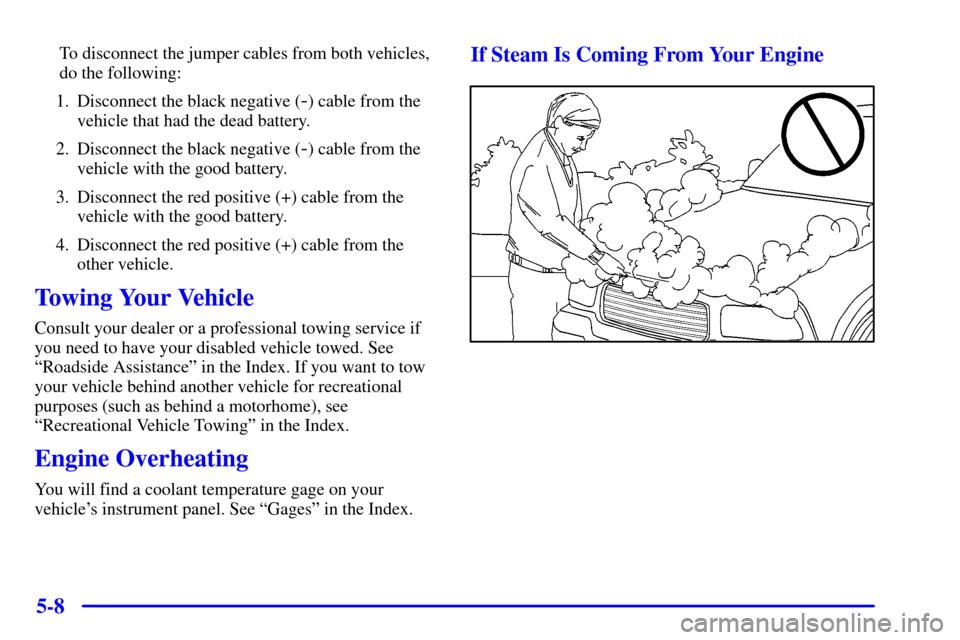
Engine Overheating
You will find a coolant temperature gage on your
vehicle's instrument panel. See ªGagesº in the Index.
If Steam Is Coming From Your Engine
Page 354 of 488
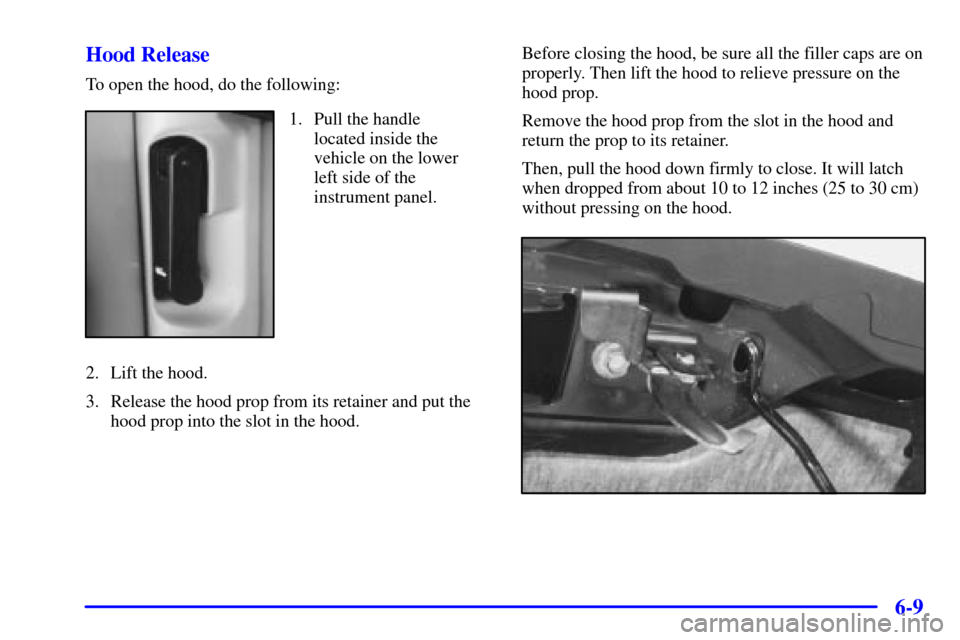
6-9 Hood Release
To open the hood, do the following:
1. Pull the handle
located inside the
vehicle on the lower
left side of the
instrument panel.
2. Lift the hood.
3. Release the hood prop from its retainer and put the
hood prop into the slot in the hood.Before closing the hood, be sure all the filler caps are on
properly. Then lift the hood to relieve pressure on the
hood prop.
Remove the hood prop from the slot in the hood and
return the prop to its retainer.
Then, pull the hood down firmly to close. It will latch
when dropped from about 10 to 12 inches (25 to 30 cm)
without pressing on the hood.
Page 402 of 488
6-57
Stains caused by candy, ice cream, mayonnaise, chili
sauce and unknown stains can be removed as follows:
1. Carefully scrape off excess stain.
2. First, clean with cool water and allow to
dry completely.
3. If a stain remains, follow the cleaner instructions
described earlier.
Cleaning Vinyl
Use warm water and a clean cloth.
�Rub with a clean, damp cloth to remove dirt. You
may have to do it more than once.
�Things like tar, asphalt and shoe polish will stain if
you don't get them off quickly. Use a clean cloth
and a vinyl/leather cleaner. See your dealer for
this product.
Cleaning Leather
Use a soft cloth with lukewarm water and a mild soap or
saddle soap and wipe dry with a soft cloth. Then, let the
leather dry naturally. Do not use heat to dry.
�For stubborn stains, use a leather cleaner. See your
dealer for this product.
�Never use oils, varnishes, solvent
-based or abrasive
cleaners, furniture polish or shoe polish on leather.
�Soiled or stained leather should be cleaned
immediately. If dirt is allowed to work into the
finish, it can harm the leather.
Cleaning the Top of the Instrument Panel
Use only mild soap and water to clean the top surfaces
of the instrument panel. Sprays containing silicones or
waxes may cause annoying reflections in the windshield
and even make it difficult to see through the windshield
under certain conditions.
Page 409 of 488
6-64
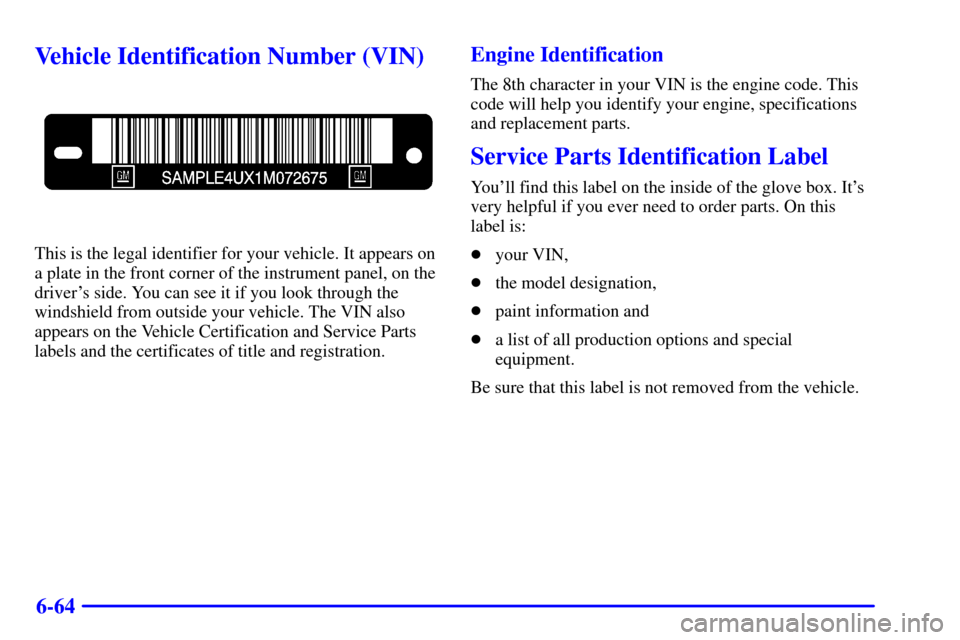
Vehicle Identification Number (VIN)
This is the legal identifier for your vehicle. It appears on
a plate in the front corner of the instrument panel, on the
driver's side. You can see it if you look through the
windshield from outside your vehicle. The VIN also
appears on the Vehicle Certification and Service Parts
labels and the certificates of title and registration.
Engine Identification
The 8th character in your VIN is the engine code. This
code will help you identify your engine, specifications
and replacement parts.
Service Parts Identification Label
You'll find this label on the inside of the glove box. It's
very helpful if you ever need to order parts. On this
label is:
�your VIN,
�the model designation,
�paint information and
�a list of all production options and special
equipment.
Be sure that this label is not removed from the vehicle.
Page 411 of 488
6-66 Fuses and Circuit Breakers
The wiring circuits in your vehicle are protected from
short circuits by a combination of fuses and circuit
breakers. This greatly reduces the chance of fires caused
by electrical problems.
Look at the silver
-colored band inside the fuse. If the
band is broken or melted, replace the fuse. Be sure you
replace a bad fuse with a new one of the identical size
and rating.
If you ever have a problem on the road and don't have a
spare fuse, you can borrow one that has the same
amperage. Just pick some feature of your vehicle that
you can get along without
-- like the radio or cigarette
lighter
-- and use its fuse, if it is the correct amperage.
Replace it as soon as you can.
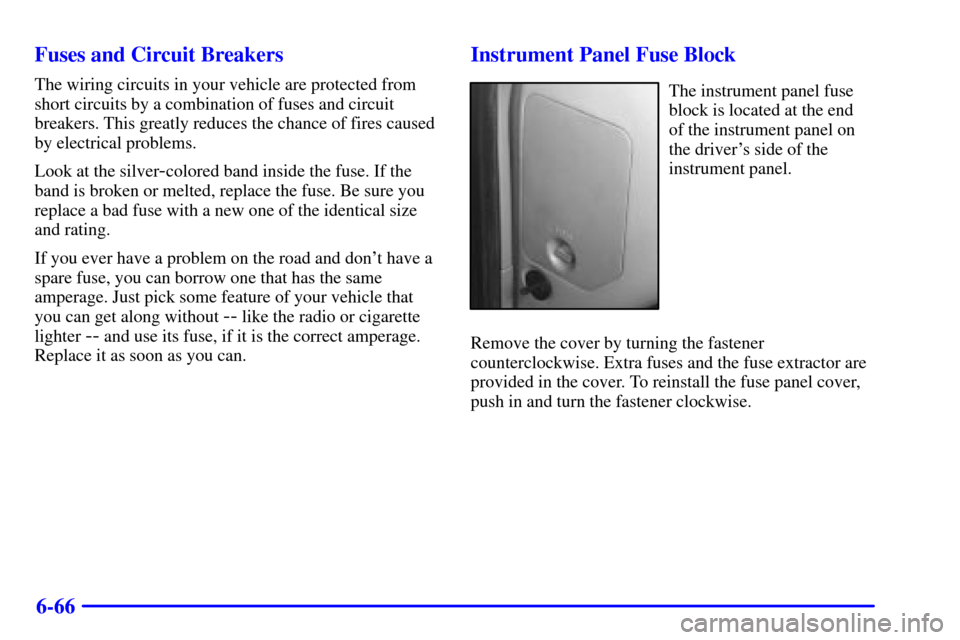
Instrument Panel Fuse Block
The instrument panel fuse
block is located at the end
of the instrument panel on
the driver's side of the
instrument panel.
Remove the cover by turning the fastener
counterclockwise. Extra fuses and the fuse extractor are
provided in the cover. To reinstall the fuse panel cover,
push in and turn the fastener clockwise.