Page 79 of 488
2-13
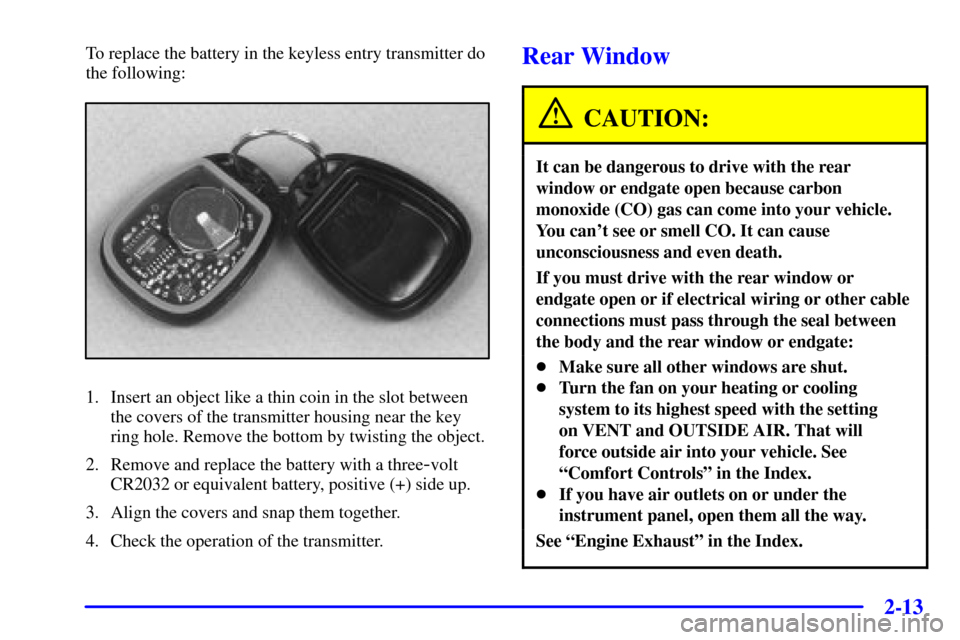
To replace the battery in the keyless entry transmitter do
the following:
1. Insert an object like a thin coin in the slot between
the covers of the transmitter housing near the key
ring hole. Remove the bottom by twisting the object.
2. Remove and replace the battery with a three
-volt
CR2032 or equivalent battery, positive (+) side up.
3. Align the covers and snap them together.
4. Check the operation of the transmitter.
Rear Window
CAUTION:
It can be dangerous to drive with the rear
window or endgate open because carbon
monoxide (CO) gas can come into your vehicle.
You can't see or smell CO. It can cause
unconsciousness and even death.
If you must drive with the rear window or
endgate open or if electrical wiring or other cable
connections must pass through the seal between
the body and the rear window or endgate:
�Make sure all other windows are shut.
�Turn the fan on your heating or cooling
system to its highest speed with the setting
on VENT and OUTSIDE AIR. That will
force outside air into your vehicle. See
ªComfort Controlsº in the Index.
�If you have air outlets on or under the
instrument panel, open them all the way.
See ªEngine Exhaustº in the Index.
Page 81 of 488
2-15
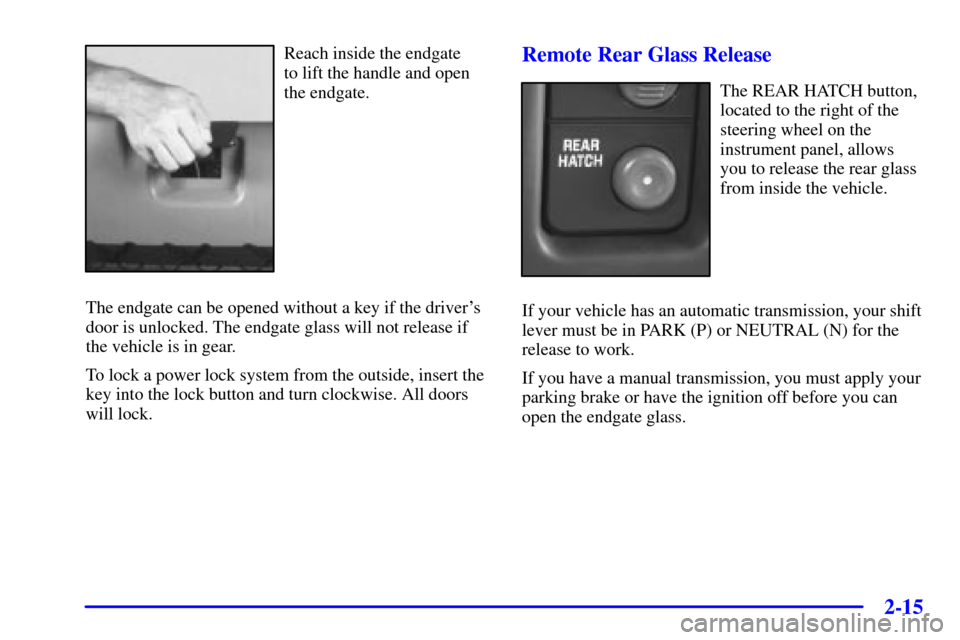
Reach inside the endgate
to lift the handle and open
the endgate.
The endgate can be opened without a key if the driver's
door is unlocked. The endgate glass will not release if
the vehicle is in gear.
To lock a power lock system from the outside, insert the
key into the lock button and turn clockwise. All doors
will lock.Remote Rear Glass Release
The REAR HATCH button,
located to the right of the
steering wheel on the
instrument panel, allows
you to release the rear glass
from inside the vehicle.
If your vehicle has an automatic transmission, your shift
lever must be in PARK (P) or NEUTRAL (N) for the
release to work.
If you have a manual transmission, you must apply your
parking brake or have the ignition off before you can
open the endgate glass.
Page 92 of 488
2-26
Automatic Transmission Operation
Your automatic transmission may have a shift lever
located on the console between the seats or on the
steering column.
There are several different positions for your shift lever.If your vehicle is equipped with a column shift lever, it
features an electronic shift position indicator within the
instrument panel cluster. This display must be powered
anytime the shift lever is capable of being moved out of
PARK (P). This means that if your key is in OFF, but
not locked, there will be a small current drain on your
battery which could discharge your battery over a period
of time. If you need to leave your key in the ignition in
OFF for an extended period, it is recommended that you
disconnect the battery cable from the battery to prevent
discharging your battery.
Page 96 of 488
2-30
Tow/Haul Selector Button (If Equipped)
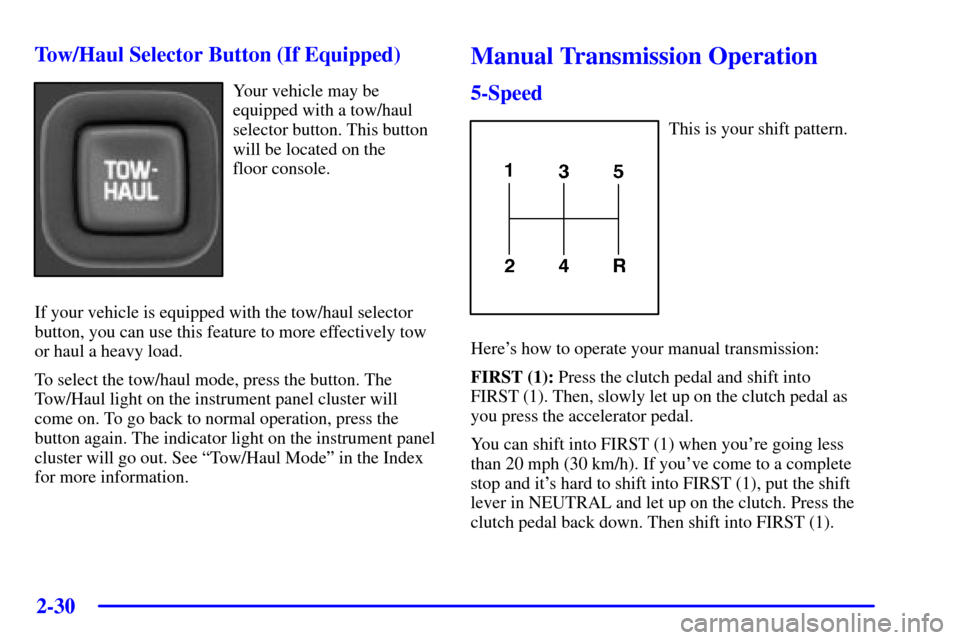
Your vehicle may be
equipped with a tow/haul
selector button. This button
will be located on the
floor console.
If your vehicle is equipped with the tow/haul selector
button, you can use this feature to more effectively tow
or haul a heavy load.
To select the tow/haul mode, press the button. The
Tow/Haul light on the instrument panel cluster will
come on. To go back to normal operation, press the
button again. The indicator light on the instrument panel
cluster will go out. See ªTow/Haul Modeº in the Index
for more information.
Manual Transmission Operation
5-Speed
This is your shift pattern.
Here's how to operate your manual transmission:
FIRST (1): Press the clutch pedal and shift into
FIRST (1). Then, slowly let up on the clutch pedal as
you press the accelerator pedal.
You can shift into FIRST (1) when you're going less
than 20 mph (30 km/h). If you've come to a complete
stop and it's hard to shift into FIRST (1), put the shift
lever in NEUTRAL and let up on the clutch. Press the
clutch pedal back down. Then shift into FIRST (1).
Page 98 of 488
2-32
Shift Light (If Equipped)
If you have a manual
transmission, you have a
SHIFT light on your
instrument panel cluster.
This light will show you when to shift to the next higher
gear for best fuel economy.
When this light comes on, you can shift to the next
higher gear if weather, road and traffic conditions let
you. For the best fuel economy, accelerate slowly and
shift when the light comes on.While you accelerate, it is normal for the light to go on
and off if you quickly change the position of the
accelerator. Ignore the SHIFT light when you downshift.
CAUTION:
If you skip a gear when you downshift, you could
lose control of your vehicle. You could injure
yourself or others. Don't shift down more than
one gear at a time when you downshift.
If your vehicle has four-wheel drive and is equipped
with a manual transmission, disregard the SHIFT light
when the transfer case is in 4LO.
Page 99 of 488
2-33
Four-Wheel Drive (If Equipped)
If your vehicle has four-wheel drive, you can send your
engine's driving power to all four wheels for extra
traction. To get the most satisfaction out of four
-wheel
drive, you must be familiar with its operation. Read the
part that follows before using four
-wheel drive. You
should use two
-wheel high (2HI) for most normal
driving conditions.
NOTICE:
Driving in the 4HI or 4LO positions for a long
time on dry or wet pavement could shorten the
life of your vehicle's drivetrain.
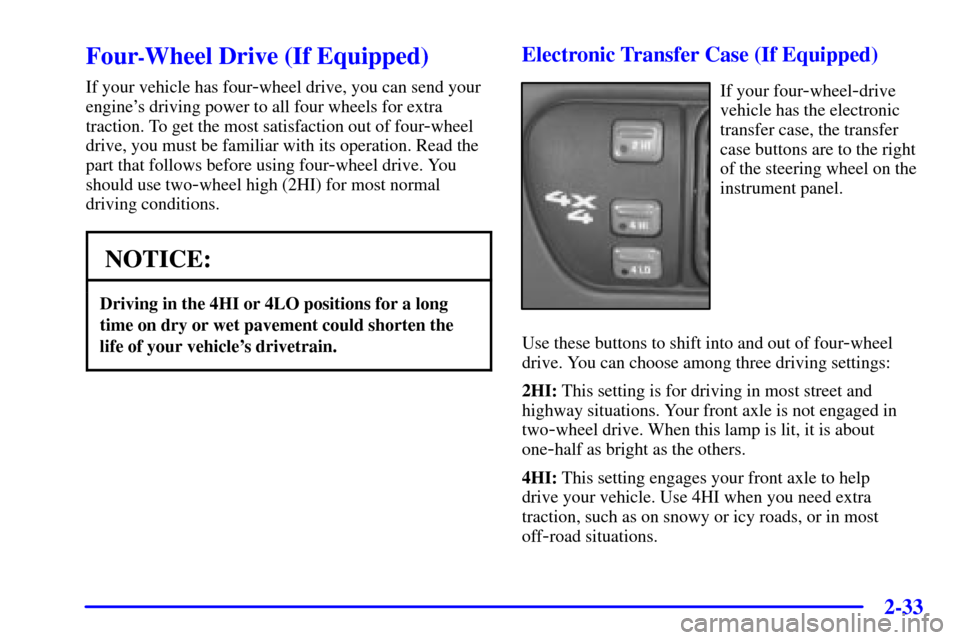
Electronic Transfer Case (If Equipped)
If your four-wheel-drive
vehicle has the electronic
transfer case, the transfer
case buttons are to the right
of the steering wheel on the
instrument panel.
Use these buttons to shift into and out of four
-wheel
drive. You can choose among three driving settings:
2HI: This setting is for driving in most street and
highway situations. Your front axle is not engaged in
two
-wheel drive. When this lamp is lit, it is about
one
-half as bright as the others.
4HI: This setting engages your front axle to help
drive your vehicle. Use 4HI when you need extra
traction, such as on snowy or icy roads, or in most
off
-road situations.
Page 102 of 488
2-36
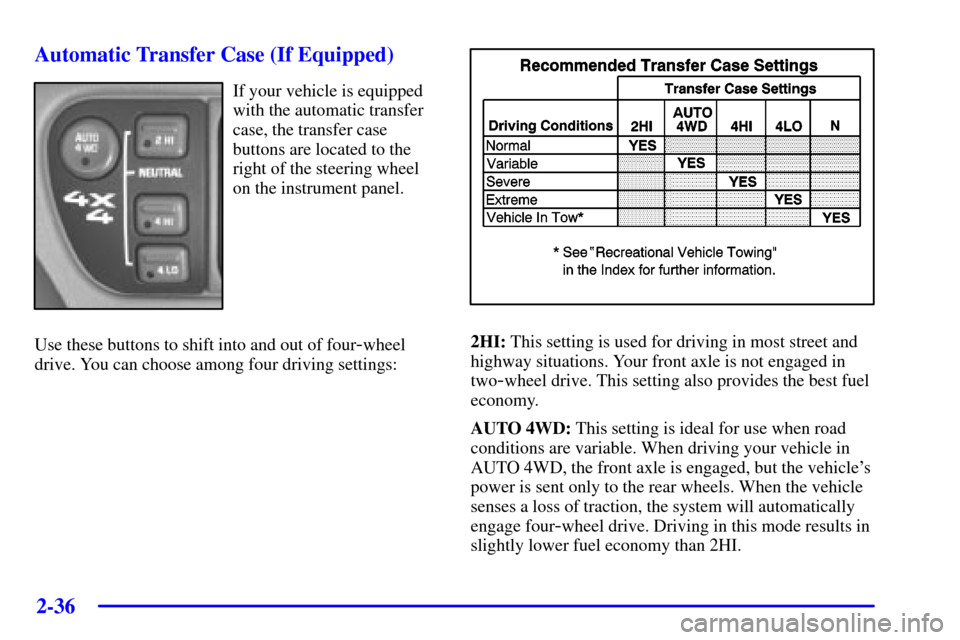
Automatic Transfer Case (If Equipped)
If your vehicle is equipped
with the automatic transfer
case, the transfer case
buttons are located to the
right of the steering wheel
on the instrument panel.
Use these buttons to shift into and out of four
-wheel
drive. You can choose among four driving settings:2HI: This setting is used for driving in most street and
highway situations. Your front axle is not engaged in
two
-wheel drive. This setting also provides the best fuel
economy.
AUTO 4WD: This setting is ideal for use when road
conditions are variable. When driving your vehicle in
AUTO 4WD, the front axle is engaged, but the vehicle's
power is sent only to the rear wheels. When the vehicle
senses a loss of traction, the system will automatically
engage four
-wheel drive. Driving in this mode results in
slightly lower fuel economy than 2HI.
Page 106 of 488
2-40
Parking Brake
The parking brake is located near the bottom of the
instrument panel on the driver's side of the vehicle.
To set the parking brake, hold the regular brake pedal
down with your right foot. Push down the parking brake
pedal with your left foot. If the ignition is on, the brake
system warning light will come on.
NOTICE:
Driving with the parking brake on can cause
your rear brakes to overheat. You may have to
replace them, and you could also damage other
parts of your vehicle.
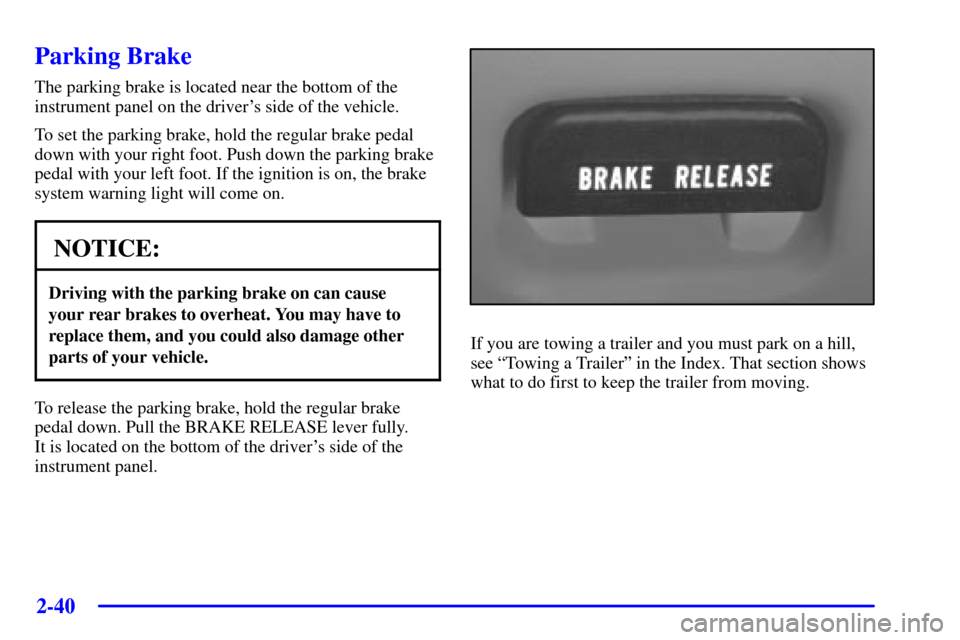
To release the parking brake, hold the regular brake
pedal down. Pull the BRAKE RELEASE lever fully.
It is located on the bottom of the driver's side of the
instrument panel.
If you are towing a trailer and you must park on a hill,
see ªTowing a Trailerº in the Index. That section shows
what to do first to keep the trailer from moving.