Page 120 of 417

2-41 Fog Lamps
Use the fog lamps for better vision in foggy or misty
conditions. Your parking lamps and/or low
-beam
headlamps must be on for your fog lamps to work.
The fog lamp button is
located on the left side
of the instrument panel.
Press the button to turn the fog lamps on while the
headlamps are on. Press the button again to turn
them off.
Remember, fog lamps alone will not give off as much
light as your headlamps. Never use your fog lamps in
the dark without turning on your headlamps.The fog lamps will go off whenever your high
-beam
headlamps come on. When the high beams go off,
the fog lamps will come on again.
The fog lamps will be cancelled after the ignition is
turned off. If you still want to use the fog lamps after
you restart the vehicle, you will need to press the fog
lamp button again.
Interior Lamps
Instrument Panel Intensity Control
The instrument panel intensity control is located to the
right of the headlamp/parking lamp knob.
Turn the thumbwheel up to adjust the instrument panel
lights. To turn on the dome lamps (with the vehicle
doors closed) turn the thumbwheel all the way up.
Exit Lighting
With exit lighting, the interior lamps will come on when
you remove the key from the ignition. The lights will
not come on if the DOME OVERRIDE button is
pressed in.
Page 122 of 417

2-43 Dome Lamps
The dome lamps will come on when you open a door
and will slowly dim to off when all doors are closed.
You can also turn the dome lamps on by turning the
thumbwheel, located next to the headlamp and parking
lamp knob, all the way up. In this position, the dome
lamps will remain on whether a door is opened
or closed.
You can use the DOME OVERRIDE button, located
below the headlamp/parking lamp knob, to set the dome
lamps to come on automatically when a door is opened,
or remain off. To turn the lamps off, press the button
into the ªinº position. With the button in this position,
the dome lamps will remain off when the doors are
open. To return the lamps to automatic operation,
press the button again and return it to the ªoutº position.
With the button in this position, the dome lamps will
come on when you open a door.
Battery Run-Down Protection
This feature shuts off the dome, reading, glove box
and underhood lamps if they are left on for more than
20 minutes when the ignition is off. This will keep your
battery from running down.
Mirrors
Electrochromic Inside Rearview Mirror
with Compass and Temperature Display
When on, an electrochromic mirror automatically dims
to the proper level to minimize glare from lights behind
you after dark.
Page 124 of 417

2-45
Compass Operation
With the ignition on, the compass will show
two character boxes. The mirror will display the
compass heading.
When cleaning the mirror, use a paper towel or similar
material dampened with glass cleaner. Do not spray
glass cleaner directly on the mirror as that may cause
the liquid cleaner to enter the mirror housing.
Compass Calibration
The compass may need calibration if one of the
following occurs:
�After five seconds, the display does not show a
compass heading (ªNº for North, for example),
there may be a strong magnetic field interfering with
the compass. Such interference may be caused by a
magnetic antenna mount, magnetic note pad holder
or a similar magnetic item.
�The compass does not display the correct heading
and the compass zone variance is set correctly.In order to calibrate, the letters ªCALº must be
displayed in the mirror compass windows. If CAL is not
displayed, push in the COMP button for approximately
eight seconds or until the letter CAL is displayed.
The compass can be calibrated in one of two ways:
�Drive the vehicle in circles at five mph (8 km/h) or
less until the display reads a direction, or
�drive the vehicle on your everyday routine and after
several turns the compass will become calibrated and
will display a direction.
Compass Variance
The mirror is set in zone eight upon leaving the factory.
It will be necessary to adjust the compass to compensate
for compass variance if you live outside zone eight.
Under certain circumstances, as during a long distance
cross
-country trip, it will be necessary to adjust for
compass variance. Compass variance is the difference
between earth's magnetic north and true geographic
north. If not adjusted to account for compass variance,
your compass could give false readings.
Page 140 of 417

2-61
�subject to limitations caused by atmospheric
conditions, such as severe weather or topographical
conditions, such as mountainous terrain;
�subject to cellular carrier equipment limitations.
Global positioning capabilities used to deliver
OnStar service will not be available if satellite signals
are obstructed.
OnStar will not function if the vehicle's battery is
discharged or disconnected. It may also be inoperative
if the vehicle is in an accident and the OnStar or vehicle
electrical system components are damaged.
Safety and security services are provided by existing
governmental emergency service providers. OnStar
will use reasonable efforts to contact the appropriate
emergency service provider and request assistance but
cannot promise that they will respond to the call in a
timely manner or at all.Sunroof (If Equipped)
Your vehicle may be equipped with a power sliding
sunroof. To open or close your sunroof, the ignition
or RAP needs to be active. See ªRetained Accessory
Powerº in the Index.
Press and release the rear side of the button located in
the front overhead console to express
-open the glass
panel and sunshade. To close the glass panel, press and
hold the front of the button. The glass will not be fully
seated unless the button is held until the glass stops
moving. With the sunroof closed, press the forward side
of the button to open the sunroof to the vent position.
Page 148 of 417

2-69 Speedometer and Odometer
Your speedometer lets you see your speed in both
miles per hour (mph) and kilometers per hour (km/h).
Your odometer shows how far your vehicle has been
driven, in either miles (used in the United States) or
kilometers (used in Canada).
Trip Odometer
The trip odometer can tell you how far your vehicle has
been driven since you last set the trip odometer to zero.
Press the reset button to toggle between the trip
odometer and the regular odometer. Holding the reset
button for two seconds while the trip odometer is
displayed will reset it.
To display the odometer reading with the ignition off,
press the reset button.
Engine Hour Meter Display
The odometer can also display the number of hours
the engine has run. To display the hour meter, turn the
ignition off, press and hold the reset button for at least
four seconds. The hour meter will be displayed for up
to 30 seconds, or until the ignition is turned on.
Tachometer
Your tachometer displays the engine speed in
revolutions per minute (rpm).
Warning Lights, Gages
and Indicators
Warning lights and gages can signal that something is
wrong before it becomes serious enough to cause an
expensive repair or replacement. Paying attention to
your warning lights and gages could also save you or
others from injury.
Warning lights come on when there may be or is a
problem with one of your vehicle's functions. As you
will see in the details on the next few pages, some
warning lights come on briefly when you start the
engine just to let you know they're working. If you
are familiar with this section, you should not be
alarmed when this happens.
Gages can indicate when there may be or is a problem
with one of your vehicle's functions. Often gages and
warning lights work together to let you know when
there's a problem with your vehicle.
Page 150 of 417
2-71
CAUTION:
If the air bag readiness light stays on after you
start your vehicle, it means the air bag system
may not be working properly. The air bags in
your vehicle may not inflate in a crash, or they
could even inflate without a crash. To help avoid
injury to yourself or others, have your vehicle
serviced right away if the air bag readiness light
stays on after you start your vehicle.
The air bag readiness light should flash for a few seconds
when you turn the ignition key to RUN. If the light
doesn't come on then, have it fixed so it will be ready
to warn you if there is a problem.
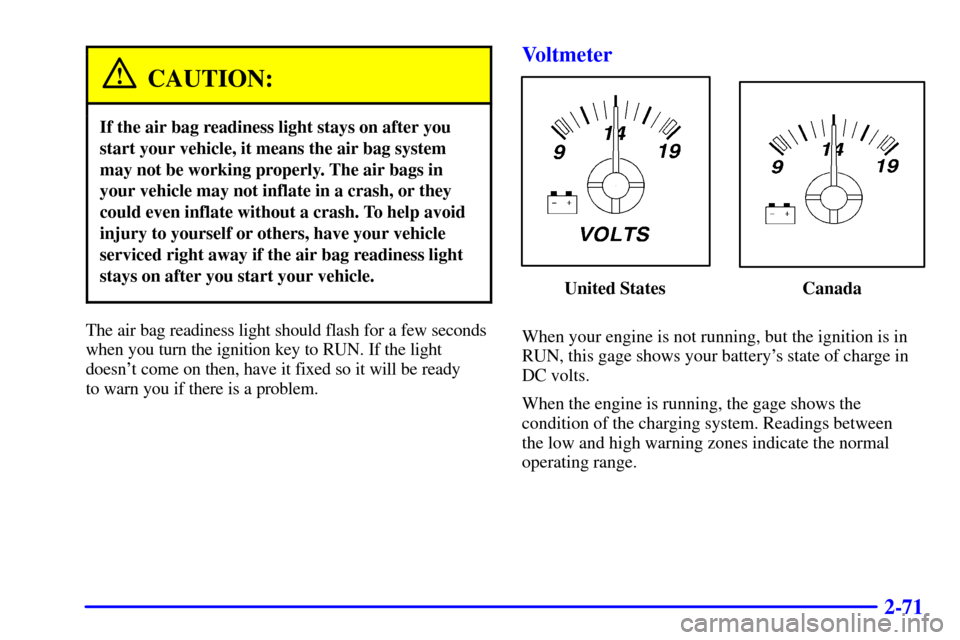
Voltmeter
United States Canada
When your engine is not running, but the ignition is in
RUN, this gage shows your battery's state of charge in
DC volts.
When the engine is running, the gage shows the
condition of the charging system. Readings between
the low and high warning zones indicate the normal
operating range.
Page 151 of 417

2-72
Readings in the low warning zone may occur when
a large number of electrical accessories are operating
in the vehicle and the engine is left at an idle for an
extended period. This condition is normal since the
charging system is not able to provide full power
at engine idle. As engine speeds are increased, this
condition should correct itself as higher engine speeds
allow the charging system to create maximum power.
You can only drive for a short time with the reading
in either warning zone. If you must drive, turn off all
unnecessary accessories.
Readings in either warning zone indicate a possible
problem in the electrical system. Have the vehicle
serviced as soon as possible.
Brake System Warning Light
With the ignition on, the brake system warning light
will flash when you set the parking brake. The light
will flash if the parking brake doesn't release fully.
If you try to drive with the parking brake engaged,
a chime will sound when the vehicle speed is greater
than 3 mph (5 km/h).Your vehicle's hydraulic brake system is divided into
two parts. If one part isn't working, the other part can
still work and stop you. For good braking, though,
you need both parts working well.
If the warning light comes on, there could be a brake
problem. Have your brake system inspected right away.
United States Canada
This light should come on briefly when you turn the
ignition key to RUN. If it doesn't come on then, have it
fixed so it will be ready to warn you if there's a problem.
Page 152 of 417

2-73
If the light comes on while you are driving, pull off the
road and stop carefully. You may notice that the pedal is
harder to push. Or, the pedal may go closer to the floor.
It may take longer to stop. If the light is still on, have the
vehicle towed for service. See ªTowing Your Vehicleº in
the Index.
CAUTION:
Your brake system may not be working properly
if the brake system warning light is on. Driving
with the brake system warning light on can lead
to an accident. If the light is still on after you've
pulled off the road and stopped carefully, have
the vehicle towed for service.
Anti-Lock Brake System Warning Light
With the anti-lock brake
system, this light will come
on when you start your
engine and may stay
on for several seconds.
That's normal.
If the light stays on, or comes on when you're driving,
your vehicle needs service. If the regular brake system
warning light isn't on, you still have brakes, but you
don't have anti
-lock brakes. If the regular brake system
warning light is also on, you don't have anti
-lock brakes
and there's a problem with your regular brakes. See
ªBrake System Warning Lightº earlier in this section.
The anti
-lock brake system warning light should come
on briefly when you turn the ignition key to RUN.
If the light doesn't come on then, have it fixed so
it will be ready to warn you if there is a problem.