2002 BMW Z8 flat tire
[x] Cancel search: flat tirePage 103 of 174

103n
IndexDataTechnologyRepairsCar careControlsOverview
Special features of winter tires Snow chains
*
Choosing the right tireFor winter road driving, BMW recom-
mends winter tires (M+S radial belt
tires). Although all-season M+S tires
provide better winter traction than stan-
dard summer tires with H, V, W, Y and
ZR speed ratings, they generally fail to
provide the same levels of performance
as standard snow tires in winter driving.
In the interests of safe tracking and
steering response, install radial tires
made by the same manufacturer and
with the same tread configuration on all
four wheels if you elect to mount winter
tires.
When selecting winter tires,
remember that you should never
mount anything other than safety tires,
as your vehicle is not equipped with a
spare tire.
For further information, refer to
page 137.<
Do not exceed specified
maximum speeds
Never exceed the maximum speed
for which winter tires are rated.
Unprofessional attempts by laymen to
service tires can lead to damage and
accidents.
Have this work performed by skilled
professionals only. Your BMW center
will be glad to assist you with both their
expertise and the proper equipment for
your vehicle.<
Tire condition, tire pressureOnce the tread depth on winter tires is
less than 0.16 in (4 mm), they are no
longer suitable for winter road driving,
and in the interest of safety should be
replaced.
Comply with the specified tire inflation
pressures Ð and be sure to have the
wheel and tire assemblies balanced
every time you change the tires.
The use of narrow-link BMW snow
chains is permissible in pairs only on
the rear wheels with winter tires with
tire size 245/45 R 18 96 H. Comply with
all manufacturer's safety precautions
when mounting the chains. Do not
exceed a speed of 30 mph (50 km/h)
while driving with mounted snow
chains.
Do not activate the Flat Tire
Monitor when driving with snow
chains mounted. Malfunction warnings
and undetected losses in pressure are
a possibility when driving with snow
chains.
For further information, refer to
page 67.<
Page 104 of 174

104n
Approved wheel and tire specifications Snow chains
*
It is impossible to install snow chains
on 275/40 R 18 99 W summer tires.
Do not activate the Flat Tire
Monitor when driving with snow
chains mounted. Malfunction warnings
and undetected losses in pressure are
a possibility when driving with snow
chains.
For further information, refer to
page 67.< BMW tests certain tire brands for each tire size, classifies them as road-safe and
approves them. Your BMW center can provide further information.
Observe any regulations applicable in the country of use, e. g. requiring entry in
the vehicle documents.
Tire specifications Light-alloy wheel
BMW Z8
Summer tires
Front: 245/45 R 18 96 W 8Jx18EH2
Rear: 275/40 R 18 99 W 9Jx18EH2
Winter tires
245/45 R 18 96 H M+S 8Jx18EH2
The use of rims and wheel bolts
that do not meet the specifica-
tions of the original factory-installed
equipment will affect the safe operation
of your vehicle and may cause an acci-
dent and personal injury.
Never mix tires of different design, such
as steel-belted radials with radial bias-
belted or bias-ply tires, etc. Mixing tire
types will adversely affect roadholding
and can lead to loss of vehicle
control.<
Page 124 of 174

124n
Vehicle storage
If the vehicle is to be stored for
more than three months, ensure
that the following service operations
are carried out first.<
Preparations for storageHave your BMW center perform the
following procedures:
1. Clean and apply a rust proofing
agent or other treatment to the
engine, engine compartment, under-
carriage, axles and major compo-
nents in accordance with approved
repair procedures. Wash the vehicle,
clean the interior and treat painted
and chromed parts. Clean the
weather-stripping around the hood,
luggage compartment and doors
2. Change engine oil and oil filter at
operating temperature. As an addi-
tional corrosion protection measure,
an anticorrosive agent can be added
to the engine in accordance with the
manufacturer's instructions
3. Check the coolant level and concen-
tration and top off if necessary
4. Check the fluid level of the wind-
shield washer fluid reservoir; top off
if necessary
5. Fill the fuel tank completely to
prevent the formation of condensa-
tion
6. Increase the tire inflation pressure to
51 psi (350 kPa).Before parking the vehicle1. Dry the parking brake and footbrake
by brake applications to prevent the
brake discs and drums from
corroding
2. Park the vehicle in a covered, dry,
and well-ventilated area. Place the
transmission in first gear or, if neces-
sary, chock the wheels to prevent the
vehicle from rolling. Do not engage
the parking brake
3. Remove the battery, charge it
completely and store it in a cool (but
frost-free) room
4. Remove the hardtop and store it
separately, refer to page 96
5. Close the convertible top.
During storageRecharge a battery that has been taken
out of the vehicle every six months. If it
is not recharged, it will not be service-
able. Every time the battery is
discharged, especially over extended
periods, its service life is reduced.Removing the vehicle from
storageRecharge the battery if the "Magic Eye"
turns black, refer to page 138.
Then have Inspection I performed by
your BMW center, including a brake
fluid replacement, if necessary. Refer to
the Service and Warranty Information
Booklet (US models) or the Warranty
and Service Guide Booklet (Canadian
models).
Page 137 of 174

137n
IndexDataTechnologyRepairsCar careControlsOverview
Changing a wheel Safety tiresYour BMW Z8 roadster is equipped
with safety tires.
The safety tires are made of self-
supporting tires mounted on specially-
designed wheel rims. Special reinforce-
ment elements support the sidewalls in
the event of pressure loss. Although tire
performance is then restricted, the
vehicle can still be driven on the
deflated tire for a limited distance. Your
vehicle is equipped with a tire pressure
monitor that signals you in case of a flat
tire.
In the event of a flat tireThe red indicator lamp on the instru-
ment panel will flash in the event of a
flat tire. In addition, a gong will sound.
Refer to page 67.
Carefully reduce speed to less than
50 mph (80 km/h), avoiding any hard
braking or steering maneuvers while
doing so.
You will still be able to drive approx.
155 miles (250 km) on your safety tire,
until you can get to a safe place to park,
a gas station, or to your nearest BMW
center. Under minimum vehicle loading,
it could conceivably last more than
155 miles (250 km).
If you cannot immediately determine
which tire is defective just by looking
at it, then check the tire pressure in all
four tires.Have your BMW center replace
your tires. For safety reasons, do
not have safety tires repaired. Your
BMW center has been trained to work
with the safety tires and is equipped
with the necessary special tools.<
If necessary, please have your
BMW center switch the tires on
your vehicle from summer to winter
tires, or the reverse.<
Page 150 of 174

150n
Deceleration sensors continuously
monitor the acceleration forces acting
upon the vehicle. If there is a decelera-
tion because of a collision, where the
protection normally afforded by the
safety belts is no longer sufficient by
itself, then the gas generators for the
front airbag will be simultaneously
ignited on both the driver and
passenger sides. The front airbag on
the passenger side, however, will be
deployed only if a second sensor has
detected that the passenger is occu-
pied.
In the event of a side collision, only the
side airbags will be triggered if neces-
sary. And only that airbag for that side
of the vehicle where the collision
occurred will be triggered.
390de012
The airbags located under the marked
covers inflate and unfold in a matter of
milliseconds. In this process, they tear
through the designed separation points
of the covers or press them out.
Because the inflation process must be
virtually instantaneous, it is necessarily
accompanied by a certain amount of
ignition and inflation noise. The gas
required to inflate the airbags is not
dangerous, and the associated smoke
then dissipates.
The entire process is completed within
fractions of a second.
Airbags
Page 168 of 174

Everything from A to ZFFailure to start146t
Fault in ABS89
Filler cap cover25
Filling capacities161
Filling the washer
reservoir161
First-aid kit24
Fittings, tow-starting and
towing146t
Flashlight79
Flat tire137t
Flat Tire Monitor67
Fog lamp, bulb
replacement133t
"Follow me home"
lamps49, 69
Footbrake90
Footwell lamps71
bulb replacement134t
Front seat adjustment45
Frost protection,
radiator113
Fuel26
gauge62
indicator62
quality26
Fuel filler door
manual release after
electrical fault142tFuel injection system158
Fuel tank capacity161
Fuses140
GGasoline26
quality26
Glove compartment78
bulb replacement135t
Gross vehicle weight160HHand lamp79
Handbrake57
Hands-free system81
Hardtop96
Hazard warning
flashers24t
Hazard warning
triangle24t
Head restraint46
Headlamp covers,
care117t, 131t
Headlamp flasher70
Headlamp washer
system60, 110, 161
Headlamps70
Headlight glare in rearview
mirror48
Heated mirrors48
Heated seats77
Heating and ventilation72Heating, rapid77
Heavy loads83
Height159
High beams23, 58, 70
Holder for beverage
cans80
Hood release105t
Horn17
Hydraulic system88, 92
IIdentification, tires102
Ignition keys30
Ignition lock55
Imprint4
Incoming-air mode74
Indicator lamps20
Inflation pressure26t, 99
monitoring67
INSPECTION63
Instrument cluster18
Instrument panel lighting69
Instruments18
Interaxle tire rotation101
Interface socket for Onboard
Diagnostic126
Interference
cellular phone94
radio reception95
Interior lamps34, 71
bulb replacement135t
remote control34Interior motion sensor39
deactivating34
Interior rearview mirror with
automatic
dimmer48, 154
Intermittent mode of wiper
system59
JJump-starting145KKey Memory49
Key with remote control30
Keys30LLamps and bulbs131t
Leather care122
Length159
License plate lamp, bulb
replacement133t
Light switch69
Light-alloy wheels104
Lighter82
LIGHTS ON warning69
Loading83
Lock deicer92
Louvers72
Low beam headlamps69
Page 170 of 174

Everything from A to ZRestraint systems53
Return used
batteries140t
Reverse17, 58
Roof load capacity160
Rotating the tires101
Rubber parts93SSafety belt tensioners153
Safety belts50
Safety buttons36
Safety tires99
Seat adjustment45
Seat heating77
Securing cargo83
Self-defrosting mirrors48
Service Interval
Display63, 116
Shelves78, 79
Should131t
Side airbags51
Side marker lamps69
bulb
replacment131t, 132t
Skid control94
Slippery roads93
Snow chains93, 103, 104
Socket82
for flashlights82
for power supplies82
for vacuum cleaners82Sound system, refer to the
separate Owner's Manual
Spare key30
Spark plugs162
Speaker81
Specified engine oil112
Speedometer18
Starting56
problems87t, 145
Steel wheels104
Steering94
Steering wheel lock55
Stopping the vehicle57
Storage areas78, 79
Storing your vehicle124
Stroke158
Summer tires102
Switching off the engine57
Switching off the interior
motion sensor39t
Switching off the tilt alarm
sensor39t
Symbols4, 138
TTachometer62
Tail lamps132
bulb replacment132t
Tank capacity161
Technical data158
Technical
modifications6, 125Telephone81
Temperature display
outside temperature64
Temperature gauge
engine coolant63
Temperature
selection74, 75
Tilt alarm34
Tilt alarm sensor39
Tire codes102
Tire damage99t
Tire inflation
pressure26, 99
Tire pressure monitor67
Tire replacement100, 101
Tire rotation101
Tire specifications104
Tire tread99
Tools130t
Torque158
Tow fittings146t
Towing the vehicle146t
Tow-starting146t
Track159
Traction Control System
refer to DSC65
Transmission58
Transmitter key30
Tread depth, tires99
Trip odometer62
Trunk lid, refer to luggage
compartment lid37Turn signal indicator23, 59
Turning circle159
UUniform Tire Quality
Grading101
Unusually high steering
effort20, 94
Use antifreeze114t
radiator114t
Used batteries,
disposal140tVVacuum cleaner82
Vehicle battery138, 162
Vehicle care
exterior119
interior121
Vehicle equipment
options and accessories5
Vehicle Identification
Number (VIN)115
Vehicle immobilizer31
Vehicle painting119
Vehicle storage124
Vehicle weight160
Vehicle, starting56
Vehicle, stopping57
Ventilation72
draft-free75
Vinyl upholstery, care121
Page 172 of 174
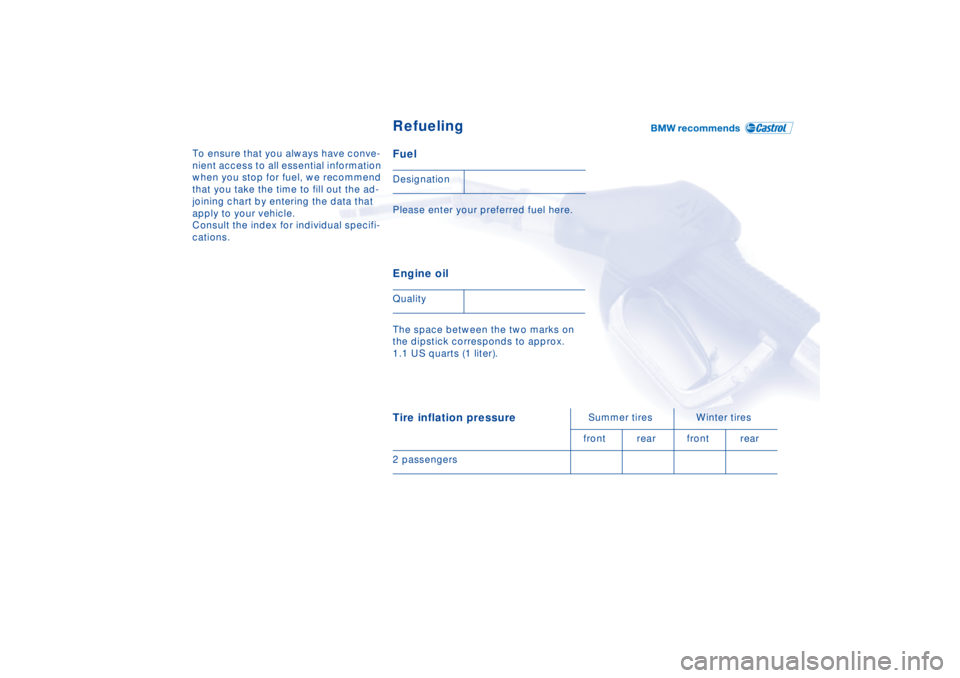
To ensure that you always have conve-
nient access to all essential information
when you stop for fuel, we recommend
that you take the time to fill out the ad-
joining chart by entering the data that
apply to your vehicle.
Consult the index for individual specifi-
cations.
Fuel Please enter your preferred fuel here. Engine oil The space between the two marks on
the dipstick corresponds to approx.
1.1 US quarts (1 liter). Designation
QualityTire inflation pressure
Summer tires Winter tires
front rear front rear
2 passengers
Refueling