2002 BMW Z8 flat tire
[x] Cancel search: flat tirePage 67 of 174
67n
IndexDataTechnologyRepairsCar careControlsOverview
Dynamic Performance Flat Tire MonitorSport mode recognitionActivating:
In ignition position 2, press the button.
The indicator lamp will come on.
Deactivating:
Whenever the indicator lamp is on, it
will go out if you press the button again.
The conceptThe Flat Tire Monitor keeps track of the
inflation pressures in all four wheels as
you drive. The system provides an alert
whenever the inflation pressure has
dropped significantly in one of the tires.
To initialize the Flat Tire Monitor with
the correct inflation pressures, start by
ensuring that all of the vehicle's tires
are inflated to the pressures specified
in the inflation pressure table on
page 27. Now you can activate the
system.
The indicator lamp within the
instrument cluster flashes to
alert you to substantial pres-
sure loss in any of the tires.
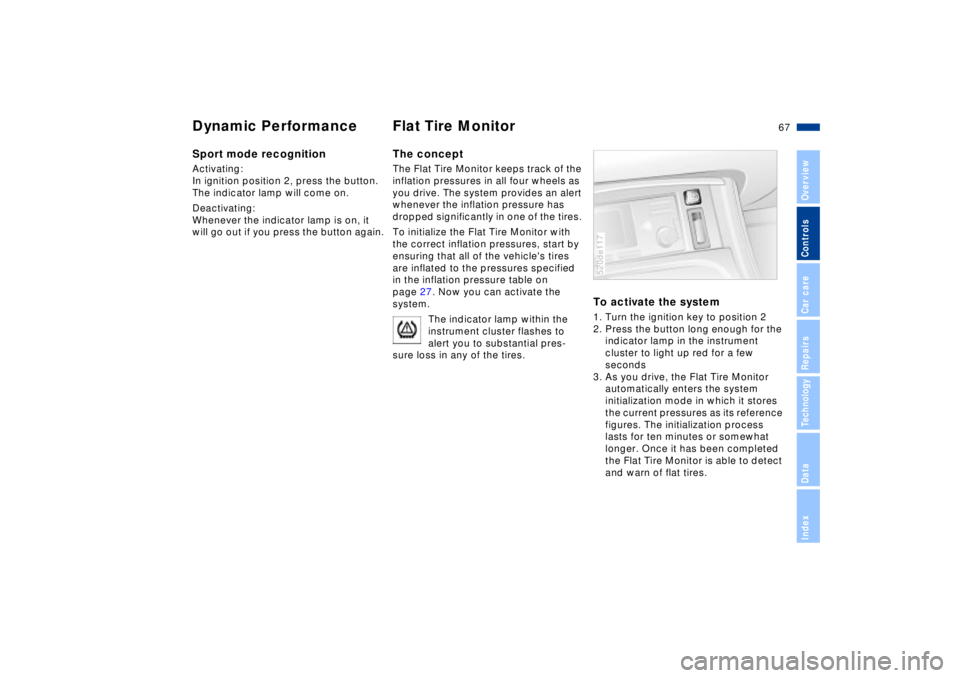
To activate the system1. Turn the ignition key to position 2
2. Press the button long enough for the
indicator lamp in the instrument
cluster to light up red for a few
seconds
3. As you drive, the Flat Tire Monitor
automatically enters the system
initialization mode in which it stores
the current pressures as its reference
figures. The initialization process
lasts for ten minutes or somewhat
longer. Once it has been completed
the Flat Tire Monitor is able to detect
and warn of flat tires.520de117
Page 68 of 174

68n
Flat Tire MonitorRepeat this process after any changes
in tire inflation pressure, tire rotation or
replacement.
Do not reactivate the system after peri-
odic corrections of inflation pressures
to maintain them at the levels stored
during an earlier initialization process. In the event of a flat tireThe red indicator lamp will flash in the
event of a flat tire.
A supplementary gong is also heard.
Carefully reduce speed to less than
50 mph (80 km/h), avoiding any hard
braking or steering maneuvers while
doing so.
For additional details, refer to
page 137.
The Flat Tire Monitor cannot alert
you to severe and sudden tire
damage caused by external factors.
Another factor which the Flat Tire
Monitor does not recognize is the
balanced and very gradual pressure
loss that takes place in all tires over an
extended period of time.<
Check tire pressure on a regular
basis and correct it as required.
Refer to page 26.
Do not activate the system when driving
on snow chains or when operating the
vehicle on a closed racing circuit. False
alarms and undetected pressure loss
are both possible under these condi-
tions.
In certain circumstances, there could
be a delayed detection of any loss in
inflation pressure while driving on
snow-covered or slippery road
surfaces.
Performance-oriented driving (slip at
the drive wheels, high levels of lateral
acceleration) can also delay the
appearance of status reports in the Flat
Tire Monitor's display panel.<
System interferenceThe red indicator lamp in the instrument
cluster will stay on for as long as there
is a malfunction.
The indicator lamp will come on if the
system malfunctions.
Please contact your BMW center for
additional information.
Page 85 of 174

Overview
Controls and features
Operation, care
and maintenance
Owner service procedures
Technical data
Index Advanced technology
85n
IndexDataTechnologyRepairsCar careControlsOverview
Car care Special operating instructions:
Break-in procedures86
Driving notes87
Catalytic converter87
Antilock Brake System (ABS)88
Dynamic Brake Control
(DBC)90
Disc brakes90
Brake system92
Winter operation92
Power steering94
Cellular phone94
Car radio reception95
Wind deflector95
Hardtop96
Wheels and tires:
Tire inflation pressure99
Tire condition99
Tire replacement100
Tire rotation101
Wheel and tire
combinations102
Special features of winter
tires103
Snow chains103
Approved wheel and tire
specifications104Under the hood:
Hood105
Engine compartment108
Washer fluids110
Washer nozzles110
Engine oil111
Coolant113
Brake fluid114
Vehicle Identification
Number115
Maintenance and care:
The BMW Maintenance
System116
Caring for your vehicle117
Airbags123
Vehicle storage124
Laws and regulations:
Technical modifications125
California Proposition 65
Warning125
OBD interface socket126
Page 93 of 174

93n
IndexDataTechnologyRepairsCar careControlsOverview
Winter operationRubber seals and componentsTo prevent the weather-stripping from
freezing, apply a spray-on rubber treat-
ment or silicone spray to the door, hood
and luggage compartment lid seals.
A full range of car-care products is
available from your BMW center.
on rear tires, complying with the manu-
facturer's safety precautions. Do not
exceed a maximum speed of 30 mph
(50 km/h) while the snow chains are
mounted and refrain from activating the
Flat Tire Monitor, as the snow chains
could trigger false alarms and/or
prevent the system from detecting
actual pressure loss.
Starting off When starting off in deep snow or when
"rocking" the vehicle to free it, it may be
advisable to temporarily deactivate the
DSC. Refer to page 65.
To maintain vehicle stability,
always drive with the system
switched on whenever possible.<
Driving on low-traction road
surfaces Do not activate the Sport mode (refer to
page 66). Use smooth, gentle pressure
to control the accelerator pedal. Avoid
excessive engine speeds and upshift
early. Downshift well in advance when
approaching uphill or downhill grades.
Maintain an adequate distance
between yourself and the vehicle
ahead. BrakesWinter road conditions substantially
reduce the amount of traction available
between the tires and the road surface.
The resulting increases in braking
distance are considerable and should
be kept in mind at all times.
ABS is intended to prevent the wheels
from locking during brake applications,
thus helping to maintain vehicle stability
and steering response. If the ABS does not respond in a critical
braking situation and the wheels lock,
reduce the pressure on the brake pedal
until the wheels just start to roll again
while still maintaining enough force to
continue braking.
Then increase the pressure, reduce the
pressure when the wheels lock, reapply
pressure etc.
This staggered braking procedure will
reduce braking distances while helping
you maintain steering control.
You can always then attempt to steer
around hazards after you have reduced
pressure on the brake pedal.
Never downshift to exploit engine
braking when driving on slippery
road surfaces, as this could lead to a
loss of traction at the rear wheels,
impairing your ability to control the
vehicle.<
Depress the clutch during hard
braking on road surfaces that
provide only poor or uneven traction.<
Page 99 of 174

99n
IndexDataTechnologyRepairsCar careControlsOverview
Information for your safetyThe vehicle's factory-approved safety
tires have been specially designed to
provide optimum safety and driving
comfort on your vehicle.
It is not merely the tire's service life, but
also driving comfort and Ð above all else
Ð driving safety that depend on the
condition of the tires and the mainte-
nance of the specified tire pressure.
Incorrect inflation pressure is a
frequent cause of tire damage. It
also significantly influences the road-
holding ability of your BMW. Check tire
inflation pressures regularly (refer to
page 26), at least every two weeks and
before beginning a longer trip. If this is
not done, incorrect tire pressures can
cause driving instability and tire
damage, ultimately resulting in acci-
dents.<
Safety tiresYour BMW Z8 is equipped with safety
tires.
The assembly consists of self-
supporting tires mounted on specially-
designed wheel rims. Special reinforce-
ment elements support the sidewalls in
the event of pressure loss. Although tire
performance is then restricted, the
vehicle can still be driven on the
deflated tire for a limited distance. Your
vehicle is equipped with a Flat Tire
Monitor that signals you in case of a flat
tire.
For further information, refer to
pages 67, 137.
Tire tread Ð tire damageInspect your tires frequently for tread
depth, wear, signs of damage and for
foreign objects lodged in the tread.
Tread depth should not be allowed to
fall below 0.12 in (3 mm), even though
the legally specified minimum tread
depth is only 0.063 in (1.6 mm). At at
tread depth of 0.063 in (1.6 mm), tread
depth indicators (arrow) in the tread-
groove base will indicate that the legally
permissible wear limit has been
reached. Below 0.12 in (3 mm) tread
depth, there is an increased risk of
aquaplaning, even at relatively
moderate speeds and with only small
amounts of water on the road.390de331
Tire inflation pressure Tire condition
Page 100 of 174

100n
Avoid overloading the vehicle so
that the permitted load on the tires
is not exceeded. Overloading can lead
to overheating and increases the rate at
which damage develops inside the
tires. You could have a blowout as a
result.
Unusual vibrations encountered during
normal vehicle operation can indicate a
flat tire or some other vehicle defect, as
can variations in normal vehicle
response, such as a pronounced
tendency to pull to the left or right.
Should this occur, respond by immedi-
ately reducing your speed. Proceed
carefully to the nearest BMW center or
professional tire center, or have the
vehicle towed in to have it and its tires
inspected.
Tire damage can endanger the lives of
both the vehicle occupants and other
road users.<
To maintain good handling and vehicle
response, use only tires of a single
tread configuration from a single manu-
facturer. BMW tests and approves
wheel and tire combinations. Refer to
page 104.DOT Quality GradesTread wear
Traction AA A B C
Temperature A B C
All passenger vehicle tires
must conform to Federal Safety
Requirements in addition to these
grades.
when tested under controlled condi-
tions on a specified government test
course.
For example, a tire graded 150 would
wear one and one-half (1g) times as
well on the government course as a tire
graded 100. The relative performance
of tires depends upon the actual condi-
tions of their use, however, and may
depart significantly from the norm due
to variations in driving habits, service
practices and differences in road char-
acteristics and climate.TractionThe traction grades, from highest to
lowest, are AA, A, B and C.
Those grades represent the tire's ability
to stop on wet pavement as measured
under controlled conditions on speci-
fied government test surfaces of
asphalt and concrete. A tire marked C
may have poor traction performance.
The traction grade assigned to
this tire is based on straight-
ahead braking traction tests, and does
not include acceleration, cornering,
aquaplaning, or peak traction charac-
teristics.<
Tire condition Tire replacement
Page 101 of 174

101n
IndexDataTechnologyRepairsCar careControlsOverview
Tire replacement Tire rotationTemperatureThe temperature grades are A (the
highest), B and C, representing the
tire's resistance to the generation of
heat and its ability to dissipate heat
when tested under controlled condi-
tions on a specified indoor laboratory
test wheel.
Sustained high temperature can cause
the tire material to degenerate and
reduce tire life, and excessive tempera-
ture can lead to sudden flat tire. The
grade C corresponds to a level of
performance which all passenger
vehicle tires must meet under the
Federal Motor Vehicle Safety Standard
No. 109. Grades B and A represent
higher levels of performance on the
laboratory test wheel than the minimum
required by law.
The temperature grade for this tire
is established for a tire that is
properly inflated and not overloaded.
Excessive speed, underinflation, or
excessive loading, either separately or
in combination, can cause heat buildup
and possibly a flat tire.<
Uniform Tire Quality GradingQuality grades can be found where
applicable on the tire sidewall between
tread shoulder and maximum section
width. For example:
Tread wear 200 Traction AA
Temperature A
Use only safety tires as there is no
spare tire available if you get a flat
tire.
For further information, refer to
page 137.
sidewall:
DOT ... 3201 indicates that the tire was
manufactured in week 32 of 2001.
Although tires may have a theoretical
service life of up to 10 years, BMW
strongly recommends that you replace
all tires after an absolute maximum of
6 years.
Between the axles
If different tire sizes are mounted
on the front and rear axles (refer to
page 10 4), then the tires may not be
rotated from one axle to the other.<
The tread wear patterns at the front end
differ from those at the rear Ð the actual
patterns will vary according to indi-
vidual driving conditions. In the inter-
ests of safety and maintaining optimal
handling characteristics, tire rotation is
not recommended.
Page 102 of 174

102n
Wheel and tire combinations The right choice
Use only wheels and tires
approved by BMW for the corre-
sponding vehicle model, as otherwise
the tires may make contact with the
body as the result of tolerances despite
the same nominal size being used,
resulting in serious accidents. If non-
approved wheels and tires are used,
BMW cannot evaluate their suitability,
and therefore cannot be held liable for
driving safety.<
For wheel and tire specifications
approved by BMW, refer to page 104.
The correct wheel and tire combi-
nation affects different systems
that otherwise will not function prop-
erly, e. g. ABS, DSC and Flat Tire
Monitor.
For this reason, use only tires of the
same brand and tread pattern on the
vehicle and, for example, restore the
approved wheel and tire combination
following a flat tire as soon as
possible.<
Codes on tires and wheels The code on tires has the following
meaning.
Codes on radial tires:
The speed rating indicates the
approved maximum speed for the tire.
Summer tires:
S = up to 112 mph (180 km/h)
T = up to 118 mph (190 km/h)
H = up to 130 mph (210 km/h)
V = up to 150 mph (240 km/h)
W = up to 167 mph (270 km/h)
Y = up to 186 mph (300 km/h)
ZR = over 150 mph (240 km/h)
Winter tires:
Q M+S = up to 100 mph (160 km/h)
T M+S = up to 118 mph (190 km/h)
H M+S = up to 130 mph (210 km/h) For example:
Nominal width
in mm
Aspect ratio in X
Radial tire code
Rim diameter in inches
Load rating
(not on ZR tires)
Speed rating
(before R on ZR tires)
245/45 R
1896W
Codes on light-alloy wheels:
Protect tire valves from dirt by using
screw-on valve stem caps. Dirt in the
valves frequently leads to slow leaks.
Safety tires carry additional designation
codes; these vary according to manu-
facturer:
Bridgestone RFT
Dunlop DSST
Goodyear EMT
Michelin ZPStorageAlways store tires in a cool, dry place,
protecting them against light whenever
possible. Protect the tires against
contact with oil, grease and fuel. For example:
Rim width
in inches
Code letter for
flange type
Symbol for full-drop
center rim
Rim diameter in inches
Hump on the 2 rim shoulders
8 x 18 EH2
J