2002 BMW Z3 tow
[x] Cancel search: towPage 138 of 187
138n
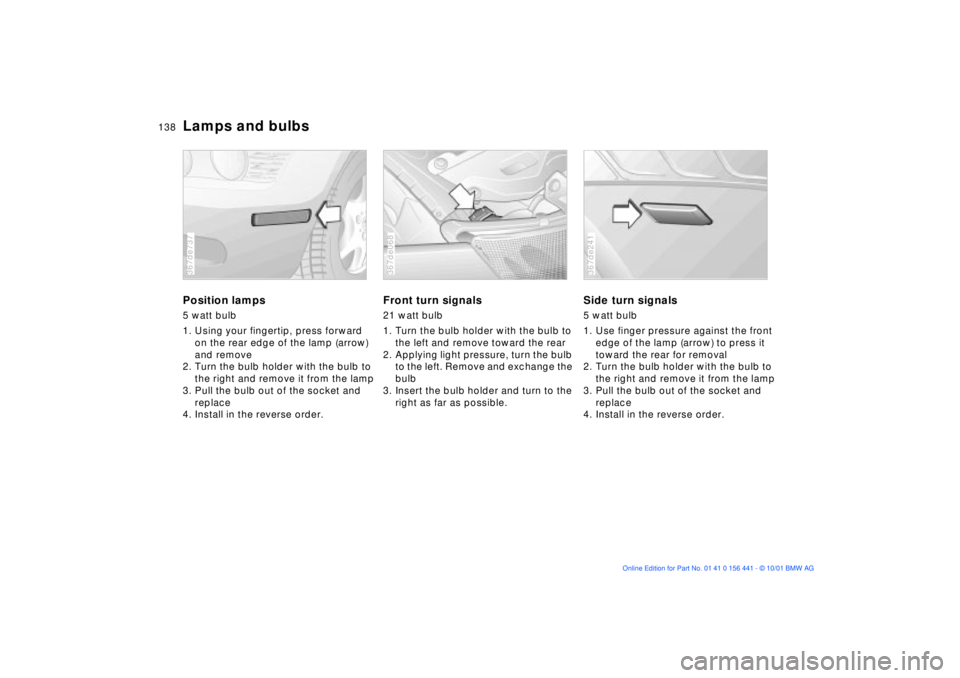
Lamps and bulbsPosition lamps5 watt bulb
1. Using your fingertip, press forward
on the rear edge of the lamp (arrow)
and remove
2. Turn the bulb holder with the bulb to
the right and remove it from the lamp
3. Pull the bulb out of the socket and
replace
4. Install in the reverse order.367de737
Front turn signals21 watt bulb
1. Turn the bulb holder with the bulb to
the left and remove toward the rear
2. Applying light pressure, turn the bulb
to the left. Remove and exchange the
bulb
3. Insert the bulb holder and turn to the
right as far as possible.367de068
Side turn signals5 watt bulb
1. Use finger pressure against the front
edge of the lamp (arrow) to press it
toward the rear for removal
2. Turn the bulb holder with the bulb to
the right and remove it from the lamp
3. Pull the bulb out of the socket and
replace
4. Install in the reverse order.367de241
Page 140 of 187
140n
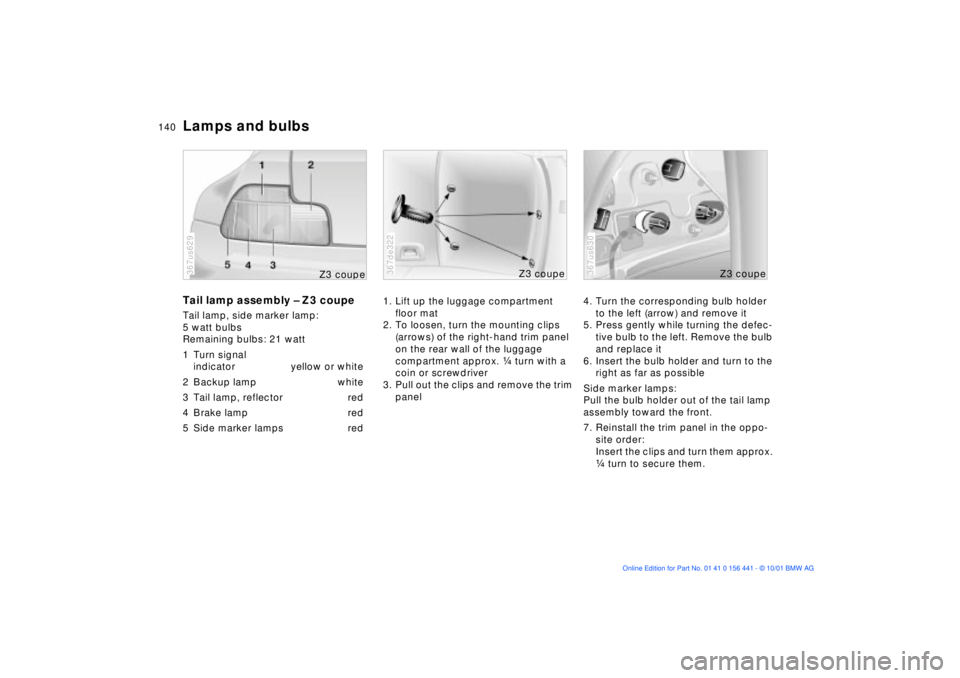
Lamps and bulbsTail lamp assembly Ð Z3 coupeTail lamp, side marker lamp:
5 watt bulbs
Remaining bulbs: 21 watt
1 Turn signal
indicator yellow or white
2 Backup lamp white
3 Tail lamp, reflector red
4 Brake lamp red
5 Side marker lamps red367us629
Z3 cou
pe
1. Lift up the luggage compartment
floor mat
2. To loosen, turn the mounting clips
(arrows) of the right-hand trim panel
on the rear wall of the luggage
compartment approx. f turn with a
coin or screwdriver
3. Pull out the clips and remove the trim
panel367de322
Z3 coupe
4. Turn the corresponding bulb holder
to the left (arrow) and remove it
5. Press gently while turning the defec-
tive bulb to the left. Remove the bulb
and replace it
6. Insert the bulb holder and turn to the
right as far as possible
Side marker lamps:
Pull the bulb holder out of the tail lamp
assembly toward the front.
7. Reinstall the trim panel in the oppo-
site order:
Insert the clips and turn them approx.
f turn to secure them.367us630
Z3 coupe
Page 149 of 187
149n
IndexDataTechnologyRepairsMaintenanceControlsOverview
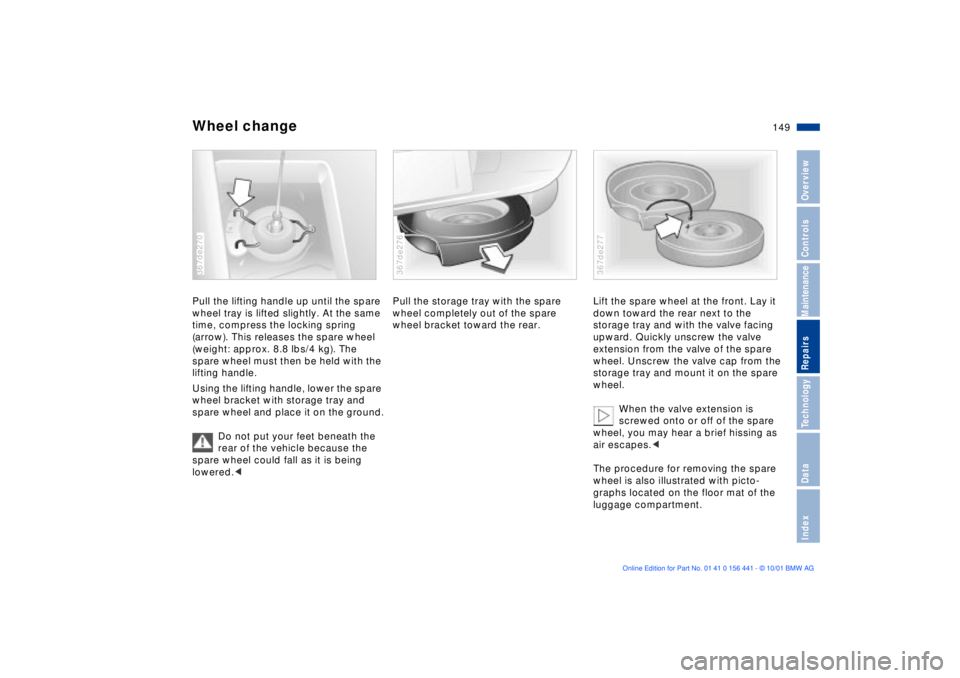
Wheel changePull the lifting handle up until the spare
wheel tray is lifted slightly. At the same
time, compress the locking spring
(arrow). This releases the spare wheel
(weight: approx. 8.8 lbs/4 kg). The
spare wheel must then be held with the
lifting handle.
Using the lifting handle, lower the spare
wheel bracket with storage tray and
spare wheel and place it on the ground.
Do not put your feet beneath the
rear of the vehicle because the
spare wheel could fall as it is being
lowered.< 367de270
Pull the storage tray with the spare
wheel completely out of the spare
wheel bracket toward the rear.367de276
Lift the spare wheel at the front. Lay it
down toward the rear next to the
storage tray and with the valve facing
upward. Quickly unscrew the valve
extension from the valve of the spare
wheel. Unscrew the valve cap from the
storage tray and mount it on the spare
wheel.
When the valve extension is
screwed onto or off of the spare
wheel, you may hear a brief hissing as
air escapes.<
The procedure for removing the spare
wheel is also illustrated with picto-
graphs located on the floor mat of the
luggage compartment.367de277
Page 150 of 187
150n
Wheel change
The wheel with the flat tire cannot
be placed in the spare wheel
bracket in the place of the spare
wheel.<
There is a plastic bag in the onboard
tool kit. Put the flat tire and the storage
tray into this bag.
Do not reposition the storage tray
in the spare wheel bracket without
the spare wheel.<
Using the lifting handle, pull the spare
wheel bracket upward until the spring
retainer catches. Secure the bracket
with the hexagon nut Ð ensure that it is
tightened down correctly.
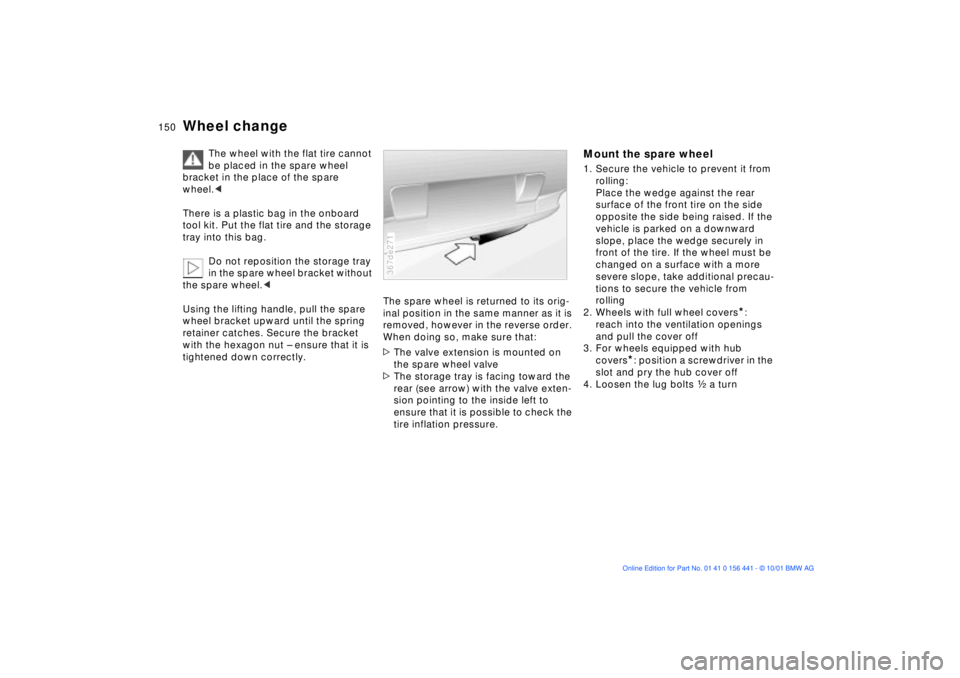
The spare wheel is returned to its orig-
inal position in the same manner as it is
removed, however in the reverse order.
When doing so, make sure that:
>The valve extension is mounted on
the spare wheel valve
>The storage tray is facing toward the
rear (see arrow) with the valve exten-
sion pointing to the inside left to
ensure that it is possible to check the
tire inflation pressure.367de271
Mount the spare wheel1. Secure the vehicle to prevent it from
rolling:
Place the wedge against the rear
surface of the front tire on the side
opposite the side being raised. If the
vehicle is parked on a downward
slope, place the wedge securely in
front of the tire. If the wheel must be
changed on a surface with a more
severe slope, take additional precau-
tions to secure the vehicle from
rolling
2. Wheels with full wheel covers
*:
reach into the ventilation openings
and pull the cover off
3. For wheels equipped with hub
covers
*: position a screwdriver in the
slot and pry the hub cover off
4. Loosen the lug bolts g a turn
Page 159 of 187
159n
IndexDataTechnologyRepairsMaintenanceControlsOverview
Jump-starting Towing the vehicle7. Start the support vehicle's engine
and let it run at an increased idling
speed for a few minutes. Start the
engine on the vehicle needing the
jump-start, and allow it to run as
usual. If the first start attempt is not
successful, wait a few minutes
before another attempt in order to
allow the discharged battery to
recharge
8. Before disconnecting the jumper
cables let the engines run for a few
minutes
9. Then disconnect the jumper cables
in reverse sequence.
Depending on the cause of the fault,
have the battery recharged by your
BMW center.
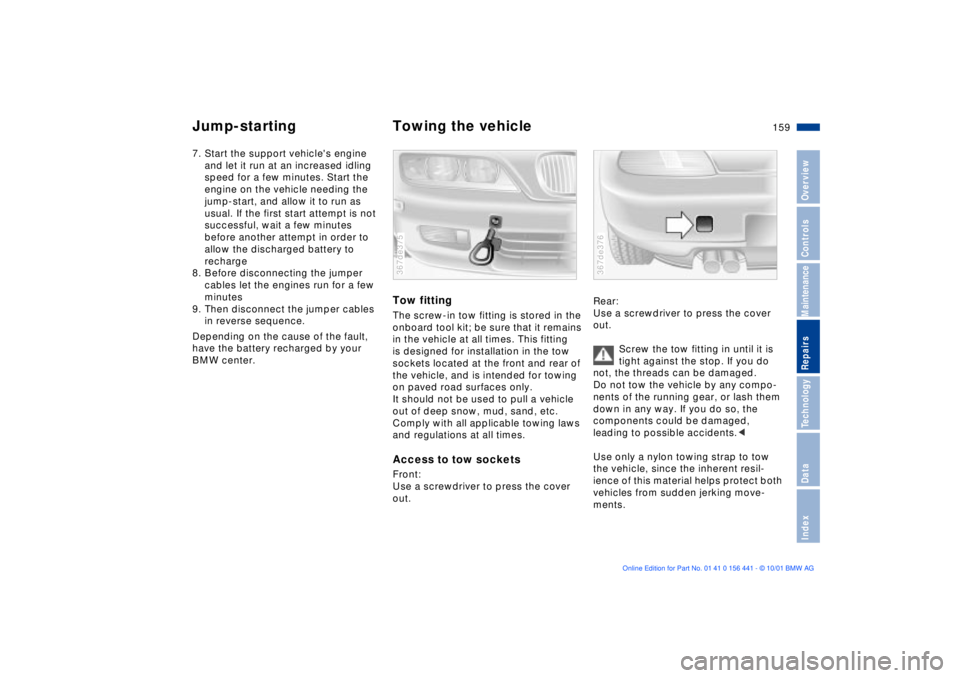
Tow fittingThe screw-in tow fitting is stored in the
onboard tool kit; be sure that it remains
in the vehicle at all times. This fitting
is designed for installation in the tow
sockets located at the front and rear of
the vehicle, and is intended for towing
on paved road surfaces only.
It should not be used to pull a vehicle
out of deep snow, mud, sand, etc.
Comply with all applicable towing laws
and regulations at all times.Access to tow socketsFront:
Use a screwdriver to press the cover
out.367de375
Rear:
Use a screwdriver to press the cover
out.
Screw the tow fitting in until it is
tight against the stop. If you do
not, the threads can be damaged.
Do not tow the vehicle by any compo-
nents of the running gear, or lash them
down in any way. If you do so, the
components could be damaged,
leading to possible accidents.<
Use only a nylon towing strap to tow
the vehicle, since the inherent resil-
ience of this material helps protect both
vehicles from sudden jerking move-
ments.367de376
Page 160 of 187
160n
Towing the vehicle
The towed vehicle should always
be the lighter of the two vehicles.
If this is not the case, it will not be
possible to control vehicle handling.<
Tow-startingIt is not possible to start the engine of a
vehicle with an automatic transmission
by towing or pushing the vehicle.
For instructions on jump-starting, refer
to page 158.
Never attempt to use your vehicle to
push another vehicle. This could result
in damage to the energy-absorbing
bumpers.
Towing a vehicle with automatic
transmission1. Place the selector lever in
position "N"
2. Towing speed:
max. 45 mph (70 km/h)
3. Towing distance:
max. 95 miles (150 km)
4. Leave the ignition key in position 1 to
ensure that brake lamps, turn signal
indicators, horn and windshield
wipers remain operative, and to
prevent the steering lock from
engaging
5. Switch on the hazard-warning
flashers (observe applicable legal
regulations).
Find some means of identifying the
vehicle in tow. Place a sign or warning
triangle in the rear window, for
instance.
Even when the electrical system
has failed, make sure that the igni-
tion key remains in position 1 to prevent
the steering lock from engaging.
The steering and brakes are without
power assist when the engine is off.
This means that increased effort is
required for steering and braking.<
Towing with a commercial tow
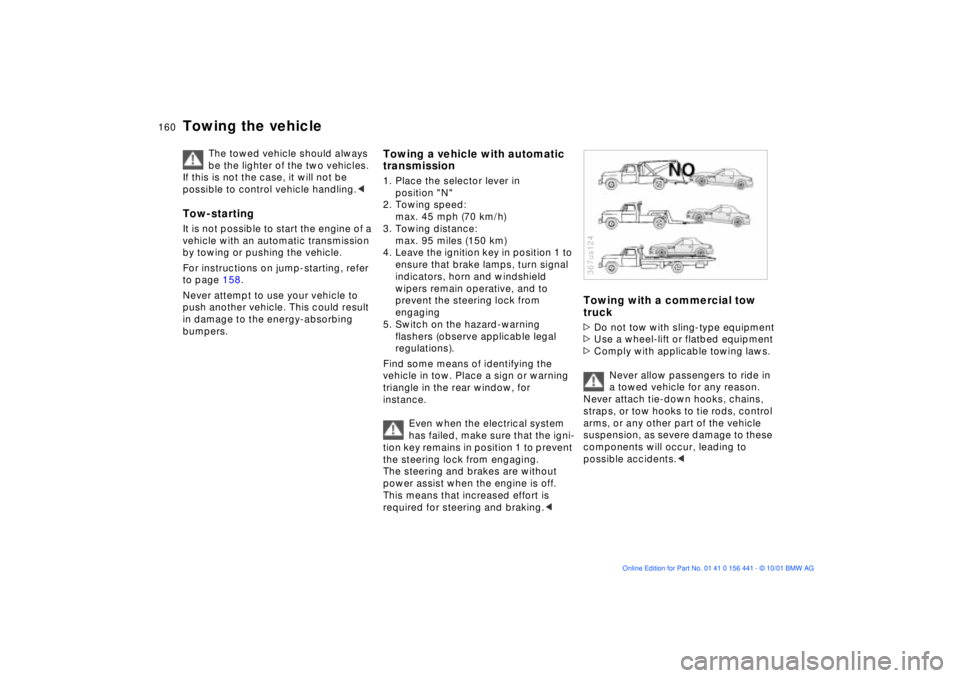
truck>Do not tow with sling-type equipment
>Use a wheel-lift or flatbed equipment
>Comply with applicable towing laws.
Never allow passengers to ride in
a towed vehicle for any reason.
Never attach tie-down hooks, chains,
straps, or tow hooks to tie rods, control
arms, or any other part of the vehicle
suspension, as severe damage to these
components will occur, leading to
possible accidents.< 367us124
Page 180 of 187

Everything from A to ZDSC (Dynamic Stability
Control)74, 165
Dynamic Brake Control
(DBC)103
Dynamic Stability Control
(DSC)74, 165EElectric convertible top
operation44
Electric power windows38
Electrical malfunction
convertible top157t
doors32t
fuel filler door157t
luggage compartment
lid37t
power convertible
top157t
Electrical system174
Electronic immobilizer31
Emergency release of
luggage compartment lid
from luggage
compartment's interior38
Engine
compartment120, 121Engine coolant126
adding126t
Engine oil123
adding123t
dipstick123
disposal125t
grades124
level21, 123t
pressure20
viscosity124
Engine output170
Engine specifications170
Exterior mirrors50
FFailure of an electrical
accessory156t
Fan82, 86
Filler cap cover25
Filling the washer
reservoir122t
First-aid kit24
Fittings, tow-starting and
towing159t
Flasher, headlamp64Flat tire111
Z3 roadster,
Z3 coupe146t
Folding top40
Footbrake103
Front airbags54, 130
Front fog lamps76
bulb replacement139t
Frost protection,
radiator105
Fuel26
Fuel consumption,
average72
Fuel filler door
electrical
malfunction157t
manual operation157t
Fuel gauge68
Fuel specifications26
Fuel tank capacity173
Fuses156
GGasoline26
Gear indicator68
Glass sunroof39
Glove compartment90
Grilles80, 84
Gross vehicle weight172HHardtop108
Hazard warning
flashers24t
Hazard warning system24
Hazard warning
triangle24t
Head restraints50
Headlamp cleaning
system122
Headlamp cover,
care137t
Headlamp flasher64
Headlamp washers66
Headlamps, high
beam23, 64
bulb replacement137t
Headlamps, low beam76
bulb replacement137t
Page 183 of 187

Everything from A to Z
183n
IndexDataTechnologyRepairsMaintenanceControlsOverview
Replacing fuses156t
Replacing windshield wiper
blades136t
Reporting safety defects7
Reservoir, washer
system122t
Roll-up cover93
Roof load capacity172
Roof-mounted luggage
rack95
Rubber seals and
components, winter105SSafety belt tensioner166
Safety belts52
Safety defects, reporting7
Seals and components,
winter105
Seat adjustment49
Seat heating89
Securing cargo94
Selector lever, automatic
transmission62
Service and Warranty
Information Booklet
(US models)129Service Interval
Display69, 128
Set temperature82, 86
Shiftlock62
Side airbags54, 130
Side marker lamps, bulb
replacement139t
Sitting correctly with
airbags55
Skid control106
Slippery roads105
Snow chains105t
Socket92
electrical appliances92
flashlight92
vacuum cleaner92
Spare keys30
Spare tire147t
Spare wheel147t
Spark plugs174
Special features of winter
tires115
Special oils124
Specifications, engine170
Speed, average72
Speed control67
Starting assistance158tStarting problems
59, 100, 158
Starting the engine59
Steel wheel116
Steering106
Steering wheel lock58
Steptronic62
Storage boxes90
Storage compartments90
Storage trays90
Storing the vehicle130
Summer tires114
Sunroof39
Switching off the engine60
Symbols4, 153
TTachometer68
Tail lamp assembly, bulb
replacement139t
Tail lamps139, 140
bulb replace-
ment139t, 140t
Tank capacity173
Technical Data169
Technical
modifications6, 132Telephone
refer to the separate
Owner's Manual
Temperature display
engine coolant69
outside temperature71
Temperature
layering82, 87
Third brake lamp141
Tire change, refer to wheel
change146t
Tire condition110
Tire failure, Z3 roadster,
Z3 coupe146
Tire inflation pressures110
checking26t
Tire Quality Grading112
Tire replacement111, 112
Tire rotation between front
and rear113
Tire size116
Tire tread110
Tires, identification114
Tools136t
Torque170
Tow fittings159t
Towing the vehicle159t