2002 BMW Z3 tow
[x] Cancel search: towPage 94 of 187
94n
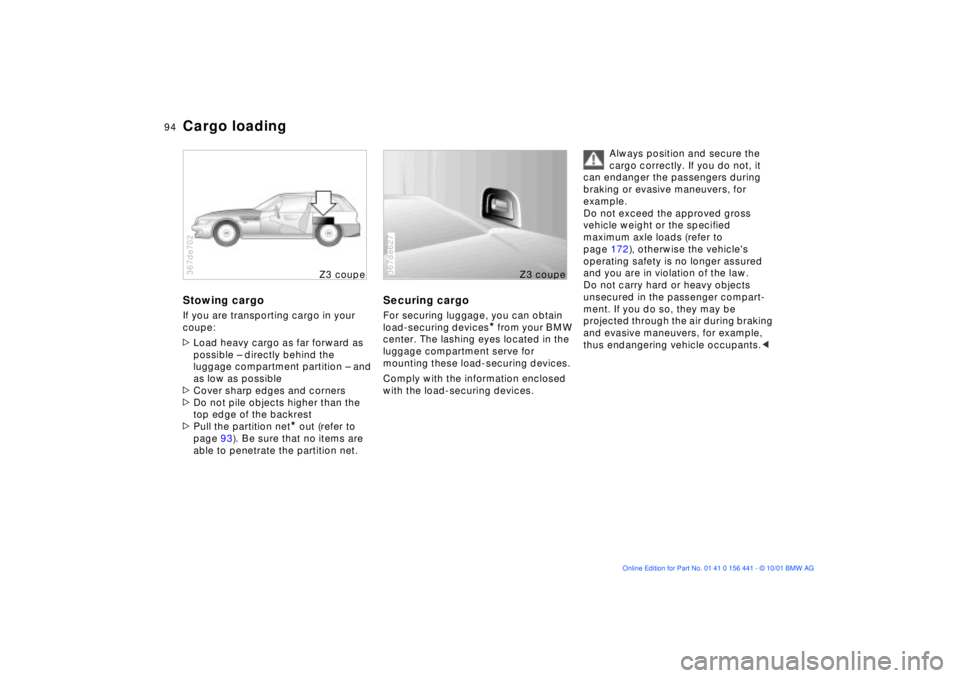
Cargo loadingStowing cargoIf you are transporting cargo in your
coupe:
>Load heavy cargo as far forward as
possible Ð directly behind the
luggage compartment partition Ð and
as low as possible
>Cover sharp edges and corners
>Do not pile objects higher than the
top edge of the backrest
>Pull the partition net
* out (refer to
page 93). Be sure that no items are
able to penetrate the partition net.
367de702
Z3 cou
pe
Securing cargoFor securing luggage, you can obtain
load-securing devices
* from your BMW
center. The lashing eyes located in the
luggage compartment serve for
mounting these load-securing devices.
Comply with the information enclosed
with the load-securing devices.
367de627
Z3 cou
pe
Always position and secure the
cargo correctly. If you do not, it
can endanger the passengers during
braking or evasive maneuvers, for
example.
Do not exceed the approved gross
vehicle weight or the specified
maximum axle loads (refer to
page 172), otherwise the vehicle's
operating safety is no longer assured
and you are in violation of the law.
Do not carry hard or heavy objects
unsecured in the passenger compart-
ment. If you do so, they may be
projected through the air during braking
and evasive maneuvers, for example,
thus endangering vehicle occupants.<
Page 98 of 187

98n
To ensure that your vehicle provides
maximum economy throughout a long
service life, we request that you
observe the following:
Engine and differentialUp to 1,200 miles (2,000 km):
Drive with varying engine and road
speeds, but do not exceed 4,500 rpm
or 100 mph (150 km/h).
Comply with local and state maximum
speed limits.
Refrain from using full throttle and avoid
pressing the accelerator beyond the
kickdown point.
After you have driven 1,200 miles
(2,000 km), you can gradually increase
the engine and road speeds.
You should also comply with these
break-in procedures if the engine or
differential is replaced later in the
course of the vehicle's service life.
TiresDue to technical factors associated with
their manufacture, tires do not achieve
their full traction potential until an initial
break-in period has elapsed. You should
therefore drive with extra caution during
the initial 200 miles (300 km).
Comply with local and state maximum
speed limits.
When the vehicle is operated on
wet or slushy roads, a wedge of
water may form between the tire and
the road surface. This phenomenon is
referred to as aquaplaning or hydro-
planing, and can lead to partial or
complete loss of traction, vehicle
control and braking effectiveness.
Reduce your speed on wet roads.<
Brake systemApprox. 300 miles (500 km) must
elapse before the brake pads and
rotors achieve the optimal surface and
wear pattern.
To break-in the separate parking brake
drums, apply the parking brake lightly
when coasting to a standstill (at a traffic
signal, for instance), provided that
traffic conditions allow you to do so.
To avoid corrosion, repeat this proce-
dure from time to time.
The brake lamps do not light up
when the parking brake is applied.
Vacuum for the brake system booster
on your BMW is available only when the
engine is running. When you move the vehicle with the engine off Ð for instance
,
by towing Ð substantially higher levels
of pedal force will be required to brake
the vehicle.<
ClutchThe clutch will reach optimal function
after approx. 300 miles (500 km). Shift
gears carefully during the break-in
period.
Break-in procedure
Page 100 of 187

100n
Catalytic converterThe catalytic converter reduces harmful
exhaust emissions.
It is designed for use with unleaded fuel
only.
Even minute quantities of lead would be
enough to permanently damage both
the catalytic converter and the system's
oxygen sensor.
To ensure efficient, trouble-free engine
operation and avoid potential damage:
>Be sure to comply with the scheduled
maintenance requirements
>Fill the fuel tank well before it is
empty
>If the engine runs roughly, shut it off
as soon as possible
>Tow-start the vehicle only when the
engine is cold. Tow-starting when the
engine is warm could cause unburned
fuel to ignite on the way to the cata-
lytic converter, resulting in significant
damage. It is better to start the vehicle
with an outside starting aid>Avoid any other situations in which
the fuel would not be (completely)
burned, for instance:
Frequent or consecutive extended
starting attempts or repeated starting
attempts when the engine fails to
start. (Shutting down and restarting
an engine which is running properly
does not present a problem.) Never
allow the engine to run with any of
the spark plug cables disconnected.Be sure to comply with the
instructions above to prevent
unburned fuel from reaching the cata-
lytic converter. Otherwise, the catalytic
converter could respond by over-
heating, leading to serious damage.
Extreme temperatures occur at the
catalytic converter on this and every
catalyst-equipped vehicle. Heat shields
are installed adjacent to some sections
of the exhaust system. Never remove
these shields; do not apply under-
coating to their surfaces.
When driving, standing while the engine
is idling, or when parking, be careful to
avoid contact between the hot exhaust
system and easily-flammable materials
(hay, dry grass, leaves, etc.). Such
contact could cause a fire, resulting in
personal injuries and property
damage.<
Page 111 of 187

111n
IndexDataTechnologyRepairsMaintenanceControlsOverview
Tire condition Tire replacementmoderate speeds and with only small
amounts of water on the road.
Never continue driving on a
deflated (flat) tire. A flat tire greatly
impairs steering and braking response,
and can lead to complete loss of
control over the vehicle.
Avoid overloading the vehicle so that
the permitted load on the tires is not
exceeded. Overloading causes over-
heating and damage inside the tires.
The ultimate result can assume the
form of a sudden air loss.
Unusual vibrations encountered during
normal vehicle operation can indicate a
flat tire or some other vehicle malfunc-
tion. The type of problem can be
caused by contact with curbs, etc. This
is also true for irregularities in the
vehicle's handling characteristics, such
as a pronounced tendency to pull to the
left or right. Should this occur, respond
by immediately reducing your speed.
Proceed carefully to the nearest BMW
center or professional tire center, or
have the vehicle towed in to have it, its
wheels and tires inspected.
Tire damage (up to and including
sudden and complete air loss) can pose
an extreme hazard for both vehicle
occupants and other road users.< To maintain good handling and vehicle
response, use only tires of a single tread
configuration from a single manufac-
turer. BMW tests and approves wheel
and tire combinations, refer to page 116.
DOT Quality GradesTread wear
Traction AA A B C
Temperature A B C
All passenger vehicle tires must
conform to Federal Safety
Requirements in addition to these
grades.
when tested under controlled condi-
tions on a specified government test
course.
For example, a tire graded 150 would
wear one and one-half (1g) times as
well on the government course as a tire
graded 100. The relative performance
of tires depends upon the actual condi-
tions of their use, however, and may
depart significantly from the norm due
to variations in driving habits, service
practices and differences in road char-
acteristics and climate.
Page 123 of 187
123n
IndexDataTechnologyRepairsMaintenanceControlsOverview
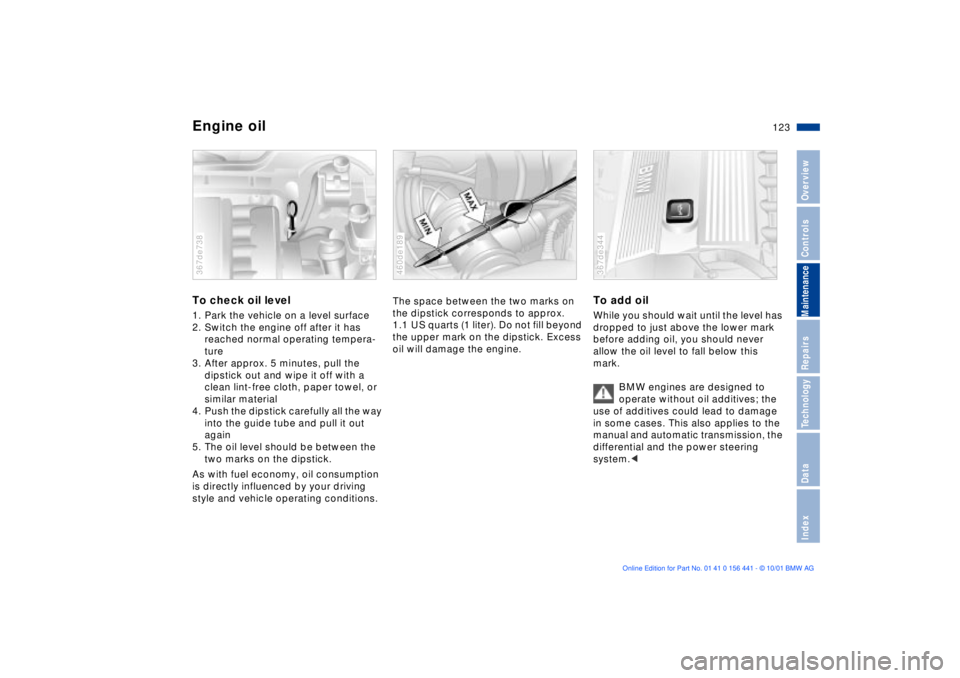
Engine oil To check oil level1. Park the vehicle on a level surface
2. Switch the engine off after it has
reached normal operating tempera-
ture
3. After approx. 5 minutes, pull the
dipstick out and wipe it off with a
clean lint-free cloth, paper towel, or
similar material
4. Push the dipstick carefully all the way
into the guide tube and pull it out
again
5. The oil level should be between the
two marks on the dipstick.
As with fuel economy, oil consumption
is directly influenced by your driving
style and vehicle operating conditions.367de738
The space between the two marks on
the dipstick corresponds to approx.
1.1 US quarts (1 liter). Do not fill beyond
the upper mark on the dipstick. Excess
oil will damage the engine.460de189
To add oilWhile you should wait until the level has
dropped to just above the lower mark
before adding oil, you should never
allow the oil level to fall below this
mark.
BMW engines are designed to
operate without oil additives; the
use of additives could lead to damage
in some cases. This also applies to the
manual and automatic transmission, the
differential and the power steering
system.< 367de344
Page 135 of 187

Overview
Controls and features
Operation, maintenance
Owner service procedures
Technical data
Index Advanced technology
135n
IndexDataTechnologyRepairsMaintenanceControlsOverview
Replacement procedures:
Onboard tool kit136
Windshield wiper blades136
Lamps and bulbs137
Master key with battery
lamp143
Remote control144
Wheel change146
Battery153
Fuses156
In case of electrical
malfunction:
Power convertible top157
Fuel filler door157
Assistance, giving and
receiving:
Jump-starting158
Towing the vehicle159
Repairs
Page 136 of 187
136n
The onboard tool kit is located in the
luggage compartment, under the floor
mat.
Z3 coupe:
Grasp the floor mat by the straps on the
left and right. Pull it upward and remove
it.
Z3 roadster:
Lift the floor mat from the rear by the
strap and fold it forward.
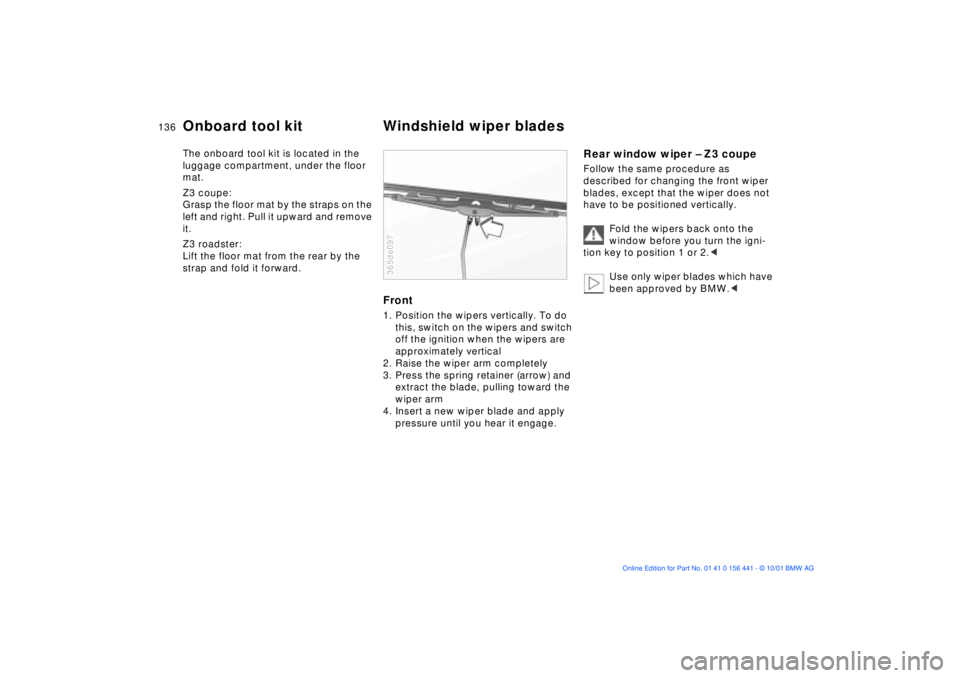
Front1. Position the wipers vertically. To do
this, switch on the wipers and switch
off the ignition when the wipers are
approximately vertical
2. Raise the wiper arm completely
3. Press the spring retainer (arrow) and
extract the blade, pulling toward the
wiper arm
4. Insert a new wiper blade and apply
pressure until you hear it engage.365de097
Rear window wiper Ð Z3 coupeFollow the same procedure as
described for changing the front wiper
blades, except that the wiper does not
have to be positioned vertically.
Fold the wipers back onto the
window before you turn the igni-
tion key to position 1 or 2.<
Use only wiper blades which have
been approved by BMW.<
Onboard tool kit Windshield wiper blades
Page 137 of 187

137n
IndexDataTechnologyRepairsMaintenanceControlsOverview
Lamps and bulbsThe lamps and bulbs make essential
contributions to the safety of your
vehicle. Therefore, comply fully with the
following instructions during bulb
replacement. If you are not familiar with
any of the procedures, consult your
BMW center.
Do not touch the glass portion of
a new bulb with your bare hands
since even small amounts of impurities
burn in to the surface and reduce the
service life of the bulb. Use a clean
cloth, paper napkin, or a similar mate-
rial, or hold the bulb by its metallic
base.<
A replacement bulb set is available from
your BMW center.
Before working on the electrical
system, switch off the electrical
accessory you are working on or
disconnect the cable from the negative
terminal of the battery. Failure to
observe this precaution could result in
short circuits.
To prevent injuries and damage,
comply with any instructions provided
by the bulb manufacturer.<
The illustration depicts the right side
of the engine compartment.1 High beams HB3 bulb, 65 watts2 Low beams HB4 bulb, 55 watts
The bulb is pressurized. There-
fore, wear safety glasses and
protective gloves. Failure to comply
with these precautions could result in
physical injury if the bulb breaks.< 367us067
1. Turn the bulb holder with the bulb to
the left and remove toward the rear
2. Pull off the plug
3. Push the new bulb holder with the
bulb into the plug Ð ensure proper
locking
4. Reinstall in reverse order.
When cleaning the headlamps,
please observe the following:
>Do not wipe dry (this causes
scratches) and never use abrasives
or strong solvents to clean the covers
>Remove dirt and contamination (such
as insects) by soaking with BMW Car
Shampoo and then rinsing with plenty
of water
>Always use a deicer spray to remove
accumulated ice and snow Ð never
use a scraper.<