Page 25 of 132

INSTRUMENT AND CONTROL FUNCTIONS
3-10
3
EAU01859
7. Cruise control switches
See page 3-6 for an explanation of the
cruise control system.
EAU00143
8. Start switch “ ”
Push this switch to crank the engine
with the starter.
EC000005
CAUTION:@ See page 6-1 for starting instruc-
tions prior to starting the engine. @
EAU00152
Clutch lever The clutch lever is located at the left
handlebar grip. To disengage the
clutch, pull the lever toward the handle-
bar grip. To engage the clutch, release
the lever. The lever should be pulled
rapidly and released slowly for smooth
clutch operation.
The clutch lever is equipped with a
clutch switch, which is part of the ignition
circuit cut-off system. (See page 3-22
for an explanation of the ignition circuit
cut-off system.)
EAU01215
Shift pedal The shift pedal is located on the left
side of the engine and is used in com-
bination with the clutch lever when
shifting the gears of the 5-speed con-
stant-mesh transmission equipped on
this motorcycle.NOTE:@ Use your toes or heel to shift up and
your toes to shift down. @
1. Clutch lever
1. Shift pedal
E_5jc.book Page 10 Monday, January 22, 2001 12:12 PM
Page 26 of 132
INSTRUMENT AND CONTROL FUNCTIONS
3-11
3
EAU00158
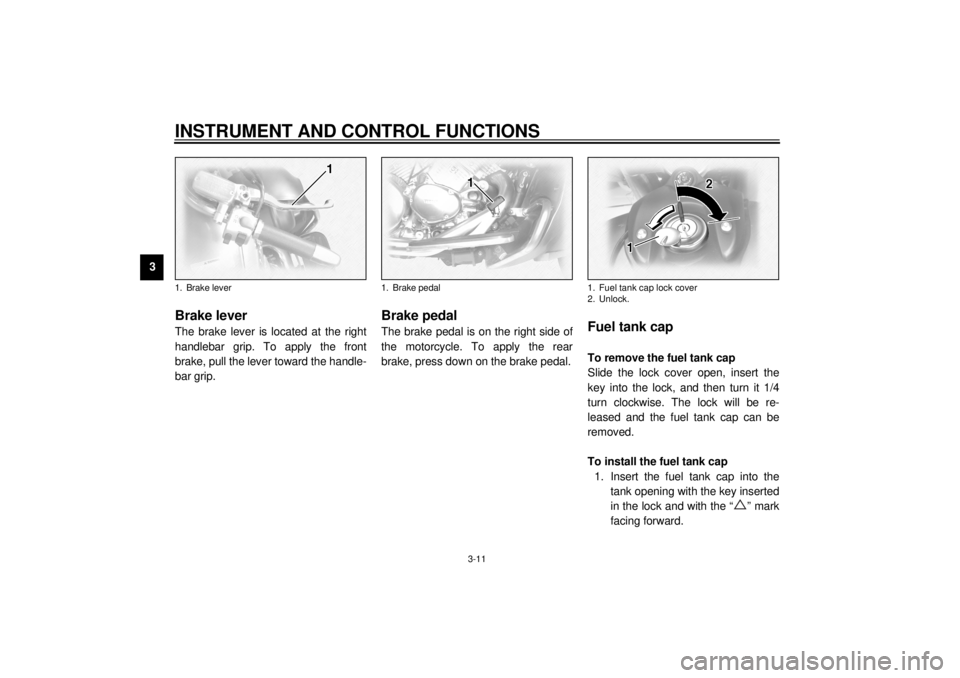
Brake lever The brake lever is located at the right
handlebar grip. To apply the front
brake, pull the lever toward the handle-
bar grip.
EAU00162
Brake pedal The brake pedal is on the right side of
the motorcycle. To apply the rear
brake, press down on the brake pedal.
EAU02917
Fuel tank cap To remove the fuel tank cap
Slide the lock cover open, insert the
key into the lock, and then turn it 1/4
turn clockwise. The lock will be re-
leased and the fuel tank cap can be
removed.
To install the fuel tank cap
1. Insert the fuel tank cap into the
tank opening with the key inserted
in the lock and with the “ ” mark
facing forward.
1. Brake lever
1. Brake pedal
1. Fuel tank cap lock cover
2. Unlock.
E_5jc.book Page 11 Monday, January 22, 2001 12:12 PM
Page 69 of 132
OPERATION AND IMPORTANT RIDING POINTS
6-4
6
EC000048
CAUTION:@ l
Even with the transmission in
the neutral position, do not
coast for long periods of time
with the engine off, and do not
tow the motorcycle for long dis-
tances. The transmission is
properly lubricated only when
the engine is running. Inade-
quate lubrication may damage
the transmission.
l
Always use the clutch while
changing gears to avoid dam-
aging the engine, transmission,
and drive train, which are not
designed to withstand the
shock of forced shifting.
@
EAU02941
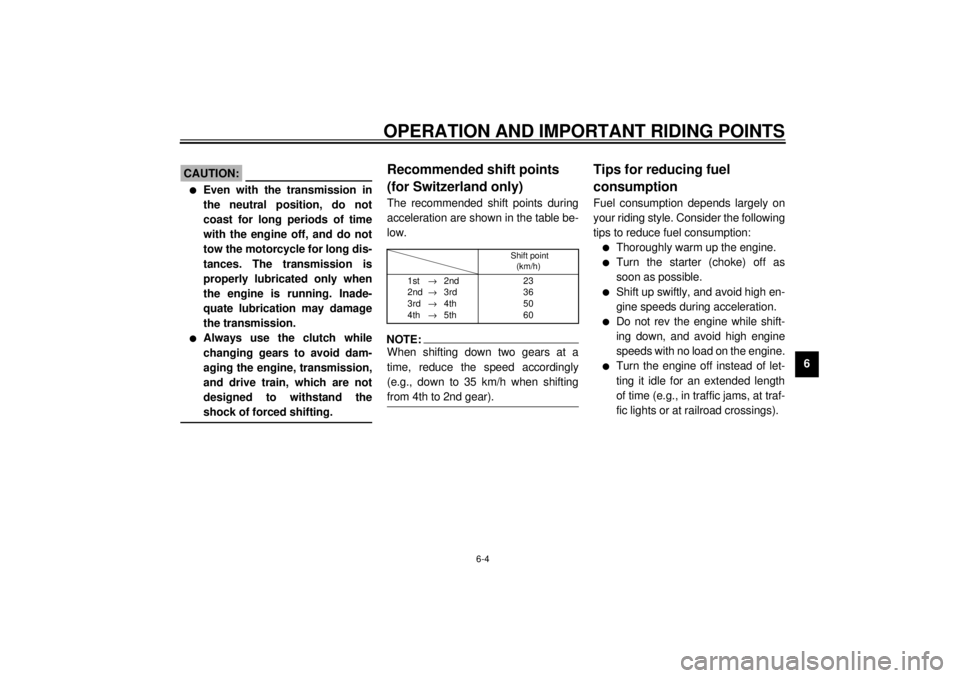
Recommended shift points
(for Switzerland only) The recommended shift points during
acceleration are shown in the table be-
low.CF-01ENOTE:_ When shifting down two gears at a
time, reduce the speed accordingly
(e.g., down to 35 km/h when shifting
from 4th to 2nd gear). _
EAU00424
Tips for reducing fuel
consumption Fuel consumption depends largely on
your riding style. Consider the following
tips to reduce fuel consumption:l
Thoroughly warm up the engine.
l
Turn the starter (choke) off as
soon as possible.
l
Shift up swiftly, and avoid high en-
gine speeds during acceleration.
l
Do not rev the engine while shift-
ing down, and avoid high engine
speeds with no load on the engine.
l
Turn the engine off instead of let-
ting it idle for an extended length
of time (e.g., in traffic jams, at traf-
fic lights or at railroad crossings).
Shift point
(km/h)
1st®2nd
2nd®3rd
3rd®4th
4th®5th23
36
50
60
E_5jc.book Page 4 Monday, January 22, 2001 12:12 PM
Page 112 of 132

PERIODIC MAINTENANCE AND MINOR REPAIR
7-39
7Engine overheating
EW000070
WARNING
@ l
Do not remove the radiator cap when the engine and radiator are hot. Scalding hot fluid and steam may be
blown out under pressure, which could cause serious injury. Be sure to wait until the engine has cooled.
l
After removing the radiator cap retaining bolt, place a thick rag, like a towel, over the radiator cap, and then
slowly rotate the cap counterclockwise to the detent to allow any residual pressure to escape. When the hiss-
ing sound has stopped, press down on the cap while turning it counterclockwise, and then remove the cap.
@NOTE:@ If coolant is not available, tap water can be temporarily used instead, provided that it is changed to the recommended coolant
as soon as possible. @
Wait until the
engine has cooled.
Check the coolant level in the
reservoir and radiator.
The coolant level
is OK.The coolant level is low.
Check the cooling system
for leakage.
Have a Yamaha dealer checkand repair the cooling system.Add coolant. (See NOTE.)
Start the engine. If the engine overheats again,
have a
Yamaha dealer check
and repair the cooling system.
There is
leakage.
There is
no leakage.
E_5jc.book Page 39 Monday, January 22, 2001 12:12 PM