Page 78 of 107

4-9
E
EJU00536
Periodic maintenance chart
The following chart gives general guidelines for periodic maintenance. However, depend-
ing on your operating conditions maintenance may need to be performed more frequently.
(
●) This mark indicates maintenance that you may do yourself.
(
❍) This mark indicates work to be done by a Yamaha dealer.
*1: Grease capacity: 20.0–22.0 cm3 (0.68–0.74 oz)
*2: Grease capacity: 3.0–5.0 cm3 (0.10–0.17 oz) MAINTENANCE INTERVAL INITIALTHEREAF-
TER EVERYPA G E
10
hours50
hours100
hours 100
hours 200
hours
ITEM
3
months6
months6
months12
months
Spark plug Inspect, clean, adjust ●●●●
4-13
Lubrication points Lubricate●●
4-14
Intermediate housing Lubricate❍
*1●
*2●
*2 4-16
Fuel system Inspect❍❍
4-10
Fuel filter Check, replace❍❍
4-11
Fuel tank Clean❍
4-11
Carburetor setting Inspect, adjust❍❍❍
4-19
Trolling speed Adjust●●
4-19
Carburetor throttle shaft Inspect❍❍
—
Cooling water passages Flush●
(after
ever y
use) 4-1
Bilge strainer Clean●●●
—
Impeller Inspect●●●
—
Steering cable Inspect●●
4-12
Steering pivot Inspect❍❍❍
—
Steering friction Inspect●●●
4-20
Throttle cable Inspect, adjust●●
4-12
Choke cable Inspect, adjust ●●
4-16
Battery Inspect●
(Inspect
fluid level
before
ever y
use)4-17
Rubber coupling Inspect❍
—
Nuts and bolts Tighten❍❍❍
—
E_GM6-4.fm Page 9 Tuesday, July 11, 2000 11:28 AM
Page 81 of 107
4-12
E
EJU00546
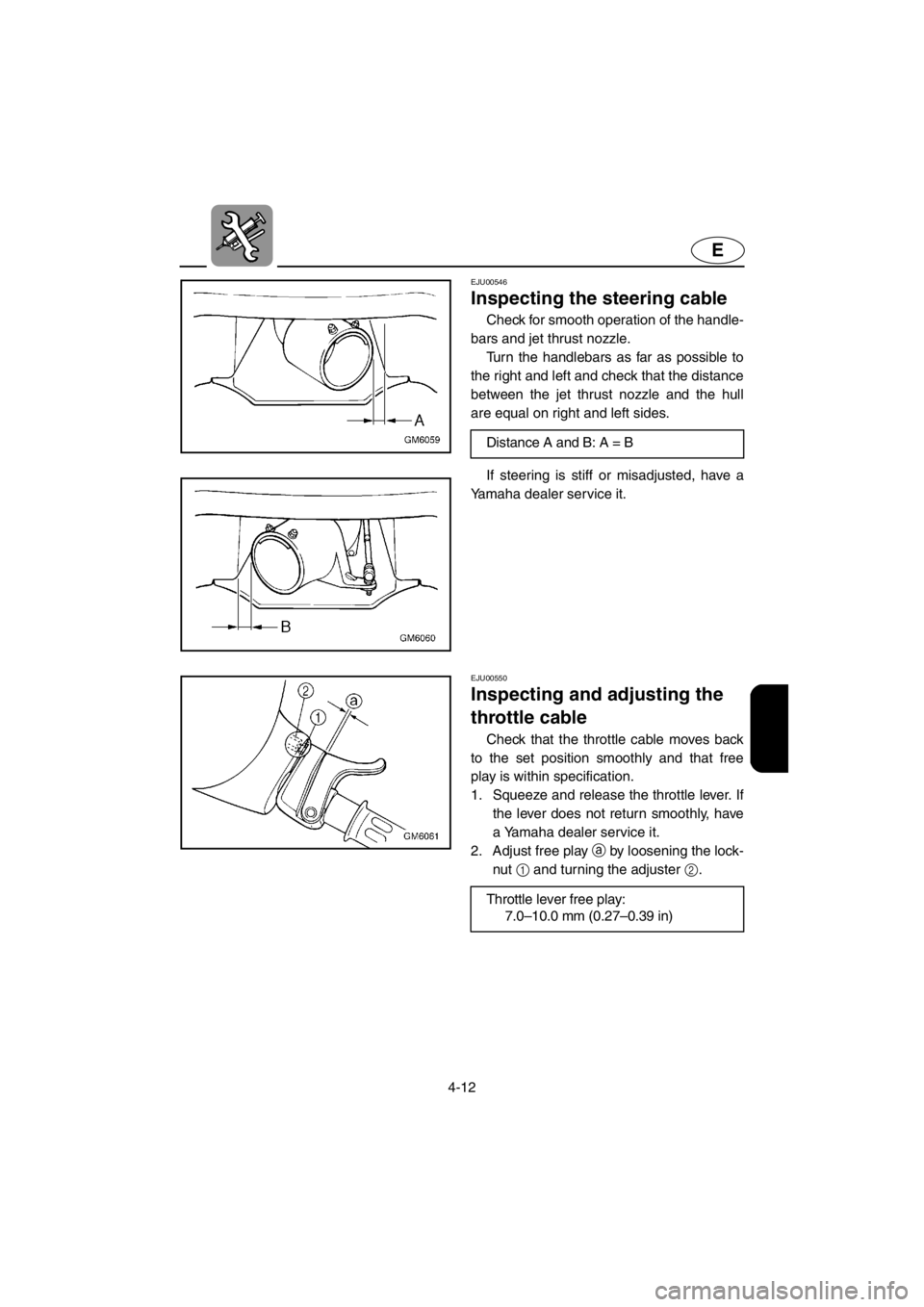
Inspecting the steering cable
Check for smooth operation of the handle-
bars and jet thrust nozzle.
Turn the handlebars as far as possible to
the right and left and check that the distance
between the jet thrust nozzle and the hull
are equal on right and left sides.
If steering is stiff or misadjusted, have a
Yamaha dealer service it.Distance A and B: A = B
EJU00550
Inspecting and adjusting the
throttle cable
Check that the throttle cable moves back
to the set position smoothly and that free
play is within specification.
1. Squeeze and release the throttle lever. If
the lever does not return smoothly, have
a Yamaha dealer service it.
2. Adjust free play a by loosening the lock-
nut 1 and turning the adjuster 2.
Throttle lever free play:
7.0–10.0 mm (0.27–0.39 in)
E_GM6-4.fm Page 12 Tuesday, July 11, 2000 11:28 AM
Page 84 of 107
4-15
E
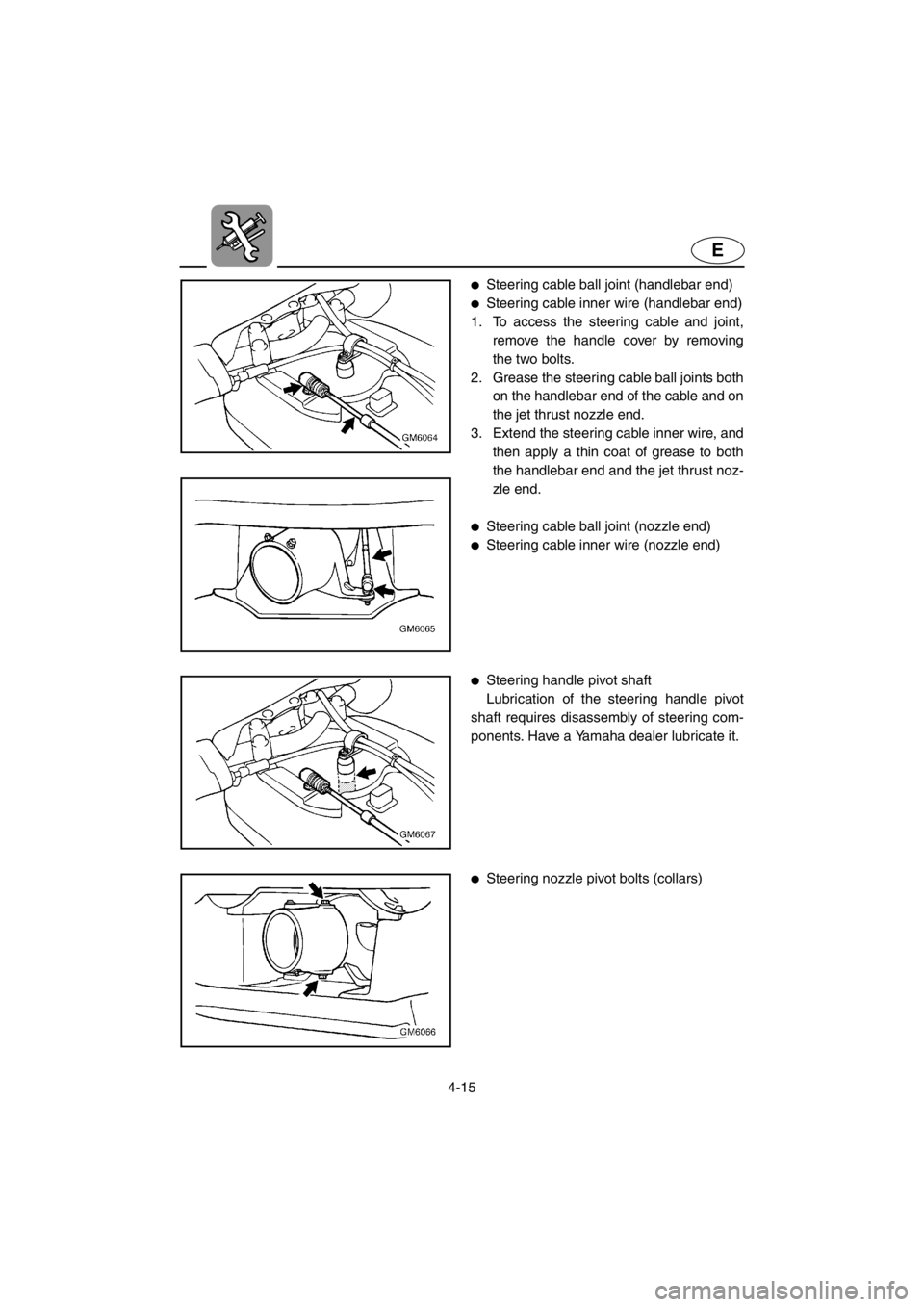
●Steering cable ball joint (handlebar end)
●Steering cable inner wire (handlebar end)
1. To access the steering cable and joint,
remove the handle cover by removing
the two bolts.
2. Grease the steering cable ball joints both
on the handlebar end of the cable and on
the jet thrust nozzle end.
3. Extend the steering cable inner wire, and
then apply a thin coat of grease to both
the handlebar end and the jet thrust noz-
zle end.
●Steering cable ball joint (nozzle end)
●Steering cable inner wire (nozzle end)
●Steering handle pivot shaft
Lubrication of the steering handle pivot
shaft requires disassembly of steering com-
ponents. Have a Yamaha dealer lubricate it.
●Steering nozzle pivot bolts (collars)
E_GM6-4.fm Page 15 Tuesday, July 11, 2000 11:28 AM
Page 89 of 107

4-20
E
EJU00578
Replacing the fuse
The fuse is in the electrical box 1.
To replace the fuse:
1. Remove the cap 2, pull out the red lead,
and bring the fuse holder 3 out of the
electrical box.
2. Open the fuse holder and replace the
fuse4 with one of the correct amper-
age.
WARNING@Do not use fuses of higher amperage
than those recommended. Substitution
of a fuse of improper rating can cause
extensive electrical system damage and
possible fire.
@
Fuse amperage: 10 A
EJU00582
Adjusting the steering friction
The amount of friction in the steering can
be adjusted to suit operator preference.
To adjust the friction:
1. Loosen the four screws, and then
remove the handlebar cover.
2. Turn the handlebars as far as possible to
starboard (right).
3. Loosen the locknut 2.
4. Tighten or loosen the adjusting nut 1
until the desired amount of friction is
reached.
5. Hold the adjusting nut with one wrench
while tightening the locknut with another
wrench.
Tightening torque:
29 Nm (2.9 m·kg, 21 ft·lb)
E_GM6-4.fm Page 20 Tuesday, July 11, 2000 11:28 AM
Page 90 of 107
4-21
E
EJU00953
Adjusting the jet thrust nozzle
angle
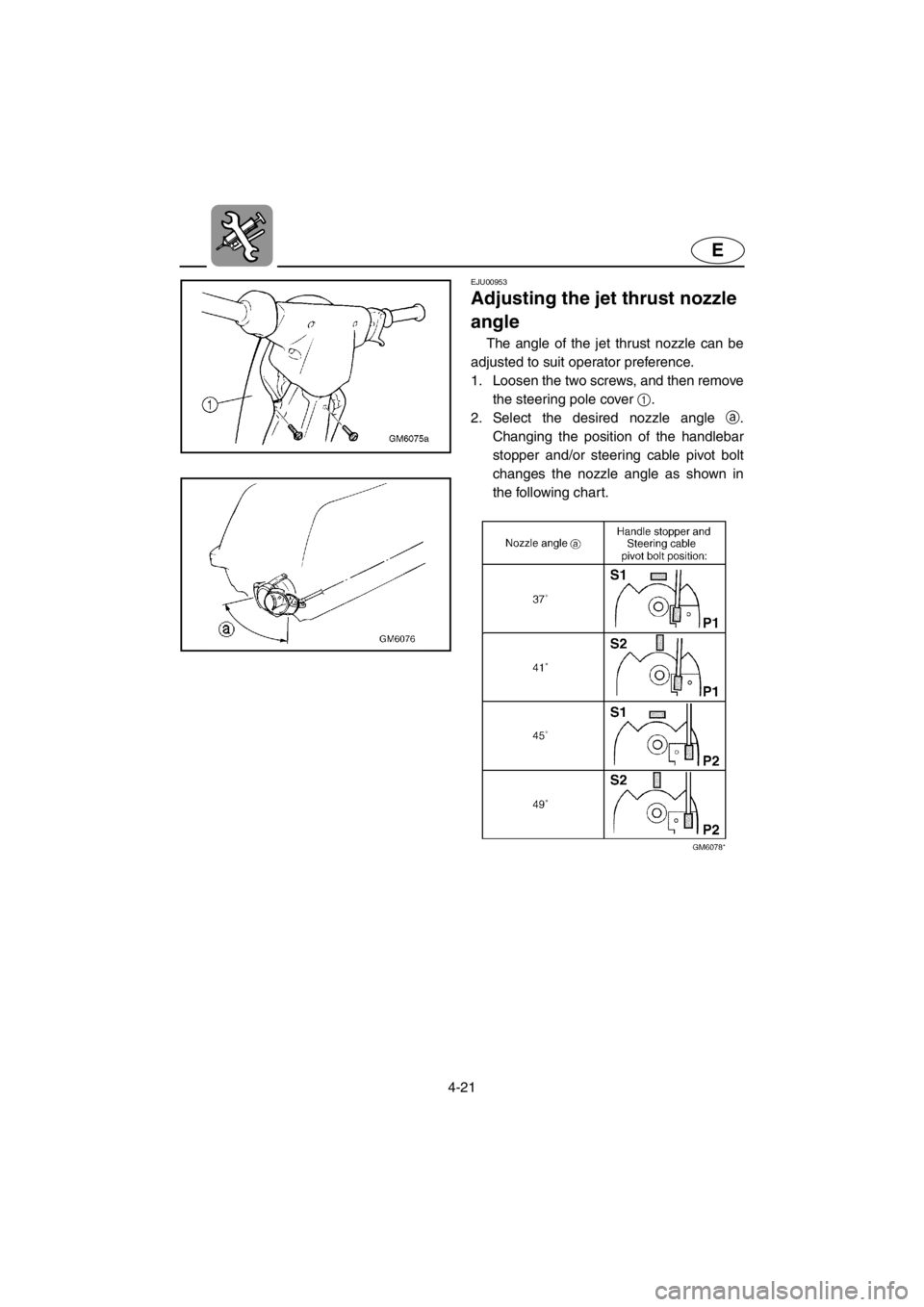
The angle of the jet thrust nozzle can be
adjusted to suit operator preference.
1. Loosen the two screws, and then remove
the steering pole cover 1.
2. Select the desired nozzle angle a.
Changing the position of the handlebar
stopper and/or steering cable pivot bolt
changes the nozzle angle as shown in
the following chart.
E_GM6-4.fm Page 21 Tuesday, July 11, 2000 11:28 AM
Page 91 of 107
4-22
E
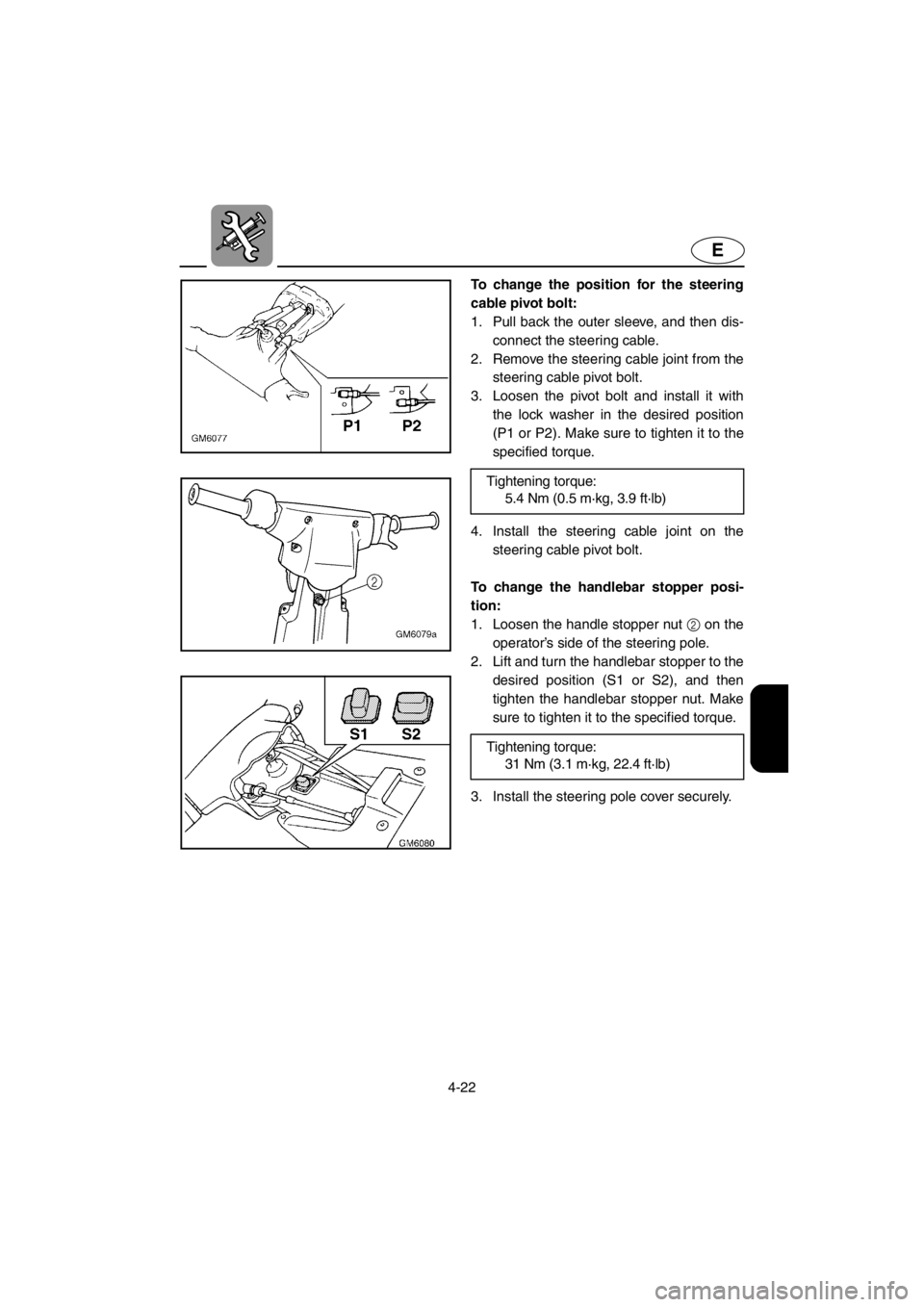
To change the position for the steering
cable pivot bolt:
1. Pull back the outer sleeve, and then dis-
connect the steering cable.
2. Remove the steering cable joint from the
steering cable pivot bolt.
3. Loosen the pivot bolt and install it with
the lock washer in the desired position
(P1 or P2). Make sure to tighten it to the
specified torque.
4. Install the steering cable joint on the
steering cable pivot bolt.
To change the handlebar stopper posi-
tion:
1. Loosen the handle stopper nut 2 on the
operator’s side of the steering pole.
2. Lift and turn the handlebar stopper to the
desired position (S1 or S2), and then
tighten the handlebar stopper nut. Make
sure to tighten it to the specified torque.
3. Install the steering pole cover securely. Tightening torque:
5.4 Nm (0.5 m·kg, 3.9 ft·lb)
Tightening torque:
31 Nm (3.1 m·kg, 22.4 ft·lb)
E_GM6-4.fm Page 22 Tuesday, July 11, 2000 11:28 AM
Page 96 of 107
5-3
E
EJU00597
Emergency procedures
Cleaning the jet intake and
impeller
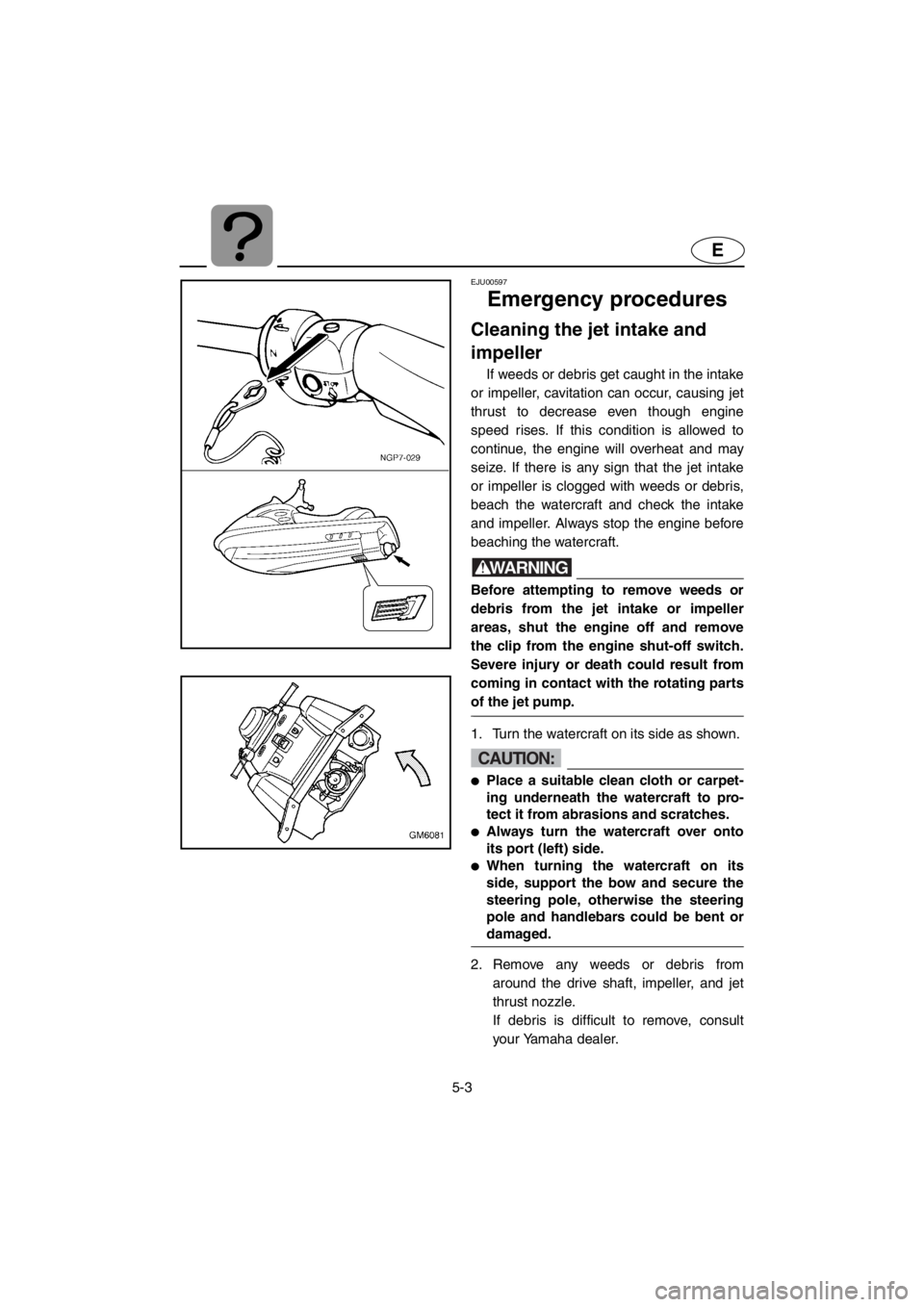
If weeds or debris get caught in the intake
or impeller, cavitation can occur, causing jet
thrust to decrease even though engine
speed rises. If this condition is allowed to
continue, the engine will overheat and may
seize. If there is any sign that the jet intake
or impeller is clogged with weeds or debris,
beach the watercraft and check the intake
and impeller. Always stop the engine before
beaching the watercraft.
WARNING@Before attempting to remove weeds or
debris from the jet intake or impeller
areas, shut the engine off and remove
the clip from the engine shut-off switch.
Severe injury or death could result from
coming in contact with the rotating parts
of the jet pump.
@
1. Turn the watercraft on its side as shown.
CAUTION:@●Place a suitable clean cloth or carpet-
ing underneath the watercraft to pro-
tect it from abrasions and scratches.
●Always turn the watercraft over onto
its port (left) side.
●When turning the watercraft on its
side, support the bow and secure the
steering pole, otherwise the steering
pole and handlebars could be bent or
damaged.
@
2. Remove any weeds or debris from
around the drive shaft, impeller, and jet
thrust nozzle.
If debris is difficult to remove, consult
your Yamaha dealer.
E_GM6-5.fm Page 3 Tuesday, July 11, 2000 11:29 AM
Page 100 of 107
5-7
E
EJU00606
Submerged watercraft
If the watercraft is submerged or flooded
with water, follow the procedure below and
consult a Yamaha dealer as soon as possi-
ble. Failure to do so may result in serious
engine damage!
1. Beach the watercraft and remove the
hood. Turn the watercraft over far
enough to drain the water from the
engine compartment. Make sure all
water is thoroughly drained.
CAUTION:@Turning the watercraft on its side with the
hood removed could cause damage to
the steering pole. Use two people to pro-
vide enough support to make sure that
the steering pole is not damaged.
@
2. Turn the watercraft upright again.
3. Turn the fuel cock knob to “OFF.”
4. Remove the spark plugs and dry them
with a cloth.
5. Without reinstalling the spark plugs,
crank the engine until all water in the cyl-
inders has been drained.
6. Install the spark plugs.
7. Turn the fuel cock knob to “ON.”
8. Launch the watercraft into the water, and
then run the engine for at least
10 minutes. If engine will not start,
repeat steps above.
9. Turn the engine off. Turn the fuel cock
knob to “OFF.”
10. Remove the silencer cap and spray a
rust inhibitor into the carburetor while
cranking the engine.
11. Have the watercraft inspected by a
Yamaha Dealer as soon as possible.
E_GM6-5.fm Page 7 Tuesday, July 11, 2000 11:29 AM