Page 58 of 107
3-23
E
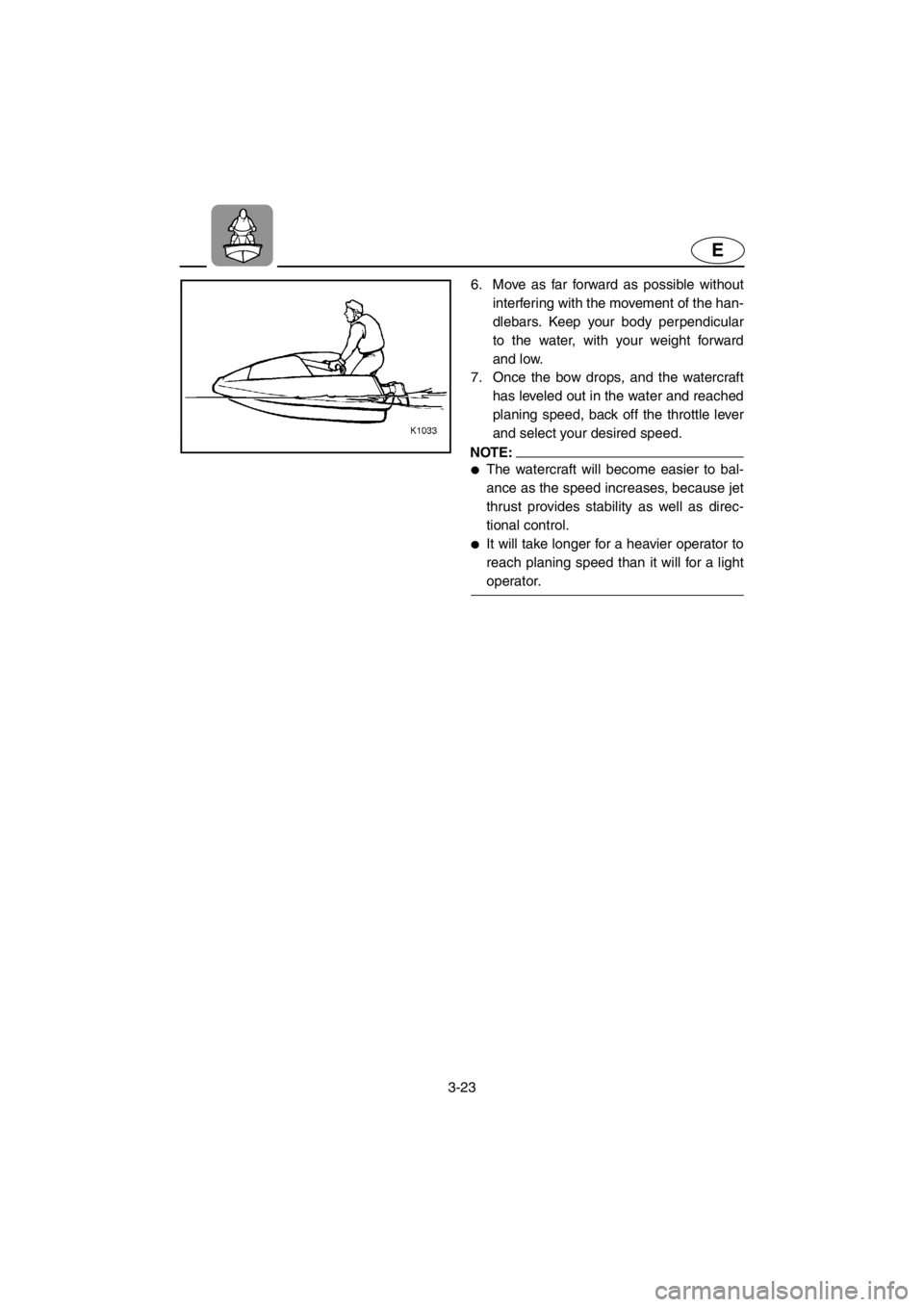
6. Move as far forward as possible without
interfering with the movement of the han-
dlebars. Keep your body perpendicular
to the water, with your weight forward
and low.
7. Once the bow drops, and the watercraft
has leveled out in the water and reached
planing speed, back off the throttle lever
and select your desired speed.
NOTE:@●The watercraft will become easier to bal-
ance as the speed increases, because jet
thrust provides stability as well as direc-
tional control.
●It will take longer for a heavier operator to
reach planing speed than it will for a light
operator.
@
E_GM6-3.fm Page 23 Tuesday, July 11, 2000 10:52 AM
Page 59 of 107
3-24
E
EJU00930
Boarding and starting in shallow
water
Be sure to learn the deep-water starting
method before operating the watercraft in
water where it is too deep for you to stand.
Do not try to start the watercraft in water
less than 60 cm (2 ft) deep.
1. Launch the watercraft into water.
2. Attach the engine shut-off cord to your
wrist. Attach the clip to the engine shut-
off switch.
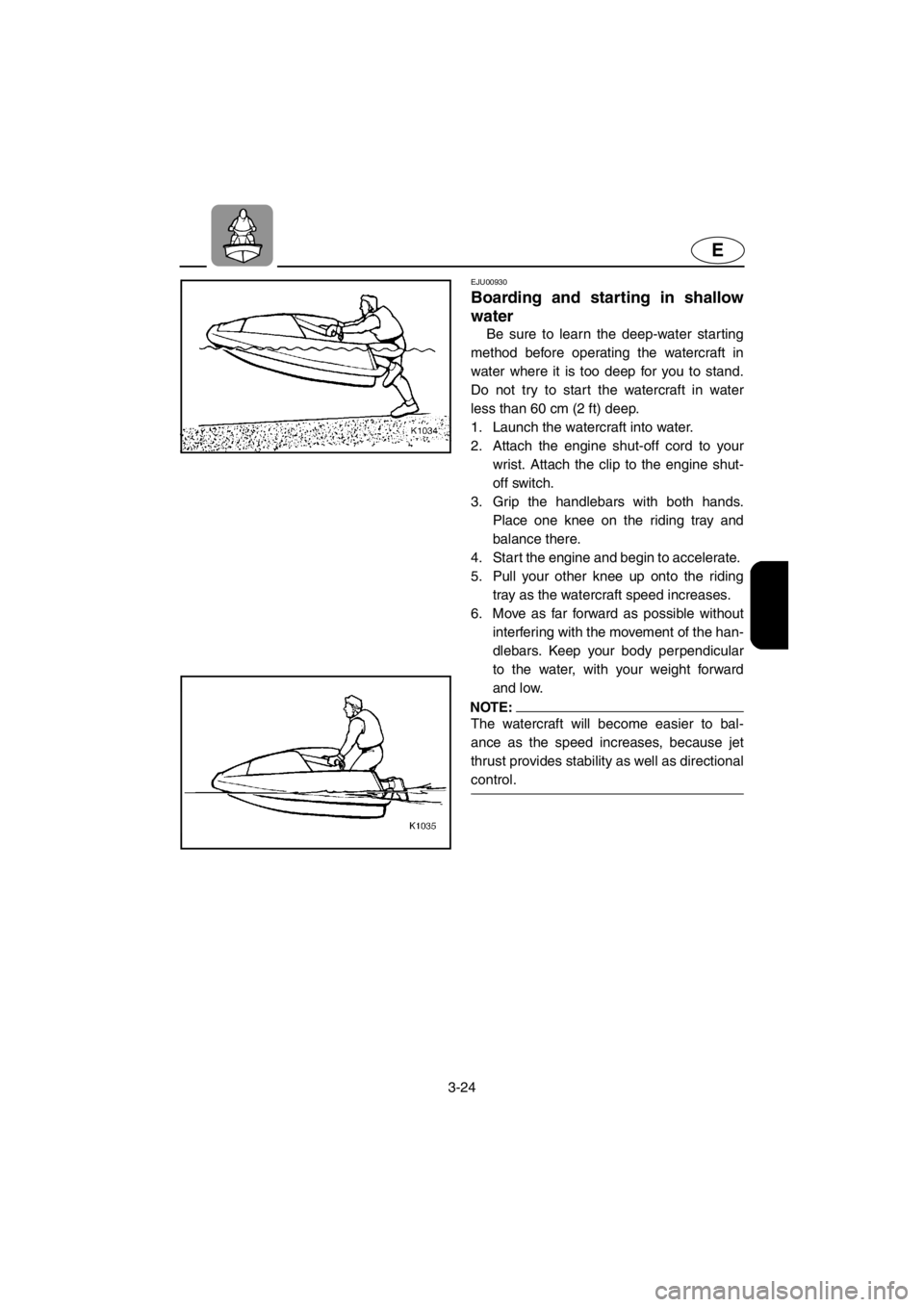
3. Grip the handlebars with both hands.
Place one knee on the riding tray and
balance there.
4. Start the engine and begin to accelerate.
5. Pull your other knee up onto the riding
tray as the watercraft speed increases.
6. Move as far forward as possible without
interfering with the movement of the han-
dlebars. Keep your body perpendicular
to the water, with your weight forward
and low.
NOTE:@The watercraft will become easier to bal-
ance as the speed increases, because jet
thrust provides stability as well as directional
control.
@
E_GM6-3.fm Page 24 Tuesday, July 11, 2000 10:52 AM
Page 60 of 107
3-25
E
EJU00495
Operating positions
After you are underway, you may choose
to kneel or stand, depending upon water-
craft speed, your skill level, and your prefer-
ence. Here are some guidelines.
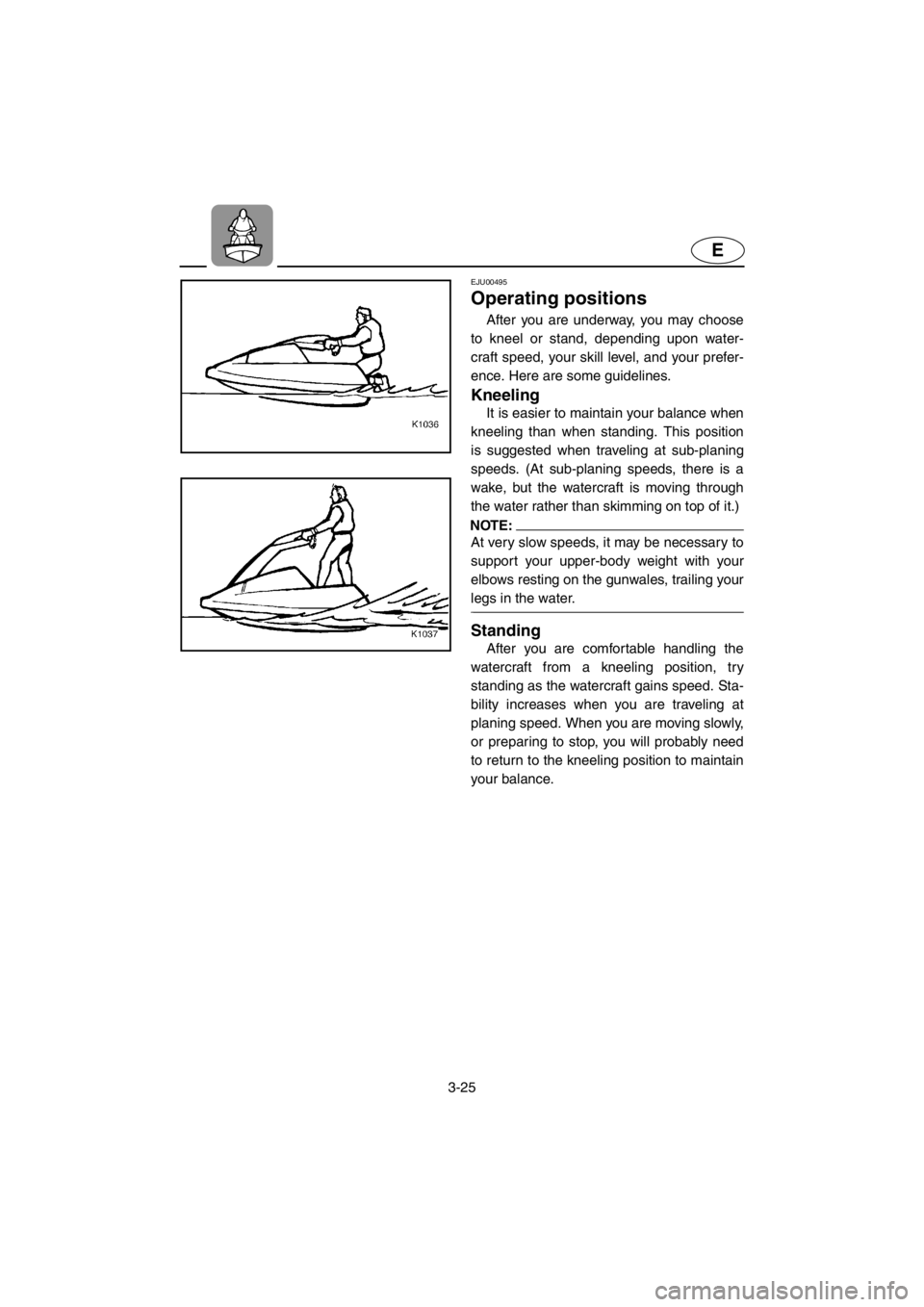
Kneeling
It is easier to maintain your balance when
kneeling than when standing. This position
is suggested when traveling at sub-planing
speeds. (At sub-planing speeds, there is a
wake, but the watercraft is moving through
the water rather than skimming on top of it.)
NOTE:@At very slow speeds, it may be necessary to
support your upper-body weight with your
elbows resting on the gunwales, trailing your
legs in the water.
@
Standing
After you are comfortable handling the
watercraft from a kneeling position, try
standing as the watercraft gains speed. Sta-
bility increases when you are traveling at
planing speed. When you are moving slowly,
or preparing to stop, you will probably need
to return to the kneeling position to maintain
your balance.
E_GM6-3.fm Page 25 Tuesday, July 11, 2000 10:52 AM
Page 64 of 107
3-29
E
EJU00620*
Stopping the watercraft
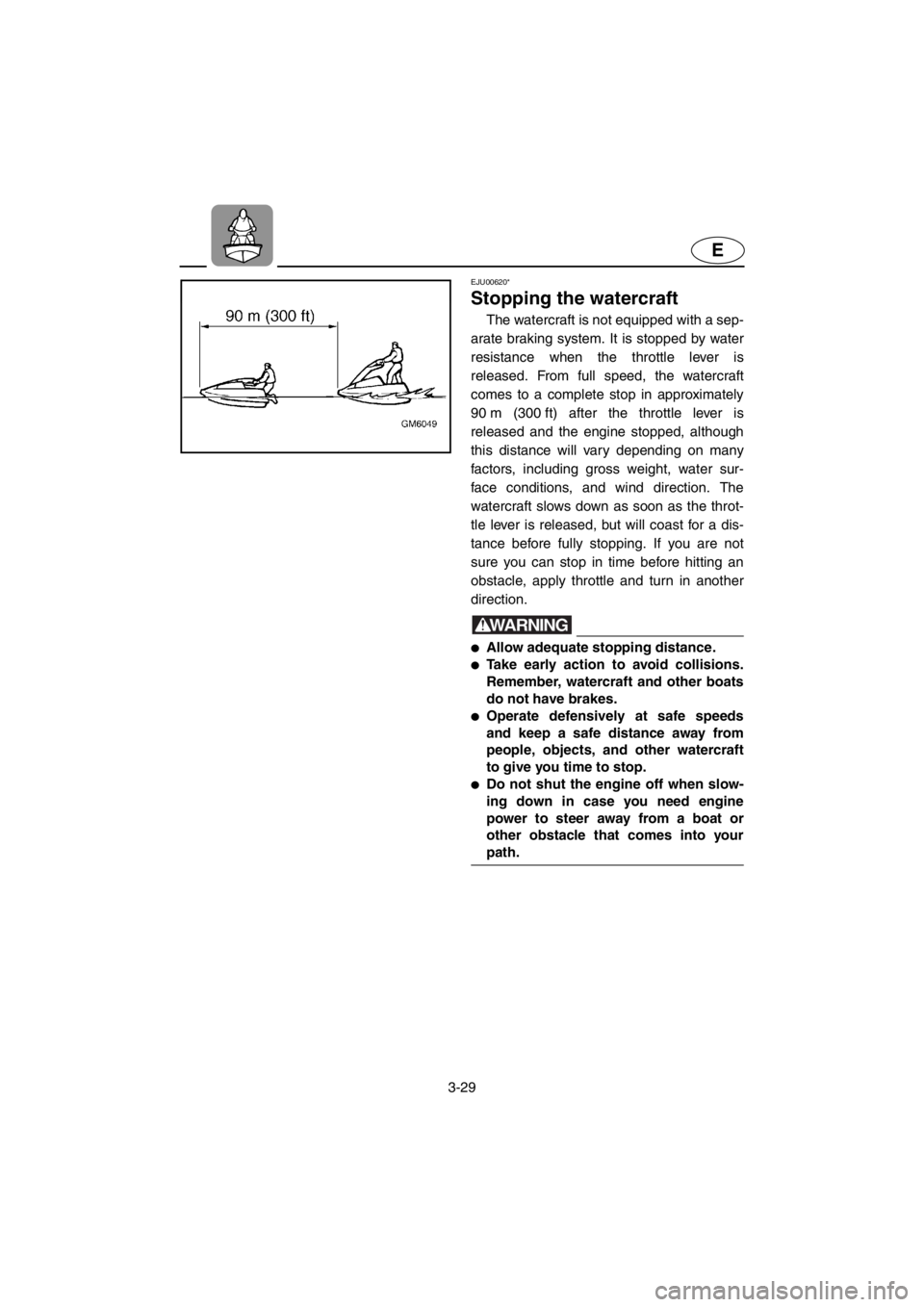
The watercraft is not equipped with a sep-
arate braking system. It is stopped by water
resistance when the throttle lever is
released. From full speed, the watercraft
comes to a complete stop in approximately
90 m (300 ft) after the throttle lever is
released and the engine stopped, although
this distance will vary depending on many
factors, including gross weight, water sur-
face conditions, and wind direction. The
watercraft slows down as soon as the throt-
tle lever is released, but will coast for a dis-
tance before fully stopping. If you are not
sure you can stop in time before hitting an
obstacle, apply throttle and turn in another
direction.
WARNING
●Allow adequate stopping distance.
●Take early action to avoid collisions.
Remember, watercraft and other boats
do not have brakes.
●Operate defensively at safe speeds
and keep a safe distance away from
people, objects, and other watercraft
to give you time to stop.
●Do not shut the engine off when slow-
ing down in case you need engine
power to steer away from a boat or
other obstacle that comes into your
path.
E_GM6-3.fm Page 29 Tuesday, July 11, 2000 10:52 AM
Page 92 of 107

4-23
E
EJU00590
Specifications
*1: Pump Octane Number
*1: Research Octane NumberMODEL
ITEMUnit SJ700
WATERCRAFT CAPACITY
Maximum people on board Number of people 1
DIMENSIONS
Length mm (in) 2,240 (88.2)
Width mm (in) 680 (26.8)
Height mm (in) 660 (26.0)
Dry weight kg (lb) 132 (291)
PERFORMANCE
Maximum power output kW (PS) @ r/min 53.6 (73) @ 6,300
Maximum fuel consumption L/h (US gal/h, Imp gal/h) 29 (7.7, 6.4)
Cruising range at full throttle hr. 0.6
Trolling speed r/min 1,250–1,350
ENGINE
Engine type 2-stroke
Number of cylinders 2
Engine displacement
cm
3 (cu in)701 (42.78)
Bore & stroke mm (in) 81 ×
68 (3.19 ×
2.68)
Compression ratio 7.2
Lubrication system Pre-mixed fuel
Cooling system Water cooled
Starting system Electric starter
Ignition system CDI
Spark plug BR-7HS (NGK)
Spark plug gap mm (in) 0.6–0.7 (0.024–0.028)
Battery capacity V-AH 12-19
Charging system Flywheel magneto
DRIVE UNIT
Propulsion system Jet pump
Jet pump type Mixed flow, single stage
Impeller rotation Counterclockwise (viewed from rear)
Transmission Direct drive from engine
Jet thrust nozzle angle Degree 37, 41, 45, 49
FUEL AND OIL
Recommended fuel Regular unleaded gasoline
Minimum octane rating PON (*1)
RON (*1)86
90
Recommended engine oil YAMALUBE 2-W, or an equivalent NMMA-
certified TC-W3 marine oil
Fuel mixing ratio (fuel to oil) 50:1
Fuel tank capacity
Total L (US gal, Imp gal) 18 (4.8, 4.0)
Reserve L (US gal, Imp gal) 5.5 (1.45, 1.21)
E_GM6-4.fm Page 23 Tuesday, July 11, 2000 11:28 AM
Page 99 of 107
5-6
E
EJU00601
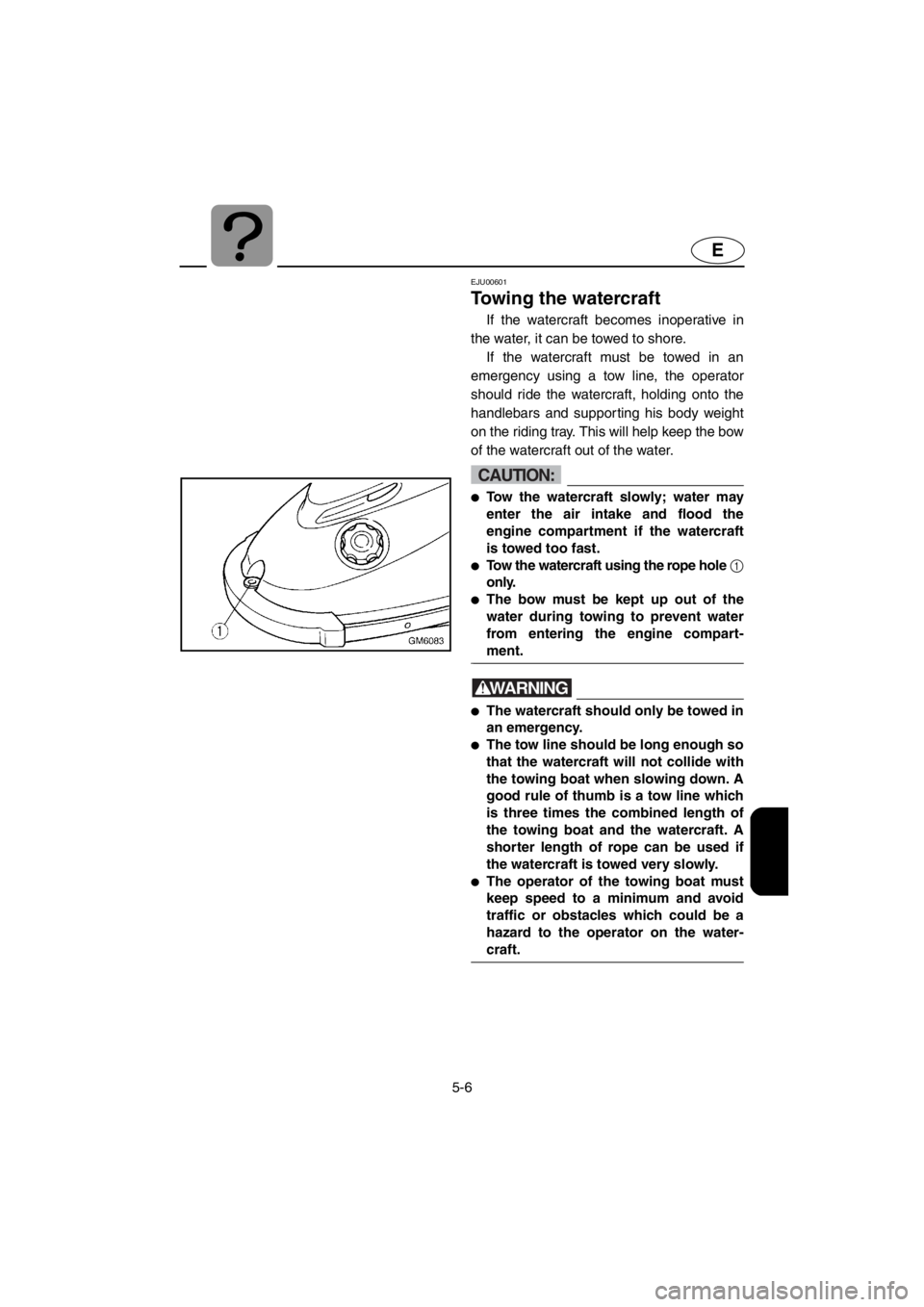
Towing the watercraft
If the watercraft becomes inoperative in
the water, it can be towed to shore.
If the watercraft must be towed in an
emergency using a tow line, the operator
should ride the watercraft, holding onto the
handlebars and supporting his body weight
on the riding tray. This will help keep the bow
of the watercraft out of the water.
CAUTION:@●Tow the watercraft slowly; water may
enter the air intake and flood the
engine compartment if the watercraft
is towed too fast.
●Tow the watercraft using the rope hole 1
only.
●The bow must be kept up out of the
water during towing to prevent water
from entering the engine compart-
ment.
@
WARNING@●The watercraft should only be towed in
an emergency.
●The tow line should be long enough so
that the watercraft will not collide with
the towing boat when slowing down. A
good rule of thumb is a tow line which
is three times the combined length of
the towing boat and the watercraft. A
shorter length of rope can be used if
the watercraft is towed very slowly.
●The operator of the towing boat must
keep speed to a minimum and avoid
traffic or obstacles which could be a
hazard to the operator on the water-
craft.
@
E_GM6-5.fm Page 6 Tuesday, July 11, 2000 11:29 AM