Page 23 of 107
E
2
EJU00326
FEATURES AND
FUNCTIONS
Location of main components............... 2-1
Operation of controls and other
functions ................................................... 2-3
Hood ........................................................ 2-3
Fuel tank filler cap ................................... 2-4
Fuel cock knob........................................ 2-4
Engine stop switch .................................. 2-5
Engine shut-off switch............................. 2-5
Choke knob ............................................. 2-6
Throttle lever ........................................... 2-6
Start switch.............................................. 2-6
Cooling water pilot outlet ........................ 2-7
Steering system ...................................... 2-7
Steering pole ........................................... 2-8
Engine overheat warning system ........... 2-9
Storage pouch....................................... 2-10
E_GM6-2TOC.fm Page 1 Tuesday, July 11, 2000 10:50 AM
Page 24 of 107
2-1
E
EJU00327
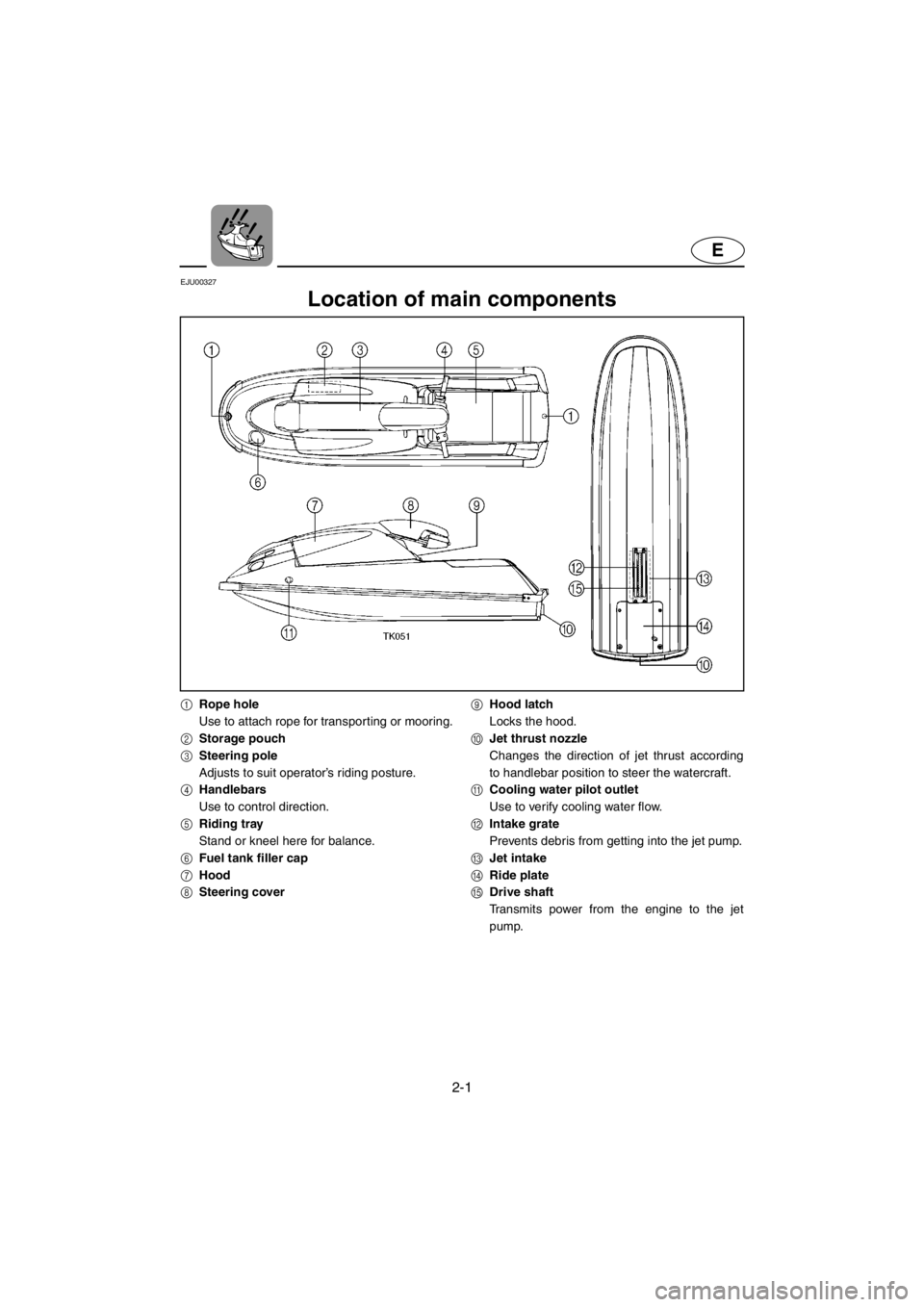
Location of main components
1Rope hole
Use to attach rope for transporting or mooring.
2Storage pouch
3Steering pole
Adjusts to suit operator’s riding posture.
4Handlebars
Use to control direction.
5Riding tray
Stand or kneel here for balance.
6Fuel tank filler cap
7Hood
8Steering cover9Hood latch
Locks the hood.
0Jet thrust nozzle
Changes the direction of jet thrust according
to handlebar position to steer the watercraft.
ACooling water pilot outlet
Use to verify cooling water flow.
BIntake grate
Prevents debris from getting into the jet pump.
CJet intake
DRide plate
EDrive shaft
Transmits power from the engine to the jet
pump.
E_GM6-2.fm Page 1 Tuesday, July 11, 2000 10:51 AM
Page 26 of 107
2-3
E
EJU00328
Operation of controls and
other functions
EJU00338
Hood
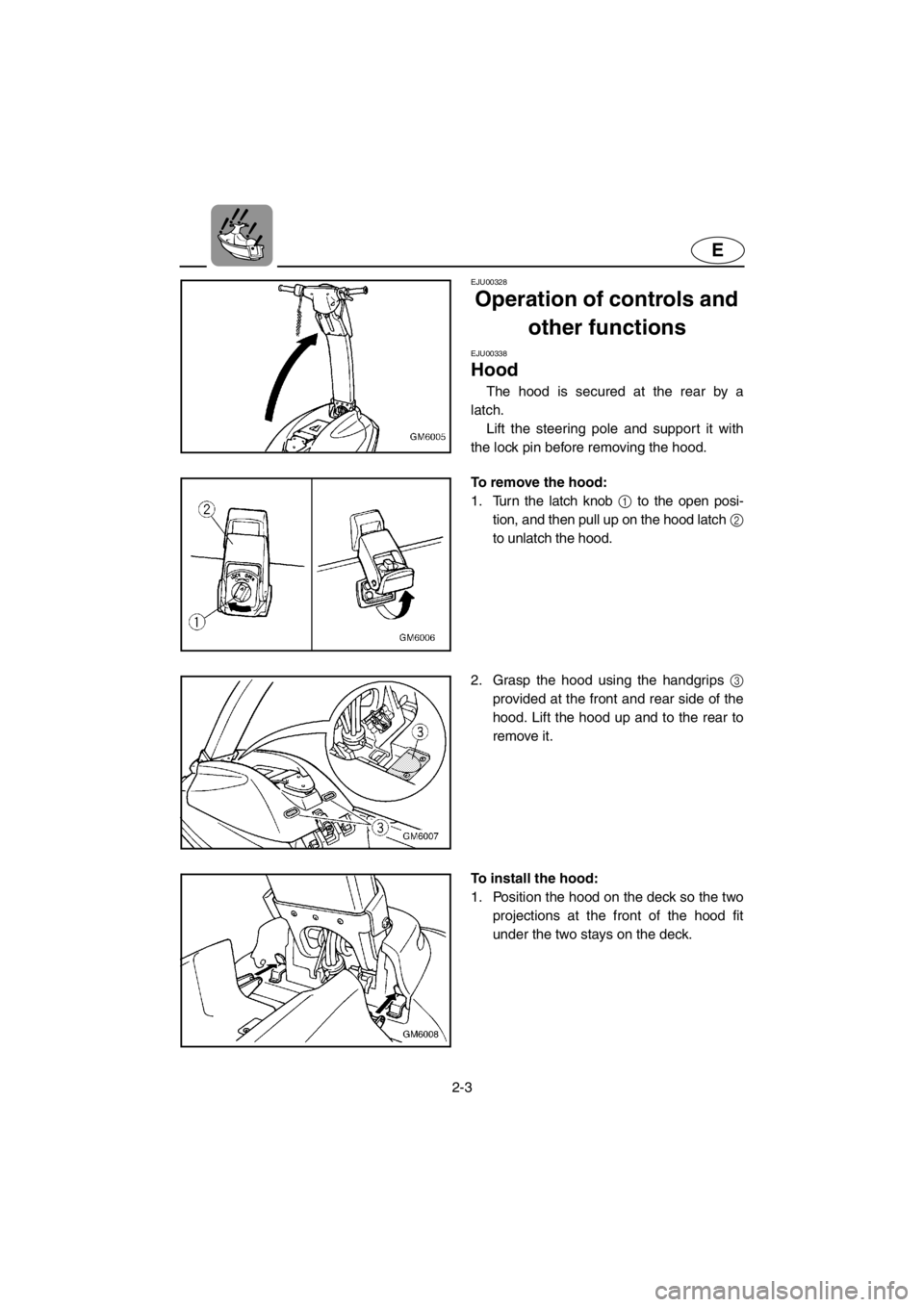
The hood is secured at the rear by a
latch.
Lift the steering pole and support it with
the lock pin before removing the hood.
To remove the hood:
1. Turn the latch knob 1 to the open posi-
tion, and then pull up on the hood latch 2
to unlatch the hood.
2. Grasp the hood using the handgrips 3
provided at the front and rear side of the
hood. Lift the hood up and to the rear to
remove it.
To install the hood:
1. Position the hood on the deck so the two
projections at the front of the hood fit
under the two stays on the deck.
E_GM6-2.fm Page 3 Tuesday, July 11, 2000 10:51 AM
Page 30 of 107
2-7
E
EJU00923
Cooling water pilot outlet
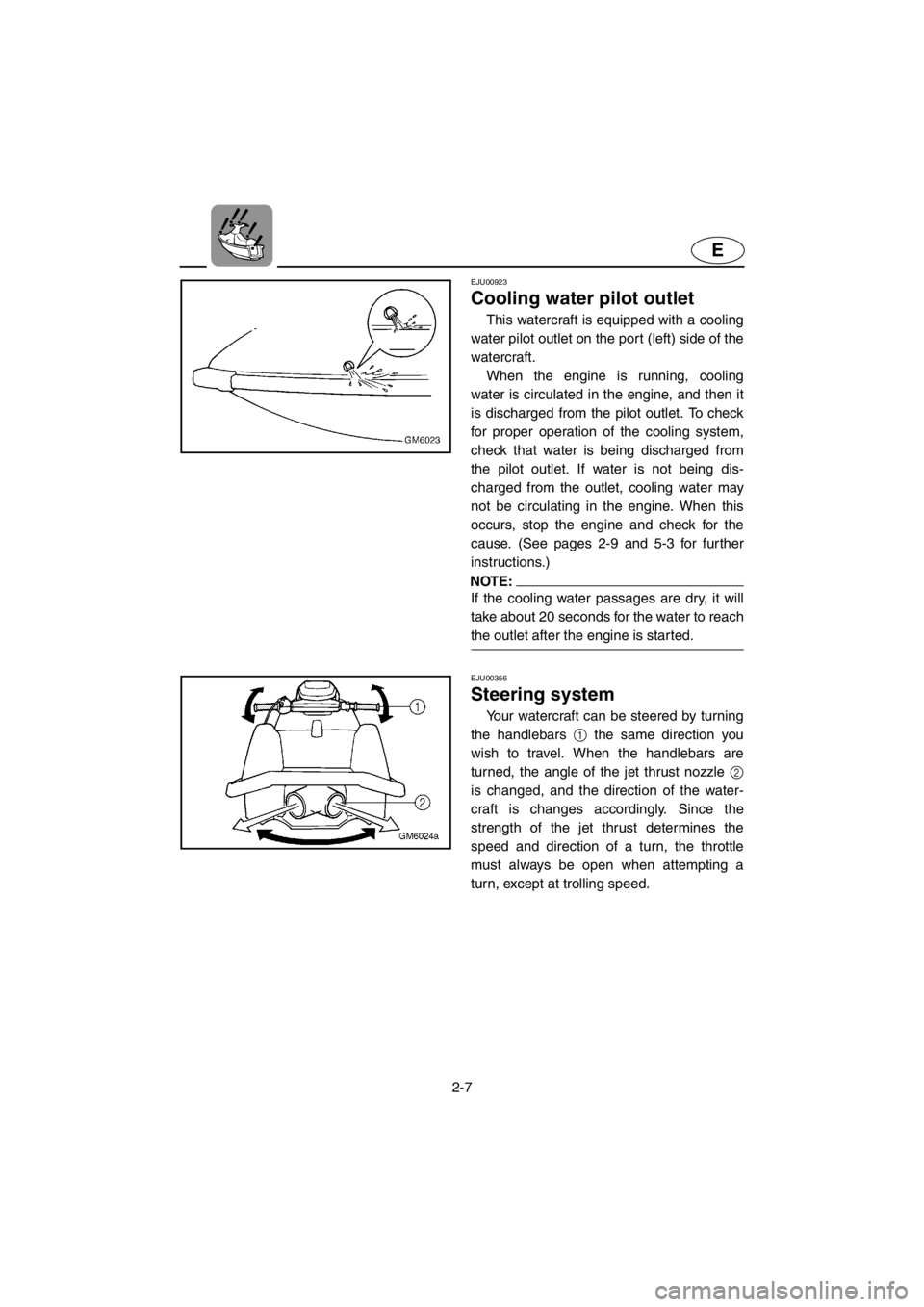
This watercraft is equipped with a cooling
water pilot outlet on the port (left) side of the
watercraft.
When the engine is running, cooling
water is circulated in the engine, and then it
is discharged from the pilot outlet. To check
for proper operation of the cooling system,
check that water is being discharged from
the pilot outlet. If water is not being dis-
charged from the outlet, cooling water may
not be circulating in the engine. When this
occurs, stop the engine and check for the
cause. (See pages 2-9 and 5-3 for further
instructions.)
NOTE:@If the cooling water passages are dry, it will
take about 20 seconds for the water to reach
the outlet after the engine is started.
@
EJU00356
Steering system
Your watercraft can be steered by turning
the handlebars 1 the same direction you
wish to travel. When the handlebars are
turned, the angle of the jet thrust nozzle 2
is changed, and the direction of the water-
craft is changes accordingly. Since the
strength of the jet thrust determines the
speed and direction of a turn, the throttle
must always be open when attempting a
turn, except at trolling speed.
E_GM6-2.fm Page 7 Tuesday, July 11, 2000 10:51 AM
Page 31 of 107
2-8
E
EJU00357
Steering pole
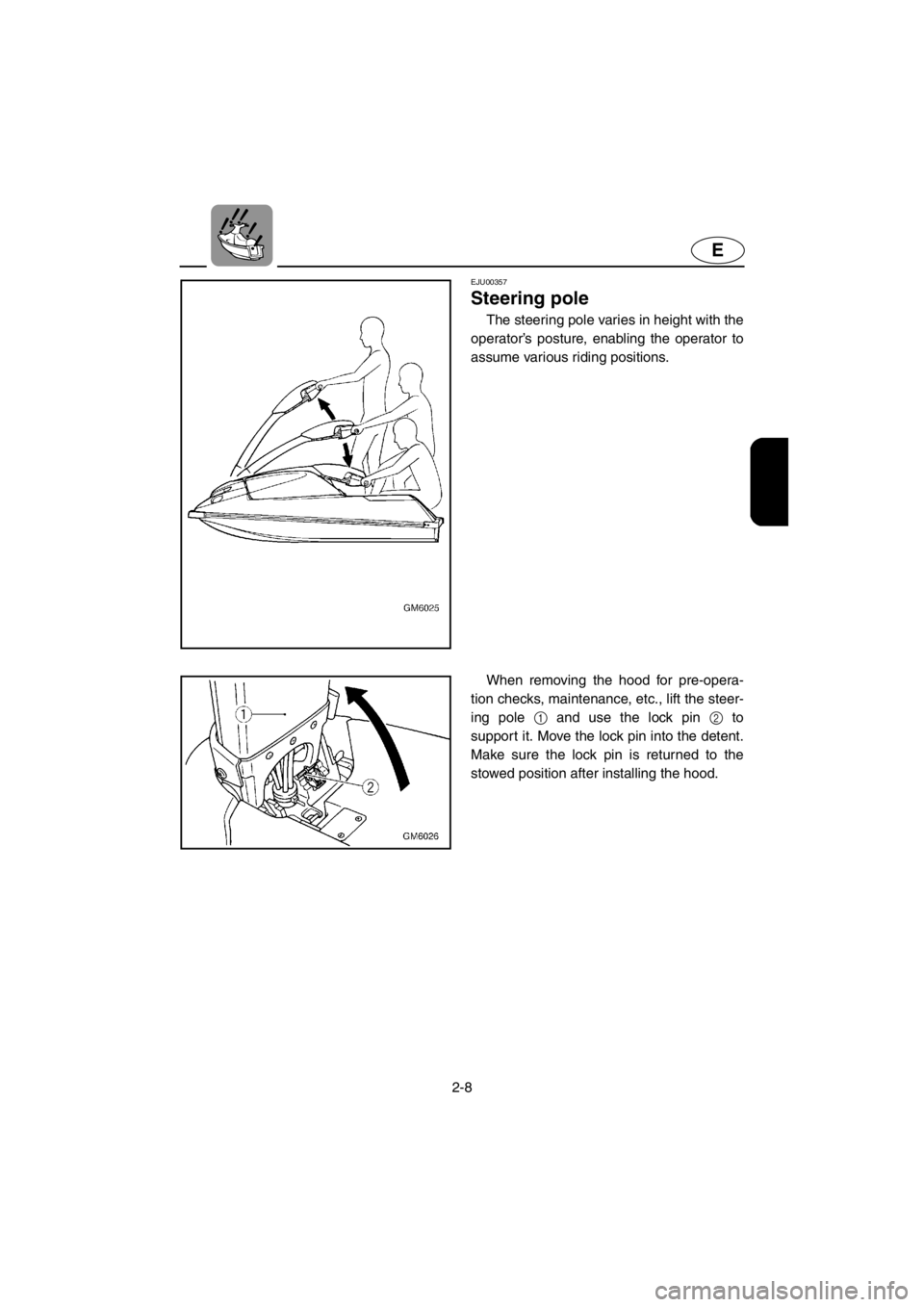
The steering pole varies in height with the
operator’s posture, enabling the operator to
assume various riding positions.
When removing the hood for pre-opera-
tion checks, maintenance, etc., lift the steer-
ing pole 1 and use the lock pin 2 to
support it. Move the lock pin into the detent.
Make sure the lock pin is returned to the
stowed position after installing the hood.
E_GM6-2.fm Page 8 Tuesday, July 11, 2000 10:51 AM
Page 39 of 107
3-4
E
Filling the fuel tank
CAUTION:@Be careful when refueling. Avoid getting
water or other contaminants in the fuel
tank. Contaminated fuel can cause poor
running or engine damage.
@
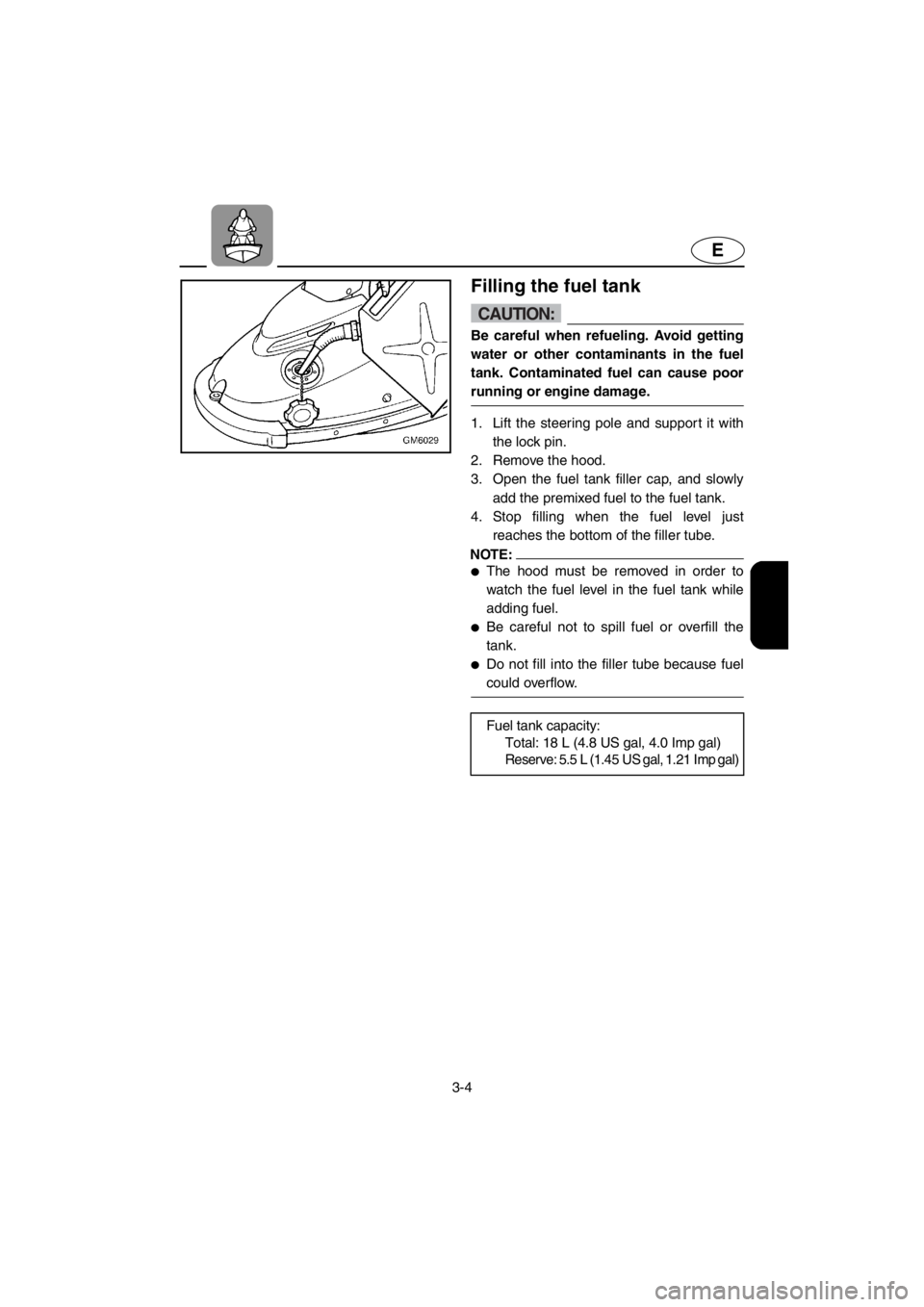
1. Lift the steering pole and support it with
the lock pin.
2. Remove the hood.
3. Open the fuel tank filler cap, and slowly
add the premixed fuel to the fuel tank.
4. Stop filling when the fuel level just
reaches the bottom of the filler tube.
NOTE:@●The hood must be removed in order to
watch the fuel level in the fuel tank while
adding fuel.
●Be careful not to spill fuel or overfill the
tank.
●Do not fill into the filler tube because fuel
could overflow.
@
Fuel tank capacity:
Total: 18 L (4.8 US gal, 4.0 Imp gal)
Reserve: 5.5 L (1.45 US gal, 1.21 Imp gal)
E_GM6-3.fm Page 4 Tuesday, July 11, 2000 10:52 AM
Page 40 of 107
3-5
E
EJU00422
Pre-operation checks
Pre-operation check list
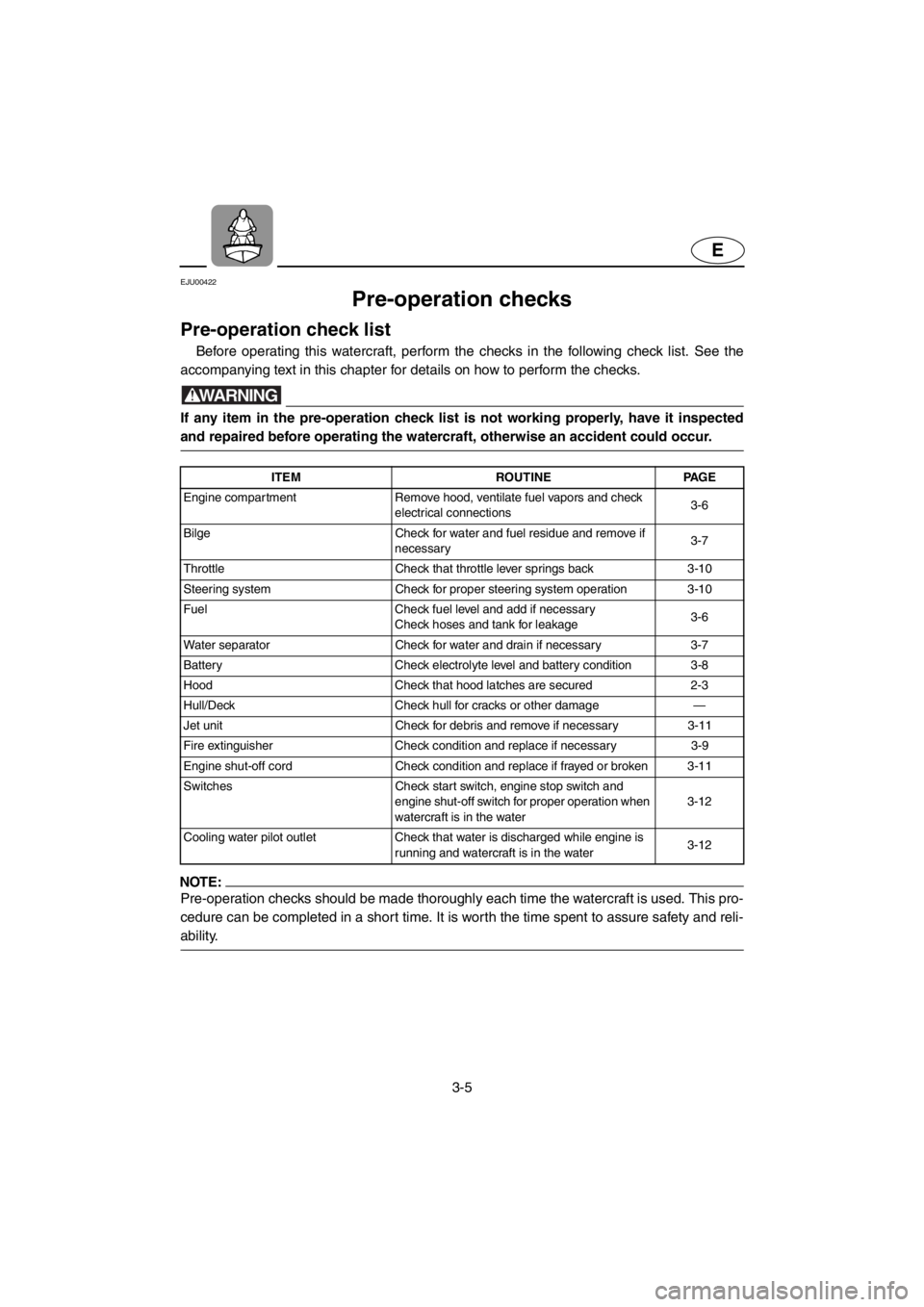
Before operating this watercraft, perform the checks in the following check list. See the
accompanying text in this chapter for details on how to perform the checks.
WARNING@If any item in the pre-operation check list is not working properly, have it inspected
and repaired before operating the watercraft, otherwise an accident could occur.
@
NOTE:@Pre-operation checks should be made thoroughly each time the watercraft is used. This pro-
cedure can be completed in a short time. It is worth the time spent to assure safety and reli-
ability.
@
ITEM ROUTINE PAGE
Engine compar tment Remove hood, ventilate fuel vapors and check
electrical connections3-6
Bilge Check for water and fuel residue and remove if
necessary3-7
Throttle Check that throttle lever springs back 3-10
Steering system Check for proper steering system operation 3-10
Fuel Check fuel level and add if necessary
Check hoses and tank for leakage3-6
Water separator Check for water and drain if necessary 3-7
Battery Check electrolyte level and battery condition 3-8
Hood Check that hood latches are secured 2-3
Hull/Deck Check hull for cracks or other damage —
Jet unit Check for debris and remove if necessary 3-11
Fire extinguisher Check condition and replace if necessary 3-9
Engine shut-off cord Check condition and replace if frayed or broken 3-11
Switches Check start switch, engine stop switch and
engine shut-off switch for proper operation when
watercraft is in the water 3-12
Cooling water pilot outlet Check that water is discharged while engine is
running and watercraft is in the water3-12
E_GM6-3.fm Page 5 Tuesday, July 11, 2000 10:52 AM
Page 41 of 107
3-6
E
EJU00424
Pre-operation check points
Engine compartment
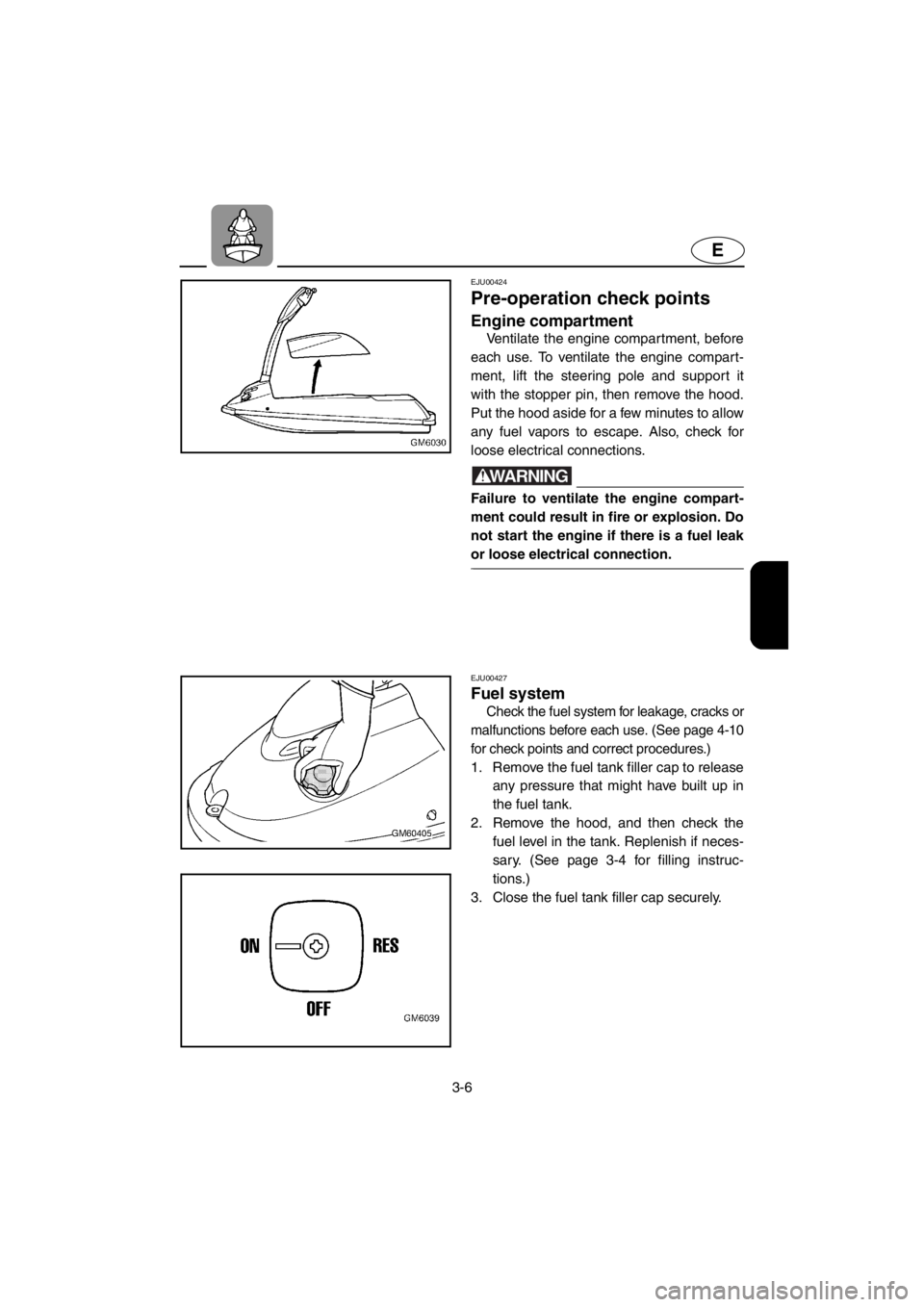
Ventilate the engine compartment, before
each use. To ventilate the engine compart-
ment, lift the steering pole and support it
with the stopper pin, then remove the hood.
Put the hood aside for a few minutes to allow
any fuel vapors to escape. Also, check for
loose electrical connections.
WARNING@Failure to ventilate the engine compart-
ment could result in fire or explosion. Do
not start the engine if there is a fuel leak
or loose electrical connection.
@
EJU00427
Fuel system
Check the fuel system for leakage, cracks or
malfunctions before each use. (See page 4-10
for check points and correct procedures.)
1. Remove the fuel tank filler cap to release
any pressure that might have built up in
the fuel tank.
2. Remove the hood, and then check the
fuel level in the tank. Replenish if neces-
sary. (See page 3-4 for filling instruc-
tions.)
3. Close the fuel tank filler cap securely.
E_GM6-3.fm Page 6 Tuesday, July 11, 2000 10:52 AM