Page 86 of 107
4-17
E
EJU00572
Inspecting the battery
Check the level of the battery electrolyte
and make sure the leads are secure.
WARNING@Battery electrolyte is poisonous and dan-
gerous, causing severe burns, etc. Elec-
trolyte contains sulfuric acid. Avoid
contact with skin, eyes or clothing.
Antidotes
External: Flush with water.
Internal: Drink large quantities of water
or milk. Follow with milk of magnesia,
beaten egg or vegetable oil. Call physi-
cian immediately.
Eyes: Flush with water for 15 minutes
and get prompt medical attention.
Batteries produce explosive gases. Keep
sparks, flame, cigarettes, etc., well away.
If using or charging the battery in an
enclosed space, make sure that it is well
ventilated. Always shield your eyes when
working near batteries.
KEEP OUT OF THE REACH OF CHIL-
DREN.
@
CAUTION:
Be careful not to place the battery on its
side.
Make sure to remove the battery from the
battery compartment when adding the
battery electrolyte or charging the bat-
tery.
When checking the battery, make sure
the breather hose is connected to the
battery and not obstructed.
@
E_GM6-4.fm Page 17 Tuesday, July 11, 2000 11:28 AM
Page 87 of 107
4-18
E
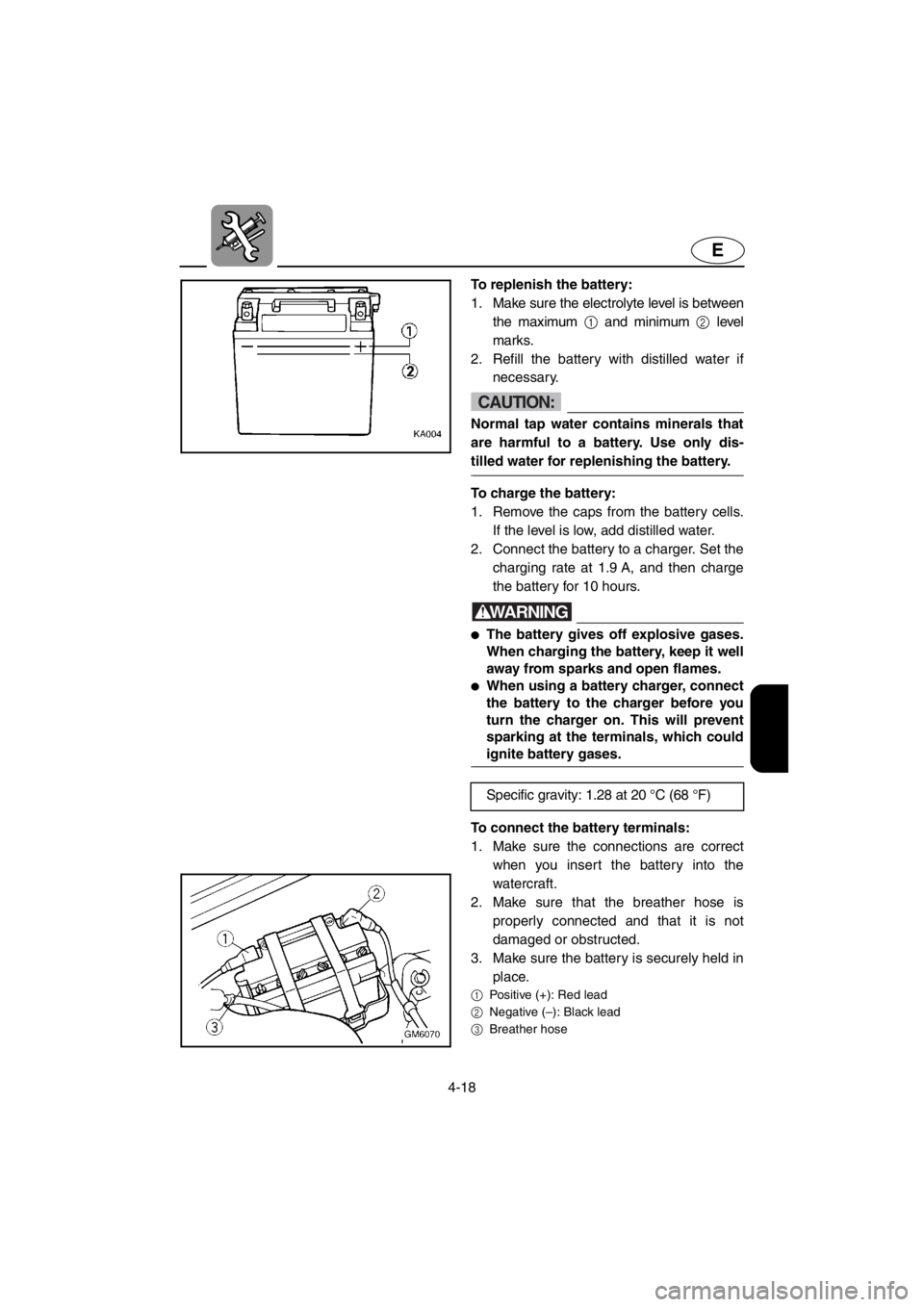
To replenish the battery:
1. Make sure the electrolyte level is between
the maximum 1 and minimum 2 level
marks.
2. Refill the battery with distilled water if
necessary.
CAUTION:@Normal tap water contains minerals that
are harmful to a battery. Use only dis-
tilled water for replenishing the battery.
@
To charge the battery:
1. Remove the caps from the battery cells.
If the level is low, add distilled water.
2. Connect the battery to a charger. Set the
charging rate at 1.9 A, and then charge
the battery for 10 hours.
WARNING@●The battery gives off explosive gases.
When charging the battery, keep it well
away from sparks and open flames.
●When using a battery charger, connect
the battery to the charger before you
turn the charger on. This will prevent
sparking at the terminals, which could
ignite battery gases.
@
To connect the battery terminals:
1. Make sure the connections are correct
when you insert the battery into the
watercraft.
2. Make sure that the breather hose is
properly connected and that it is not
damaged or obstructed.
3. Make sure the battery is securely held in
place.
1Positive (+): Red lead
2Negative (–): Black lead
3Breather hose
Specific gravity: 1.28 at 20 °C (68 °F)
E_GM6-4.fm Page 18 Tuesday, July 11, 2000 11:28 AM
Page 92 of 107

4-23
E
EJU00590
Specifications
*1: Pump Octane Number
*1: Research Octane NumberMODEL
ITEMUnit SJ700
WATERCRAFT CAPACITY
Maximum people on board Number of people 1
DIMENSIONS
Length mm (in) 2,240 (88.2)
Width mm (in) 680 (26.8)
Height mm (in) 660 (26.0)
Dry weight kg (lb) 132 (291)
PERFORMANCE
Maximum power output kW (PS) @ r/min 53.6 (73) @ 6,300
Maximum fuel consumption L/h (US gal/h, Imp gal/h) 29 (7.7, 6.4)
Cruising range at full throttle hr. 0.6
Trolling speed r/min 1,250–1,350
ENGINE
Engine type 2-stroke
Number of cylinders 2
Engine displacement
cm
3 (cu in)701 (42.78)
Bore & stroke mm (in) 81 ×
68 (3.19 ×
2.68)
Compression ratio 7.2
Lubrication system Pre-mixed fuel
Cooling system Water cooled
Starting system Electric starter
Ignition system CDI
Spark plug BR-7HS (NGK)
Spark plug gap mm (in) 0.6–0.7 (0.024–0.028)
Battery capacity V-AH 12-19
Charging system Flywheel magneto
DRIVE UNIT
Propulsion system Jet pump
Jet pump type Mixed flow, single stage
Impeller rotation Counterclockwise (viewed from rear)
Transmission Direct drive from engine
Jet thrust nozzle angle Degree 37, 41, 45, 49
FUEL AND OIL
Recommended fuel Regular unleaded gasoline
Minimum octane rating PON (*1)
RON (*1)86
90
Recommended engine oil YAMALUBE 2-W, or an equivalent NMMA-
certified TC-W3 marine oil
Fuel mixing ratio (fuel to oil) 50:1
Fuel tank capacity
Total L (US gal, Imp gal) 18 (4.8, 4.0)
Reserve L (US gal, Imp gal) 5.5 (1.45, 1.21)
E_GM6-4.fm Page 23 Tuesday, July 11, 2000 11:28 AM
Page 97 of 107
5-4
E
CAUTION:@Always avoid operating your watercraft in
areas where weed growth is thick. If trav-
eling in weeded areas is unavoidable,
operate the engine alternately at partial
throttle and full throttle. Weeds tend to
accumulate more at a steady speed and
at trolling speed. If weeds clog the intake
or impeller area and cause cavitation, fol-
low the cleaning procedure above.
@
EJU00599
Jumping the battery
If the watercraft battery has run down, the
engine can be started using a 12-volt bat-
tery and jumper cables.
WARNING@Battery electrolyte is poisonous and dan-
gerous, causing severe burns, etc. Elec-
trolyte contains sulfuric acid. Avoid
contact with skin, eyes or clothing.
Antidotes
External: Flush with water.
Internal: Drink large quantities of water
or milk. Follow with milk of magnesia,
beaten egg, or vegetable oil. Call physi-
cian immediately.
Eyes: Flush with water for 15 minutes
and get prompt medical attention
Batteries give off explosive gases. Keep
sparks, flame, cigarettes, etc. well away.
If using or charging the battery in an
enclosed area, make sure that it is well
ventilated. Always shield your eyes when
working near batteries.
KEEP OUT OF THE REACH OF CHIL-
DREN
@
E_GM6-5.fm Page 4 Tuesday, July 11, 2000 11:29 AM