Page 31 of 107
2-8
E
EJU00357
Steering pole
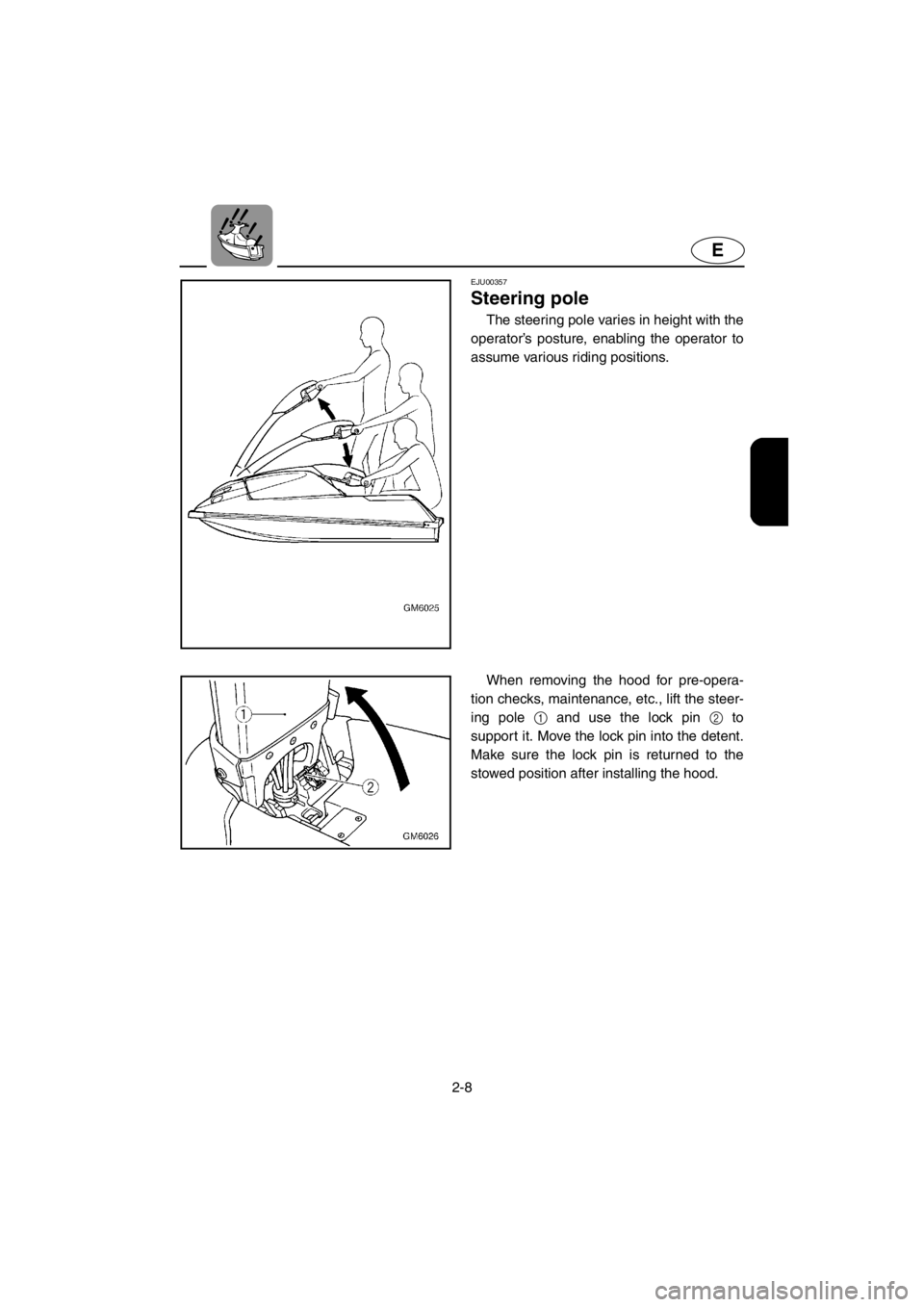
The steering pole varies in height with the
operator’s posture, enabling the operator to
assume various riding positions.
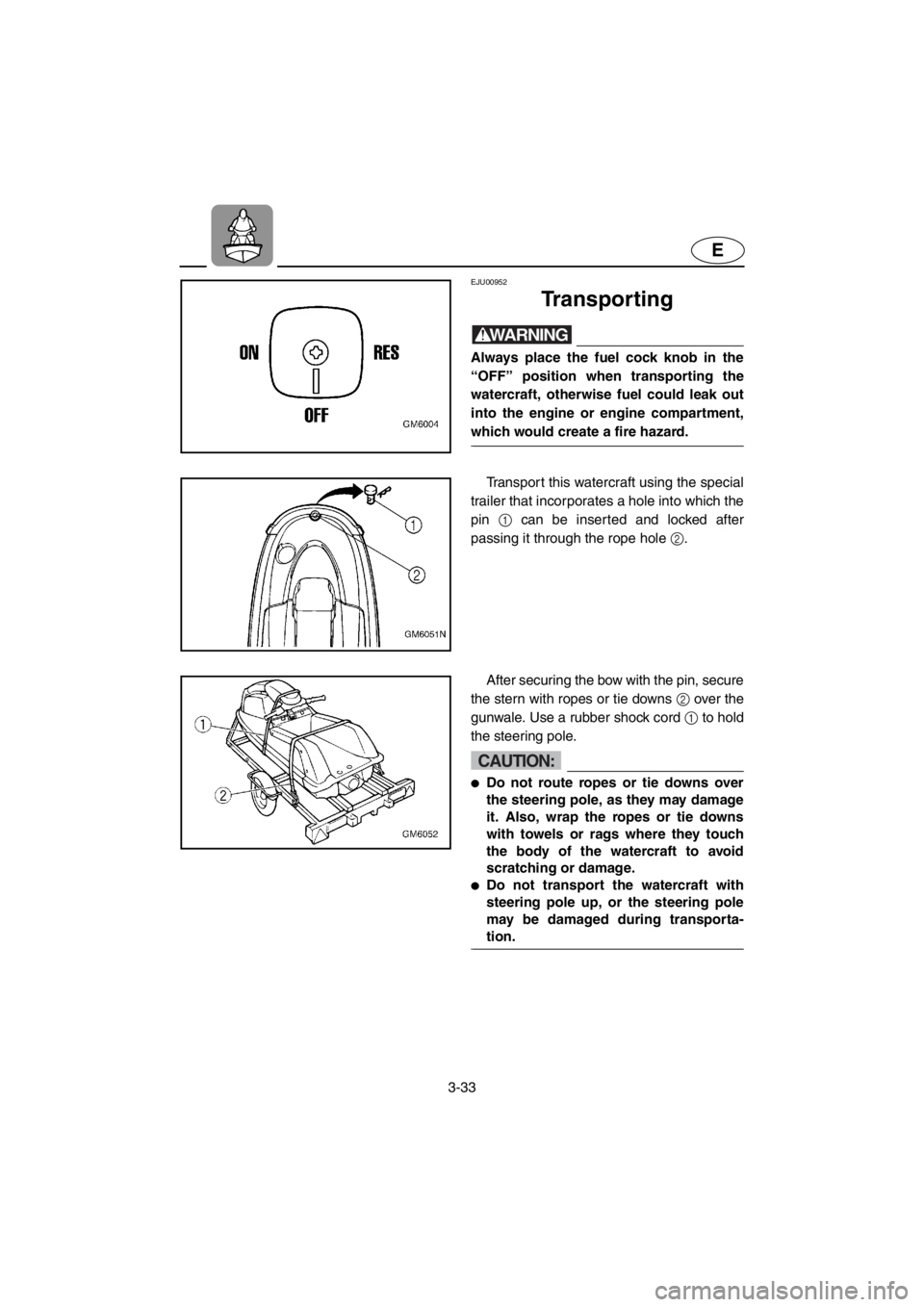
When removing the hood for pre-opera-
tion checks, maintenance, etc., lift the steer-
ing pole 1 and use the lock pin 2 to
support it. Move the lock pin into the detent.
Make sure the lock pin is returned to the
stowed position after installing the hood.
E_GM6-2.fm Page 8 Tuesday, July 11, 2000 10:51 AM
Page 68 of 107
3-33
E
EJU00952
Transporting
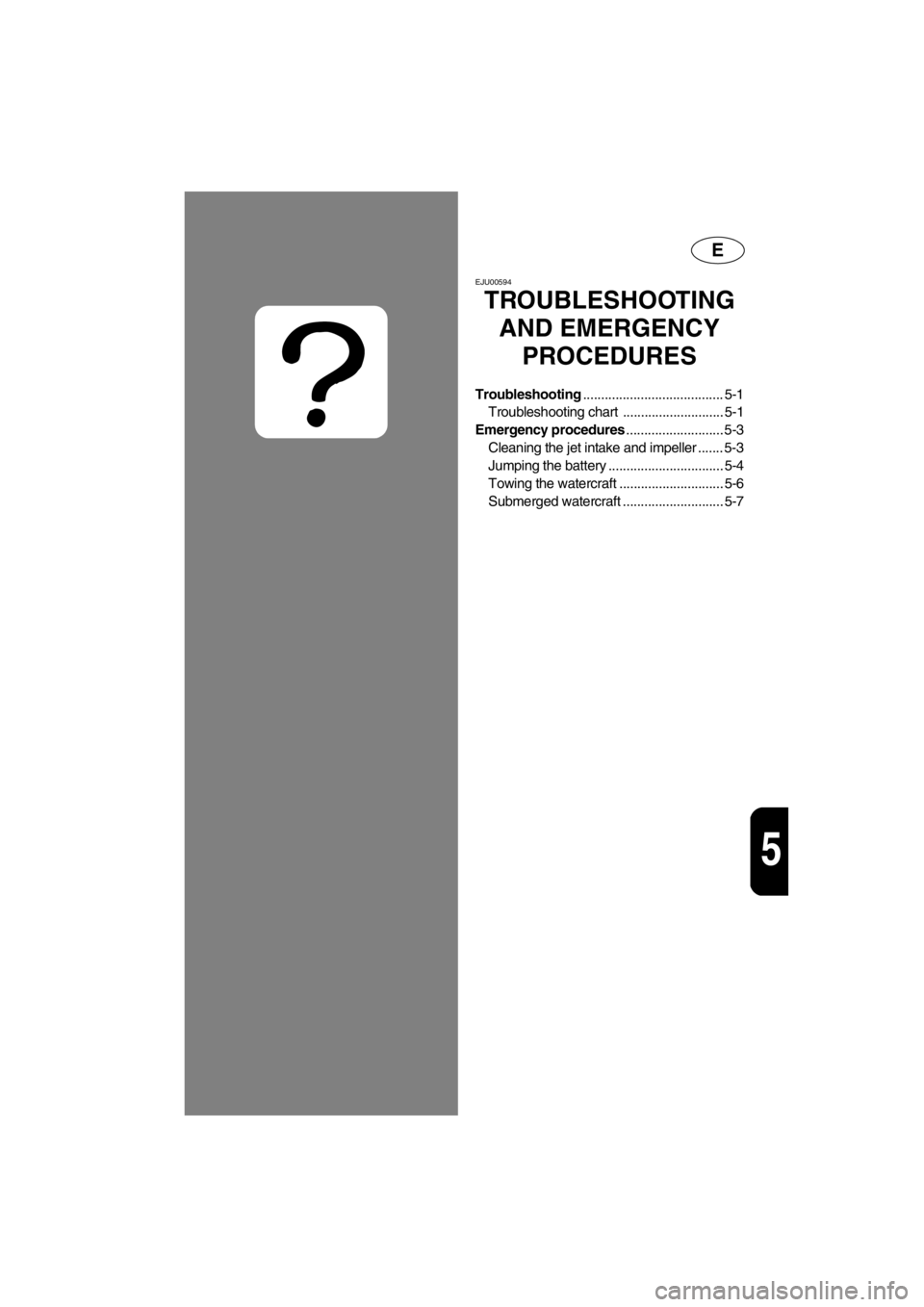
WARNING@Always place the fuel cock knob in the
“OFF” position when transporting the
watercraft, otherwise fuel could leak out
into the engine or engine compartment,
which would create a fire hazard.
@
Transport this watercraft using the special
trailer that incorporates a hole into which the
pin 1 can be inserted and locked after
passing it through the rope hole 2.
After securing the bow with the pin, secure
the stern with ropes or tie downs 2 over the
gunwale. Use a rubber shock cord 1 to hold
the steering pole.
CAUTION:@●Do not route ropes or tie downs over
the steering pole, as they may damage
it. Also, wrap the ropes or tie downs
with towels or rags where they touch
the body of the watercraft to avoid
scratching or damage.
●Do not transport the watercraft with
steering pole up, or the steering pole
may be damaged during transporta-
tion.
@
E_GM6-3.fm Page 33 Tuesday, July 11, 2000 10:52 AM
Page 93 of 107
E
5
EJU00594
TROUBLESHOOTING
AND EMERGENCY
PROCEDURES
Troubleshooting....................................... 5-1
Troubleshooting chart ............................ 5-1
Emergency procedures........................... 5-3
Cleaning the jet intake and impeller ....... 5-3
Jumping the battery ................................ 5-4
Towing the watercraft ............................. 5-6
Submerged watercraft ............................ 5-7
E_GM6-5TOC.fm Page 1 Tuesday, July 11, 2000 11:29 AM
Page 99 of 107
5-6
E
EJU00601
Towing the watercraft
If the watercraft becomes inoperative in
the water, it can be towed to shore.
If the watercraft must be towed in an
emergency using a tow line, the operator
should ride the watercraft, holding onto the
handlebars and supporting his body weight
on the riding tray. This will help keep the bow
of the watercraft out of the water.
CAUTION:@●Tow the watercraft slowly; water may
enter the air intake and flood the
engine compartment if the watercraft
is towed too fast.
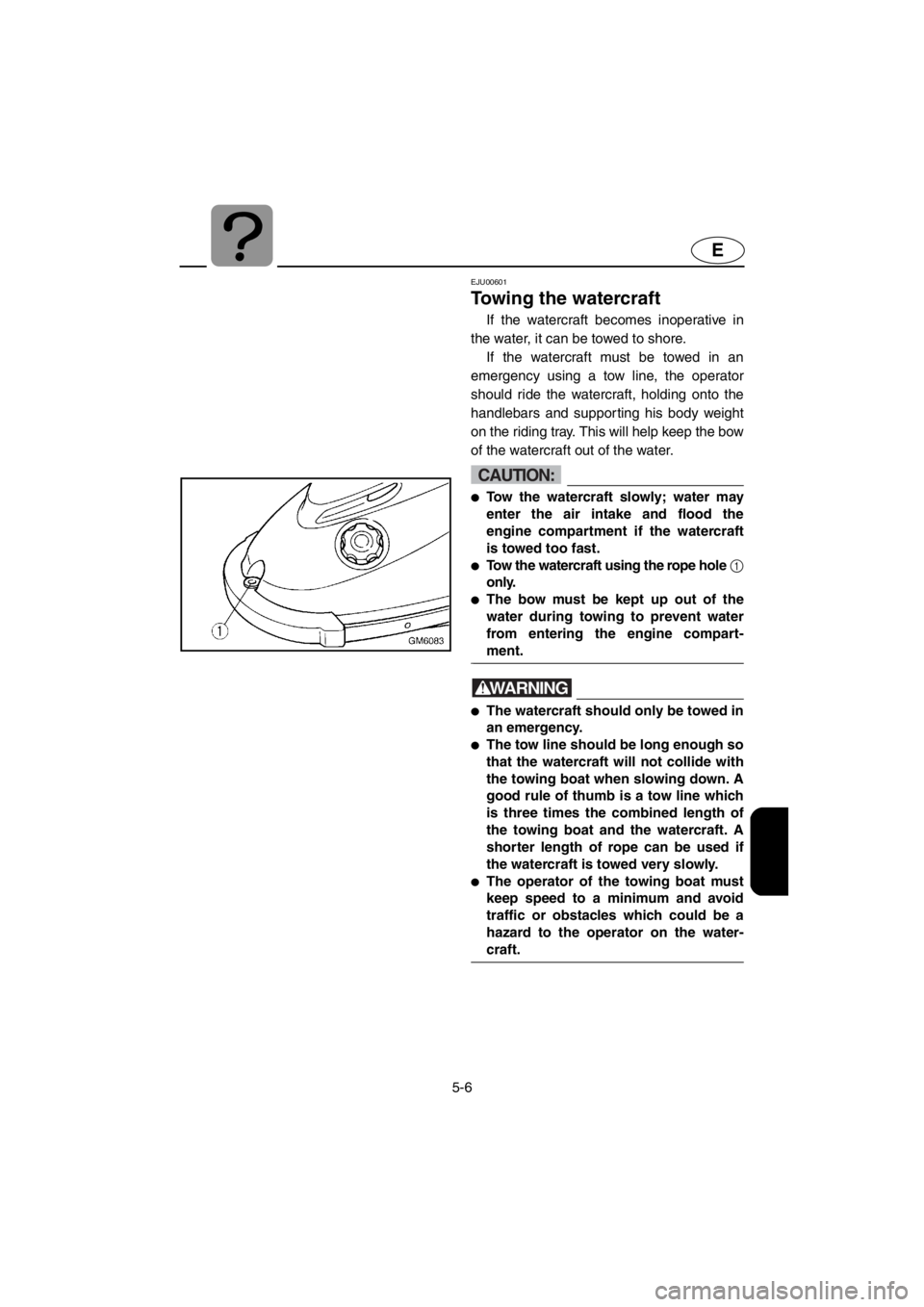
●Tow the watercraft using the rope hole 1
only.
●The bow must be kept up out of the
water during towing to prevent water
from entering the engine compart-
ment.
@
WARNING@●The watercraft should only be towed in
an emergency.
●The tow line should be long enough so
that the watercraft will not collide with
the towing boat when slowing down. A
good rule of thumb is a tow line which
is three times the combined length of
the towing boat and the watercraft. A
shorter length of rope can be used if
the watercraft is towed very slowly.
●The operator of the towing boat must
keep speed to a minimum and avoid
traffic or obstacles which could be a
hazard to the operator on the water-
craft.
@
E_GM6-5.fm Page 6 Tuesday, July 11, 2000 11:29 AM
Page 103 of 107

6-2
E
Operating your watercraft...................... 3-19
Operation .............................................. 3-13
Operation of controls and other
functions .................................................. 2-3
Operation requirements ........................ 1-10
Other labels ............................................. 1-7
Owner’s/Operator’s Manual and tool kit .. 4-8
P
Periodic maintenance chart..................... 4-9
Post-operation checks........................... 3-31
Pre-operation check list........................... 3-5
Pre-operation check points ..................... 3-6
Pre-operation checks .............................. 3-5
Primary Identification (PRI-ID) number ... 1-1
R
Replacing the fuse ................................ 4-20
Rough water operation .......................... 3-30
S
Safe boating rules ................................. 1-14
Safety information ................................... 1-8
Specifications ........................................ 4-23
Standing ................................................ 3-25
Starting the engine ................................ 3-15
Starting the watercraft ........................... 3-21
Start switch.............................................. 2-6
Steering pole .................................. 2-8, 3-10
Steering system ............................. 2-7, 3-10
Stopping the engine .............................. 3-18
Stopping the watercraft ......................... 3-29
Storage.................................................... 4-1
Storage pouch ....................................... 2-10
Submerged watercraft ............................. 5-7
Switches ................................................ 3-12
T
Throttle .................................................. 3-10
Throttle lever ........................................... 2-6
Towing the watercraft .............................. 5-6
Transporting .......................................... 3-33
Troubleshooting ...................................... 5-1
Troubleshooting chart ............................. 5-1
Turning the watercraft ........................... 3-27
W
Warning labels ........................................ 1-4Watercraft characteristics ...................... 1-13
Water separator ...................................... 3-7
E_GM6-75IX.fm Page 2 Tuesday, July 11, 2000 11:30 AM