Page 19 of 107
1-12
E
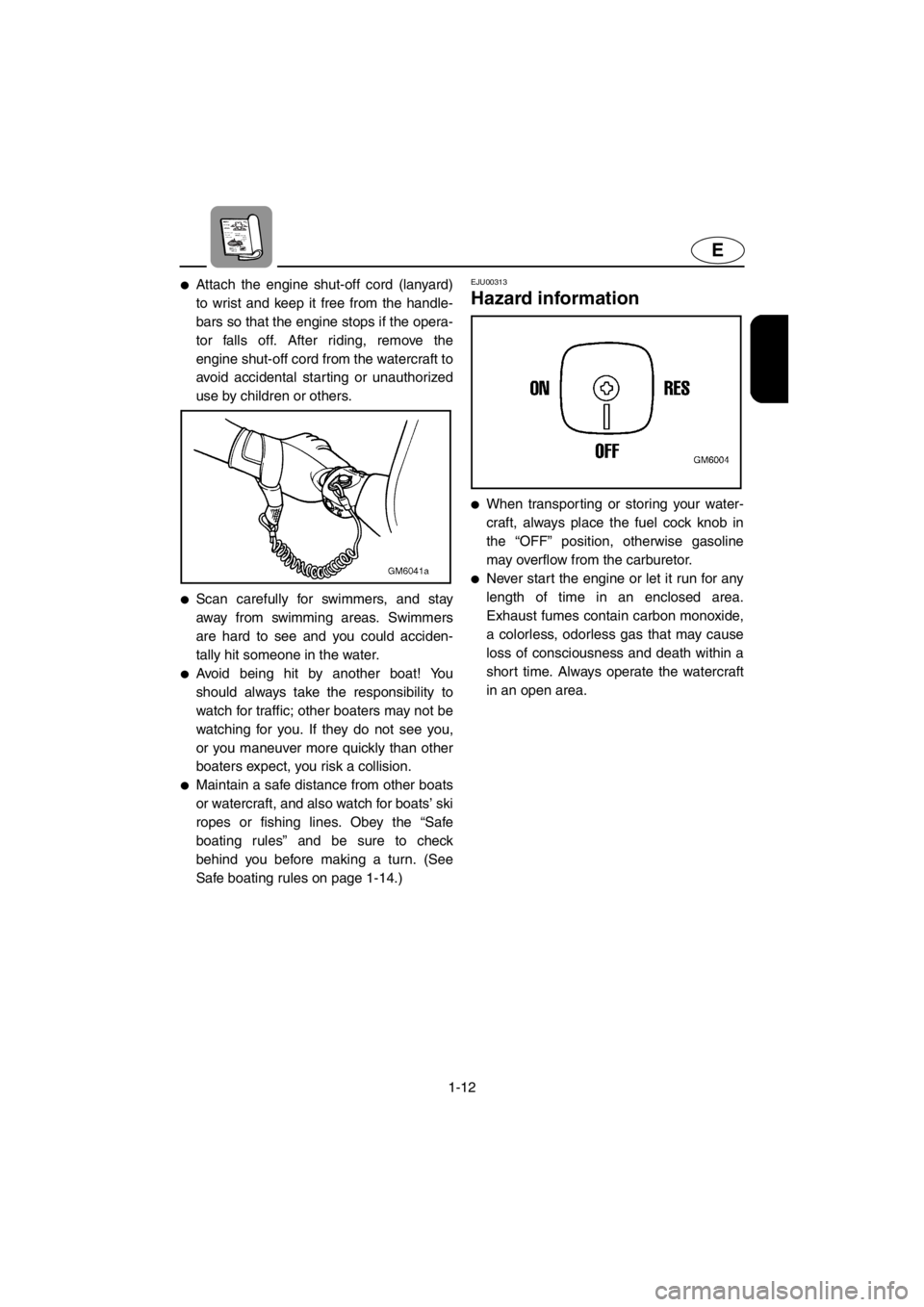
●Attach the engine shut-off cord (lanyard)
to wrist and keep it free from the handle-
bars so that the engine stops if the opera-
tor falls off. After riding, remove the
engine shut-off cord from the watercraft to
avoid accidental starting or unauthorized
use by children or others.
●Scan carefully for swimmers, and stay
away from swimming areas. Swimmers
are hard to see and you could acciden-
tally hit someone in the water.
●Avoid being hit by another boat! You
should always take the responsibility to
watch for traffic; other boaters may not be
watching for you. If they do not see you,
or you maneuver more quickly than other
boaters expect, you risk a collision.
●Maintain a safe distance from other boats
or watercraft, and also watch for boats’ ski
ropes or fishing lines. Obey the “Safe
boating rules” and be sure to check
behind you before making a turn. (See
Safe boating rules on page 1-14.)
EJU00313
Hazard information
●When transporting or storing your water-
craft, always place the fuel cock knob in
the “OFF” position, otherwise gasoline
may overflow from the carburetor.
●Never start the engine or let it run for any
length of time in an enclosed area.
Exhaust fumes contain carbon monoxide,
a colorless, odorless gas that may cause
loss of consciousness and death within a
short time. Always operate the watercraft
in an open area.
E_GM6-1.fm Page 12 Tuesday, July 11, 2000 10:49 AM
Page 50 of 107
3-15
E
EJU00927
Starting the engine
WARNING@Never start the engine or let it run for any
length of time in an enclosed area.
Exhaust fumes contain carbon monox-
ide, a colorless, odorless gas that may
cause loss of consciousness and death
within a short time. Always operate the
watercraft in an open area.
@
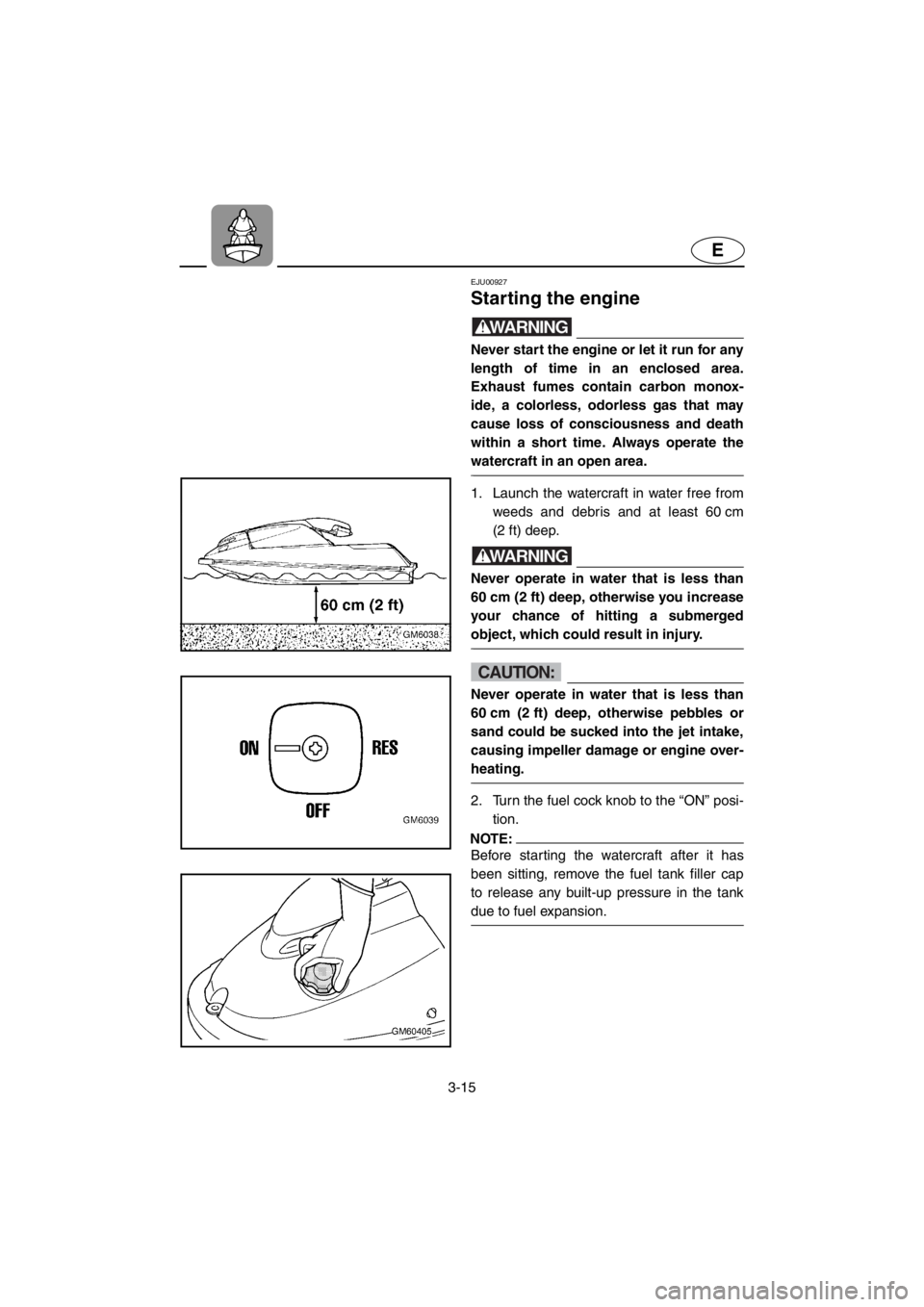
1. Launch the watercraft in water free from
weeds and debris and at least 60 cm
(2 ft) deep.
WARNING@Never operate in water that is less than
60 cm (2 ft) deep, otherwise you increase
your chance of hitting a submerged
object, which could result in injury.
@
CAUTION:@Never operate in water that is less than
60 cm (2 ft) deep, otherwise pebbles or
sand could be sucked into the jet intake,
causing impeller damage or engine over-
heating.
@
2. Turn the fuel cock knob to the “ON” posi-
tion.
NOTE:@Before starting the watercraft after it has
been sitting, remove the fuel tank filler cap
to release any built-up pressure in the tank
due to fuel expansion.
@
E_GM6-3.fm Page 15 Tuesday, July 11, 2000 10:52 AM
Page 92 of 107

4-23
E
EJU00590
Specifications
*1: Pump Octane Number
*1: Research Octane NumberMODEL
ITEMUnit SJ700
WATERCRAFT CAPACITY
Maximum people on board Number of people 1
DIMENSIONS
Length mm (in) 2,240 (88.2)
Width mm (in) 680 (26.8)
Height mm (in) 660 (26.0)
Dry weight kg (lb) 132 (291)
PERFORMANCE
Maximum power output kW (PS) @ r/min 53.6 (73) @ 6,300
Maximum fuel consumption L/h (US gal/h, Imp gal/h) 29 (7.7, 6.4)
Cruising range at full throttle hr. 0.6
Trolling speed r/min 1,250–1,350
ENGINE
Engine type 2-stroke
Number of cylinders 2
Engine displacement
cm
3 (cu in)701 (42.78)
Bore & stroke mm (in) 81 ×
68 (3.19 ×
2.68)
Compression ratio 7.2
Lubrication system Pre-mixed fuel
Cooling system Water cooled
Starting system Electric starter
Ignition system CDI
Spark plug BR-7HS (NGK)
Spark plug gap mm (in) 0.6–0.7 (0.024–0.028)
Battery capacity V-AH 12-19
Charging system Flywheel magneto
DRIVE UNIT
Propulsion system Jet pump
Jet pump type Mixed flow, single stage
Impeller rotation Counterclockwise (viewed from rear)
Transmission Direct drive from engine
Jet thrust nozzle angle Degree 37, 41, 45, 49
FUEL AND OIL
Recommended fuel Regular unleaded gasoline
Minimum octane rating PON (*1)
RON (*1)86
90
Recommended engine oil YAMALUBE 2-W, or an equivalent NMMA-
certified TC-W3 marine oil
Fuel mixing ratio (fuel to oil) 50:1
Fuel tank capacity
Total L (US gal, Imp gal) 18 (4.8, 4.0)
Reserve L (US gal, Imp gal) 5.5 (1.45, 1.21)
E_GM6-4.fm Page 23 Tuesday, July 11, 2000 11:28 AM
Page 99 of 107
5-6
E
EJU00601
Towing the watercraft
If the watercraft becomes inoperative in
the water, it can be towed to shore.
If the watercraft must be towed in an
emergency using a tow line, the operator
should ride the watercraft, holding onto the
handlebars and supporting his body weight
on the riding tray. This will help keep the bow
of the watercraft out of the water.
CAUTION:@●Tow the watercraft slowly; water may
enter the air intake and flood the
engine compartment if the watercraft
is towed too fast.
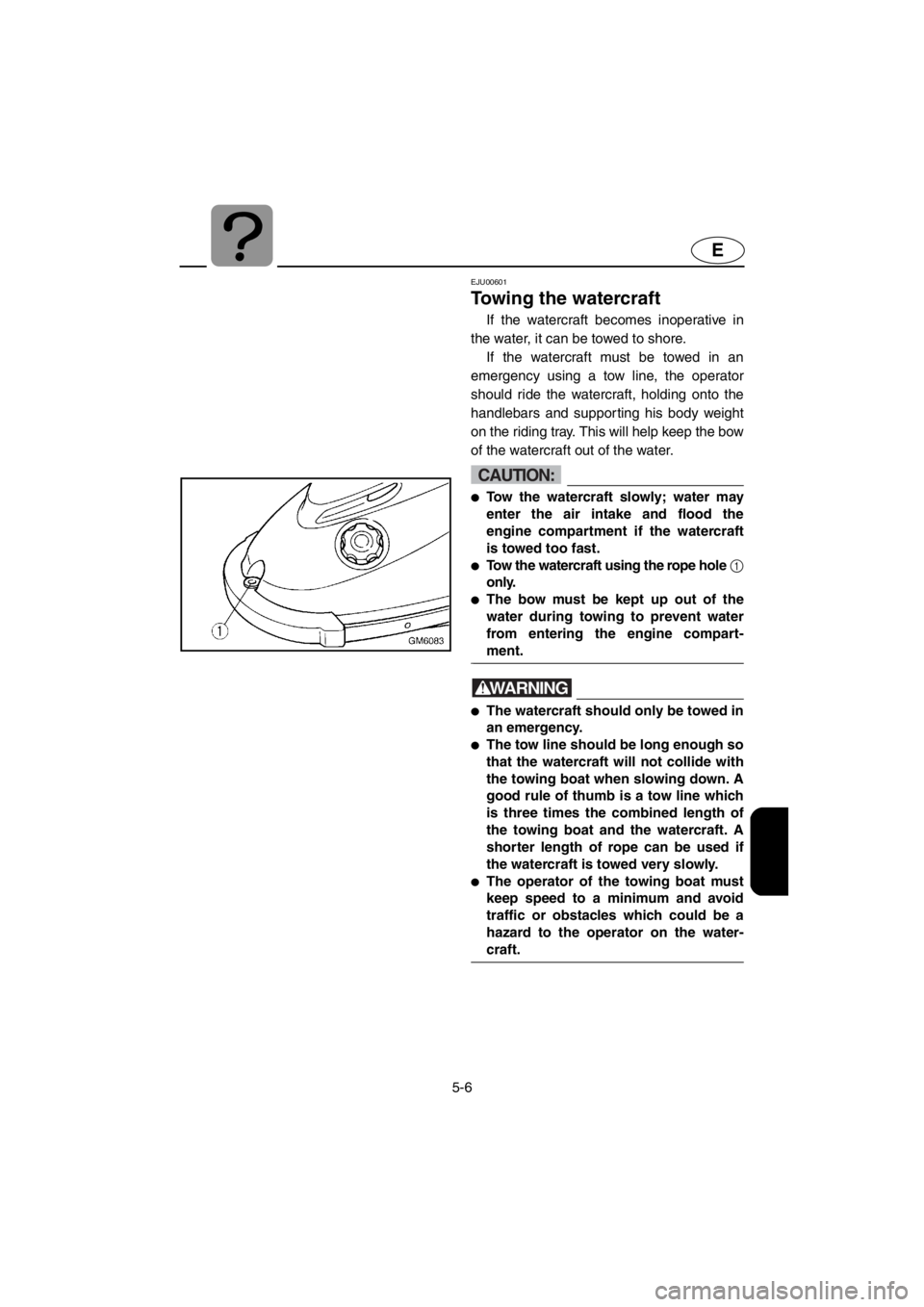
●Tow the watercraft using the rope hole 1
only.
●The bow must be kept up out of the
water during towing to prevent water
from entering the engine compart-
ment.
@
WARNING@●The watercraft should only be towed in
an emergency.
●The tow line should be long enough so
that the watercraft will not collide with
the towing boat when slowing down. A
good rule of thumb is a tow line which
is three times the combined length of
the towing boat and the watercraft. A
shorter length of rope can be used if
the watercraft is towed very slowly.
●The operator of the towing boat must
keep speed to a minimum and avoid
traffic or obstacles which could be a
hazard to the operator on the water-
craft.
@
E_GM6-5.fm Page 6 Tuesday, July 11, 2000 11:29 AM