2001 VOLVO S60 height
[x] Cancel search: heightPage 10 of 128

If the indicator light remains on, drive to an authorized Volvo retailer to have the system inspected.
pg. 35 Indicator and warning symbols
Messages in the text window
When a warning light in the instrument panel comes on, a message is also displayed in the text window. After you
have read the message, you can erase it by pressing button A (see illus- tration).
NOTE: Certain messages cannot be erased until the condition has been corrected. If a warning message is displayed
when e. g. you are using the trip computer or would like to use the telephone, this message must be erased before you
can access the function of your choice. Press button A to erase the warning message.
You can scroll through the stored messages by pressing button A (see illustration). The text window can be cleared
(the message will be returned to memory) by pressing button A again.
MessageMeaning:
REDUCE SPEED This message may be displayed when STC or DSTC are not switched on.
STOP SAFELY ASAP Stop and switch off the engine. Serious risk of damage.
STOP ENGINE Stop and switch off the engine. Serious risk of damage.
SERVICE URGENT Take your car in for service immediately.
SEE MANUAL Consult your owner's manual.
SERVICE REQUIRED Take your car in for service as soon as possible.
FIX NEXT SERVICE Have your car checked at the next service interval.
pg. 36 Steering wheel adjustment
Both the height and the reach of the steering wheel can be adjusted to a comfortable position for the driver. Pull down
the lever on the left of the steering column. Adjust the steering wheel to a suitable position and press the lever back
into place to lock the steering wheel in the new position. Check that the steering wheel is locked in the new position.
WARNING!
Never adjust the steering wheel while driving.
pg. 37 Switches in the center console
ProCarManuals.com
Page 52 of 128
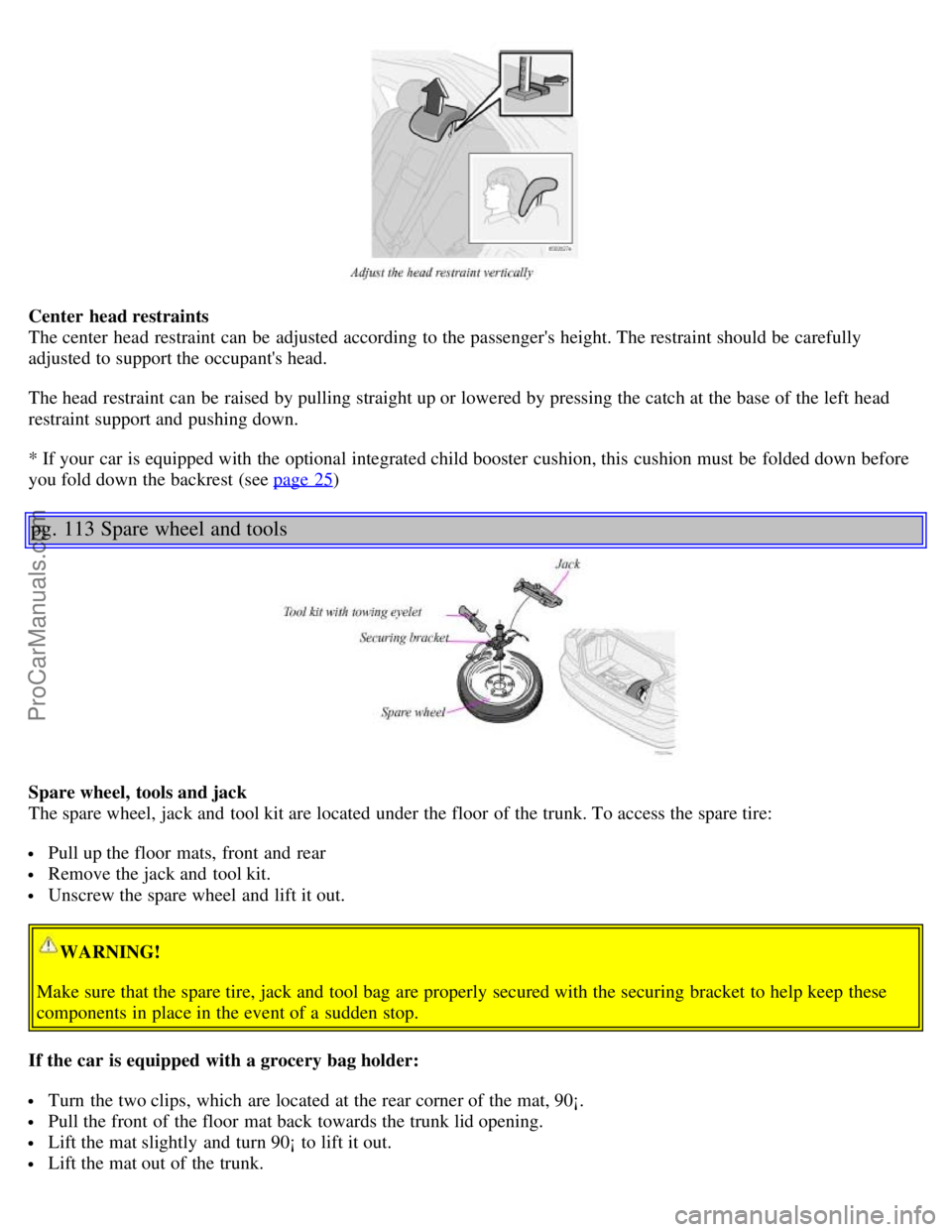
Center head restraints
The center head restraint can be adjusted according to the passenger's height. The restraint should be carefully
adjusted to support the occupant's head.
The head restraint can be raised by pulling straight up or lowered by pressing the catch at the base of the left head
restraint support and pushing down.
* If your car is equipped with the optional integrated child booster cushion, this cushion must be folded down before
you fold down the backrest (see page 25
)
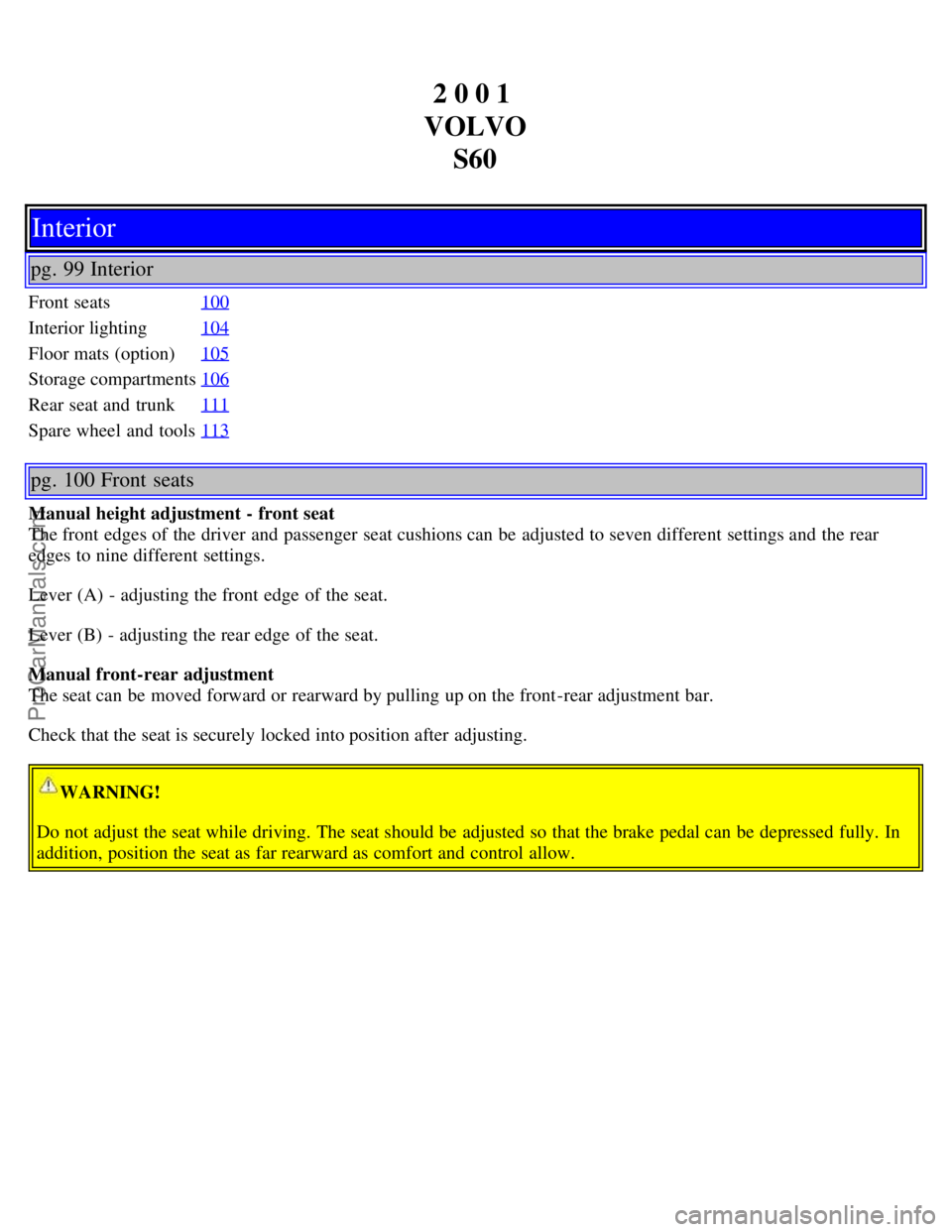
pg. 113 Spare wheel and tools
Spare wheel, tools and jack
The spare wheel, jack and tool kit are located under the floor of the trunk. To access the spare tire:
Pull up the floor mats, front and rear
Remove the jack and tool kit.
Unscrew the spare wheel and lift it out.
WARNING!
Make sure that the spare tire, jack and tool bag are properly secured with the securing bracket to help keep these
components in place in the event of a sudden stop.
If the car is equipped with a grocery bag holder:
Turn the two clips, which are located at the rear corner of the mat, 90¡.
Pull the front of the floor mat back towards the trunk lid opening.
Lift the mat slightly and turn 90¡ to lift it out.
Lift the mat out of the trunk.
ProCarManuals.com
Page 54 of 128
2 0 0 1
VOLVO S60
Interior
pg. 99 Interior
Front seats 100
Interior lighting104
Floor mats (option)105
Storage compartments106
Rear seat and trunk111
Spare wheel and tools113
pg. 100 Front seats
Manual height adjustment - front seat
The front edges of the driver and passenger seat cushions can be adjusted to seven different settings and the rear
edges to nine different settings.
Lever (A) - adjusting the front edge of the seat.
Lever (B) - adjusting the rear edge of the seat.
Manual front-rear adjustment
The seat can be moved forward or rearward by pulling up on the front -rear adjustment bar.
Check that the seat is securely locked into position after adjusting.
WARNING!
Do not adjust the seat while driving. The seat should be adjusted so that the brake pedal can be depressed fully. In
addition, position the seat as far rearward as comfort and control allow.
ProCarManuals.com
Page 60 of 128
2 0 0 1
VOLVO S60
Safety
pg. 9 Safety
Seat belts 10
Airbags (Supplemental Restraint System)12
Side airbags (SIPS airbags)18
Inflatable Curtain (IC)20
Inspection of airbags, inflatable curtains and seat belt tensioners21
WHIPS22
Child safety24
Occupant safety, Reporting safety defects28
pg. 10 Seat belts
Seat belts
Not wearing a seat belt is like believing "It'll never happen to me!" Volvo, the inventor of the three-point seat belt,
urges you and all occupants of your car to wear seat belts and ensure that children are properly restrained, using an
infant, car or booster seat determined by age, weight and height. Volvo also believes no child should sit in the front
seat of a car.
NOTE: Legislation in your state or province may mandate seat belt usage. Additionally, most states and provinces
have already made it mandatory for occupants of a car to use seat belts.
So, urging you to "buckle up" is not just our recommendation - legislation in your state or province may mandate seat
belt usage. The few seconds it takes to buckle up may one day allow you to say, "It's a good thing I was wearing my
seat belt."
NOTE: A chime will sound several times if the driver has not fastened his/ her seat belt.
To buckle a seat belt:
ProCarManuals.com
Page 64 of 128

release of the powder may appear as smoke- like matter. This is a normal characteristic and does not indicate fire.
NOTE: Volvo's dual- threshold, dual- stage airbags use special sensors that are integrated with the front seat buckles.
The point at which the airbag deploys is determined by whether or not the seat belt is being used, as well as the
severity of the collision. Collisions can occur where only one of the airbags deploys.
If the impact is less severe, but severe enough to present a clear injury risk, the dual- stage airbags are triggered at
just 70% of their total capacity. If the impact is more severe, the dual- stage airbags are triggered at full capacity.
WARNING!
Do not use child safety seats or child booster cushions/ backrests in the front passenger's seat. We also recommend
that occupants under 4 feet 7 inches (140 cm) in height who have outgrown these devices sit in the rear seat with the
seat belt fastened. Never drive with the airbags deployed. The fact that they hang out can impair the steering of your
car. Other safety systems can also be damaged. The smoke and dust formed when the airbags are deployed can
cause skin and eye irritation in the event of prolonged exposure.
pg. 14 Airbags (Supplemental Restraint System)
WARNING!
Children must never be allowed in the front passenger's seat. Volvo recommends that ALL occupants (adults and
children) shorter than 4 feet 7 inches (140 cm) be seated in the back seat of any vehicle with a front passenger -side
airbag. See page 28
for guidelines.
Occupants in the front passenger's seat must never sit on the edge of the seat, sit leaning toward the instrument
panel or otherwise sit out of position. The occupant's back must be as upright as comfort allows and be against the
seat back with the seat belt properly fastened.
Feet must be on the floor, e. g. not on the dash, seat or out of the window. No objects or accessory equipment, e. g.
dash covers, may be placed on, attached to, or installed near the SRS hatch (the area above the glove compartment)
or the area affected by airbag deployment (see illustration on page 12
).
There should be no loose articles, e. g. coffee cups, on the floor, seat or dash area. Never try to open the SRS cover
on the steering wheel or the passenger side dash. This should only be done by an authorized Volvo service
technician.
Failure to follow these instructions can result in injury to the vehicle occupants
Warning light in the instrument panel
A self - diagnostic system incorporated in the sensor monitors the SRS. This system does not, however, monitor the
Side Impact Protection System (SIPS) airbags. If a fault is detected, the warning light will illuminate. The light is
included in the warning/ indicator light cluster in the instrument panel. Normally, the SRS warning lamp should light
ProCarManuals.com
Page 90 of 128

2 0 0 1
VOLVO S60
Wheels and tires
pg. 151 Wheels and tires
General information 152
Tire pressure154
Tread wear indicators155
Changing wheels156
Uniform Tire Quality Grading158
pg. 152 General information
General information about wheels and tires
Your vehicle is equipped with tires according to the tire information label on the inside of the fuel filler door.
All tires have a dimension designation.
Example of designation: 215/ 55R16.
215 section width (mm)
55 relationship between section
height and width
R radial tire
16 wheel rim diameter (")
The tires have good road holding characteristics and offer good handling on dry and wet surfaces. It should be noted
however that the tires have been developed to give these features on snow/ ice- free surfaces.
Certain models are equipped with "all- season" tires, which provide a somewhat higher degree of road holding
on slippery surfaces than tires without the "all- season" rating. However, for optimum road holding on icy or
snow-covered roads - we recommend suitable winter tires on all four wheels. When replacing tires, be sure that the
new tires are the same size designation, type (radial) and preferably from the same manufacturer, on all four wheels.
Otherwise there is a risk of altering the car's roadholding and handling characteristics.
NOTE: When storing wheel/ tire assemblies (e. g. winter tires and wheels), either stand the assemblies upright, or
suspend them off the ground. Laying wheel/ tire assemblies on their sides for prolonged periods can cause wheel and/
or tire damage.
New tires
Remember that tires are perishable goods. This tire was manufactured week 15 in 1998! (158). As of 2000,
manufacturing year and week will be indicated with 4 digits (e. g. 0015 means that the tire is manufactured year 2000,
ProCarManuals.com
Page 112 of 128

*The Vehicle Identification Number (VIN) should always be quoted in all correspondence concerning your vehicle
with the retailer and when ordering parts.
pg. 193 Dimensions, weights
Dimensions
Length 180 in. (458 cm)
Width 71 in. (180 cm)
Height 56.2 in. (143 cm)
Wheelbase 107 in. (272 cm)
Front track 61.5 in. (156 cm)
Rear track 61.4 (156 cm)
Turning circle, between curbs 35.4- 38.7 ft. (10.8- 11.8 m)
Cargo capacity, trunk SAE V1 - 13.9 (394)
Weights
Gross vehicle weight *
5 cyl. (manual transmission)
USA 4360 lbs (1978 kg)
Canada 1980 kg
5 cyl. (automatic transmission)
USA 4400 lbs (1996 kg)
Canada 1996 kg
5 cyl. turbo (manual transmission)
USA 4430 lbs (2009 kg)
Canada 2110 kg
5 cyl. turbo (automatic transmission)
USA 4470 lbs (2028 kg)
Canada 2030 kg
ProCarManuals.com