Page 3235 of 4323
BR0A7±07
BR±60
± BRAKEREAR SPEED SENSOR
3227 Author�: Date�:
2005 SEQUOIA (RM1146U)
INSTALLATION
Installation is in the reverse order of removal (See page BR±59).
HINT:
After installation, check speed sensor signal (See page DI±899).
Page 3236 of 4323

SR01S±06
± STEERINGSTEERING SYSTEM
SR±1
3228 Author�: Date�:
2005 SEQUOIA (RM1146U)
STEERING SYSTEM
PRECAUTION
�Care must be taken to replace parts properly because they could affect the performance of the
steering system and result in a driving hazard.
�The SEQUOIA is equipped with an SRS (Supplemental Restraint System) such as the driver air-
bag and front passenger airbag. Failure to carry out service operation in the correct sequence
could cause the SRS to unexpectedly deploy during servicing, possibly leading to a serious
accident. Before servicing (including removal or installation of parts, inspection or replace-
ment), be sure to read the notices precautionary in the RS section.
�When disconnecting the battery terminal, initialize the following system after the terminal is re-
connected.
System NameSee Page
Back Door Power Window Control SystemBE±77
�When replacing the steering angle sensor, drive the vehicle straight ahead at a speed of 6.5 mph
(10.5 km/h) or more. Accordingly, zero point calibration of the steering angle sensor is per-
formed.
�After performing ºFront wheel alignment adjustmentº, clearing and reading the yaw rate & de-
celeration sensor zero point calibration data is necessary (See page DI±897).
Page 3258 of 4323
SR1KE±01
F17897Matchmarks
F17913
Matchmarks
± STEERINGTILT STEERING COLUMN
SR±23
3250 Author�: Date�:
2005 SEQUOIA (RM1146U)
INSTALLATION
NOTICE:
When replacing the steering angle sensor, drive the vehicle
straight ahead at a speed of 6.5 mph (10.5 km/h) or more.
Accordingly, zero point calibration of the steering angle
sensor is performed.
HINT:
If the steering angle sensor zero point calibration is not per-
formed, its value will be fixed. Check after driving the vehicle
straight ahead at a speed of 6.5 mph (10.5 km/h) or more (See
page DI±946).
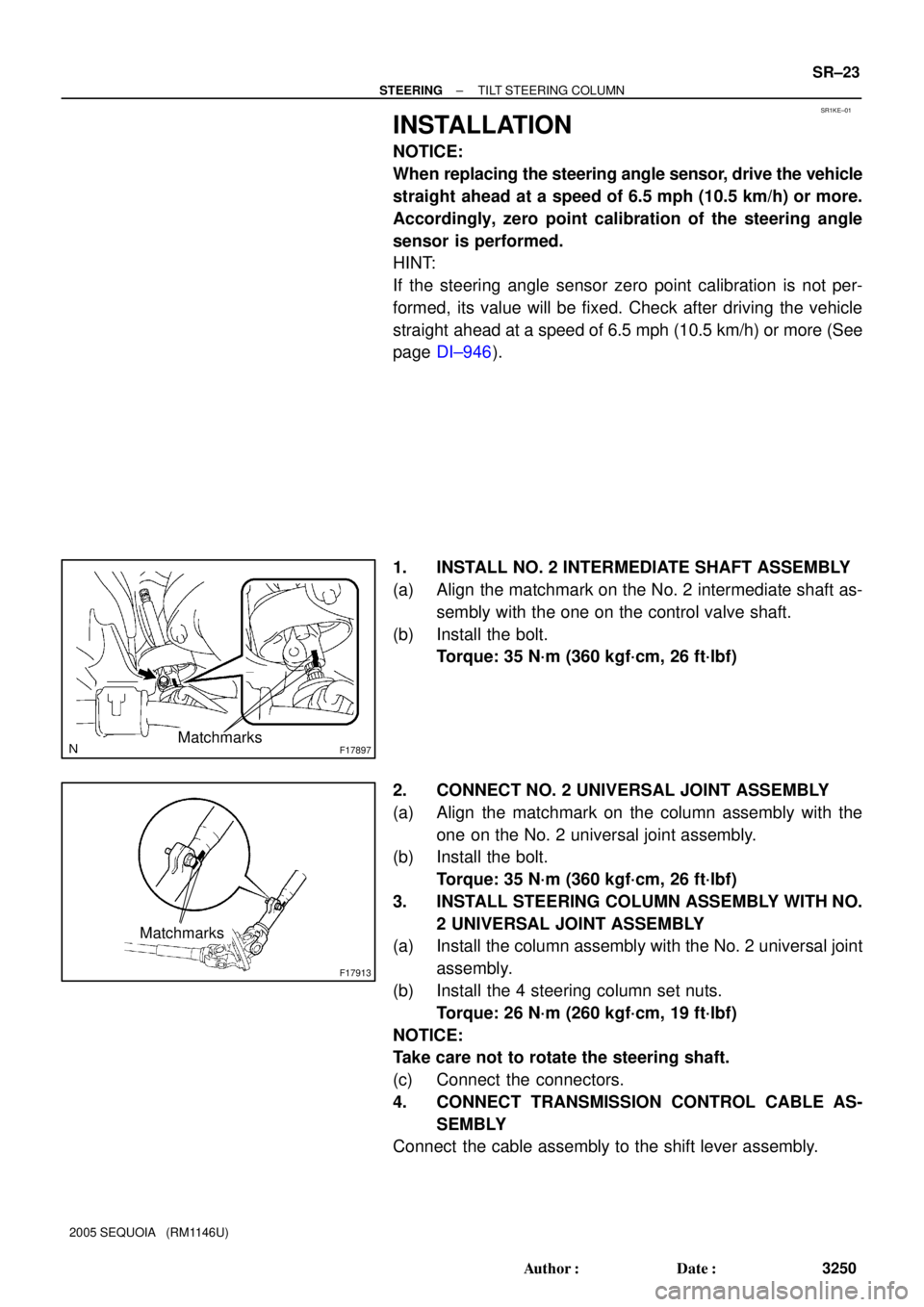
1. INSTALL NO. 2 INTERMEDIATE SHAFT ASSEMBLY
(a) Align the matchmark on the No. 2 intermediate shaft as-
sembly with the one on the control valve shaft.
(b) Install the bolt.
Torque: 35 N´m (360 kgf´cm, 26 ft´lbf)
2. CONNECT NO. 2 UNIVERSAL JOINT ASSEMBLY
(a) Align the matchmark on the column assembly with the
one on the No. 2 universal joint assembly.
(b) Install the bolt.
Torque: 35 N´m (360 kgf´cm, 26 ft´lbf)
3. INSTALL STEERING COLUMN ASSEMBLY WITH NO.
2 UNIVERSAL JOINT ASSEMBLY
(a) Install the column assembly with the No. 2 universal joint
assembly.
(b) Install the 4 steering column set nuts.
Torque: 26 N´m (260 kgf´cm, 19 ft´lbf)
NOTICE:
Take care not to rotate the steering shaft.
(c) Connect the connectors.
4. CONNECT TRANSMISSION CONTROL CABLE AS-
SEMBLY
Connect the cable assembly to the shift lever assembly.
Page 3744 of 4323

± AIR CONDITIONINGAIR CONDITIONING SYSTEM
AC±9
3736 Author�: Date�:
2005 SEQUOIA (RM1146U)
3. INSPECT IDLE±UP SPEED
(a) Warm up the engine.
(b) Inspect idle±up speed when the following conditions are
established.
�Warm up engine
�Blower speed control switch at ºHIº position
�A/C switch ON
�Temperature control dial at ºCOOLº position
Magnetic clutch conditionIdle±up speed
Magnetic clutch not engaged700 ± 50 rpm
Magnetic clutch engaged780 ± 50 rpm
If idle speed is not as specified, check the Idle control system.
4. INSPECT FOR LEAKAGE OF REFRIGERANT
(a) Perform under the following conditions:
�Stop the engine.
�Secure good ventilation (If not, the gas leak detec-
tor may react to volatile gases witch are not refriger-
ant, such as evaporated gasoline and exhaust gas.)
�Repeat the test 2 or 3 times.
�Make sure that there is some refrigerant remaining
in the refrigeration system.
When the compressor is OFF: approx. 392 to 588
kPa (4 to 6 kgf/ cm
2, 57 to 85 psi)
(b) Bring the gas leak detector close to the drain hose before
performing the test.
HINT:
�After the blower motor stopped, leave the cooling unit for
more than 15 minutes.
�Bring the gas leak detector sensor under the drain hose.
�When bringing the gas leak detector close to the drain
hose, make sure that the gas leak detector does not react
to the volatile gases.
If such reaction is unavoidable, the vehicle must be lifted up.
(c) If gas leak is not detected on the drain hose, remove the
blower motor linear controller from the cooling unit. Then
insert the gas leak detector sensor into the unit and per-
form the test.
(d) Disconnect the connector and leave the pressure switch
for approx. 20 minutes. Then bring the gas leak detector
close to the pressure switch and perform the test.
(e) Bring the gas leak detector close to the refrigerant lines
and perform the test.
Page 3853 of 4323

05_SEQUOIA_U (L/O 0408)
iv
2005 SEQUOIA from Aug. '04 Prod. (OM34424U)
In order to be effective, the SRS airbags must deploy with
tremendous speed. The rapid deployment of the SRS air-
bags makes the SRS airbags themselves potential sources
of serious injury if an occupant is too close to an airbag,
or if an object or some part of his or her body has been
placed between the occupant and the airbag at the time of
deployment. This is just one example of how the instruc-
tions in Section 1±3 of this Owner 's Manual will help en-
sure proper use of the occupant restraint systems, and
increase the safety they can provide to you and your fami-
ly in the event of an accident.
Toyota recommends you to read the provisions in Section
1±3 carefully and refer to them as needed during your time
of ownership of this vehicle.Event data recorder
Your vehicle has computers that monitor and control cer-
tain aspects of your vehicle. These computers assist in
driving and maintaining optimal vehicle performance. Be-
sides storing data useful for troubleshooting, there is a
system to record data in a crash or a near car crash
event. This is called an Event Data Recorder (EDR).
The SRS airbag sensor assembly contains the EDR. In a
crash or a near car crash event, this device records some
or all of the following information:
�Engine speed
�Whether the brake pedal was applied or not
�Vehicle speed
�To what extent the accelerator pedal was depressed
�Position of the transmission selector lever
�Whether the driver and front passenger wore the seat
belts or not
�Driver 's seat position
�Front passenger 's occupant classification
Page 4202 of 4323
05_SEQUOIA_U (L/O 0408)
343
2005 SEQUOIA from Aug. '04 Prod. (OM34424U)
�Driving with tire chains installed.
�Driving over the steps such as the
joints on the road.
�Driving on roads where the road
surface is pitted or has other differ-
ences in surface height.
Install all 4 tires of specified size at
appropriate pressure: The anti±lock
brake system detects vehicle speeds
using the speed sensors for respec-
tive wheels' turning speeds. The use
of tires other than specified may fail
to detect the accurate turning speed
resulting in a longer stopping dis-
tance.
Ty p e A
Ty p e B
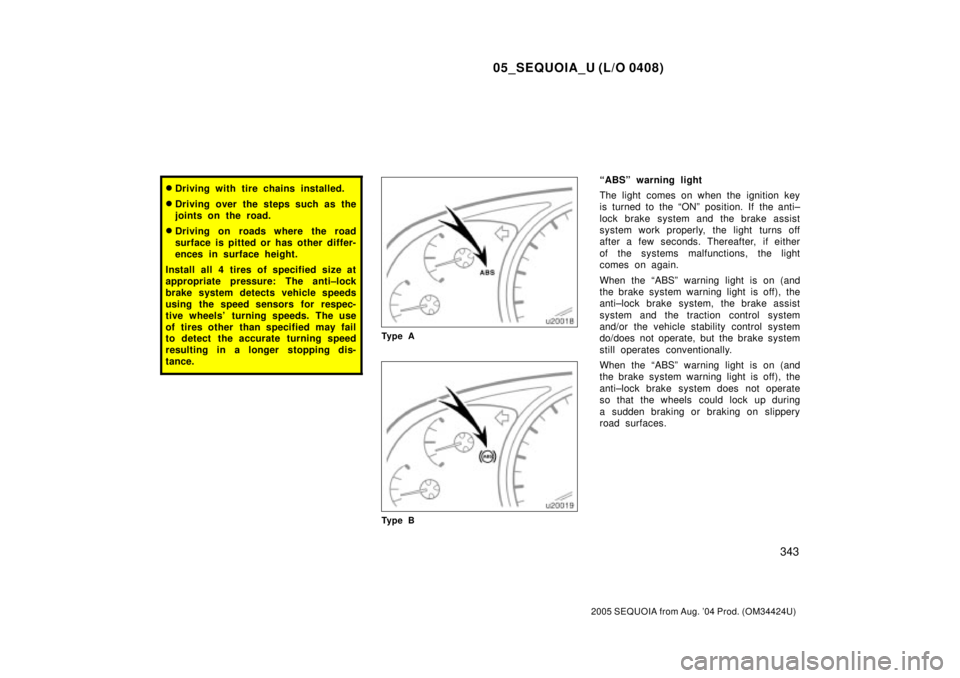
ªABSº warning light
The light comes on when the ignition key
is turned to the ªONº position. If the anti±
lock brake system and the brake assist
system work properly, the light turns off
after a few seconds. Thereafter, if either
of the systems malfunctions, the light
comes on again.
When the ªABSº warning light is on (and
the brake system warning light is off), the
anti±lock brake system, the brake assist
system and the traction control system
and/or the vehicle stability control system
do/does not operate, but the brake system
still operates conventionally.
When the ªABSº warning light is on (and
the brake system warning light is off), the
anti±lock brake system does not operate
so that the wheels could lock up during
a sudden braking or braking on slippery
road surfaces.