2001 NISSAN X-TRAIL wheel alignment
[x] Cancel search: wheel alignmentPage 2734 of 3833
RSU-14
SERVICE DATA AND SPECIFICATIONS (SDS)
SERVICE DATA AND SPECIFICATIONS (SDS)
PFP:00030
General SpecificationEES000J7
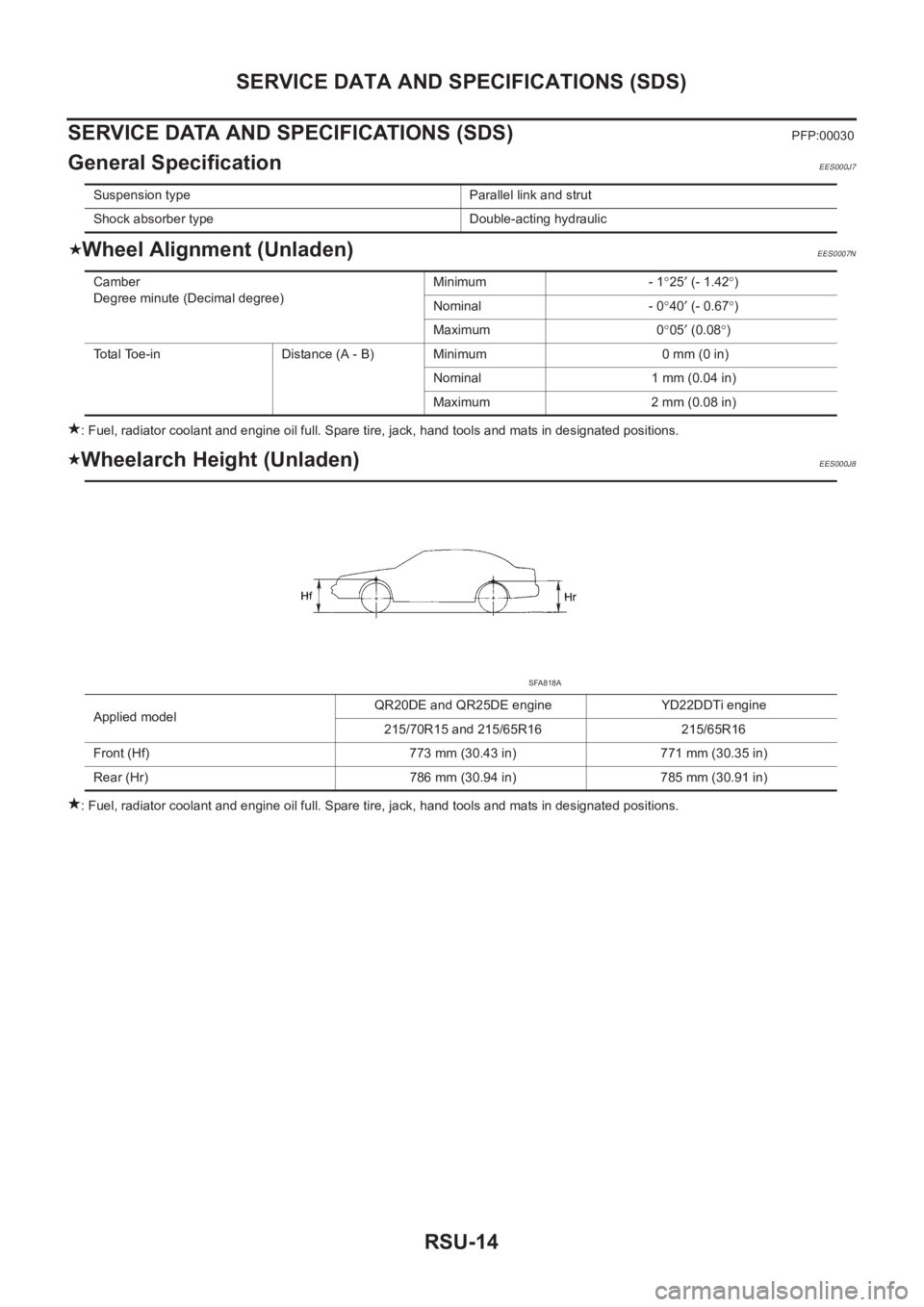
Wheel Alignment (Unladen)EES0007N
: Fuel, radiator coolant and engine oil full. Spare tire, jack, hand tools and mats in designated positions.
Wheelarch Height (Unladen)EES000J8
: Fuel, radiator coolant and engine oil full. Spare tire, jack, hand tools and mats in designated positions. Suspension type Parallel link and strut
Shock absorber type Double-acting hydraulic
Camber
Degree minute (Decimal degree)Minimum - 1°25′ (- 1.42°)
Nominal - 0°40′ (- 0.67°)
Maximum 0°05′ (0.08°)
Total Toe-in Distance (A - B) Minimum 0 mm (0 in)
Nominal 1 mm (0.04 in)
Maximum 2 mm (0.08 in)
Applied modelQR20DE and QR25DE engine YD22DDTi engine
215/70R15 and 215/65R16 215/65R16
Front (Hf) 773 mm (30.43 in) 771 mm (30.35 in)
Rear (Hr) 786 mm (30.94 in) 785 mm (30.91 in)
SFA818A
Page 2841 of 3833
![NISSAN X-TRAIL 2001 Service Repair Manual ON-VEHICLE SERVICE
BRC-57
[ESP/TCS/ABS]
C
D
E
G
H
I
J
K
L
MA
B
BRC
ON-VEHICLE SERVICEPFP:00000
Adjustment of Neutral Position of Steering Wheel Angle SensorEFS0019R
●After removing/installing or r](/manual-img/5/57405/w960_57405-2840.png "NISSAN X-TRAIL 2001 Service Repair Manual ON-VEHICLE SERVICE
BRC-57
[ESP/TCS/ABS]
C
D
E
G
H
I
J
K
L
MA
B
BRC
ON-VEHICLE SERVICEPFP:00000
Adjustment of Neutral Position of Steering Wheel Angle SensorEFS0019R
●After removing/installing or r")
ON-VEHICLE SERVICE
BRC-57
[ESP/TCS/ABS]
C
D
E
G
H
I
J
K
L
MA
B
BRC
ON-VEHICLE SERVICEPFP:00000
Adjustment of Neutral Position of Steering Wheel Angle SensorEFS0019R
●After removing/installing or replacing the ESP/TCS/ABS control unit, steering wheel angle sensor, steer-
ing components, suspension components, and tires, or after adjusting the wheel alignment, make sure to
adjust the neutral position of the steering wheel angle sensor before running the vehicle.
CAUTION:
To adjust the neutral position of the steering wheel angle sensor, make sure to use CONSULT-II.
(Adjustment cannot be done other than CONSULT-II.)
1. Stop the vehicle with the front wheels in the straight-ahead position.
2. Connect CONSULT-II to data link connector on the vehicle, and
turn the ignition switch to ON position (engine not running).
3. Touch “START”, “ABS”, “WORK SUPPORT” and “ST ANGLE
SENSOR ADJUSTMENT” on the CONSULT-II screen in this
order.
PBIB0196E
SFIA0364E
SFIA0365E
SFIA0370E
Page 2874 of 3833
![NISSAN X-TRAIL 2001 Service Repair Manual BRC-90
[ESP/TCS/ABS]
TROUBLE DIAGNOSIS
ABS Warning Lamp
Touch “ON” and “OFF”on the “ABS WARNING LAMP” screen to check that the ABS warning lamp operates as
follows.
NOTE:
During the active](/manual-img/5/57405/w960_57405-2873.png "NISSAN X-TRAIL 2001 Service Repair Manual BRC-90
[ESP/TCS/ABS]
TROUBLE DIAGNOSIS
ABS Warning Lamp
Touch “ON” and “OFF”on the “ABS WARNING LAMP” screen to check that the ABS warning lamp operates as
follows.
NOTE:
During the active")
BRC-90
[ESP/TCS/ABS]
TROUBLE DIAGNOSIS
ABS Warning Lamp
Touch “ON” and “OFF”on the “ABS WARNING LAMP” screen to check that the ABS warning lamp operates as
follows.
NOTE:
During the active test when “OFF” on the “ABS WARNING LAMP” screen is touched, all of the ESP OFF indi-
cator lamp, SLIP indicator lamp, and ABS warning lamp flash once. This is not abnormal.
For Correct and Quick DiagnosisEFS001A8
PRECAUTIONS FOR TROUBLE DIAGNOSIS
●Before performing the trouble diagnosis, always read the GI-3, "PRECAUTIONS" to confirm the general
precautions.
●After replacement of ESP/TCS/ABS control unit, steering wheel angle sensor, steering parts, suspension
parts, or tires, and adjustment of alignment, always adjust the neutral position of steering wheel angle
sensor before driving.
●When the ESP/TCS/ABS control unit is replaced, check that the label on the computer unit is identical
color.
●After completing the trouble diagnosis, always erase the malfunctioning memory. Refer to BRC-81, "Pro-
cedure" .
●When inspection of the continuity or voltage between units is performed, check the connector terminals for
disconnection, looseness, bend, or collapse. If any malfunction is detected, repair or replace the applica-
ble part.
●Intermittent problems may be caused by a malfunction on harness, connector, or terminal. Move the har-
nesses, harness connectors, or terminals by hand to make sure that there is no contact malfunction.
●If a circuit tester is used for the check, be careful not to forcibly extend any connector terminal.
●For self-diagnosis, active test, and work support of ESP/TCS/ABS control unit with CONSULT-II, stop and
connect CONSULT-II and select “ABS”.
●CONSULT-II self-diagnosis results are displayed without regard to occurrence timing. In some case, the
later ones (timing value is small) appear on the next screen.
●While the self-diagnosis results of CONSULT-II shows a malfunction, if CONSULT-II active test is per-
formed, an engine system malfunction may be indicated. In this case, start the engine to resume the nor-
mal screen.
●ESP/TCS/ABS system electronically controls the brake operation and engine output. The following symp-
toms may be caused by the normal operations.
Operation ON OFF
ABS WARNING LAMP ON (Lamp ON) OFF (Lamp OFF)
Symptom Symptom description Result
Motor operation noiseDuring ESP, TCS, or ABS operation, sometimes a faint noise can be
heard. This is a motor operation noise in the ESP actuator.
Normal
Just after the engine starts, the motor operating noise may be heard.
This is a normal status of the system operation check.
System operation check
noiseWhen the engine starts, a“click” noise may be heard from the engine
compartment. This is a normal status of the system operation check.Normal
Page 2916 of 3833
PS-6
STEERING WHEEL
STEERING WHEEL
PFP:48430
On-Vehicle Inspection and ServiceEGS0004E
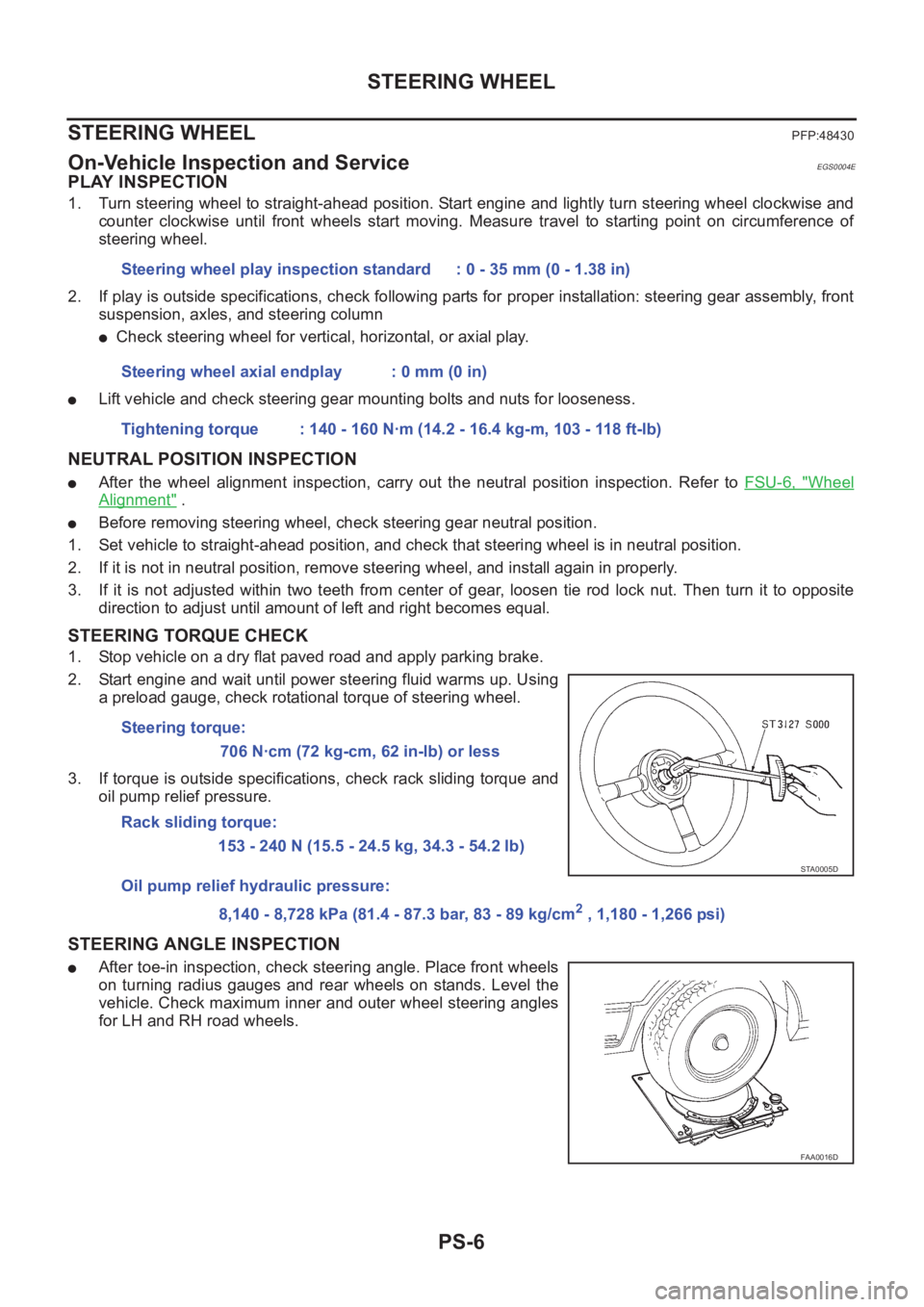
PLAY INSPECTION
1. Turn steering wheel to straight-ahead position. Start engine and lightly turn steering wheel clockwise and
counter clockwise until front wheels start moving. Measure travel to starting point on circumference of
steering wheel.
2. If play is outside specifications, check following parts for proper installation: steering gear assembly, front
suspension, axles, and steering column
●Check steering wheel for vertical, horizontal, or axial play.
●Lift vehicle and check steering gear mounting bolts and nuts for looseness.
NEUTRAL POSITION INSPECTION
●After the wheel alignment inspection, carry out the neutral position inspection. Refer to FSU-6, "Wheel
Alignment" .
●Before removing steering wheel, check steering gear neutral position.
1. Set vehicle to straight-ahead position, and check that steering wheel is in neutral position.
2. If it is not in neutral position, remove steering wheel, and install again in properly.
3. If it is not adjusted within two teeth from center of gear, loosen tie rod lock nut. Then turn it to opposite
direction to adjust until amount of left and right becomes equal.
STEERING TORQUE CHECK
1. Stop vehicle on a dry flat paved road and apply parking brake.
2. Start engine and wait until power steering fluid warms up. Using
a preload gauge, check rotational torque of steering wheel.
3. If torque is outside specifications, check rack sliding torque and
oil pump relief pressure.
STEERING ANGLE INSPECTION
●After toe-in inspection, check steering angle. Place front wheels
on turning radius gauges and rear wheels on stands. Level the
vehicle. Check maximum inner and outer wheel steering angles
for LH and RH road wheels.Steering wheel play inspection standard : 0 - 35 mm (0 - 1.38 in)
Steering wheel axial endplay : 0 mm (0 in)
Tightening torque : 140 - 160 N·m (14.2 - 16.4 kg-m, 103 - 118 ft-lb)
Steering torque:
706 N·cm (72 kg-cm, 62 in-lb) or less
Rack sliding torque:
153 - 240 N (15.5 - 24.5 kg, 34.3 - 54.2 lb)
Oil pump relief hydraulic pressure:
8,140 - 8,728 kPa (81.4 - 87.3 bar, 83 - 89 kg/cm
2 , 1,180 - 1,266 psi)
STA0005D
FAA0016D
Page 2917 of 3833
STEERING WHEEL
PS-7
C
D
E
F
H
I
J
K
L
MA
B
PS
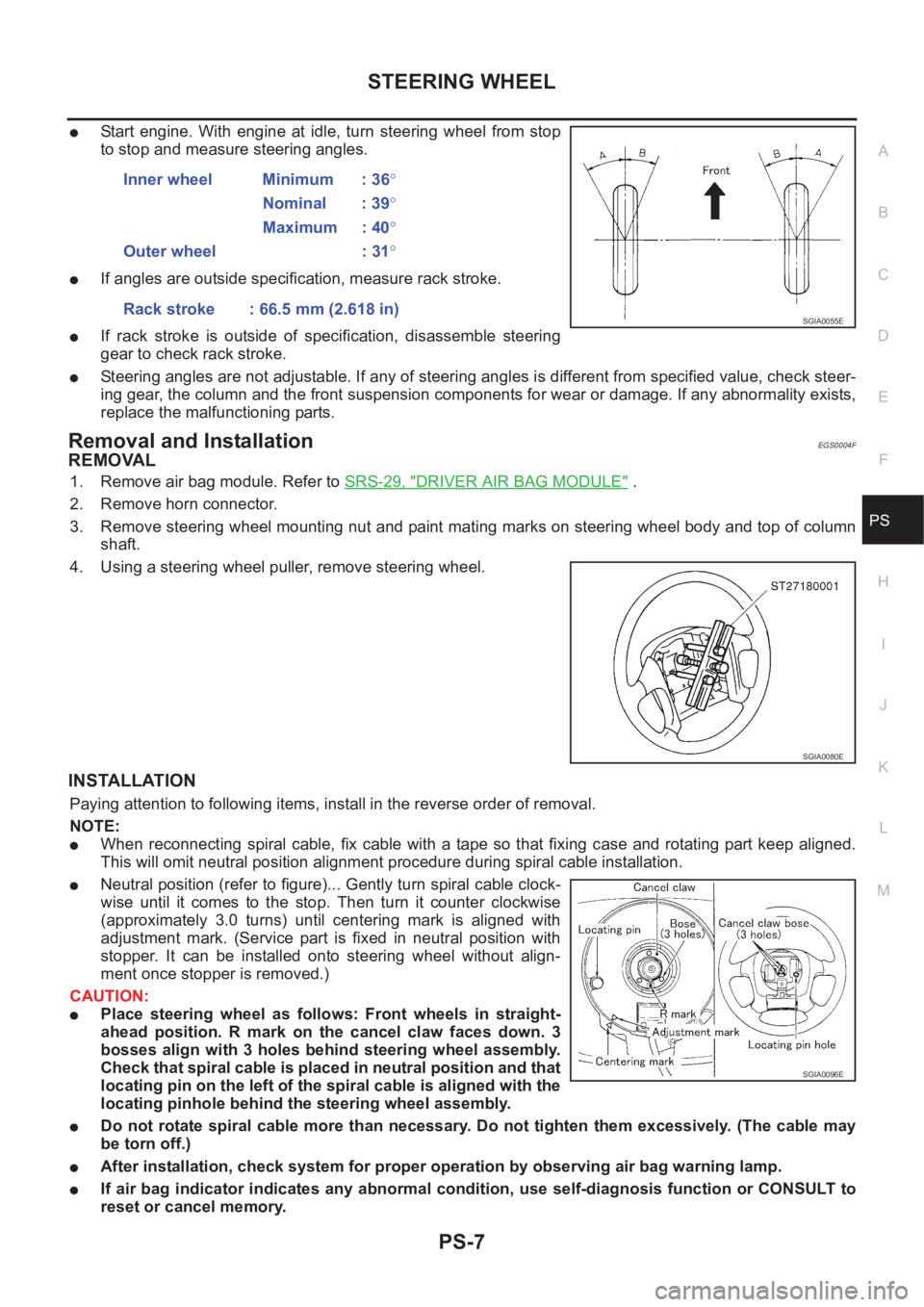
●Start engine. With engine at idle, turn steering wheel from stop
to stop and measure steering angles.
●If angles are outside specification, measure rack stroke.
●If rack stroke is outside of specification, disassemble steering
gear to check rack stroke.
●Steering angles are not adjustable. If any of steering angles is different from specified value, check steer-
ing gear, the column and the front suspension components for wear or damage. If any abnormality exists,
replace the malfunctioning parts.
Removal and InstallationEGS0004F
REMOVAL
1. Remove air bag module. Refer to SRS-29, "DRIVER AIR BAG MODULE" .
2. Remove horn connector.
3. Remove steering wheel mounting nut and paint mating marks on steering wheel body and top of column
shaft.
4. Using a steering wheel puller, remove steering wheel.
INSTALLATION
Paying attention to following items, install in the reverse order of removal.
NOTE:
●When reconnecting spiral cable, fix cable with a tape so that fixing case and rotating part keep aligned.
This will omit neutral position alignment procedure during spiral cable installation.
●Neutral position (refer to figure)... Gently turn spiral cable clock-
wise until it comes to the stop. Then turn it counter clockwise
(approximately 3.0 turns) until centering mark is aligned with
adjustment mark. (Service part is fixed in neutral position with
stopper. It can be installed onto steering wheel without align-
ment once stopper is removed.)
CAUTION:
●Place steering wheel as follows: Front wheels in straight-
ahead position. R mark on the cancel claw faces down. 3
bosses align with 3 holes behind steering wheel assembly.
Check that spiral cable is placed in neutral position and that
locating pin on the left of the spiral cable is aligned with the
locating pinhole behind the steering wheel assembly.
●Do not rotate spiral cable more than necessary. Do not tighten them excessively. (The cable may
be torn off.)
●After installation, check system for proper operation by observing air bag warning lamp.
●If air bag indicator indicates any abnormal condition, use self-diagnosis function or CONSULT to
reset or cancel memory.Inner wheel Minimum : 36°
Nominal : 39°
Maximum : 40°
Outer wheel : 31°
Rack stroke : 66.5 mm (2.618 in)
SGIA0055E
SGIA0080E
SGIA0096E
Page 2950 of 3833
FAX-2
PRECAUTIONS
PRECAUTIONS
PFP:00001
CautionEDS0005P
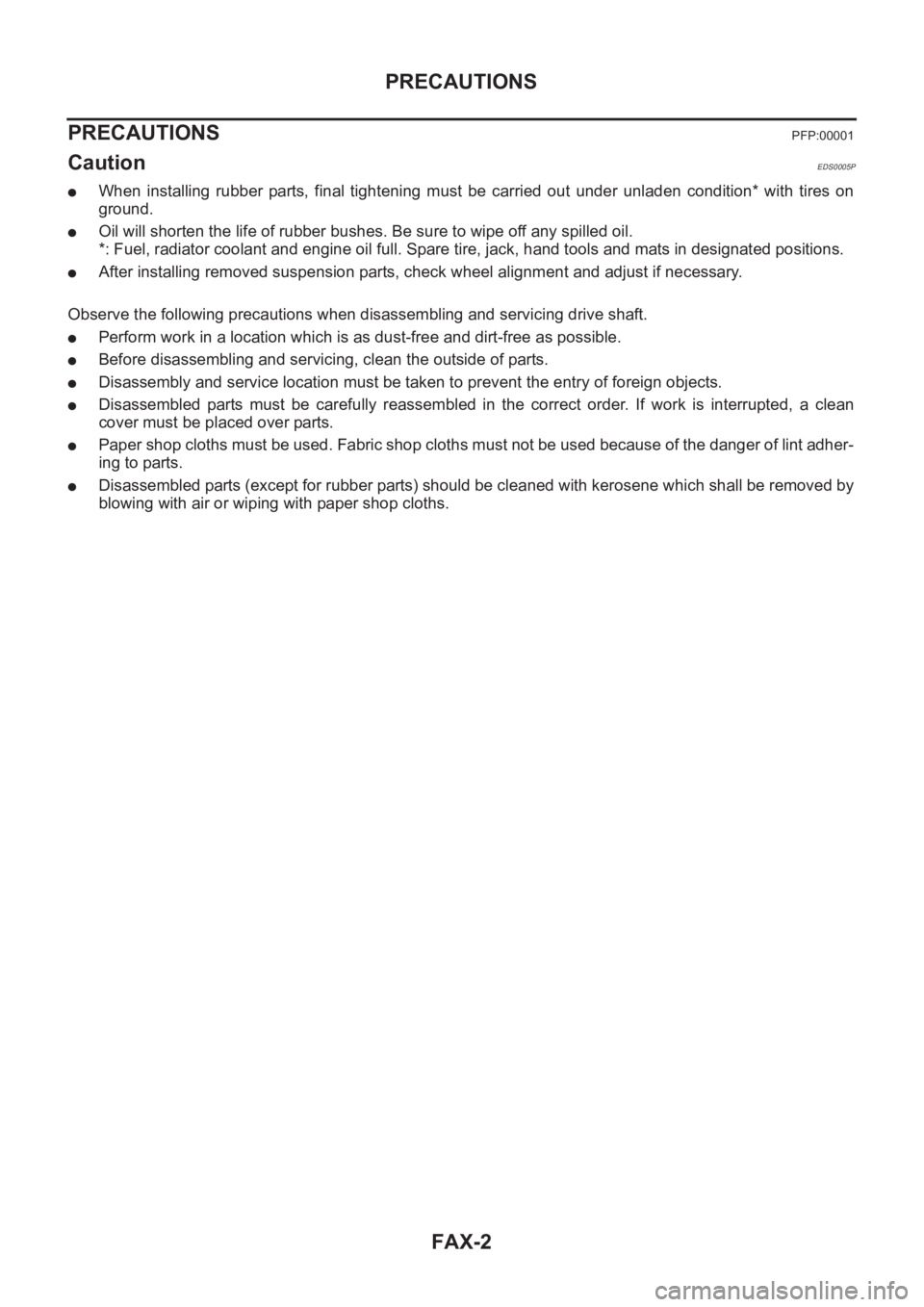
●When installing rubber parts, final tightening must be carried out under unladen condition* with tires on
ground.
●Oil will shorten the life of rubber bushes. Be sure to wipe off any spilled oil.
*: Fuel, radiator coolant and engine oil full. Spare tire, jack, hand tools and mats in designated positions.
●After installing removed suspension parts, check wheel alignment and adjust if necessary.
Observe the following precautions when disassembling and servicing drive shaft.
●Perform work in a location which is as dust-free and dirt-free as possible.
●Before disassembling and servicing, clean the outside of parts.
●Disassembly and service location must be taken to prevent the entry of foreign objects.
●Disassembled parts must be carefully reassembled in the correct order. If work is interrupted, a clean
cover must be placed over parts.
●Paper shop cloths must be used. Fabric shop cloths must not be used because of the danger of lint adher-
ing to parts.
●Disassembled parts (except for rubber parts) should be cleaned with kerosene which shall be removed by
blowing with air or wiping with paper shop cloths.
Page 2968 of 3833
RAX-2
PRECAUTIONS
PRECAUTIONS
PFP:00001
CautionEDS00060
●When installing rubber parts, final tightening must be carried out under unladen condition* with tires on
ground.
*: Fuel, radiator coolant and engine oil full. Spare tire, jack, hand tools and mats in designated positions.
●After installing removed suspension parts, check wheel alignment and adjust if necessary.
Observe the following precautions when disassembling and servicing drive shaft.
●Perform work in a location which is as dust-free and dirt-free as possible.
●Before disassembling and servicing, clean the outside of parts.
●The disassembly and service location must be clean. Care must be taken to prevent parts from becoming
dirty and to prevent the entry of foreign objects.
●Disassembled parts must be carefully reassembled in the correct order. If work is interrupted, a clean
cover must be placed over parts.
●Paper shop cloths must be used. Fabric shop cloths must not be used because of the danger of lint adher-
ing to parts.
●Disassembled parts (except for rubber parts) should be cleaned with kerosene which shall be removed by
blowing with air or wiping with paper shop cloths.
Page 2976 of 3833
RAX-10
REAR DRIVE SHAFT
Disassembly and Assembly
EDS000FM
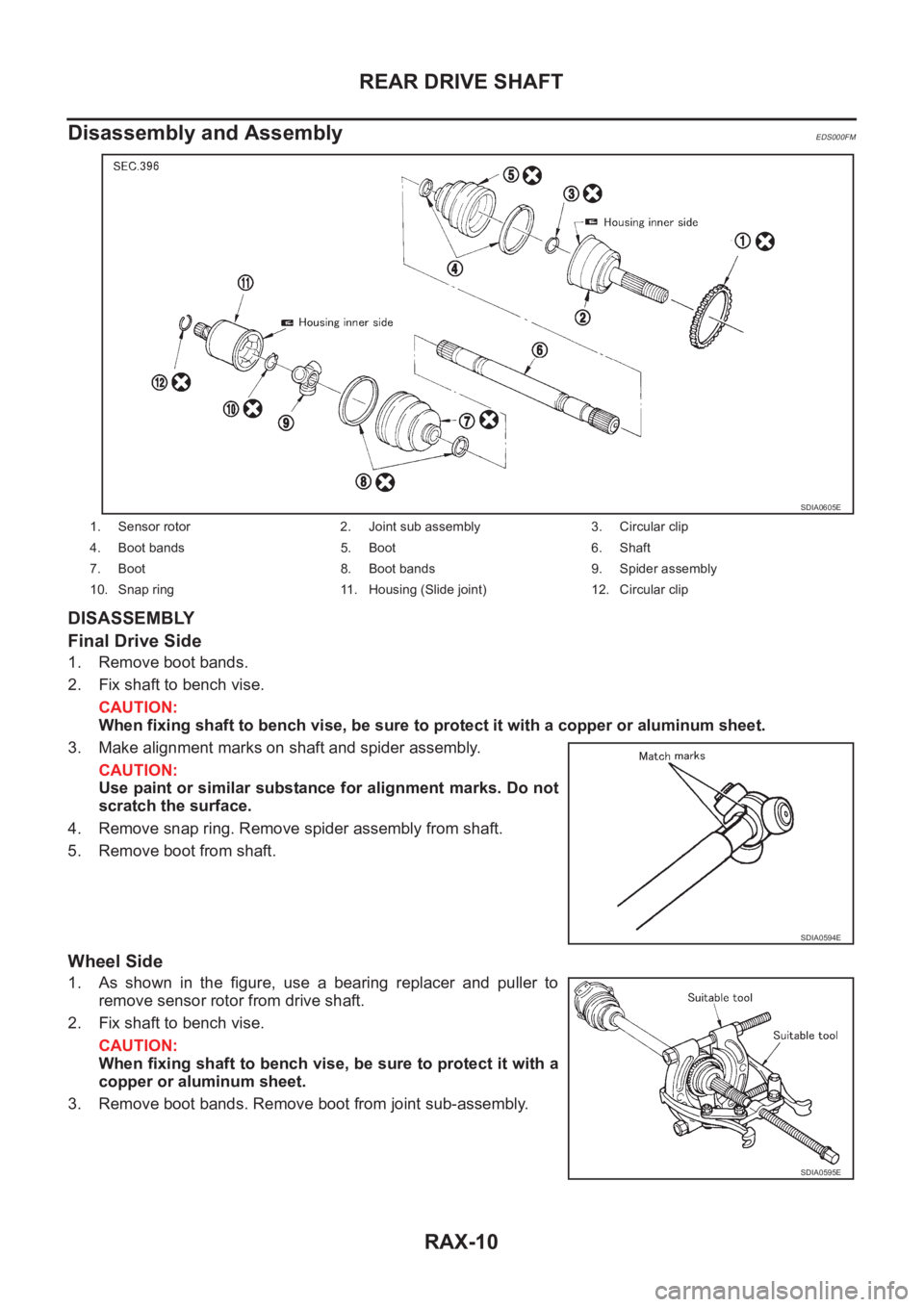
DISASSEMBLY
Final Drive Side
1. Remove boot bands.
2. Fix shaft to bench vise.
CAUTION:
When fixing shaft to bench vise, be sure to protect it with a copper or aluminum sheet.
3. Make alignment marks on shaft and spider assembly.
CAUTION:
Use paint or similar substance for alignment marks. Do not
scratch the surface.
4. Remove snap ring. Remove spider assembly from shaft.
5. Remove boot from shaft.
Wheel Side
1. As shown in the figure, use a bearing replacer and puller to
remove sensor rotor from drive shaft.
2. Fix shaft to bench vise.
CAUTION:
When fixing shaft to bench vise, be sure to protect it with a
copper or aluminum sheet.
3. Remove boot bands. Remove boot from joint sub-assembly.
1. Sensor rotor 2. Joint sub assembly 3. Circular clip
4. Boot bands 5. Boot 6. Shaft
7. Boot 8. Boot bands 9. Spider assembly
10. Snap ring 11. Housing (Slide joint) 12. Circular clip
SDIA0605E
SDIA0594E
SDIA0595E