2001 NISSAN FRONTIER roof
[x] Cancel search: roofPage 110 of 290

the on position. Be sure to return the air
recirculation button to the off position for
normal cooling.
Dehumidfied heating
This mode is used to heat and dehumidfy
the air.
1. Push the
button to the off position.
2. Turn the air control dial to the
posi-
tion.
3. Turn the fan control dial to the desired
position.
4. Turn on the air conditioner button. The
indicator light comes on.
5. Turn the temperature control dial to the
desired position.
Dehumidfied defrosting/defogging
This mode is used to defog the windows
and dehumidify the air.
1. Turn the air control dial to the
posi-
tion.
cWhen the
,or positions in be-
tween are selected, the air conditioner
automatically turns on (however, the in-
dicator light will not illuminate) if theoutside temperature is more than 45ÉF
(7ÉC). This dehumidifies the air which
helps defog the windshield. The
mode automatically turns off, al-
lowing outside air to be drawn into the
passenger compartment to further im-
prove the defogging performance.
2. Turn the fan control dial to the desired
position.
3. Turn the temperature control dial to the
desired position.
Operating tips
cKeep windows and sunroof closed while
the air conditioner is in operation.
cAfter parking in the sun, drive for two or
three minutes with the windows open to
vent hot air from the passenger compart-
ment. Then, close the windows. This
allows the air conditioner to cool the
interior more quickly.
cThe air conditioning system should be
operated for approximately ten min-
utes at least once a month. This helps
prevent damage to the system due to
lack of lubrication.
cIf the engine coolant temperaturegauge indicates engine coolant tem-
perature over the normal range, turn
the air conditioner off. See(If your
vehicle overheats(in the(In case of
emergency(section of this manual.
AIR FLOW CHARTS
The following charts show the button and
dial positions forMAXIMUM AND QUICK
heating, cooling or defrosting.The air recir-
culation switch should always be in the
OFF position for heating and defrosting.
When the
,or positions in be-
tween are selected, the air conditioner au-
tomatically turns on (however, the indicator
light will not illuminate) if the outside tem-
perature is more than 45ÉF (7ÉC). This
dehumidifies the air which helps defog the
windshield. The
mode automatically
turns off, allowing outside air to be drawn
into the passenger compartment to further
improve the defogging performance.
4-6Heater, air conditioner and audio systems
ZX
Page 149 of 290
(manual transmission vehicles), us-
ing only the brake, as this could
cause loss of control.
cHeavy braking going down a hill
could cause your brakes to overheat
and fade, resulting in loss of control
and an accident. Apply brakes lightly
and use a low gear to control your
speed.
cUnsecured cargo can be thrown
around when driving over rough ter-
rain. Properly secure all cargo so it
will not be thrown forward and cause
injury to you or your passengers.
cTo avoid raising the center of gravity
excessively, do not exceed the rated
capacity of the roof rack (if so
equipped) and evenly distribute the
load. Secure heavy loads in the
cargo area as far forward and as low
as possible. Do not equip the vehicle
with tires larger than specified in this
manual. This could cause your ve-
hicle to roll over.
cDo not grip the inside or spokes of
the steering wheel when driving off-
road. The steering wheel could movesuddenly and injure your hands. In-
stead drive with your fingers and
thumbs on the outside of the rim.
cBefore operating the vehicle, ensure
that the driver and all passengers
have their seat belts fastened.
cAlways drive with the floor mats in
place as the floor may become hot.
cLower your speed when encounter-
ing strong crosswinds. With a higher
center of gravity, your NISSAN is
more affected by strong side winds.
Slower speeds ensure better vehicle
control.
cDo not drive beyond the perfor-
mance of the tires, even with 4WD
engaged.
cAccelerating quickly, sharp steering
maneuvers or sudden braking may
cause loss of control.
cIf at all possible, avoid sharp turning
maneuvers, particularly at high
speeds. Your NISSAN four-wheel
drive vehicle has a higher center of
gravity than a two-wheel drive veh-icle. The vehicle is not designed for
cornering at the same speeds as
conventional two-wheel drive ve-
hicles. Failure to operate this vehicle
correctly could result in loss of con-
trol and/or a roll over accident.
cAlways use tires of the same type,
size, brand, construction (bias, bias-
belted, or radial), and tread pattern
on all four wheels. Install tire chains
on the rear wheels when driving on
slippery roads and drive carefully.
cBe sure to check the brakes immedi-
ately after driving in mud or water.
See(Brake system(later in this sec-
tion for(Wet brakes(.
cAvoid parking your vehicle on steep
hills. If you get out of the vehicle and
it rolls forward, backward or side-
ways, you could be injured.
cWhenever you drive off-road
through sand, mud or water as deep
as the wheel hub, more frequent-
maintenance may be required. See
(Periodic maintenance(in the(Main-
tenance(section of this manual.
Starting and driving
5-5
ZX
Page 266 of 290
cGVWR (Gross Vehicle Weight Rating) þ
maximum total weight (load) limit speci-
fied for the vehicle.
cGAWR (Gross Axle Weight Rating) þ
maximum weight (load) limit specified
for the front or rear axle.
DETERMINING VEHICLE LOAD
CAPACITY
The load capacity of this vehicle is deter-
mined by weight, not by available cargo
space. For example, a roof rack, bike car-
rier, or similar equipment does not increase
load carrying capacity of your vehicle.
To determine vehicle load capacity:
Vehicle weight can be determined by using
a commercial-grade scale, found at places
such as a truck stop, gravel quarry, grain
elevator, or a scrap metal recycling facility.
1) Determine the curb weight of your ve-
hicle.
2) Compare the curb weight amount to the
GVWR specified for your vehicle to de-
termine how much more weight your
vehicle can carry.
3) After loading (cargo and passengers),reweigh your vehicle to determine if ei-
ther GVWR or GAWR for your vehicle is
exceeded. If GVWR is exceeded, re-
move cargo as necessary. If either the
front or rear GAWR is exceeded, shift the
load or remove cargo as necessary.
SECURING THE LOAD
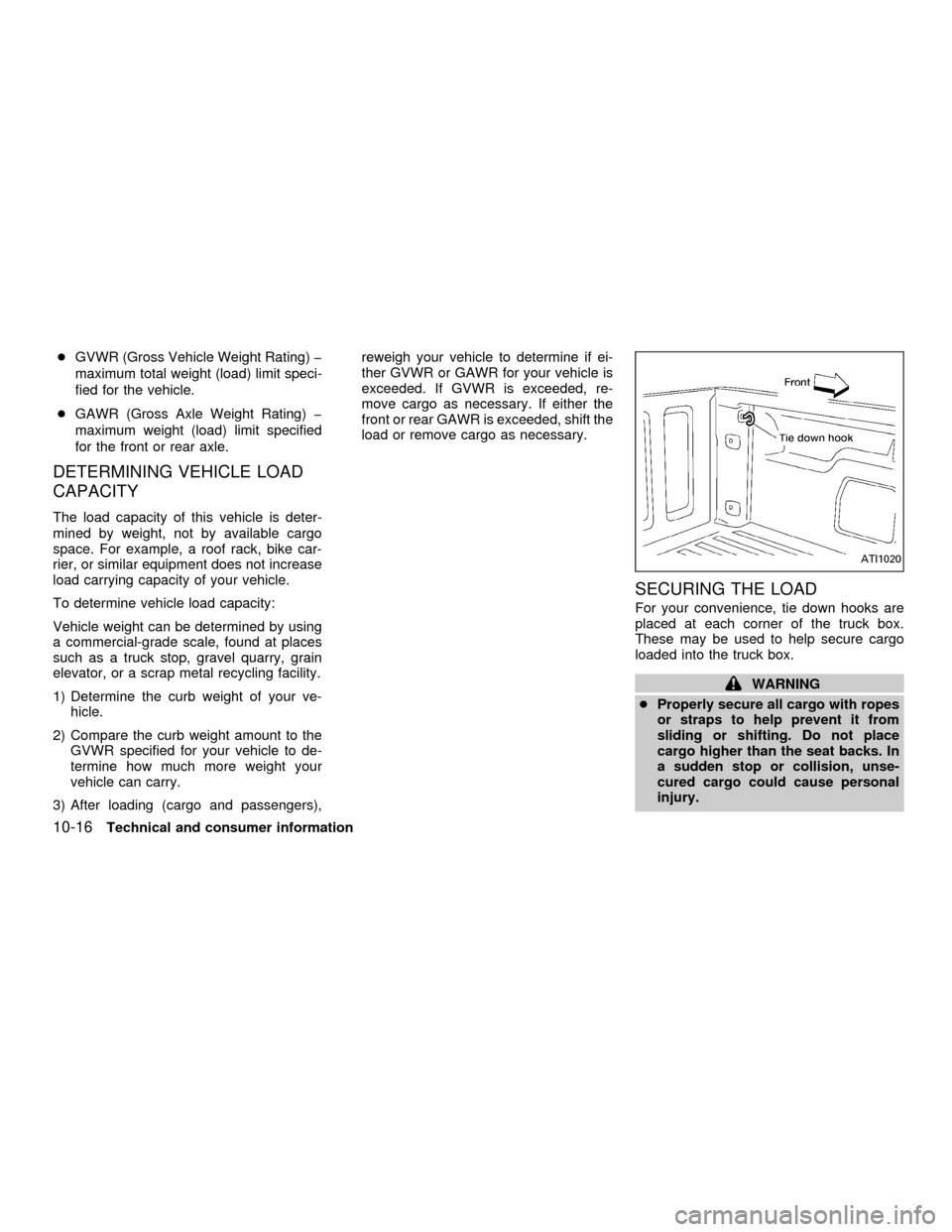
For your convenience, tie down hooks are
placed at each corner of the truck box.
These may be used to help secure cargo
loaded into the truck box.
WARNING
cProperly secure all cargo with ropes
or straps to help prevent it from
sliding or shifting. Do not place
cargo higher than the seat backs. In
a sudden stop or collision, unse-
cured cargo could cause personal
injury.
ATI1020
10-16Technical and consumer information
ZX
Page 285 of 290

Headlights .................................................. 8-29
Hood release ............................................... 3-8
Horn ........................................................... 2-19
Hubs
Auto-lock free-running hubs ................. 5-21
I
Indicator lights and chimes (See warning/
indicator lights and chimes) ......................... 2-7
Inside mirror ............................................... 3-13
Instrument brightness control .................... 2-17
J
Jump seat .................................................... 1-8
Jump starting ............................................... 6-8
K
Key ............................................................... 3-2
Keyless entry system (See multi-remote
control system) ............................................ 3-4
L
Labels
Air conditioner specification label ....... 10-14
Emission control information label...... 10-14
Engine serial number ......................... 10-13F.M.V.S.S. certification label .............. 10-13
Vehicle identification number (VIN)
plate .................................................... 10-12
Warning labels (for SRS) ..................... 1-20
Light
Air bag warning light............................. 1-20
Brake light (See stop light) ................... 8-33
Bulb check/instrument panel .................. 2-7
Bulb replacement.................................. 8-33
Headlight aiming adjustment ................ 8-30
Headlight and turn signal switch .......... 2-17
Headlights ............................................. 8-29
Light bulbs ............................................ 8-29
Passenger supplemental air bag ON/OFF
switch and light ..................................... 1-17
Spotlights (See map light) .................... 2-29
Warning/indicator lights and chimes ...... 2-7
Lock
Door locks............................................... 3-2
Power door locks .................................... 3-3
Luggage rack (see roof rack) ...................... 3-9
Luggage (See vehicle loading
information) .............................................. 10-15
M
Maintenance
General maintenance ............................. 9-2
Inside the vehicle.................................... 9-3
Maintenance precautions ....................... 8-2
Outside the vehicle ................................. 9-2
Periodic maintenance schedules ............ 9-5Seat belt maintenance.......................... 1-31
Under the hood and vehicle ................... 9-4
Malfunction indicator lamp (MIL) ............... 2-11
Manual windows ........................................ 2-25
Map lights .................................................. 2-29
Meters and gauges ...................................... 2-2
Mirror
Inside mirror.......................................... 3-13
Outside mirror control ........................... 3-14
Outside mirrors ..................................... 3-13
Vanity mirror ......................................... 3-13
Multi-remote control system ........................ 3-4
O
Octane rating (See fuel octane rating) ...... 10-5
Odometer ..................................................... 2-3
Oil
Capacities and recommended fuel/
lubricants .............................................. 10-2
Changing engine oil.............................. 8-11
Changing engine oil filter...................... 8-13
Checking engine oil level ..................... 8-10
Engine oil .............................................. 8-10
Engine oil and oil filter
recommendation ................................... 10-6
Engine oil viscosity ............................... 10-7
Outside mirror control ................................ 3-14
Outside mirrors .......................................... 3-13
Overdrive switch ............................... 5-13, 5-14
Overheat
If your vehicle overheats ...................... 6-10
11-3
ZX
Page 286 of 290

Owner's manual order form ..................... 10-30
P
Parking
Parking brake check ............................. 8-24
Parking brake operation ....................... 5-16
Parking/parking on hills ........................ 5-24
Passenger supplemental air bag ON/OFF
switch and light
Passenger supplemental air bag ON/OFF
switch and light ..................................... 1-17
Periodic maintenance schedules ................. 9-5
Power
Power door locks .................................... 3-3
Power steering fluid .............................. 8-15
Power steering system ......................... 5-25
Power windows..................................... 2-23
Precautions
Maintenance precautions ....................... 8-2
On-pavement and off-road driving
precautions ............................................. 5-3
Precautions on seat belt usage............ 1-22
Precautions when starting and driving ... 5-2
Push starting ................................................ 6-9
R
Radio
Car phone or CB radio ......................... 4-39FM-AM radio with cassette player and
compact disc (CD) player ..................... 4-17
FM-AM radio with compact disc (CD)
changer ................................................. 4-25
FM-AM radio with compact disc (CD)
player .................................................... 4-10
Steering wheel audio control switch ..... 4-38
Readiness for inspection maintenance
(I/M) test................................................... 10-29
Rear sliding window................................... 2-25
Rear window defogger switch ................... 2-16
Registering your vehicle in another
country ..................................................... 10-12
Remote keyless entry system
(See multi-remote control system) .............. 3-4
Reporting safety defects (USA) ............... 10-28
Roof rack (see luggage rack) ...................... 3-9
S
Safety
Reporting safety defects (USA) .......... 10-28
Seat
Jump seat ............................................... 1-8
Seat belt
Precautions on seat belt usage............ 1-22
Seat belt extenders .............................. 1-31
Seat belt maintenance.......................... 1-31
Seat belts.............................................. 1-22
Three-point type with retractor ............. 1-25
Two-point type without retractor ........... 1-29
Seat belt warning light ............................... 2-10Seats
Adjustment .............................................. 1-2
Bench seat.............................................. 1-6
Separate seats ....................................... 1-2
Service manual order form ...................... 10-30
Shifting
Automatic transmission ........................ 5-10
Manual transmission............................. 5-15
Spark plug replacement............................. 8-20
Speedometer ............................................... 2-3
Spotlights (See map light) ......................... 2-29
SRS warning label ..................................... 1-20
Starting
Before starting the engine ...................... 5-8
Jump starting .......................................... 6-8
Precautions when starting and driving ... 5-2
Push starting........................................... 6-9
Starting the engine ................................. 5-8
Steering
Power steering fluid .............................. 8-15
Power steering system ......................... 5-25
Tilting steering wheel............................ 3-12
Steering wheel audio control switch .......... 4-38
Step rail...................................................... 3-11
Stop light .................................................... 8-33
Sun shade.................................................. 2-26
Sunroof ...................................................... 2-25
Supplemental restraint system
(Supplemental air bag system).................. 1-10
Switch
Automatic power window switch .......... 2-24
Hazard warning flasher switch ............. 2-19
11-4
ZX