2001 MAZDA MODEL TRIBUTE 4WD lock
[x] Cancel search: lockPage 79 of 232

Front safety belt height adjustment
Your vehicle has safety belt height
adjustments for the driver and front
passenger. Adjust the height of the
shoulder belt so the belt rests
across the middle of your shoulder.
To lower the shoulder belt height,
push the button and slide the height
adjuster down. To raise the height
of the shoulder belt, slide the height
adjuster up. Pull down on the height
adjuster to make sure it is locked in
place.WARNING: Position the
shoulder belt height adjusters
so that the belt rests across
the middle of your shoulder.
Failure to adjust the safety
belt properly could reduce the
effectiveness of the seat belt
and increase the risk of injury
in a collision.
Lap belts
Adjusting the center lap belt
The lap belt does not adjust automatically. WARNING: The lap belts should fit snugly and as low as
possible around the hips, not around the waist. Failure to
position the lap belt correctly may cause serious injury in an
accident.
Seating and safety restraints
79
Page 83 of 232

WARNING: Failure to inspect and if necessary replace the
safety belt assembly under the above conditions could result in
severe personal injuries in the event of a collision.
Refer to Cleaning and maintaining the safety belts in the
Maintenance and care section.
AIR BAG SUPPLEMENTAL RESTRAINT SYSTEM (SRS)
Important supplemental restraint system (SRS) precautions
The supplemental restraint system
is designed to work with the safety
belt to help protect the driver and
right front passenger from certain
upper body injuries. WARNING: Air bags DO NOT
inflate slowly or gently and the
risk of injury from a deploying
air bag is greatest close to the
trim covering the air bag
module.
E
CMPH4x4H
F60
408
7
6
5
4
3
2
12020
40
60
80
100
120
140
16018080100
120km/hRPM X 1000
RSM
CST SETACCOFF
ON
AM/FMTAPE
CD
SCAN
12 3
45 6
LOADCLOCK
AUTO-MPRORPT
RDM/BS
TR/APC TR/APC
FF
REW
TUNE
SEEKDISCPUSH
POWER VOLP U
SH
A UD
IO CONT
LOCK
A/C OFFMAX
A/C
Seating and safety restraints
83
Page 89 of 232

WARNING: Seating Position with Side Air Bags
Sitting too close to the side air bag storage compartments or
placing hands on them is extremely dangerous. A side air bag
inflates with great force and speed directly out of the outboard
shoulder of the front seat and expands along the front door on
the side the car is hit. Serious injury could occur if someone is
sitting too close to the door or leaning against a window in the
front seats or if rear seat occupants grab the sides of the front
seatbacks. Furthermore, sleeping up against the door or
hanging out the driver's-side window while driving could block
the side air bag and eliminate the advantages of supplemental
protection. Give the side air bags room to work by sitting in the
center of the seat while the vehicle is moving with seat belts
worn properly.
WARNING: Modification of the Supplemental Restraint System
Modifying the components or wiring of the supplemental
restraint system is dangerous. You could accidentally activate it
or make it inoperable. Don't make any modifications to the
supplemental restraint system. This includes installing trim,
badges, or anything else over the air bag storage areas. It also
includes installing extra electric equipment on or near system
components or wiring.
An Authorized Mazda Dealer can provide the special care
needed in the removal and installation of front seats. It is
important to protect the side air bag wiring and connections to
assure that the bags do not accidently deploy and that the seats
retain an undamaged air bag connection.
WARNING: Do not attempt to service, repair, or modify the air
bag Supplemental Restraint System, its fuses or the seat cover
on a seat containing an air bag. See your authorized Mazda
dealer.
WARNING: All occupants of the vehicle including the driver
should always wear their safety belts even when an air bag SRS
is provided.
Seating and safety restraints
89
Page 94 of 232

Child and infant or child safety seats
Use a safety seat that is recommended for the size and weight of the
child. Carefully follow all of the manufacturer's instructions with the
safety seat you put in your vehicle. If you do not install and use the
safety seat properly, the child may be injured in a sudden stop or
collision.
When installing a child safety seat:
²Review and follow the information
presented in the Air Bag
Supplemental Restraint
Systemsection in this chapter.
² Use the correct safety belt buckle
for that seating position (the
buckle closest to the direction the
tongue is coming from).
² Insert the belt tongue into the
proper buckle until you hear a
snap and feel it latch. Make sure
the tongue is securely fastened in
the buckle.
² Keep the buckle release button
pointing up and away from the
safety seat, with the tongue
between the child seat and the
release button, to prevent accidental unbuckling.
² Place seat back in upright position.
² Put the safety belt in the automatic locking mode. Refer to Automatic
locking mode (passenger side front seat).
Mazda recommends the use of a child safety seat having a top tether
strap. Install the child safety seat in a seating position which is capable
of providing a tether anchorage. For more information on top tether
straps, refer to Attaching child safety seats with tether straps.
WARNING: Carefully follow all of the manufacturer's
instructions included with the safety seat you put in your
vehicle. If you do not install and use the safety seat properly,
the child may be injured in a sudden stop or collision.
Seating and safety restraints
94
Page 96 of 232

3. While holding the shoulder andlap belt portions together, route
the tongue through the child
seat according to the child seat
manufacturer's instructions. Be
sure the belt webbing is not
twisted.
4. Insert the belt tongue into the proper buckle (the buckle
closest to the direction the
tongue is coming from) for that
seating position until you hear a
snap and feel the latch engage.
Make sure the tongue is latched
securely by pulling on it.
5. To put the retractor in the automatic locking mode, grasp
the shoulder portion of the belt
and pull downward until all of
the belt is extracted and a click
is heard.
6. Allow the belt to retract. The belt will click as it retracts to indicate it is in the automatic locking mode.
Seating and safety restraints
96
Page 97 of 232
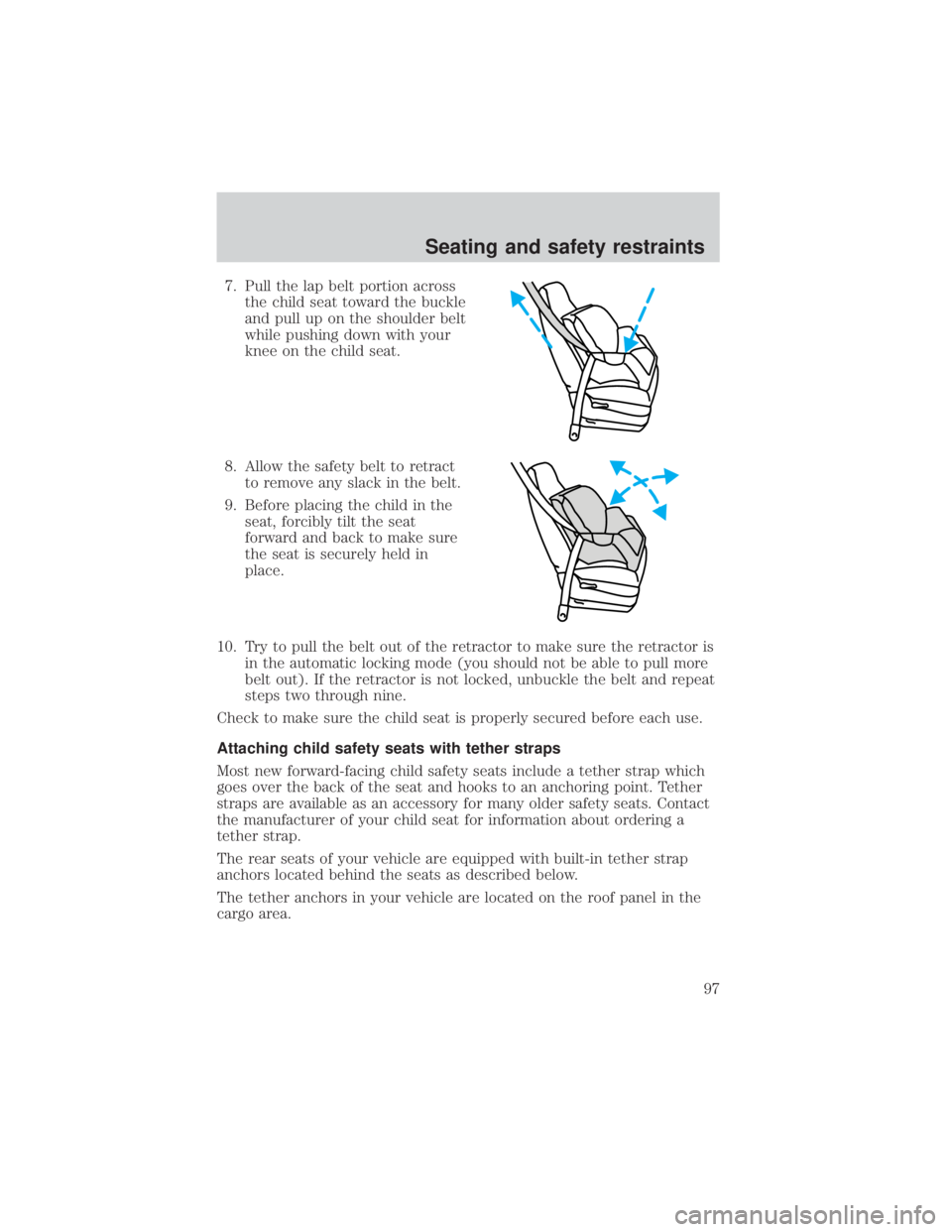
7. Pull the lap belt portion acrossthe child seat toward the buckle
and pull up on the shoulder belt
while pushing down with your
knee on the child seat.
8. Allow the safety belt to retract to remove any slack in the belt.
9. Before placing the child in the seat, forcibly tilt the seat
forward and back to make sure
the seat is securely held in
place.
10. Try to pull the belt out of the retractor to make sure the retractor is in the automatic locking mode (you should not be able to pull more
belt out). If the retractor is not locked, unbuckle the belt and repeat
steps two through nine.
Check to make sure the child seat is properly secured before each use.
Attaching child safety seats with tether straps
Most new forward-facing child safety seats include a tether strap which
goes over the back of the seat and hooks to an anchoring point. Tether
straps are available as an accessory for many older safety seats. Contact
the manufacturer of your child seat for information about ordering a
tether strap.
The rear seats of your vehicle are equipped with built-in tether strap
anchors located behind the seats as described below.
The tether anchors in your vehicle are located on the roof panel in the
cargo area.
Seating and safety restraints
97
Page 105 of 232

STARTING THE ENGINE
NOTE:Whenever you start your vehicle, release the key as soon as the
engine starts. Excessive cranking could damage the starter.
1. Turn the key to 4 (START) without pressing the accelerator
pedal and release as soon as the
engine starts. The key will
return to 3 (ON).
2. If the temperature is above ±12ÉC (10ÉF) and the engine
does not start within five
seconds on the first try, turn the
key to OFF, wait 10 seconds and
try again.
3. If the temperature is below -12É C (10É F) and the engine does not start in 15 seconds on the first try, turn the key OFF and wait 10
seconds and try again. If the engine does not start in two attempts,
press the accelerator pedal all the way to floor and hold. Turn the
key to START position.
4. When the engine starts, release the key, then release the accelerator pedal gradually as the engine speeds up.
5. After idling for a few seconds, apply the brake and release the parking brake.
Using the engine block heater (if equipped)
An engine block heater warms the engine coolant, which improves
starting, warms up the engine faster and allows the heater-defroster
system to respond quickly. Use of an engine block heater is strongly
recommended if you live in a region where temperatures reach -23ÉC
(-10ÉF) or below.
For best results, plug the heater in at least three hours before starting
the vehicle. Using the heater for longer than three hours will not harm
the engine, so the heater can be plugged in the night before starting the
vehicle. WARNING: To prevent electrical shock, do not use your heater
with ungrounded electrical systems or two-pronged (cheater)
adapters.
4
3
2
1
Starting
105
Page 107 of 232

BRAKES
Your service brakes are self-adjusting. Refer to the service maintenance
section for scheduled maintenance.
Occasional brake noise is normal and often does not indicate a
performance concern with the vehicle's brake system. In normal
operation, automotive brake systems may emit occasional or intermittent
squeal or groan noises when the brakes are applied. Such noises are
usually heard during the first few brake applications in the morning;
however, they may be heard at any time while braking and can be
aggravated by environmental conditions such as cold, heat, moisture,
road dust, salt or mud. If a ªmetal-to-metal,º ªcontinuous grindingº or
ªcontinuous squealº sound is present while braking, the brake linings
may be worn-out and should be inspected by an authorized Mazda
dealership.
Four-wheel anti-lock brake system (ABS) (if equipped)
If the vehicle is equipped with an anti-lock braking system (ABS), a
noise from the hydraulic pump motor and pulsation in the pedal may be
observed during ABS braking events. Pedal pulsation coupled with noise
while braking under panic conditions or on loose gravel, bumps, wet or
snowy roads is normal and indicates proper functioning of the vehicle's
anti-lock brake system.
NOTE:The ABS performs a self-check after you start the engine and
begin to drive away.
A brief mechanical noise may be heard during this test. This is normal. If
a malfunction is found, the ABS warning light will come on. If the vehicle
has continuous vibration or shudder in the steering wheel while braking,
the vehicle should be inspected by an authorized Mazda dealership.
The ABS operates by detecting the
onset of wheel lockup during brake
applications and compensates for
this tendency. The wheels are
prevented from locking even when
the brakes are firmly applied. The
accompanying illustration depicts
the advantage of an ABS equipped
vehicle (on bottom) to a non-ABS
equipped vehicle (on top) during hard braking with loss of front braking
traction.
Driving
107