2001 MAZDA MODEL TRIBUTE 4WD wheel
[x] Cancel search: wheelPage 111 of 232

WARNING: Vehicles with a higher center of gravity such as
utility and four-wheel drive vehicles handle differently than
vehicles with a lower center of gravity. Utility and four-wheel
drive vehicles are not designed for cornering at speeds as high
as passenger cars any more than low-slung sports cars are
designed to perform satisfactorily under off-road conditions.
Avoid sharp turns, excessive speed and abrupt maneuvers in
these vehicles. Failure to drive cautiously could result in an
increased risk of vehicle rollover, personal injury and death.
WARNING: Loaded vehicles, with a higher center of gravity,
may handle differently than unloaded vehicles. Extra
precautions, such as slower speeds and increased stopping
distance, should be taken when driving a heavily loaded vehicle.
Your vehicle has the capability to haul more cargo and people than most
passenger cars. Depending upon the type and placement of the load,
hauling people and cargo may raise the center of gravity of the vehicle.
Use extra caution while becoming familiar with your vehicle. Know the
capabilities and limitations of both you as a driver and your vehicle.
AUTOMATIC TRANSAXLE OPERATION (IF EQUIPPED)
Brake-shift interlock
This vehicle is equipped with a brake-shift interlock feature that prevents
the gearshift lever from being moved from P (Park) unless the brake
pedal is depressed.
NOTE:If the gearshift lever cannot be moved from P (Park) with the
brake pedal depressed, it is possible that a fuse has blown or the
vehicle's brakelamps are not operating properly. Refer to Fuses and
relays in theRoadside emergencies chapter.
WARNING: Do not drive your vehicle until you verify that the
brakelamps are working. A rear end colission may result after
you brake.
If your vehicle gets stuck in mud or snow it may be rocked out by
shifting between forward and reverse gears, stopping between shifts, in a
steady pattern. Press lightly on the accelerator in each gear.
Driving
111
Page 113 of 232
Understanding gearshift positions
Your automatic transaxle electronically controls the shift feel by using an
adaptive learning strategy. This feature is designed to optimize shift
smoothness.NOTE:It is normal for your transaxle to shift firmly during
the first few hundred kilometers (miles) of operation until the adaptive
strategy has been learned. The adaptive learning strategy is maintained
by power from the battery. When the battery is disconnected or a new
battery is installed, the transaxle must relearn its adaptive strategy.
Optimal shifting will resume within a few hundred kilometers (miles) of
operation.
P (Park)
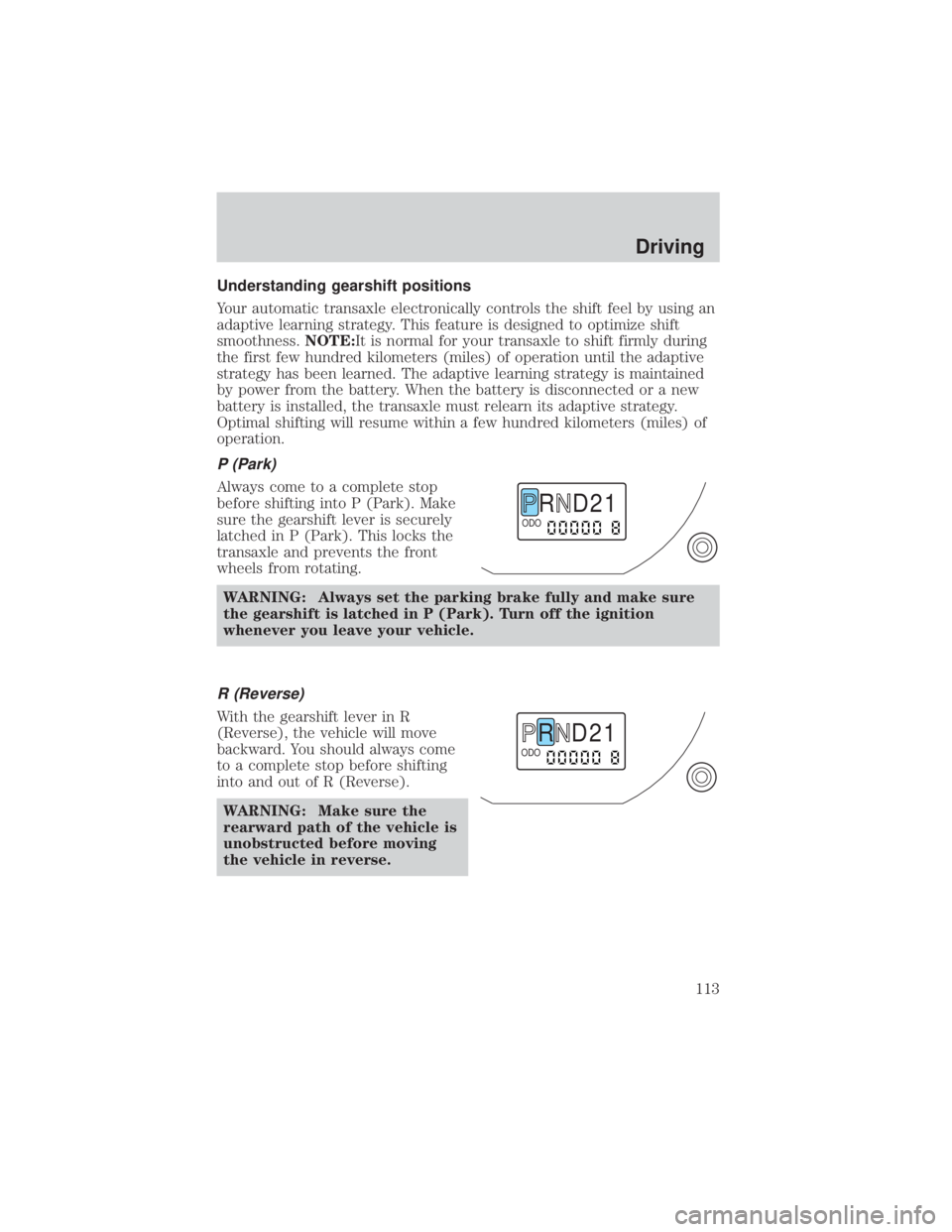
Always come to a complete stop
before shifting into P (Park). Make
sure the gearshift lever is securely
latched in P (Park). This locks the
transaxle and prevents the front
wheels from rotating.
WARNING: Always set the parking brake fully and make sure
the gearshift is latched in P (Park). Turn off the ignition
whenever you leave your vehicle.
R (Reverse)
With the gearshift lever in R
(Reverse), the vehicle will move
backward. You should always come
to a complete stop before shifting
into and out of R (Reverse).WARNING: Make sure the
rearward path of the vehicle is
unobstructed before moving
the vehicle in reverse.
R D 2 1ODO
R D 2 1ODO
Driving
113
Page 120 of 232
FOUR WHEEL DRIVE (4X4) SYSTEM (IF EQUIPPED)
4x4 system general informationWARNING: For important information regarding safe operation
of this type of vehicle, see Preparing to drive your vehicle in
this chapter.
Your vehicle is equipped with a 4x4 system. This 4x4 system can use all
four wheels to power the vehicle. This helps increase traction, enabling
you to drive your vehicle over terrain and road conditions not normally
traveled by two-wheel drive vehicles.
Power is always supplied to the front wheels and to the rear wheels
through the transaxle and Rotary Blade Coupling (RBC) unit that allows
you to select a four-wheel drive mode best suited for your current
driving conditions.
For the lubricant specification and refill capacity of the Power Take-Off
Unit and rear axle refer to the Capacities and specifications chapter.
Operating modes of the 4x4 system
The 4x4 system functions in two modes:
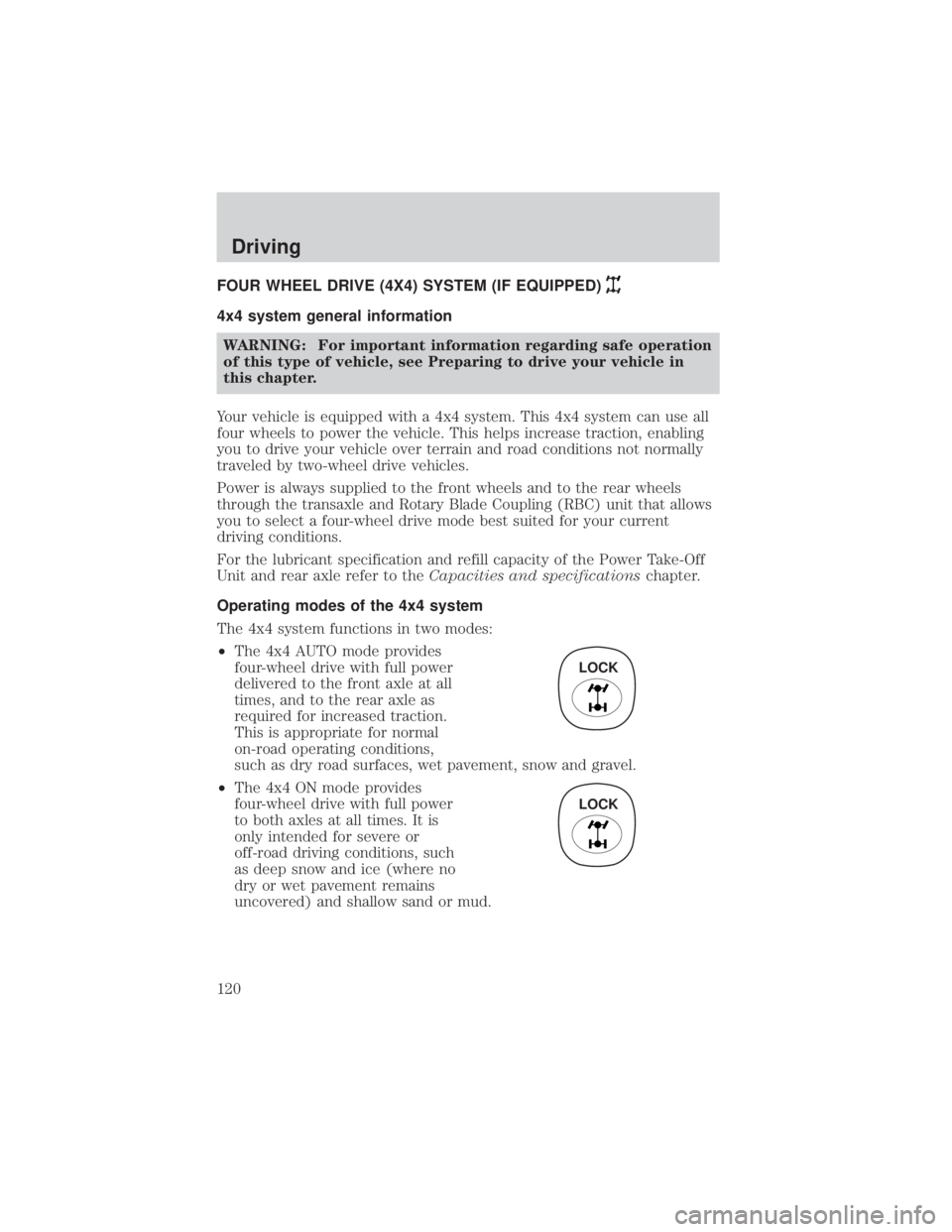
² The 4x4 AUTO mode provides
four-wheel drive with full power
delivered to the front axle at all
times, and to the rear axle as
required for increased traction.
This is appropriate for normal
on-road operating conditions,
such as dry road surfaces, wet pavement, snow and gravel.
² The 4x4 ON mode provides
four-wheel drive with full power
to both axles at all times. It is
only intended for severe or
off-road driving conditions, such
as deep snow and ice (where no
dry or wet pavement remains
uncovered) and shallow sand or mud.
LOCK
LOCK
Driving
120
Page 121 of 232
²The vehicle should not be operated in the 4x4 ON mode on dry
or merely wet pavement. Doing so will produce excessive noise,
increase tire wear and may damage driveline components. The
4x4 ON mode is intended for use only on consistently slippery
or loose surfaces.
² If your vehicle is equipped with this 4x4 system, a spare tire of
a different diameter than the road tires should never be used.
Such a tire could result in damage to driveline components and
make the vehicle difficult to control.
WARNING: Utility and four-wheel drive vehicles are not
designed for cornering at speeds as high as passenger cars any
more than low-slung sports cars are designed to perform
satisfactorily under off-road conditions. Avoid sharp turns or
abrupt maneuvers in these vehicles.
4x4 system indicator lights
The 4x4 mode indicator light illuminates only under the following
conditions. If the indicator light illuminates when driving in the 4x4
AUTO mode, contact your Mazda dealer as soon as possible.
The indicator light illuminates when the 4x4 ON mode is engaged.
Shifting between 4x4 Auto and ON modes
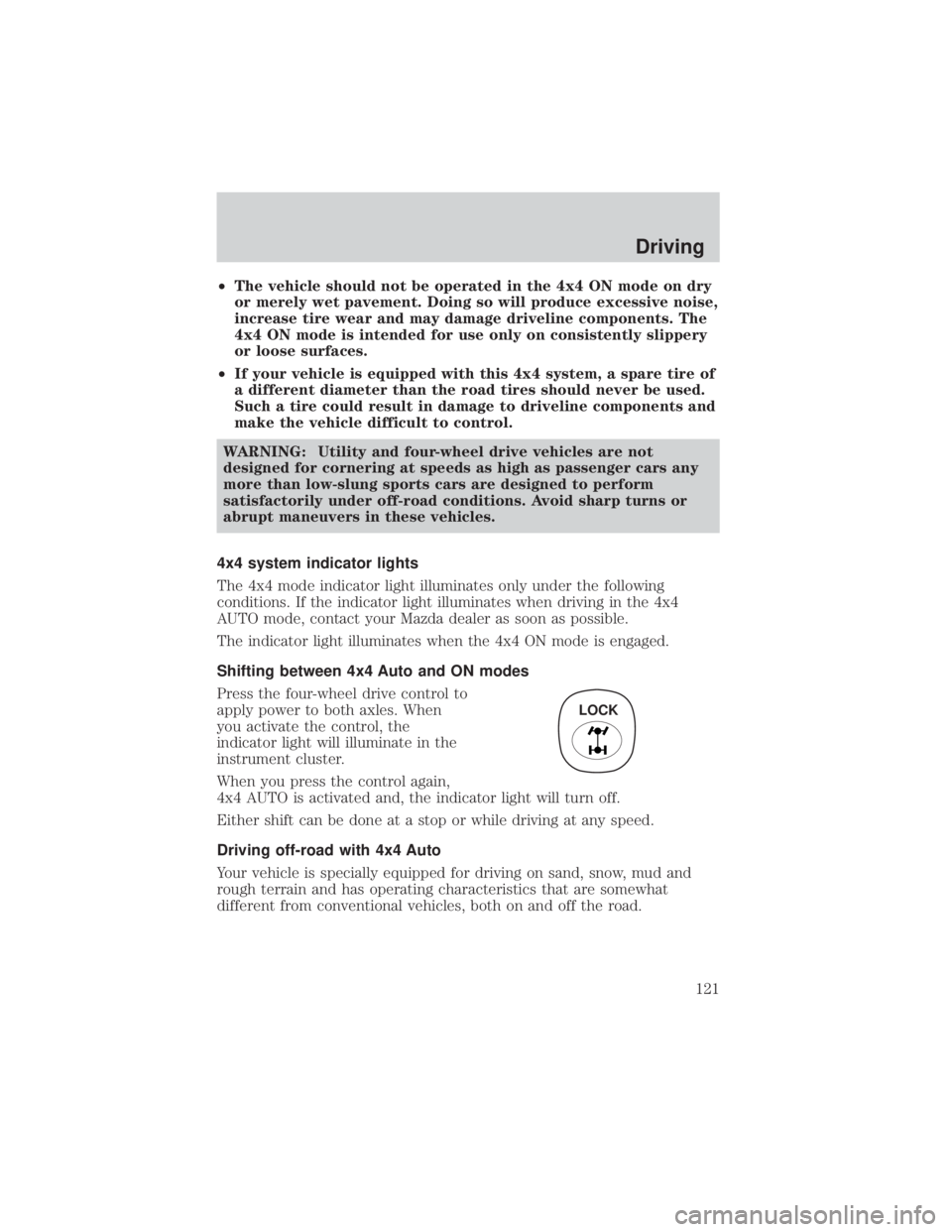
Press the four-wheel drive control to
apply power to both axles. When
you activate the control, the
indicator light will illuminate in the
instrument cluster.
When you press the control again,
4x4 AUTO is activated and, the indicator light will turn off.
Either shift can be done at a stop or while driving at any speed.
Driving off-road with 4x4 Auto
Your vehicle is specially equipped for driving on sand, snow, mud and
rough terrain and has operating characteristics that are somewhat
different from conventional vehicles, both on and off the road.
LOCK
Driving
121
Page 122 of 232
²Maintain steering wheel control at all times, especially in
rough terrain. Since sudden changes in terrain can result in
abrupt steering wheel motion, make sure you grip the steering
wheel from the outside. Do not grip the spokes.
² Drive cautiously to avoid vehicle damage from concealed
objects such as rocks and stumps.
You should either know the terrain or examine maps of the area before
driving. Map out your route before driving in the area.
If your vehicle gets stuck
If the vehicle is stuck in mud or snow select the 4x4 ON operating mode.
It may be rocked out by shifting from forward and reverse gears,
stopping between shifts, in a steady pattern. Press lightly on the
accelerator in each gear.
² Do not rock the vehicle if the engine is not at normal operating
temperature or damage to the transaxle may occur.
²
Do not rock the vehicle for more than a few minutes or damage
to the transaxle and tires may occur or the engine may overheat.
WARNING: Do not spin the wheels at over 56 km/h (35 mph).
The tires may fail and injure a passenger or bystander.
Sand
When driving over sand, try to keep all four wheels on the most solid
area of the trail. Do not reduce the tire pressures but shift to a lower
gear and drive steadily through the terrain. Apply the accelerator slowly
and avoid spinning the wheels.
Mud and water
NOTE:
² If you must drive through high water, drive slowly. Traction or brake
capability may be limited.
² When driving through water, determine the depth; avoid water higher
than the bottom of the hubs (if possible) and proceed slowly. If the
ignition system gets wet, the vehicle may stall.
² Once through water, always try the brakes. Wet brakes do not stop the
vehicle as effectively as dry brakes. Drying can be improved by moving
your vehicle slowly while applying light pressure on the brake pedal.
Driving
122
Page 127 of 232

If driving through deep or standing water is unavoidable, proceed very
slowly. Never drive through water that is higher than the bottom of the
hubs (for trucks) or the bottom of the wheel rims (for cars).
Once through the water, always try the brakes. Wet brakes do not stop
the vehicle as effectively as dry brakes. Drying can be improved by
moving your vehicle slowly while applying light pressure on the brake
pedal.
Driving through deep water where the transmission vent tube is
submerged may allow water into the transmission and cause
internal transmission damage.
TRAILER TOWING
Trailer towing with your vehicle may require the use of a trailer tow
option package.
Trailer towing puts additional loads on your vehicle's engine, transaxle,
axle, brakes, tires, and suspension. For your safety and to maximize
vehicle performance, be sure to use the proper equipment while towing.
Follow these guidelines to ensure safe towing procedure:
²Stay within your vehicle's load limits.
² Thoroughly prepare your vehicle for towing. Refer to Preparing to
tow in this chapter.
² Use extra caution when driving while trailer towing. Refer to Driving
while you tow in this chapter.
² Service your vehicle more frequently if you tow a trailer. Refer to the
ªScheduled Maintenanceº section of this manual.
² Do not tow a trailer until your vehicle has been driven at least 800 km
(500 miles).
² Refer to the instructions included with towing accessories for the
proper installation and adjustment specifications.
Do not exceed the maximum loads listed on the Certification label. For
load specification terms found on the label, refer to Vehicle loadingin
this chapter. Remember to figure in the tongue load of your loaded
vehicle when figuring the total weight.
Driving
127
Page 130 of 232

Trailer towing tips
²Practice turning, stopping and backing up before starting on a trip to
get the feel of the vehicle trailer combination. When turning, make
wider turns so the trailer wheels will clear curbs and other obstacles.
² Allow more distance for stopping with a trailer attached.
² The trailer tongue weight should be no more than 10±15% of the
loaded trailer weight.
² After you have traveled 80 km (50 miles), thoroughly check your
hitch, electrical connections and trailer wheel lug nuts.
² When stopped in traffic for long periods of time in hot weather, place
the gearshift in P (Park) (automatic transmissions) or N (Neutral)
(manual transmissions). This aids engine cooling and air conditioner
efficiency.
² Vehicles with trailers should not be parked on a grade. If you must
park on a grade, place wheel chocks under the trailer's wheels.
Launching or retrieving a boat
When backing down a ramp during boat launching or retrieval,
² Do not allow the static water level to rise above the bottom edge of
the rear bumper and
² Do not allow waves to break higher than 15 cm (6 inches) above the
bottom edge of the rear bumper.
Exceeding these limits may allow water to enter critical vehicle
components, adversely affecting driveability, emissions, reliability
and causing internal transmission damage.
Replace the rear axle lubricant any time the axle has been
submerged in water. Rear axle lubricant quantities are not to be
checked or changed unless a leak is suspected or repair required.
Disconnect the wiring to the trailer before backing the trailer into the
water. Reconnect the wiring to the trailer after the trailer is removed
from the water. Water entering these areas, while connected, could
short-circuit the system.
Driving
130
Page 131 of 232

Recreational towing
An example of ªrecreational towingº is towing your vehicle behind a
motorhome.
If your vehicle is automatic transmission equipped, with a 4x2
(front-wheel drive only) configured powertrain, ªrecreational towingº is
permitted by trailering the vehicle with its front wheels on a dolly. This
protects the transmission's internal mechanical components from
potential lack of lubrication damage.
If your vehicle is automatic transmission equipped, with a 4x4 (all-wheel
drive) configured powertrain, ªrecreational towingº is permitted only if
the vehicle is trailered with all four (4) wheels off the ground. Otherwise,
no ªrecreational towingº is permitted.
If your vehicle is manual transmission equipped, shifting the transmission
into neutral permits ªflat-towingº (all wheels on the ground) for pulling
behind a motorhome. Your vehicle may be towed up to a speed of
120 km/h (75 mph) but you should always obey local speed limits.
For other towing requirements, refer toWrecker Towingin the
Roadside emergencies chapter.
LUGGAGE RACK
Your vehicle is equipped with a roof rack. The maximum load for the roof
rack is 44 kg (100 lbs), evenly distributed on the crossbars. If it is not
possible to evenly distribute the load, position it in the center or as far
forward on the crossbars as possible. Always use the adjustable tie down
loops to secure the load.
To adjust the cross-bar position: 1. Loosen the thumbwheel at both ends of the cross-bar (both
cross-bars are adjustable).
2. Slide the cross-bar to the desired location.
3. Tighten the thumbwheel at both ends of the cross-bar.
Driving
131