Page 132 of 232
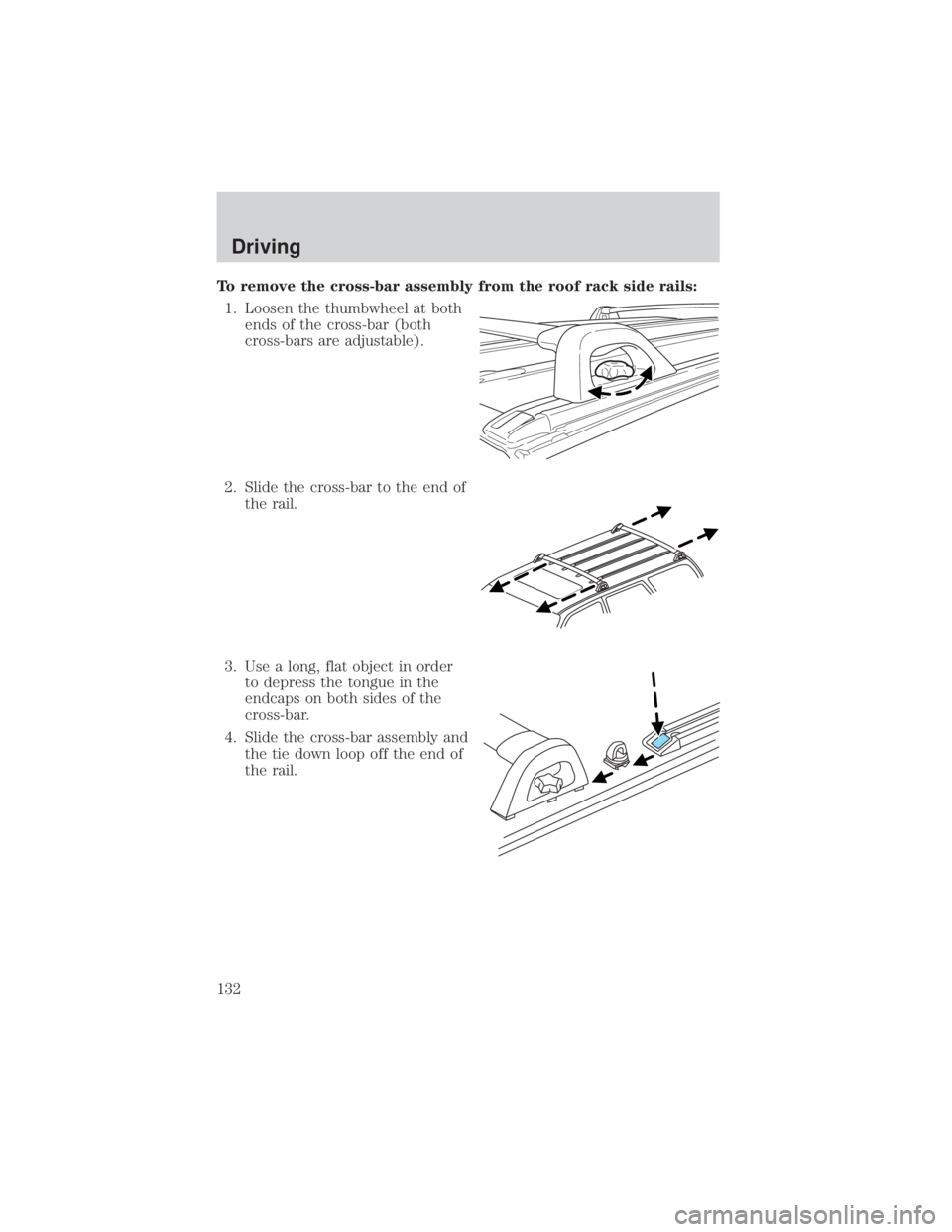
To remove the cross-bar assembly from the roof rack side rails:1. Loosen the thumbwheel at both ends of the cross-bar (both
cross-bars are adjustable).
2. Slide the cross-bar to the end of the rail.
3. Use a long, flat object in order to depress the tongue in the
endcaps on both sides of the
cross-bar.
4. Slide the cross-bar assembly and the tie down loop off the end of
the rail.
Driving
132
Page 133 of 232
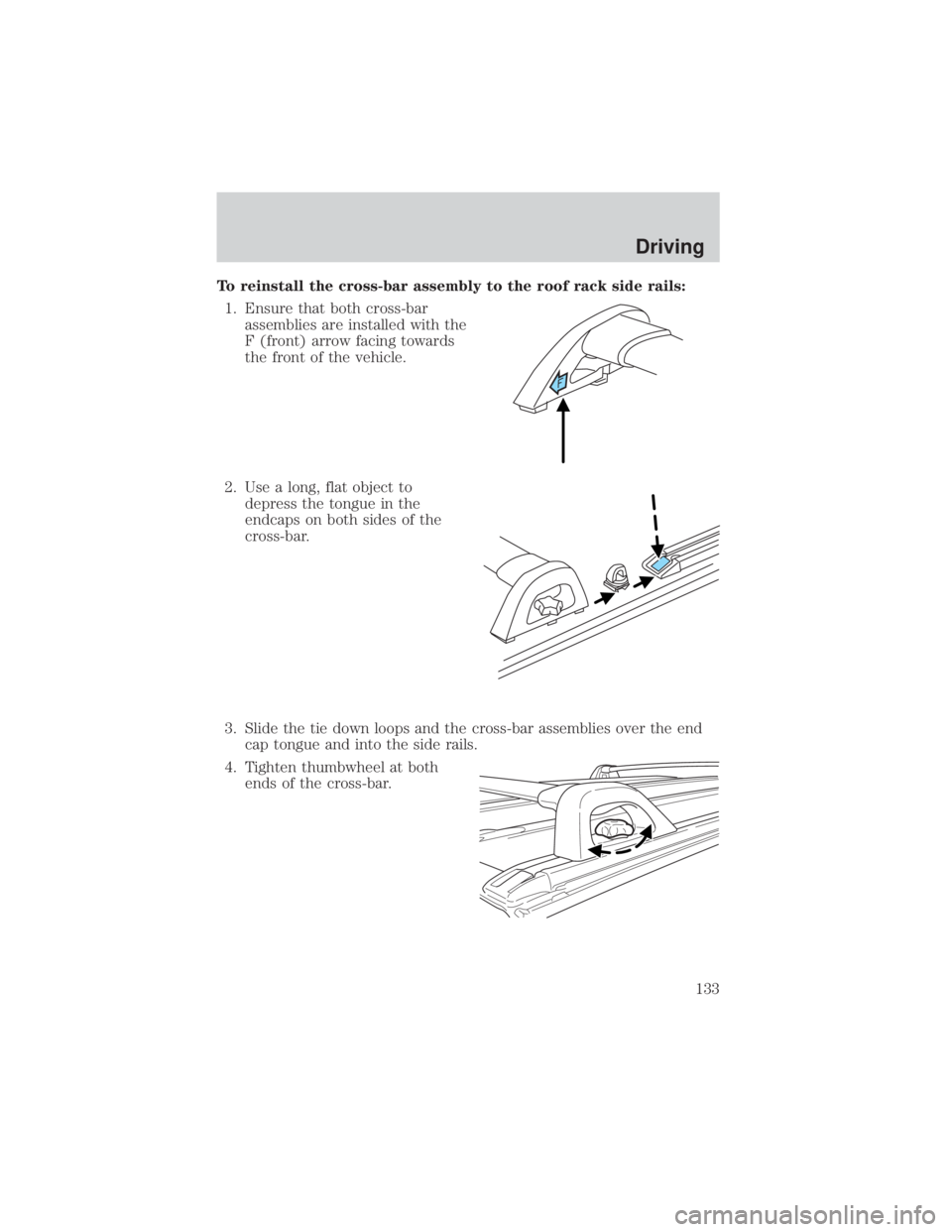
To reinstall the cross-bar assembly to the roof rack side rails:1. Ensure that both cross-bar assemblies are installed with the
F (front) arrow facing towards
the front of the vehicle.
2. Use a long, flat object to depress the tongue in the
endcaps on both sides of the
cross-bar.
3. Slide the tie down loops and the cross-bar assemblies over the end cap tongue and into the side rails.
4. Tighten thumbwheel at both ends of the cross-bar.
Driving
133
Page 136 of 232
COLOR
Fuse
rating Mini
fuses Standard
fuses Maxi
fuses Cartridge
maxi
fuses Fuse link
cartridge
30A Green Green Green Pink Pink
40A Ð Ð Orange Green Green
50A Ð Ð Red Red Red
60A Ð Ð Blue Ð Yellow
70A Ð Ð Tan Ð Brown
80A Ð Ð Natural Ð Black
Passenger compartment fuse panel
The fuse panel is located below and to the left of the steering wheel by
the brake pedal. Remove the panel cover to access the fuses.
To remove a fuse use the fuse puller tool provided on the fuse panel
cover.
Roadside emergencies
136
Page 137 of 232
The fuses are coded as follows:
Fuse/RelayLocation Fuse Amp
Rating Passenger Compartment Fuse Panel
Description
1 5A Canister Vent Control Solenoid
2 5A Blower Relay (coil), Rear Defrost Relay (coil), Pressure Switch to PCM
3 10A Rear Wiper Motor, Rear Washer Motor, Rear Wiper Relay (coil)
4 10A Four Wheel Drive Control Module, Cluster (Restraints Control Warning)
5 5A ABS Unit (EVAC & FILL), ASC Unit, Restraints Control Module, ASC Main SW to
ASC Unit
6 10A Flasher Unit, Left reversing Lamp, Right Reversing Lamp
ACC
12
34
56
78
910
11 12
13 14
15 16
17 18
19 20
21 22
23 24
25 26
27
Roadside emergencies
137
Page 142 of 232

Fuse/RelayLocation Fuse Amp
Rating Power Distribution Box Description
FUEL
PUMP ISO Ð Fuel Pump Relay
MAIN FAN ISO Ð Low Speed Fan Control Relay
(2.0L Engine)
High Speed Fan Control Relay 1
(3.0L Engine)
ADD FAN ISO Ð High Speed Fan Control Relay 1
(2.0L Engine)
Low Speed Fan Control Relay
(3.0L Engine)
DEF RELAY ISO Ð Rear Defroster Relay
ST RELAY ISO Ð Starter Relay
ADD FAN 2 ISO Ð High Speed Fan Control Relay 2
(3.0L Engine)
Medium Speed Fan Control Relay
(2.0L Engine)
FOG RELAY MICRO Ð Foglamp Relay
A/C RELAY MICRO Ð A/C Clutch Relay
CHANGING THE TIRES
If you get a flat tire while driving, do not apply the brake heavily.
Instead, gradually decrease your speed. Hold the steering wheel firmly
and slowly move to a safe place on the side of the road.
Temporary spare tire information
Your vehicle may have a temporary or conventional spare tire. The
temporary spare tire for your vehicle is labeled as such. It is smaller than
a regular tire and is designed for emergency use only. Replace this tire
with a full-size tire as soon as possible.
Roadside emergencies
142
Page 143 of 232
It is not recommended that the vehicle be operated in 4WD modes with
a temporary spare. If 4WD operation is necessary, do not operate above
speeds of 16 km/h (10 mph) or for distances above 80 km (50 miles).WARNING: If you use the temporary spare tire continuously or
do not follow these precautions, the tire could fail, causing you
to lose control of the vehicle, possibly injuring yourself or
others.
When driving with the temporary spare tire do not:
² exceed 80 km/h (50 mph) under any circumstances
² load the vehicle beyond maximum vehicle load rating listed on the
Safety Compliance Label
² tow a trailer
² use tire chains
² drive through an automatic car wash, because of the vehicle's reduced
ground clearance
² try to repair the temporary spare tire or remove it from its wheel rim
² use the wheel for any other type of vehicle
Tire change procedure WARNING: When one of the front wheels is off the ground, the
transmission alone will not prevent the vehicle from moving or
slipping off the jack, even if the vehicle is in P (Park)
(automatic transaxle) or R (Reverse) (manual transaxle).
WARNING: To prevent the vehicle from moving when you
change a tire, be sure the parking brake is set, then block (in
both directions) the wheel that is diagonally opposite (other
side and end of the vehicle) to the tire being changed.
WARNING: If the vehicle slips off the jack, you or someone
else could be seriously injured.
Roadside emergencies
143
Page 144 of 232
1. Park on a level surface, activatehazard flashers and place
gearshift lever in P (Park)
(automatic transmission) or R
(Reverse) (manual
transmission).
2. Set the parking brake and turn engine OFF.
3. Block the diagonally opposite wheel.
4. Lift the cargo cover and remove the tool bag with jack handle,
lug nut wrench and long spare
tire rod and spare tire from the
wheel well.
5. Loosen each wheel lug nut one-half turn counterclockwise
but do not remove them until
the wheel is raised off the
ground.
Roadside emergencies
144
Page 146 of 232
Never use the differentials as a
jacking point. It is too easy for
the vehicle to tilt or fall and you
can be injured.WARNING: To lessen the risk
of personal injury, do not put
any part of your body under
the vehicle while changing a
tire. Do not start the engine
when your vehicle is on the
jack. The jack is only meant
for changing the tire.
7. Remove the lug nuts with the lug nut wrench.
8. Replace the flat tire with the spare tire, making sure the valve stem is facing outward. Reinstall lug nuts until the wheel is snug against
the hub. Do not fully tighten the lug nuts until the wheel has been
lowered.
9. Lower the wheel by turning the jack handle counterclockwise.
10. Remove the jack and fully tighten the lug nuts in the order
shown.
1
4
3
2
5
Roadside emergencies
146