Page 219 of 363
�Î�Î
�Î�Î
on loose or
uneven surf aces, such as gravel or
snow, than a vehicle without anti-
lock. Slow down and allow a greater
distance between vehicles under
those conditions.
Always steer moderately
when you are braking hard. Severe
or sharp steering wheel movement
can still cause your vehicle to veer
into oncoming traffic or off the road. such as trying to take a
corner too f ast or making a sudden
lane change. Always drive at a safe,
prudent speed f or the road and
weather conditions. it only helps with steering
control during braking. You should
always maintain a saf e f ollowing
distance f rom other vehicles.
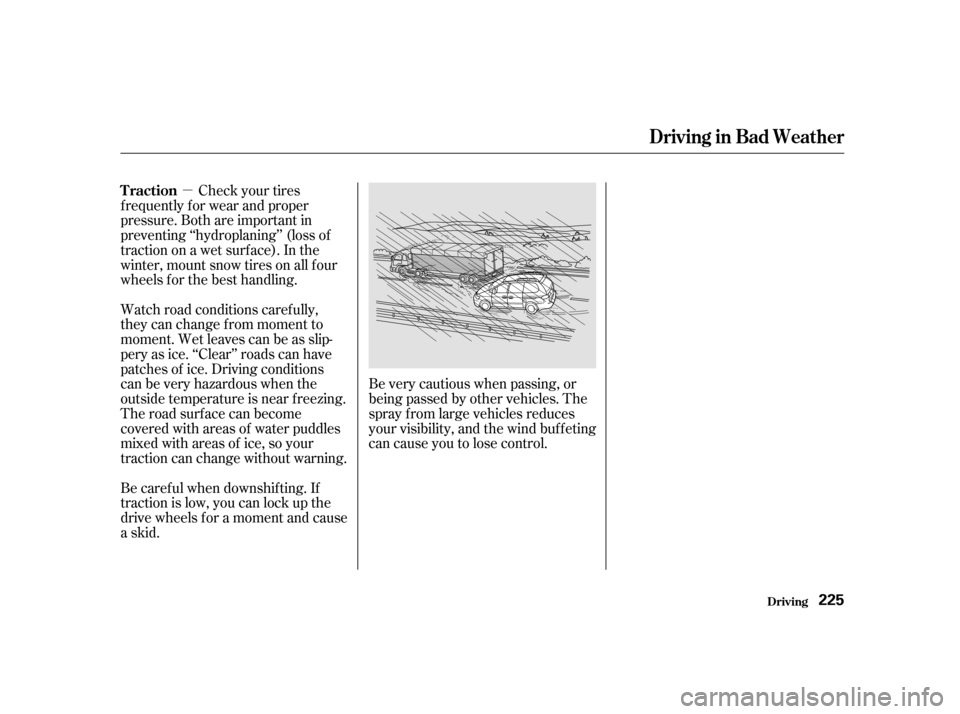
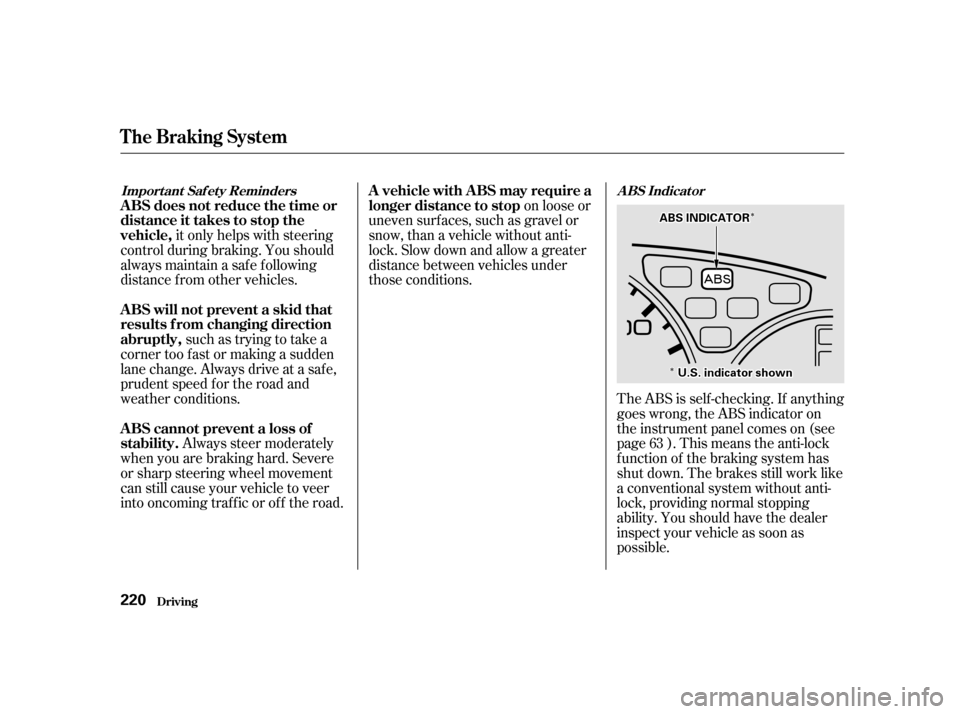
The ABS is self -checking. If anything
goes wrong, the ABS indicator on
the instrument panel comes on (see
page ). This means the anti-lock
f unction of the braking system has
shut down. The brakes still work like
a conventional system without anti-
lock, providing normal stopping
ability. You should have the dealer
inspect your vehicle as soon as
possible.63
A BS Indicat or
Import ant Saf et y RemindersA vehicle with A BS may require a
longer distance to stop
A BS cannot prevent a loss of
stability.
A BS will not prevent a skid that
results f rom changing direction
abruptly,
A BS does not reduce the time or
distance it takes to stop the
vehicle,
The Braking System
Driving
220
UU..SS..iinnddiiccaattoorrsshhoowwnn
AABBSSIINNDDIICCAATTOORR
Page 220 of 363
CONT INUED
If the ABS indicator and the brake
system indicator come on together,
and the parking brake is f ully
released, the front-to-rear braking
distribution system may also shut
down.
Test your brakes as instructed on
page . If the brakes f eel normal,
drive slowly and have your vehicle
repaired by your dealer as soon as
possible. Avoid sudden hard braking
which could cause the rear wheels to
lock up and possibly lead to a loss of
control.Driving with TCS requires no special
skills or technique. The TCS does
not control your vehicle’s whole
braking system and cannot prevent
skidding if you enter a corner too
f ast. It is still your responsibility to
drive at reasonable speeds and to
leave a sufficient margin of safety.
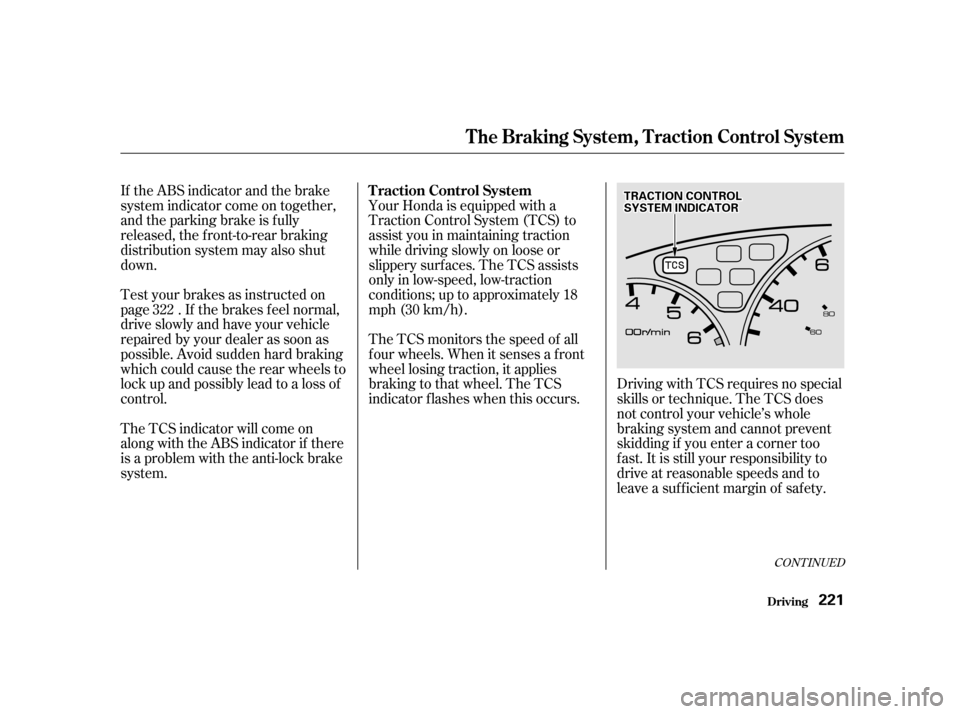
The TCS indicator will come on
alongwiththeABSindicatorif there
is a problem with the anti-lock brake
system. Your Honda is equipped with a
Traction Control System (TCS) to
assist you in maintaining traction
while driving slowly on loose or
slippery surf aces. The TCS assists
only in low-speed, low-traction
conditions; up to approximately 18
mph (30 km/h).
The TCS monitors the speed of all
f our wheels. When it senses a f ront
wheel losing traction, it applies
braking to that wheel. The TCS
indicator f lashes when this occurs.
322
The Braking System, Traction Control System
Driving
Traction Control System
221
TTRRAACCTTIIOONNCCOONNTTRROOLLSSYYSSTTEEMMIINNDDIICCAATTOORR
Page 222 of 363

If the TCS indicator comes on and
stays on for more than 10 minutes
while driving, pull to the side of the
road when it is safe and turn off the
engine. Reset the system by
restarting the engine, and watch the
TCS indicator. If the indicator
remains on, or comes back on while
driving, have the system inspected
by your Honda dealer. You can still
drive the vehicle without TCS.
This indicator will come on along
with the ABS indicator if there is a
problem in the anti-lock brake
system (see on page).
The TCS indicator may occasionally
come on f or one or two seconds and
then go out. This is normal.
The Traction Control System turns
on every time you start the engine,
even if you turned it of f the last time
you drove the vehicle.
The TCS indicator comes on or
f lashes under the f ollowing condi-
tions:
When you turn the ignition switch
to ON (II).
When you manually turn of f the
TCS.
It f lashes when the TCS is
regulating wheelspin.
If the system’s diagnostics senses
a problem in the TCS, the indica-
tor will come on and stay on.
If the brakes overheat, the
indicator will come on. 220
Traction Control System
Driving
ABS Indicator
T CS Indicat or
223
Page 223 of 363
�µ�µAlways drive
slower than you would in dry
weather. It takes your vehicle longer
to react, even in conditions that may
seem just barely damp. Apply
smooth, even pressure to all the
controls. Abrupt steering wheel
movements or sudden, hard appli-
cation of the brakes can cause loss of
control in wet weather. Be extra
cautious f or the f irst f ew miles
(kilometers) of driving while you
adjust to the change in driving
conditions. This is especially true in
snow. A person can f orget some
snow-driving techniques during the
summer months. Practice is needed
to relearn those skills.
Exercise extra caution when driving
in rain af ter a long dry spell. Af ter
months of dry weather, the f irst
rains bring oil to the surf ace of the
roadway, making it slippery.
Rain, f og, and snow conditions re-
quire a dif f erent driving technique
because of reduced traction and
visibility. Keep your vehicle well-
maintained and exercise greater
caution when you need to drive in
bad weather. The cruise control
should not be used in these condi-
tions. Being able to see
clearly in all directions and being
visible to other drivers are important
in all weather conditions. This is
more difficult in bad weather. To be
seen more clearly during daylight
hours, turn on your headlights.
Inspect your windshield wipers and
washers f requently. Keep the
windshield washer reservoir f ull of
the proper f luid. Have the windshield
wiper blades replaced if they start to
streak the windshield or leave parts
unwiped. Use the def roster and air
conditioning to keep the windows
f rom f ogging up on the inside (see
pages and ). 141 151/156
Driving
Driving in Bad Weather
Driving T echnique Visibility
224
Page 224 of 363
�µCheck your tires
f requently f or wear and proper
pressure. Both are important in
preventing ‘‘hydroplaning’’ (loss of
traction on a wet surface). In the
winter, mount snow tires on all f our
wheels f or the best handling.
Watch road conditions caref ully,
they can change f rom moment to
moment. Wet leaves can be as slip-
pery as ice. ‘‘Clear’’ roads can have
patches of ice. Driving conditions
can be very hazardous when the
outside temperature is near f reezing.
The road surf ace can become
covered with areas of water puddles
mixed with areas of ice, so your
traction can change without warning.
Be caref ul when downshif ting. If
traction is low, you can lock up the
drive wheels f or a moment and cause
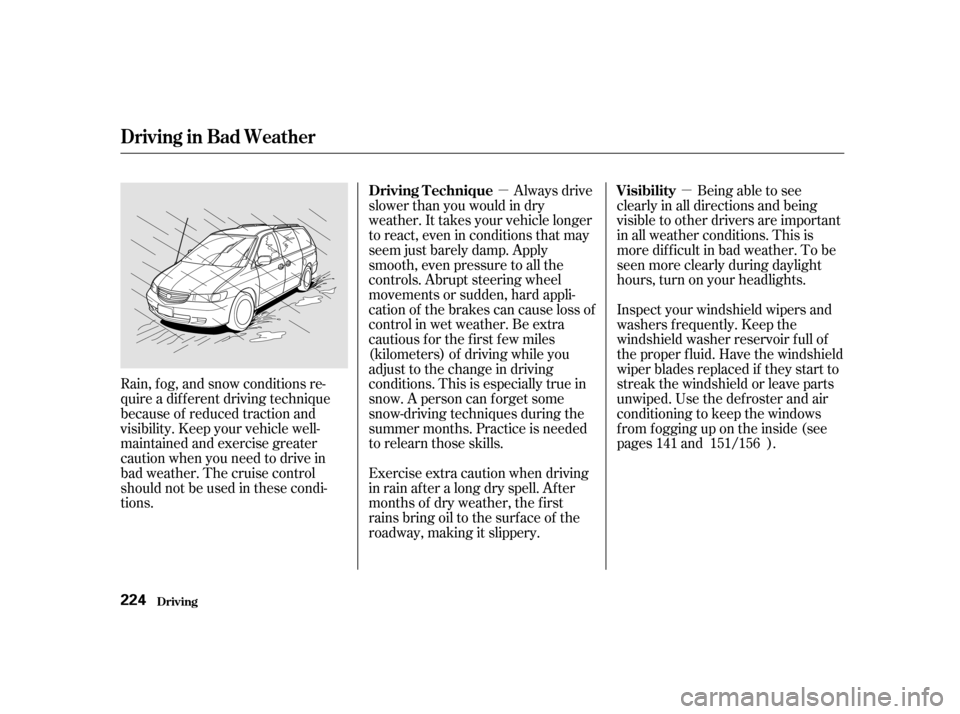
askid. Be very cautious when passing, or
beingpassedbyothervehicles.The
spray f rom large vehicles reduces
your visibility, and the wind buf f eting
can cause you to lose control.
Driving in Bad Weather
Driving
Traction
225
Page 228 of 363

Towing can require a variety of
equipment, depending on the size of
your trailer, how it will be used, and
how much load you are towing.
Discuss your needs with your trailer
sales or rental agency, and f ollow the
guidelines in the rest of this section.
Also make sure that all equipment is
properly installed and that it meets
f ederal, state, province, and local
regulations.
Any hitch used on your vehicle must
be properly bolted to the underbody,
using the six threaded holes
provided. A hitch designed especially
foryourOdysseycanbeobtained
f rom your Honda dealer.Always use a saf ety chain. Make
sure that it is secured to both the
trailer and hitch, and that it cross
under the tongue so it can catch the
trailer if it becomes unhitched.
Leave enough slack to allow the
trailer to turn corners easily, but do
not let the chain drag on the ground.
If the total trailer weight is more
than 2,000 lbs (900 kg), you must
also use a weight distributing hitch.
This device transf ers weight f rom
the vehicle’s rear wheels to the f ront
wheels, and to the trailer’s wheels.
Caref ully f ollow the hitch maker’s
instructions f or proper installation
and adjustment.
If the total trailer weight exceeds
2,000 lbs (900 kg), you should install
a sway control device to minimize
swaying that can occur in crosswinds
and in normal and emergency
driving maneuvers. Your trailer
makercantellyouwhatkindof sway
control you need and how to install it.
If the total trailer weight is more
than 2,000 lbs (900 kg), you must
also have a transmission fluid cooler
installed. This device will help
prevent transmission overheating,
which could cause serious damage.
A transmission f luid cooler designed
foryourOdysseycanbeobtained
f rom your Honda dealer.
CONT INUED
T owing Equipment and
A ccessories
HitchesWeight Distributing Hitch
Saf ety Chain Sway Cont rol
T ransmission Fluid Cooler
Towing a Trailer
Driving 229
Page 230 of 363

Your vehicle tires and spare are
properly inf lated (see page ),
and the trailer tires and spare are
inf lated as recommended by the
trailer maker.
When towing a trailer, you should
carry a f ull-size wheel and tire as a
spare in case you have a flat. If you
use the compact spare tire that came
with the vehicle, it may adversely
af f ect vehicle handling. See page
f or inf ormation on proper tire
size, and page f or inf ormation on
how to store a f ull-size tire. When
storing a f ull-size spare tire in the
trailer, f ollow the trailer maker’s
instructions.
Many states and Canadian provinces
require special outside mirrors when
towing a trailer. Even if they don’t,
you should install special mirrors if
you cannot clearly see behind you, or
if the trailer creates a blind spot.
Askyourtrailersalesorrental
agency if any other items are
recommended or required f or your
towing situation. When preparing to tow, and bef ore
driving away, be sure to check the
f ollowing:
The vehicle has been properly
serviced, and the tires, brakes,
suspension, and cooling system
are in good operating condition.
All weights and loads are within
limits (see pages and ).
Thehitch,safetychains,andany
other attachments are secure.
Allitemsonandinthetrailerare
properly secured and cannot shif t
while you drive.
The lights and brakes on your
vehicle and the trailer are working
properly. You may want to fill the fuel tank
with premium f uel. Premium f uel
provides improved perf ormance.
323
309
227 228 335
CONT INUED
Spare Vehicle T ire
Additional Trailer EquipmentPre-T ow Checklist
Towing a Trailer
Driving231
Page 232 of 363
Crosswinds and air turbulence
caused by passing trucks can disrupt
your steering and cause trailer
swaying. When being passed by a
large vehicle, keep a constant speed
and steer straight ahead. Do not try
to make quick steering or braking
corrections.Follow all normal precautions when
parking, including putting the
transmission in Park and f irmly
setting the parking brake. Also, place
wheel chocks at each of the trailer’s
tires.
Always drive slowly and have
someone guide you when backing up.
Grip the of the steering
wheel; then turn the wheel to the lef t
to get the trailer to move to the lef t,
andturnthewheelrighttomovethe
trailer to the right.
bottom
Handling Crosswinds and Buf f et ing
Backing Up Parking
Towing a Trailer
Driving
233