Page 33 of 363
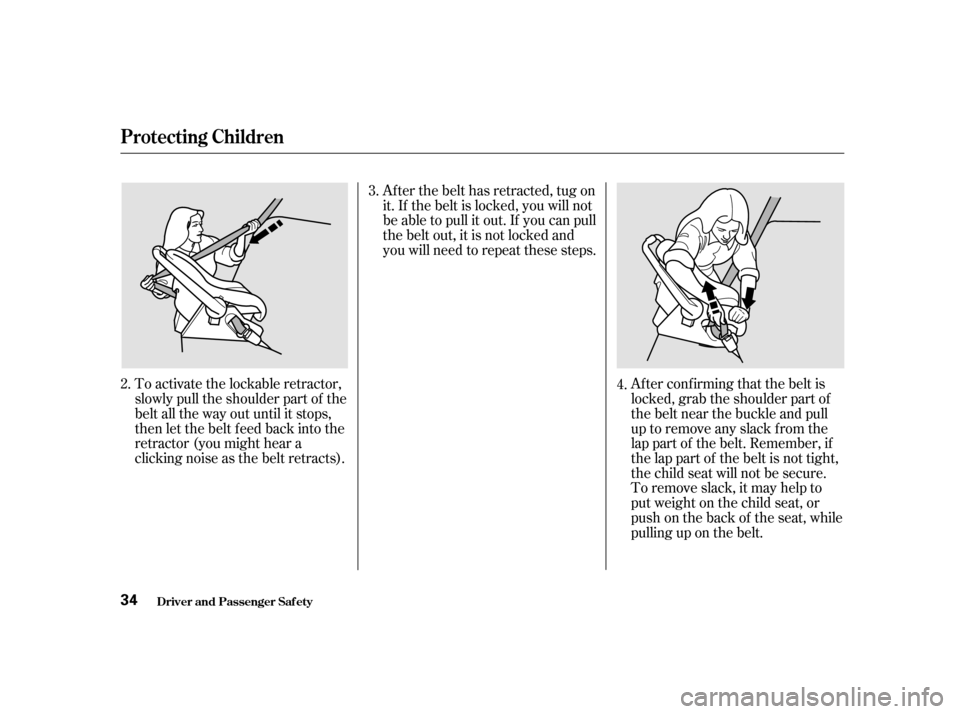
Af ter conf irming that the belt is
locked, grab the shoulder part of
the belt near the buckle and pull
up to remove any slack from the
lap part of the belt. Remember, if
the lap part of the belt is not tight,
the child seat will not be secure.
To remove slack, it may help to
putweightonthechildseat,or
push on the back of the seat, while
pulling up on the belt.
Af ter the belt has retracted, tug on
it. If the belt is locked, you will not
be able to pull it out. If you can pull
the belt out, it is not locked and
you will need to repeat these steps.
To activate the lockable retractor,
slowly pull the shoulder part of the
belt all the way out until it stops,
then let the belt f eed back into the
retractor (you might hear a
clicking noise as the belt retracts). 4.
3.
2.
Protecting Children
Driver and Passenger Saf ety
34
Page 34 of 363
CONT INUED
To deactivate the locking
mechanism and remove a child seat,
unlatch the buckle, unroute the seat
belt, and let the belt f ully retract.
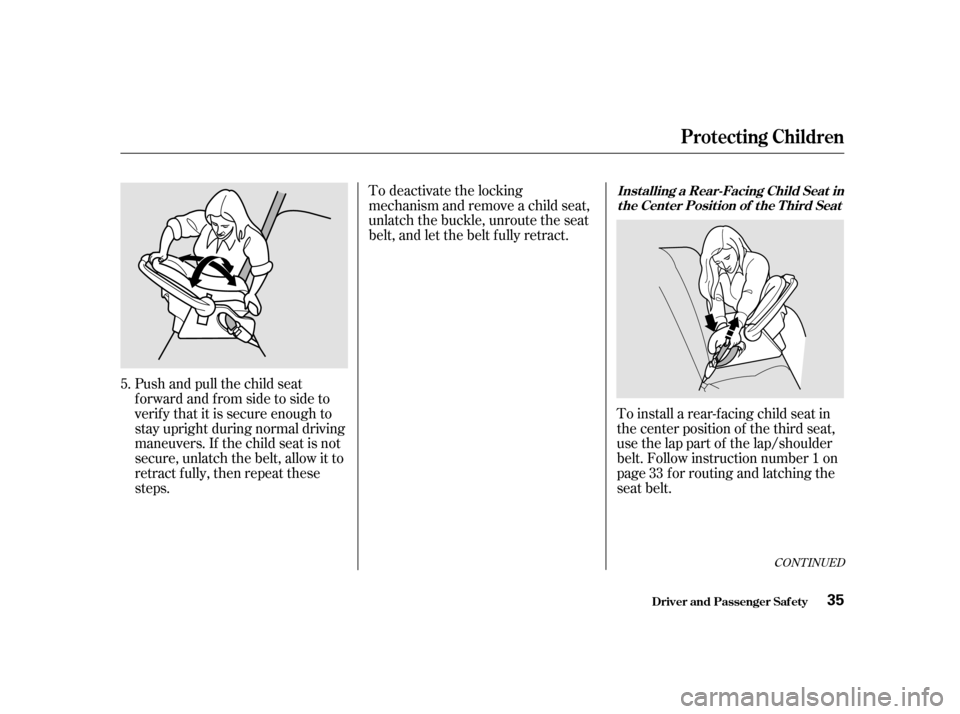
Push and pull the child seat
f orward and f rom side to side to
verif y that it is secure enough to
stay upright during normal driving
maneuvers. If the child seat is not
secure, unlatch the belt, allow it to
retract f ully, then repeat these
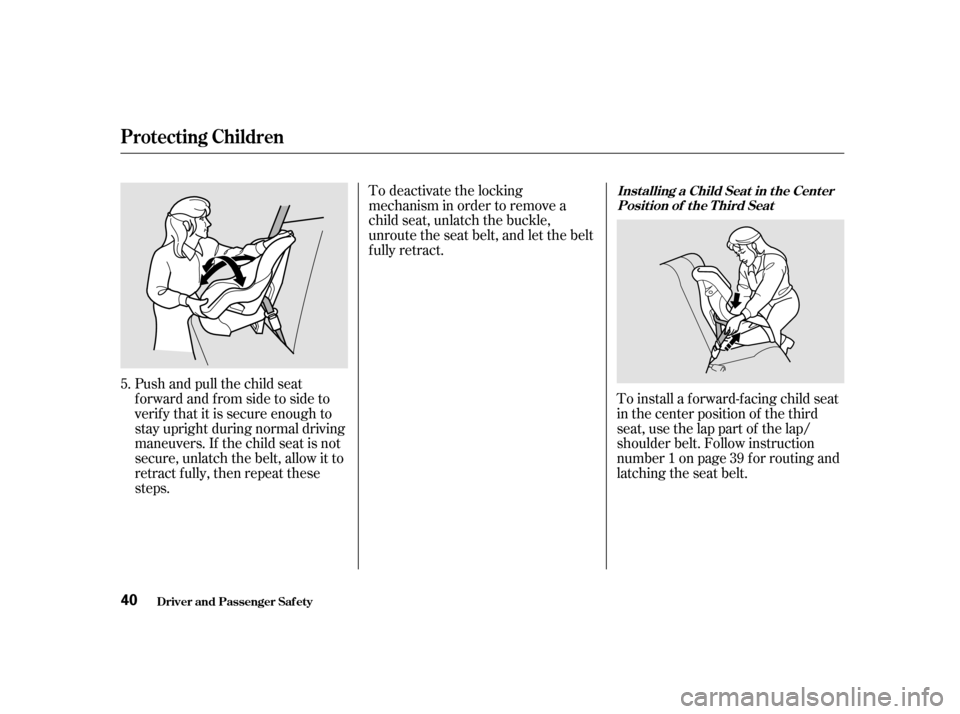
steps. To install a rear-facing child seat in
the center position of the third seat,
use the lap part of the lap/shoulder
belt. Follow instruction number 1 on
page f or routing and latching the
seat belt.
5.
33
Protecting Children
Driver and Passenger Saf ety
Inst alling a Rear-Facing Child Seat int he Cent er Posit ion of t he T hird Seat
35
Page 37 of 363

The lap/shoulder belts in the outer
back and f ront passenger seating
positions have a locking mechanism
that must be activated to secure a
child seat.
The f ollowing pages provide
instructions on how to secure a
f orward-f acing child seat with this
type of seat belt.
See page f or how to secure a
f orward-f acing child seat in the
center position on the third seat with
the lap part of the lap/shoulder belt.
If it is necessary to put a f orward-
f acing child seat in the f ront, move
the vehicle seat as far to the rear as
possible, be sure the child seat is
f irmly secured to the vehicle, and the
child is properly strapped in the seat. If you have a child seat designed to
attach to the vehicle’s lower
anchorages, f ollow the instructions
on page .
40 47
Driver and Passenger Saf ety
Protecting Children
Inst alling a Child Seat wit h a L ap/ Shoulder Belt
38 Improperly placing a forward-
facing child seat in the front
seat can result in serious injury
or death if the airbags inflate.
Ifyoumustplaceaforward-
facing child seat in front, move
the vehicle seat as far back as
possible and properly restrain
the child.
Page 38 of 363
CONT INUED
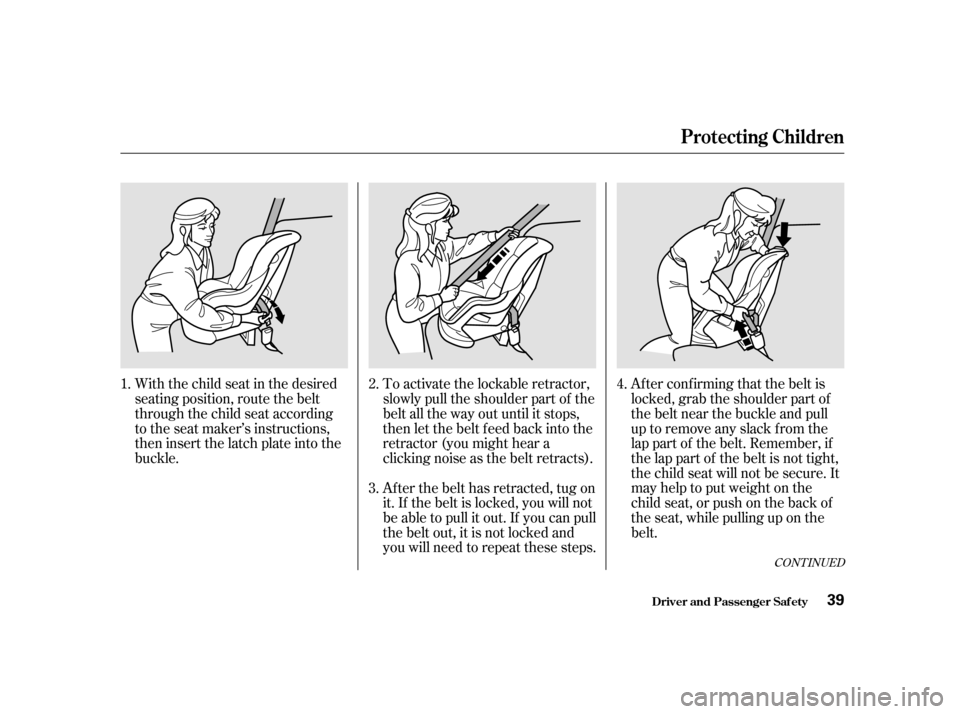
Af ter conf irming that the belt is
locked, grab the shoulder part of
the belt near the buckle and pull
up to remove any slack from the
lap part of the belt. Remember, if
the lap part of the belt is not tight,
the child seat will not be secure. It
mayhelptoputweightonthe
child seat, or push on the back of
the seat, while pulling up on the
belt.
To activate the lockable retractor,
slowly pull the shoulder part of the
belt all the way out until it stops,
then let the belt f eed back into the
retractor (you might hear a
clicking noise as the belt retracts).
Af ter the belt has retracted, tug on
it. If the belt is locked, you will not
be able to pull it out. If you can pull
the belt out, it is not locked and
you will need to repeat these steps.
With the child seat in the desired
seating position, route the belt
through the child seat according
to the seat maker’s instructions,
then insert the latch plate into the
buckle.
4.
2. 3.
1.
Driver and Passenger Saf ety
Protecting Children
39
Page 39 of 363
To deactivate the locking
mechanism in order to remove a
child seat, unlatch the buckle,
unroute the seat belt, and let the belt
fully retract.
Push and pull the child seat
f orward and f rom side to side to
verif y that it is secure enough to
stay upright during normal driving
maneuvers. If the child seat is not
secure, unlatch the belt, allow it to
retract f ully, then repeat these
steps. To install a forward-facing child seat
in the center position of the third
seat, use the lap part of the lap/
shoulder belt. Follow instruction
number 1 on page f or routing and
latching the seat belt.
5.
39
Driver and Passenger Saf ety
Protecting Children
Inst alling a Child Seat in t he Cent er Position of the T hird Seat
40
Page 48 of 363
CONT INUED
To unlock the belt, push the red
PRESSbuttononthebuckle.
To fasten the belt, insert the latch
plate into the buckle, then tug on the
belt to make sure the buckle is
latched.
Guide the belt across your body so
that it retracts completely. After
exiting the vehicle, be sure the belt
is out of the way and will not get
closed in the door.
All seat belts have an emergency
locking retractor. In normal driving,
the retractor lets you move f reely in
your seat while it keeps some
tension on the belt. During a collision
or sudden stop, the retractor
automatically locks the belt to help
restrain your body.
Your vehicle has two types of lap/
shoulder belts. The center position
of the third seat has a combination of
a lap belt and a shoulder belt. For
maximum saf ety, they are designed
to be used together.
All other seating positions have a
one-piece lap/shoulder belt. This
seat belt goes over your shoulder,
across your chest and across yourhips.
Your seat belt system includes lap/
shoulder belts in all seven seating
positions.
The system also includes a
light on the instrument
panel to remind you and your
passengers to f asten your belts. If
the driver’s seat belt is not f astened
before the ignition is turned ON (II),
the light will come on and a beeper
will also sound. The beeper will stop
af ter a f ew seconds, but the light will
stay on until the driver’s seat belt is
f astened.
Seat Belt System Components L ap/Shoulder Belt
Additional Inf ormation About Your Seat Belts
Driver and Passenger Saf ety
49
Page 49 of 363
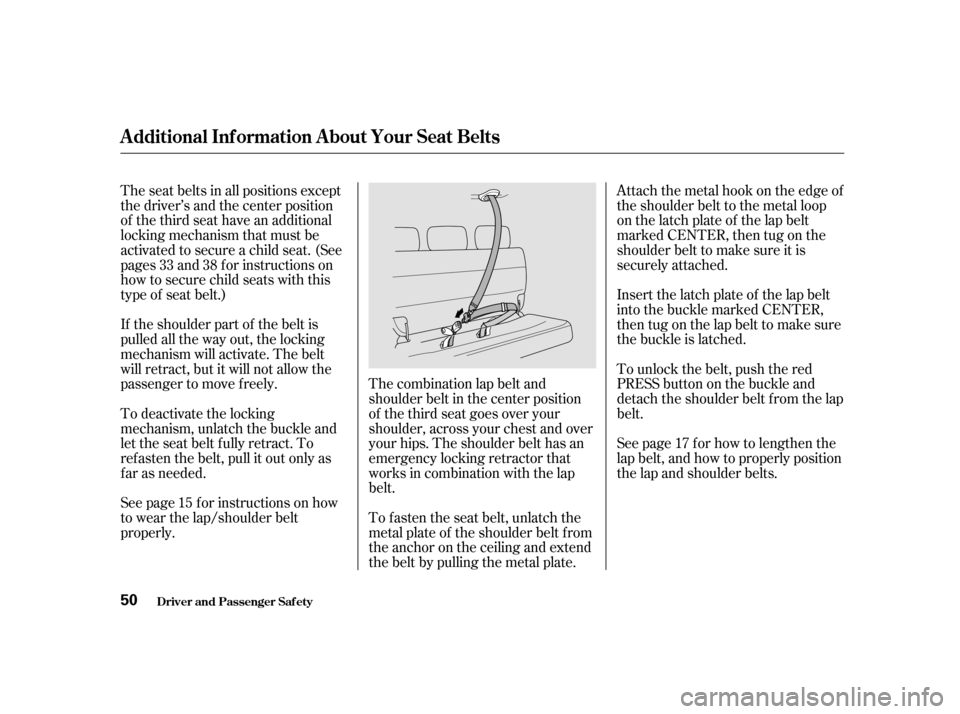
The combination lap belt and
shoulder belt in the center position
of the third seat goes over your
shoulder, across your chest and over
your hips. The shoulder belt has an
emergency locking retractor that
works in combination with the lap
belt.
The seat belts in all positions except
the driver’s and the center position
of the third seat have an additional
locking mechanism that must be
activated to secure a child seat. (See
pages and f or instructions on
how to secure child seats with this
type of seat belt.)
If the shoulder part of the belt is
pulled all the way out, the locking
mechanism will activate. The belt
will retract, but it will not allow the
passenger to move f reely.
To deactivate the locking
mechanism, unlatch the buckle and
let the seat belt f ully retract. To
ref asten the belt, pull it out only as
f ar as needed.
See page f or instructions on how
to wear the lap/shoulder belt
properly.
To f asten the seat belt, unlatch the
metal plate of the shoulder belt from
the anchor on the ceiling and extend
the belt by pulling the metal plate.Attach the metal hook on the edge of
the shoulder belt to the metal loop
on the latch plate of the lap belt
marked CENTER, then tug on the
shoulder belt to make sure it is
securely attached.
Insert the latch plate of the lap belt
into the buckle marked CENTER,
then tug on the lap belt to make sure
the buckle is latched.
To unlock the belt, push the red
PRESS button on the buckle and
detach the shoulder belt from the lap
belt.
See page f or how to lengthen the
lap belt, and how to properly position
the lap and shoulder belts.
15 17
33 38
Additional Inf ormation About Your Seat Belts
Driver and Passenger Saf ety
50
Page 52 of 363
After a crash, you may see what
looks like smoke. This is actually
powder f rom the airbag’s surf ace.
Although the powder is not harmf ul,
people with respiratory problems
may experience some temporary
discomf ort. If this occurs, get out of
the vehicle as soon as it is saf e to do
so.
For additional information on how
your airbags work, see the booklet
titledthat came with your
owner’s manual.
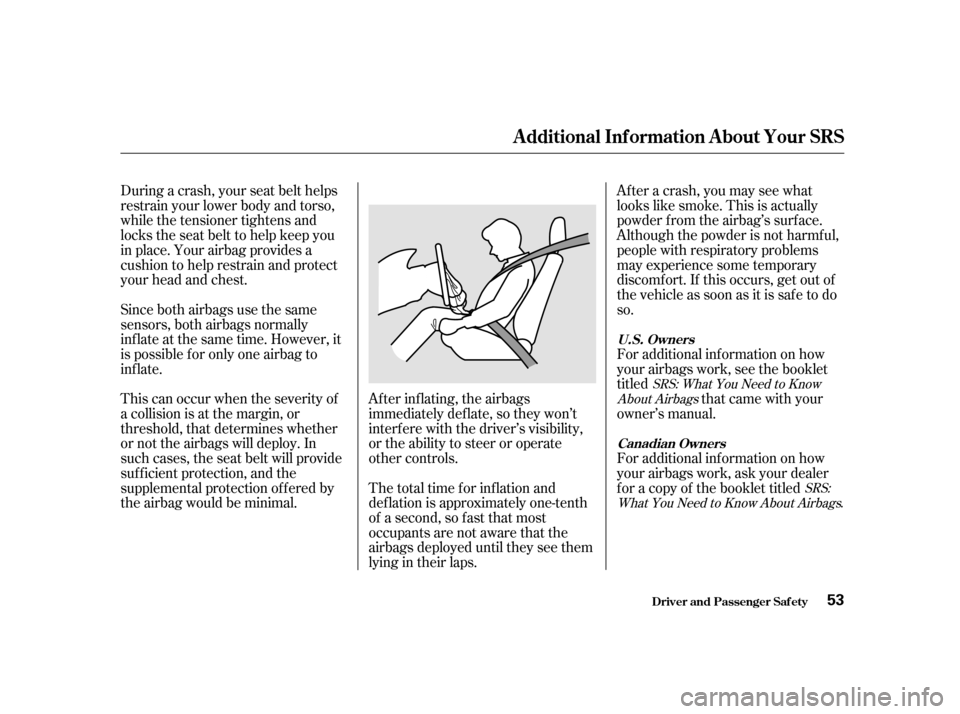
Af ter inf lating, the airbags
immediately def late, so they won’t
interf ere with the driver’s visibility,
or the ability to steer or operate
other controls.
The total time for inflation and
def lation is approximately one-tenth
of a second, so f ast that most
occupants are not aware that the
airbags deployed until they see them
lying in their laps.
During a crash, your seat belt helps
restrain your lower body and torso,
while the tensioner tightens and
locks the seat belt to help keep you
in place. Your airbag provides a
cushion to help restrain and protect
your head and chest.
Since both airbags use the same
sensors, both airbags normally
inf late at the same time. However, it
is possible f or only one airbag to
inf late.
This can occur when the severity of
a collision is at the margin, or
threshold, that determines whether
or not the airbags will deploy. In
such cases, the seat belt will provide
suf f icient protection, and the
supplemental protection of f ered by
the airbag would be minimal.
For additional information on how
your airbags work, ask your dealer
f or a copy of the booklet titled
SRS: What You Need to Know
About Airbags
SRS:
What You Need to Know About Airbags
.
Additional Inf ormation About Your SRS
Driver and Passenger Saf ety
U.S. Owners
Canadian Owners
53